Francesco Del Prato

3.1K posts

Francesco Del Prato banner
Francesco Del Prato

Francesco Del Prato

@fdelprato

Assistant professor of Economics at @AarhusUni_int. Trying to understand how labor markets work.

Katılım Mart 2012
1.5K Takip Edilen1.4K Takipçiler
Francesco Del Prato retweetledi

Luciano Capone
Luciano Capone@lucianocapone·
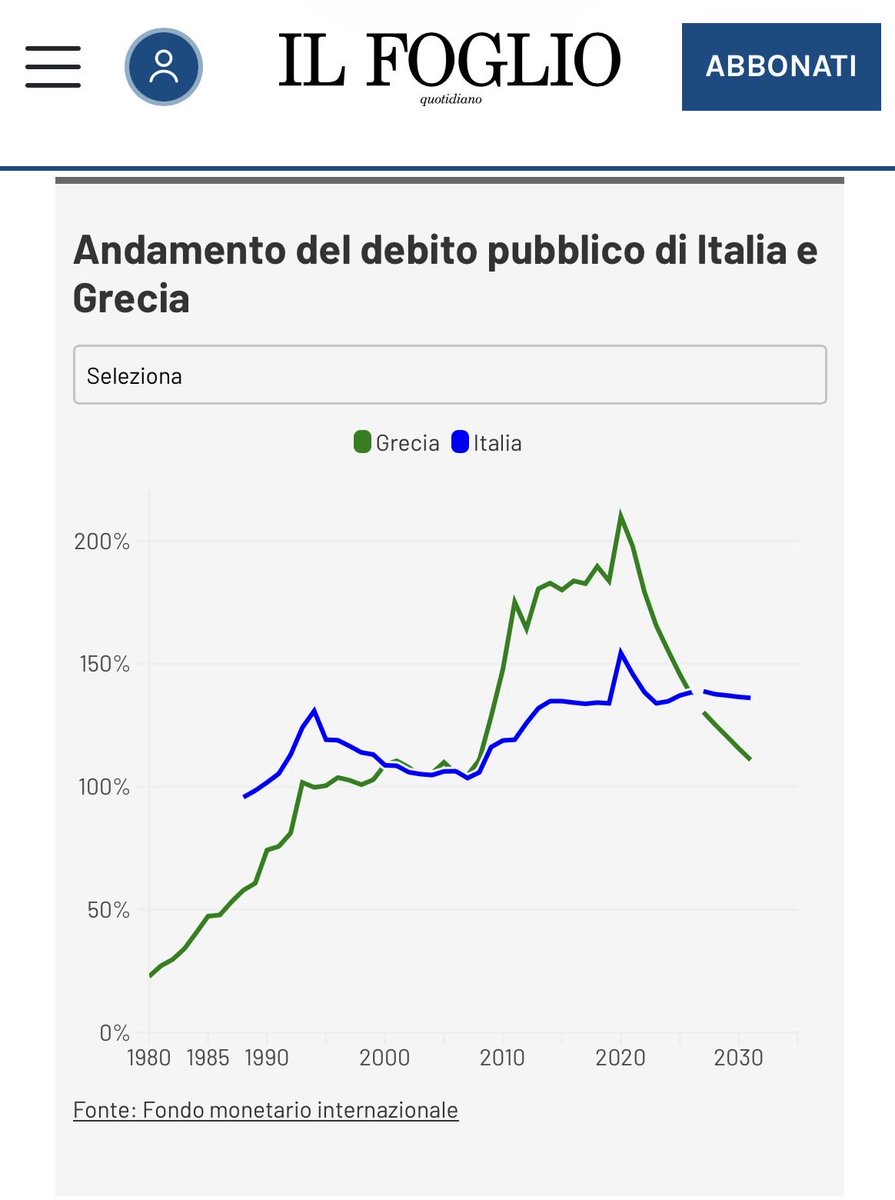
Il sorpasso, che un paio d’anni fa si pensava dovesse arrivare nel 2028, ci sarà già quest’anno: nel 2026, l’Italia🇮🇹 toglierà alla Grecia🇬🇷 il primato del paese con il debito pubblico più alto d’Europa. Secondo le previsioni del Fmi, quest’anno il debito dell’Italia salirà al 138,4% del pil mentre quello della Grecia scenderà al 136,9%. È il prodotto di scelte politiche dagli ultimi tre governi, che tra Pnrr e Superbonus hanno speso 450 miliardi di euro per investimenti che avrebbero dovuto trasformare il paese aumentando produttività e tasso di crescita: il risultato è che l’Italia cresce allo 0,5%, molto meno degli altri ex Pigs (Portogallo, Grecia e Spagna) che crescono al 2%. L’Italia è l’unico degli ex Pigs che, dieci anni dopo il Covid, avrà un debito pubblico più alto del 2019 e un tasso di crescita del pil uguale al 2019 (<1%). Le politiche fiscali espansive non hanno funzionato, eppure al centro dei programmi del centrosinistra e del centrodestra ci sono sempre gli “eurobond” (per finanziare un nuovo Pnrr) e la sospensione del Patto di stabilità (per finanziare un nuovo Superbonus).👇 ilfoglio.it/economia/2026/…
Luciano Capone tweet media
Italiano
146
512
1.6K
94.7K
Francesco Del Prato retweetledi
Luis Garicano 🇪🇺🇺🇦
Free markets are the best way to create wealth AND reduce poverty ever discovered. One of the big puzzles of history is how the same lesson has to be learned again and again. Poland, China, India, and now Argentina are the latest experiments. Argentina with Milei: - Poverty down: 53% to 28%. - Inflation down: 200% to 33% (and continuing to fall - Growth up to: 4.4% last year. - Govt surplus: first in 123 years. washingtonpost.com/opinions/2026/…
English
48
270
1.1K
114.3K
Francesco Del Prato retweetledi
microplastics rectifier
microplastics rectifier@facetedcarapace·
Sun Tzu actually has an entire section in The Art of War about screaming at the other side to open a strategic route on your own personal social media platform
English
89
2.6K
24.9K
520.6K
Francesco Del Prato retweetledi
Salvatore Lattanzio
Salvatore Lattanzio@salva_lat·
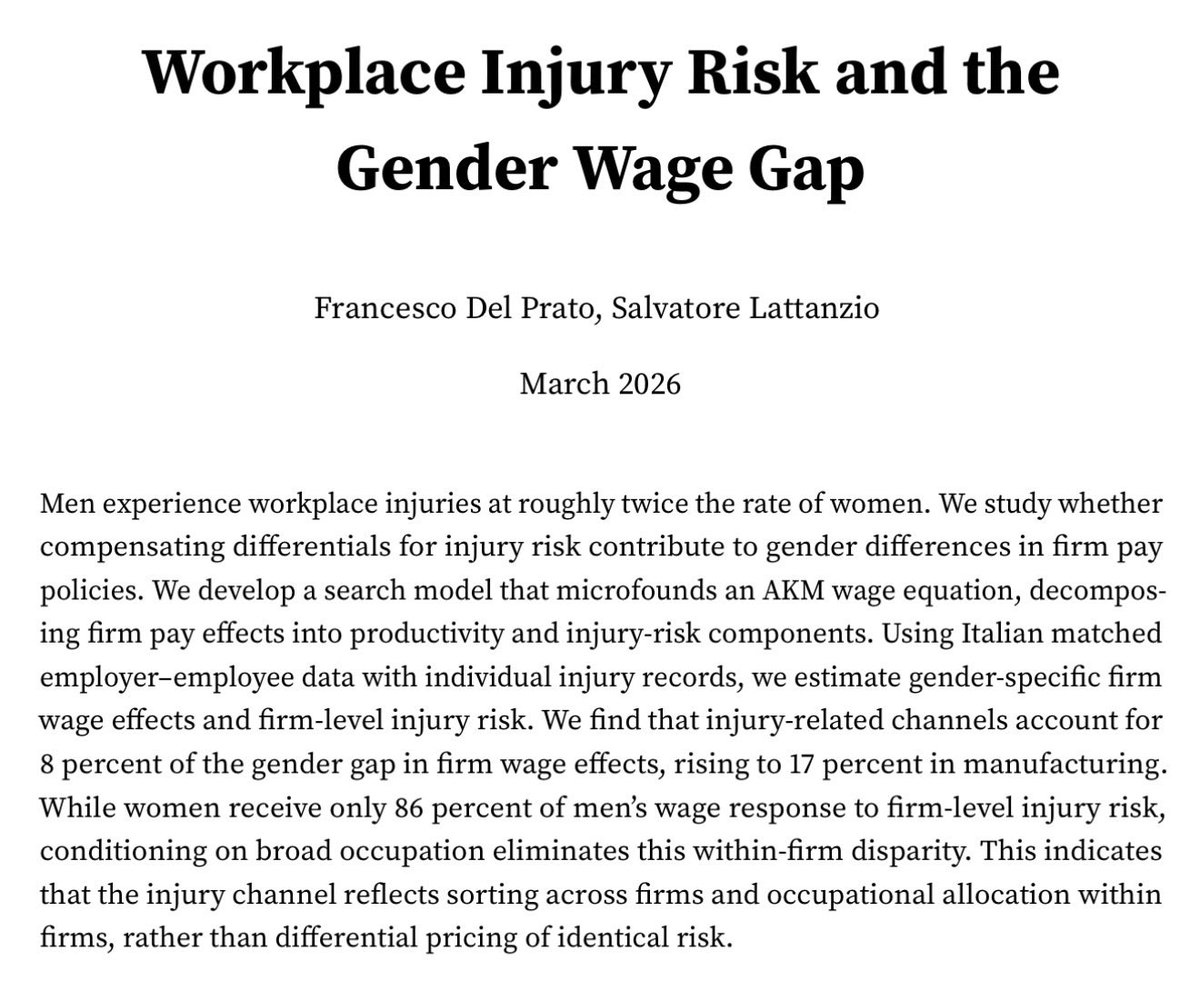
🚨New @RFBerlin working paper w/ @fdelprato Men get injured at work at ~2x the rate of women. Do compensating differentials for this risk help explain why firms pay men more? Short answer: yes — modestly but meaningfully. 1/N 📄 rfberlin.com/network-paper/…
Salvatore Lattanzio tweet media
English
1
10
19
2.5K
Francesco Del Prato
Francesco Del Prato@fdelprato·
🚨 New @RF_Berlin WP out co-authored with @salva_lat: Men get injured at work at twice the rate of women. If riskier jobs pay more, does this help explain why men earn more? Check this thread 👇
Salvatore Lattanzio@salva_lat

🚨New @RFBerlin working paper w/ @fdelprato Men get injured at work at ~2x the rate of women. Do compensating differentials for this risk help explain why firms pay men more? Short answer: yes — modestly but meaningfully. 1/N 📄 rfberlin.com/network-paper/…

English
0
1
2
709
Francesco Del Prato retweetledi
Luis Garicano 🇪🇺🇺🇦
At this point, banana republics and developing country dictators have higher standards of conduct and less corruption.
Luis Garicano 🇪🇺🇺🇦 tweet media
English
6
82
298
19.3K
Francesco Del Prato retweetledi
Alex Imas
Alex Imas@alexolegimas·
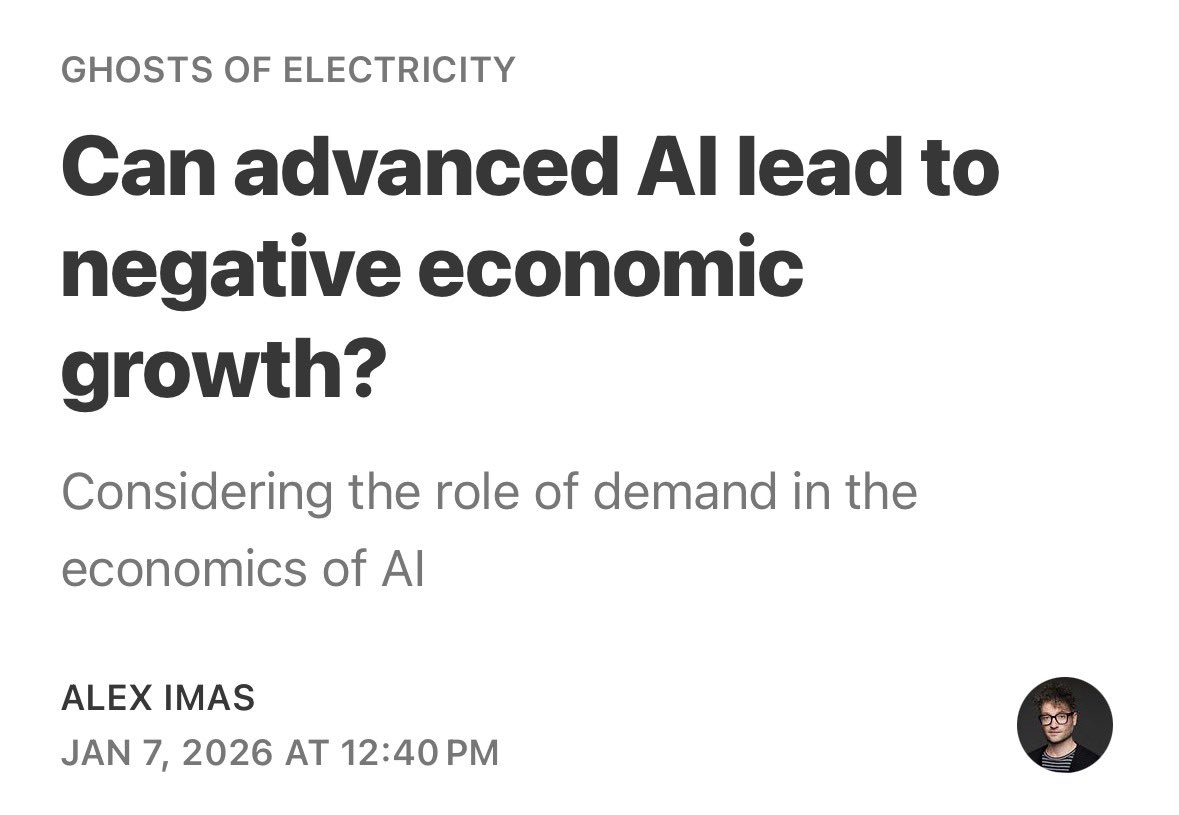
I had written a piece formally working out the exact conditions you need for what the Citrini essay describes to actually happen. In short, you need very strong/strange conditions on both on preferences (satiation and no new goods) and on what happens to investment. Plus no fiscal policy. I started out with a strong intuition that this was plausible, but that's the value of economic theory: intuition is confronted with the discipline of formal logic. Often you learn something new. Going through the exercise made me conclude that this scenario is very unlikely. Here is the essay write up, with all the math in a linked technical note. open.substack.com/pub/aleximas/p…
Alex Imas tweet media
English
17
72
463
57.1K
Francesco Del Prato retweetledi
Chad Jones
Chad Jones@ChadJonesEcon·
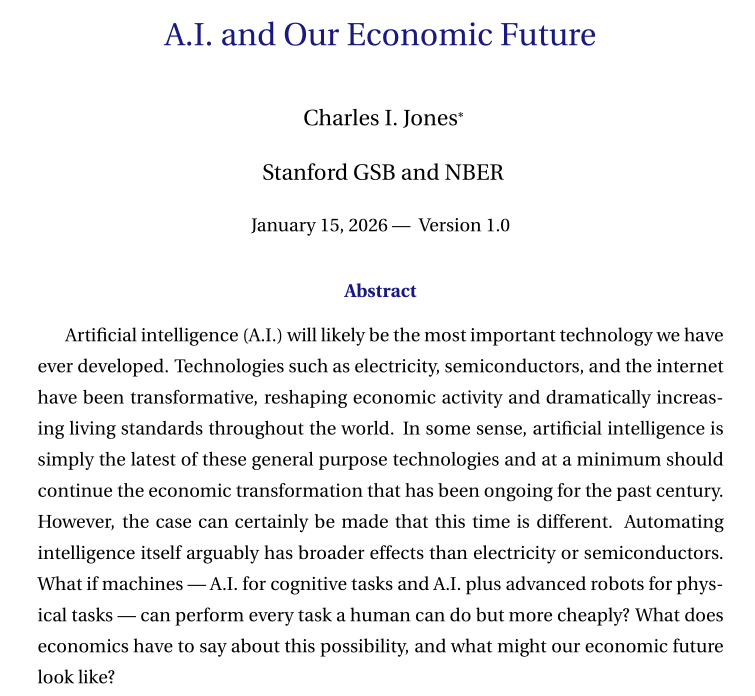
"AI and Our Economic Future" New paper in preparation for the Journal of Economic Perspectives ==> accessible to a broad audience. web.stanford.edu/~chadj/AIandEc…
Chad Jones tweet media
English
31
340
1.4K
413.2K
Francesco Del Prato retweetledi
Jesús Fernández-Villaverde
Jesús Fernández-Villaverde@JesusFerna7026·
Let me explain why I believe modern economics is such a powerful tool for understanding the world. I’ll do this by discussing a great paper by Simone Cerreia-Vioglio, @UncertainLars, Fabio Maccheroni, and Massimo Marinacci, “Making Decisions Under Model Misspecification,” published in the Review of Economic Studies a few months ago. Imagine I want to drive from UC San Diego to UCLA, but I’ve never driven that route before. I need to build a “model of the world” to guide me, which we usually call a map. Maps are simplified representations of reality. They can’t include every detail if they’re to be useful. Borges, in his short story On Exactitude in Science, makes this point beautifully. (In practice, I don’t draw the map myself—I use an app—but someone still had to make it.) Because maps simplify, I can’t fully rely on them. Maybe last night’s storm knocked down a tree and closed a street, or there’s construction and the ramp off the highway in LA is shut down. This uncertainty matters. Suppose I’m driving to UCLA for an important talk at 11 a.m. If the ramp is closed, I might need 15 extra minutes. When should I set my alarm to arrive on time, while still getting enough sleep to give a good talk? The problem is that I can’t assign precise probabilities to all these contingencies. How likely is the fallen tree? Or new roadwork? Even the best traffic apps can’t capture every disruption, and some might happen after I’ve already left. In economic terms, my “model of the world” (the map) is misspecified—and no matter how hard I try, I can’t fully fix that. But sitting down and crying about misspecification doesn’t answer my basic question: when do I set the alarm? Too early, and I’m exhausted. Too late, and I’m late. Simone and his co-authors offer a way to think about this. They start from the idea that we often hold several structured models of an economic phenomenon, grounded in theory. For example, a central bank might use a standard New Keynesian model and a search-and-matching model of money. Yet, aware that each model is misspecified by design, the bank adds a protective belt of unstructured models—statistical constructs that help it gauge the consequences of misspecification. The beauty of the paper is that it provides an axiomatic foundation for this protective belt (and even generalizes it to include a Bayesian approach). It shows that if a decision-maker’s preferences meet certain conditions —reflecting both rational and behavioral features— then those preferences can be represented by an augmented utility function that formally accounts for misspecification. Crucially, we don’t assume that augmented utility function; we derive it. We start with general, plausible properties of preferences and prove that they imply such a representation. That’s real progress. Instead of writing endless critiques of expected utility or rational expectations (as many have done for decades, with little to show), we now have a formal way to reason about misspecification—precise definitions, clear boundaries of validity, and awareness of what we still don’t know. Take, for instance, a brilliant Penn graduate student on the market, Alfonso Maselli economics.sas.upenn.edu/people/alfonso… His job-market paper pushes this frontier further. He studies cases where a decision-maker not only faces model misspecification but is also unsure which model best fits the data and can’t assign probabilities to them—what we call model ambiguity. In my example, the central bank is unsure whether the New Keynesian or the search-and-matching model fits better, and it worries that both might be incorrect. If you read Simone et al. or Alfonso’s paper, you’ll see how misguided—and, frankly, cartoonish—many of the recent criticisms of economics on X have been. First: the idea that economists don’t understand math or have “physics envy.” The math in these papers is subtle and advanced—utterly different from what physicists do (neither better nor worse, just distinct). An engineer transitioning into economics would find these tools unfamiliar. Second: claims of ideological bias are unfounded. I have no idea about the political views of the authors, and I’d be surprised if anyone could infer them from the analysis—beyond vague guesses about typical academics. Third: This has almost nothing to do with what one learns as an undergraduate, or even in first-year graduate school. If your knowledge of economics stops at an intro textbook, it’s best not to pontificate on the field’s frontiers. Fourth: Is this science? Debating that word’s boundaries is pointless; every definition of “science” breaks down somewhere. The Germans solved this long ago with the idea of Wissenschaft—the systematic pursuit of knowledge, whether of nature, society, or the humanities. By that measure, modern mainstream economics is clearly a Wissenschaft: a disciplined, cumulative, and highly useful effort to understand how the world works. Simone and his co-authors have demonstrated that beyond any reasonable doubt.
Jesús Fernández-Villaverde tweet media
English
44
475
1.8K
346.9K
Francesco Del Prato retweetledi
Ethan Mollick
Ethan Mollick@emollick·
It seems like there is not enough of a policy response to the fact that, with 57M miles of data, Waymo’s autonomous vehicles experience 85% less serious injuries & 79% less injuries overall than cars with human drivers. 2.4 million are injured & 40k killed in US accidents a year
English
275
679
5.7K
1.2M
Francesco Del Prato
Francesco Del Prato@fdelprato·
🚨 Last call! 🚨 Deadline is TODAY (Aug 22) to submit to the 1st Aarhus Workshop on Labor Markets. 📅 Oct 22–24 | 📍 Aarhus, Denmark Keynotes: Meghir, Taber, Shimer Submit 👉 app.oxfordabstracts.com/stages/78820/s… (Promise: no more spam after this 😅)
English
0
0
9
906
Francesco Del Prato retweetledi
Maarten De Ridder
Maarten De Ridder@DeRidderMaarten·
📢📢 Call for Papers 📢📢 We're organizing a *macroeconomics workshop* in Amsterdam 15-16 December 👌 ✅ Any topic in macro broadly defined ✅ Two nights in a'dam + EU travel covered ✅ Keynote by @virgiliu79 Midrigran Submit by October 5. Call here: tinbergen.nl/event/2025/12/…
English
3
43
140
16.3K
Francesco Del Prato retweetledi
Francesco Del Prato
Francesco Del Prato@fdelprato·
🚨 CALL FOR PAPERS 🚨 -- 1st Aarhus Workshop on Labor Markets -- We welcome empirical and structural work with applications on labor market dynamics, policies, and outcomes. 📍Where? Aarhus University, Denmark 📆 When? Wen 22 - Fri 24 October ⏰ Deadline: 22 August
Francesco Del Prato tweet mediaFrancesco Del Prato tweet media
English
3
48
122
13K
Francesco Del Prato
Francesco Del Prato@fdelprato·
🚨 Deadline approaching! Just 2 weeks left to submit to 1st Aarhus Workshop on Labor Markets 📅 Oct 22–24 |📍Aarhus, Denmark 🗓️ Submission deadline: Aug 22 Keynotes: Meghir, Taber, Shimer Topics: Structural & reduced-form on labor markets Submit 👉 app.oxfordabstracts.com/stages/78820/s…
English
0
5
15
1.8K
Francesco Del Prato retweetledi
Simon Jäger
Simon Jäger@simon_jaeger·
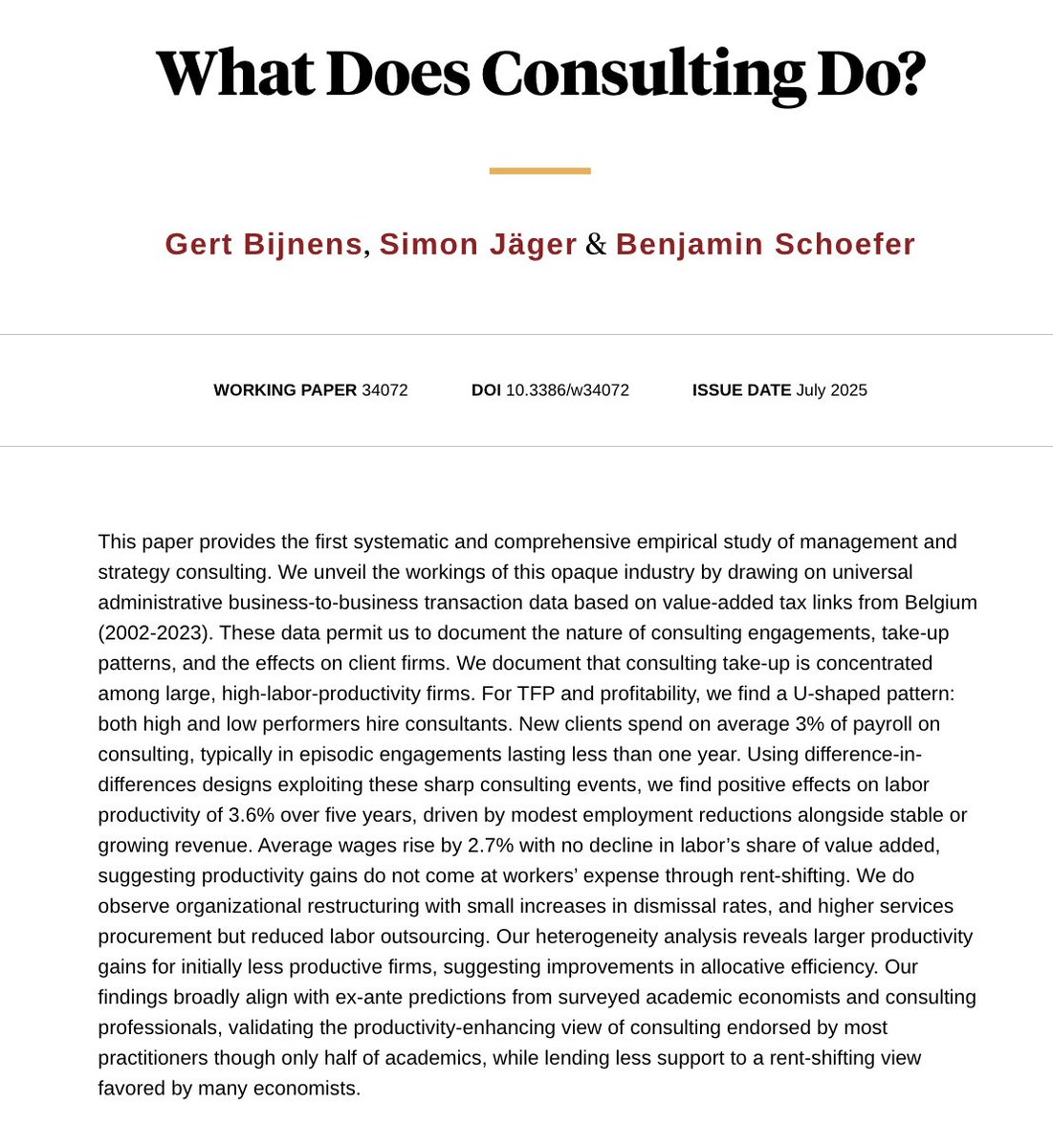
What does consulting do? Lots of strongly held views, very limited data to answer the question. In new @nberpubs paper, @bijneman @Schoefer_B and I shed light on this question using the first economy-wide data on consulting relationships (based on VAT-based B2B data). More👇
Simon Jäger tweet media
English
1
26
133
14.2K
Francesco Del Prato
Francesco Del Prato@fdelprato·
🚨 1 month left to submit to the 1st Aarhus Workshop on Labor Markets! 🚨 📅 Oct 22–24 |📍Aarhus, Denmark 🗓️ Submission deadline: Aug 22 Keynotes: Meghir, Taber, Shimer Topics: structural/reduced-form work on labor market dynamics & policies Submit 👉 app.oxfordabstracts.com/stages/78820/s…
English
0
10
25
2K