feenk

2.9K posts

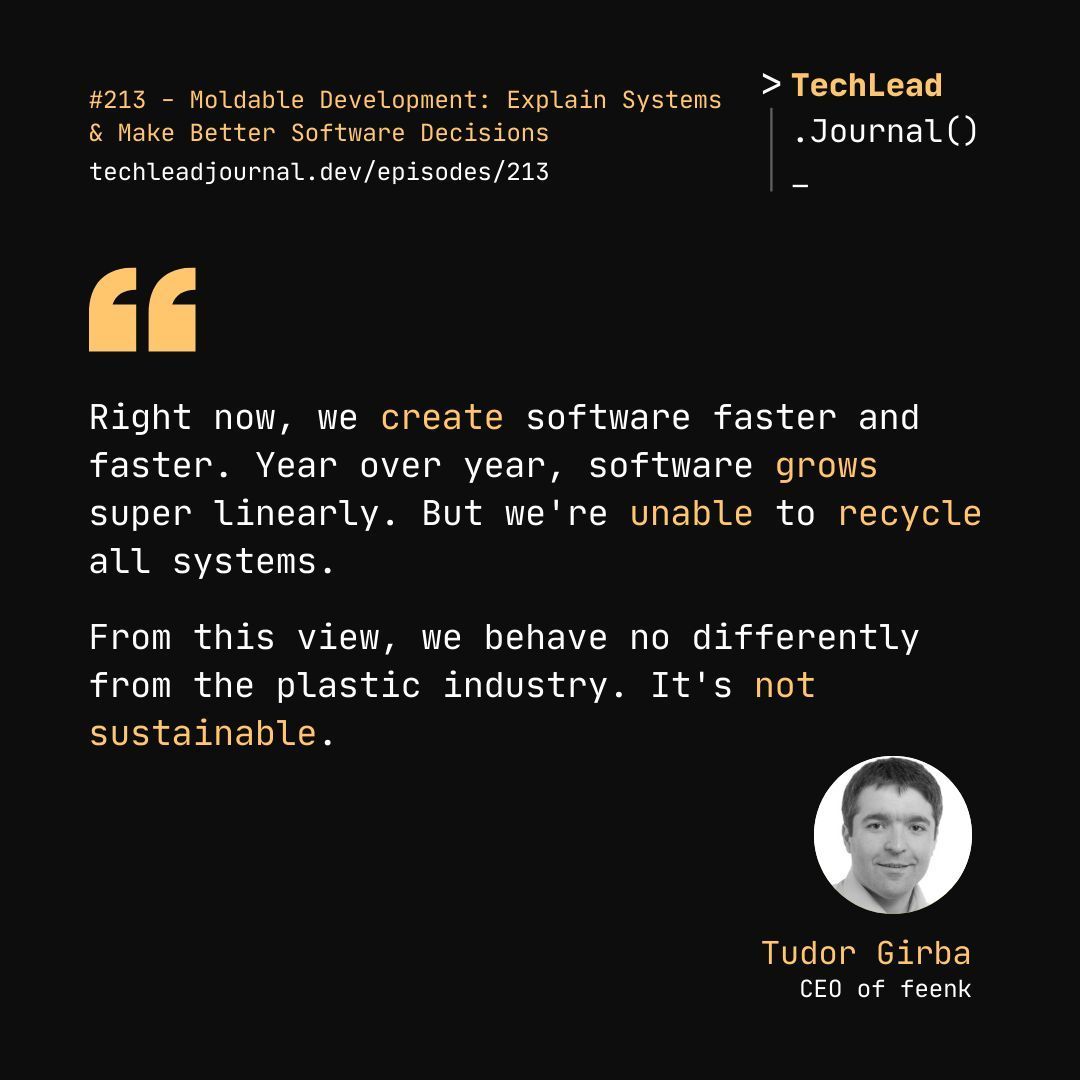
feenk banner
feenk

feenk

@feenkcom

We modernize legacy systems. We authored #MoldableDevelopment and we build #GToolkit | https://t.co/Jwau4qI3cd.

Switzerland Katılım Eylül 2016
12 Takip Edilen2K Takipçiler
feenk retweetledi
Vadym Kazulkin
Vadym Kazulkin@VKazulkin·
"Developers spend most of their time figuring the system out". I am often asked what I mean when I say that developers spend most of their time figuring the system out. Let’s unpack the statement. by @girba lepiter.io/feenk/develope…
English
0
6
21
1.6K
feenk retweetledi
Cole Lawrence
Cole Lawrence@refactorordie·
"There's absolutely nothing terrifying about COBOL or any system anywhere, [if you can change] the way you look at it" Lovely talk at the intersection of dev tooling and first principles thinking
Tudor Girba@girba

I was so nervous when I gave this talk. I showed several pieces from our work at feenk that we've never shown before: - A story that now appears in the Rewilding Software Engineering book I am writing with Simon Wardley about assessing the slowness of a data pipeline. - A COBOL demo that we built within the space of 10 days prior to the talk. I gave the talk on October 4, and the demo was prompted by the a blog post on @martinfowler’s site from September 24, 2024 in which a team was arguing why AI is useful for reverse engineering legacy systems. We took the same case study to show how far we can get to within a short amount of time and without using any AI. We started from not even having a working COBOL parser and we got to what I show in the talk. I let you decide if that’s a meaningful outcome. AI is interesting (see below), but there is an underlying narrative that assumes we have reached the peak of human ability, and I believe we are far from it. Tools are not expensive, and once it becomes possible to tackle every single development problem through contextual tools, the whole act of programming changes and so does the outcome. - A demo of showing how we took the tokenization tutorial of @karpathy and made it explainable in the development environment. I even included in my talk a little part of his video in which he goes to an external app to help people build a mental model of what tokenization is. I showed that when explanations become common place, we open up new doors for how we can understand our systems. - A story about retrieving an architecture diagram of a Spring Boot-based distributed system. In this case, we've done it through static analysis showing that if we elevate the tool to understand the semantics of libraries (and even of our specific system), we can extract much more details than generic tools might make us believe is possible. - A demo of customizing an LLM chat while chatting. This was the first time we showed how we can apply Moldable Development to the very interaction we have with AI. In the meantime, we polished and productized this ability in the latest version of Glamorous Toolkit, but at that time it was brand new. And to top it all, @swardley explicitly told people during his keynote that they should see my talk. I am always nervous when I give talks, but this time it was more than usual. I can hear it in my voice :). What do you think?

English
0
2
11
630
feenk retweetledi
Kazunori Kaz Iriya 
Kazunori Kaz Iriya @iriyak·
@girba Enjoyed the talk! Always amazed to see how a small custom view is integrated and works together and a system comes close to us!
English
0
2
3
308
feenk retweetledi
Tudor Girba
Tudor Girba@girba·
I was so nervous when I gave this talk. I showed several pieces from our work at feenk that we've never shown before: - A story that now appears in the Rewilding Software Engineering book I am writing with Simon Wardley about assessing the slowness of a data pipeline. - A COBOL demo that we built within the space of 10 days prior to the talk. I gave the talk on October 4, and the demo was prompted by the a blog post on @martinfowler’s site from September 24, 2024 in which a team was arguing why AI is useful for reverse engineering legacy systems. We took the same case study to show how far we can get to within a short amount of time and without using any AI. We started from not even having a working COBOL parser and we got to what I show in the talk. I let you decide if that’s a meaningful outcome. AI is interesting (see below), but there is an underlying narrative that assumes we have reached the peak of human ability, and I believe we are far from it. Tools are not expensive, and once it becomes possible to tackle every single development problem through contextual tools, the whole act of programming changes and so does the outcome. - A demo of showing how we took the tokenization tutorial of @karpathy and made it explainable in the development environment. I even included in my talk a little part of his video in which he goes to an external app to help people build a mental model of what tokenization is. I showed that when explanations become common place, we open up new doors for how we can understand our systems. - A story about retrieving an architecture diagram of a Spring Boot-based distributed system. In this case, we've done it through static analysis showing that if we elevate the tool to understand the semantics of libraries (and even of our specific system), we can extract much more details than generic tools might make us believe is possible. - A demo of customizing an LLM chat while chatting. This was the first time we showed how we can apply Moldable Development to the very interaction we have with AI. In the meantime, we polished and productized this ability in the latest version of Glamorous Toolkit, but at that time it was brand new. And to top it all, @swardley explicitly told people during his keynote that they should see my talk. I am always nervous when I give talks, but this time it was more than usual. I can hear it in my voice :). What do you think?
GOTO@GOTOcon

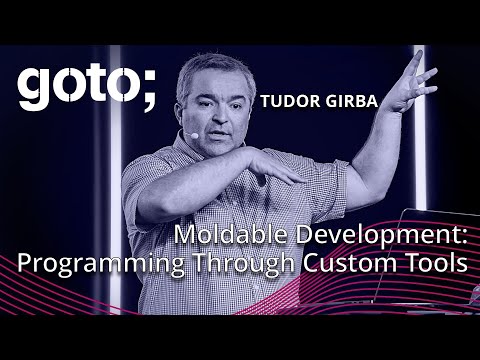
Programming is changing: tests, infra, and now tools are code. Moldable Development lets you shape tools as you code. Watch @girba’s demo with Glamorous Toolkit:

English
5
10
61
3.2K
feenk retweetledi
Romano Roth
Romano Roth@RomanoRoth·
🧠 𝐌𝐨𝐬𝐭 𝐝𝐞𝐯𝐞𝐥𝐨𝐩𝐞𝐫𝐬 𝐝𝐨𝐧'𝐭 𝐬𝐩𝐞𝐧𝐝 𝐭𝐡𝐞𝐢𝐫 𝐭𝐢𝐦𝐞 𝐜𝐨𝐝𝐢𝐧𝐠. 𝐓𝐡𝐞𝐲 𝐬𝐩𝐞𝐧𝐝 𝐢𝐭 𝐟𝐢𝐠𝐮𝐫𝐢𝐧𝐠 𝐭𝐡𝐞 𝐬𝐲𝐬𝐭𝐞𝐦 𝐨𝐮𝐭. Tudor Girba (@girba) makes a compelling case: software engineering isn't just about building. It’s about understanding. And we’ve been doing that the hard way for decades. 🔍 Historical Insight 🔹In 1979, researchers estimated that 67% of dev time was spent on maintenance. 🔹By 2018, a large-scale study found that 58% still goes to comprehension, with another 24% just navigating! Despite all our progress, the problem persists: we spend more time trying to understand systems than improving them. 🚦 Why? Because understanding is about decision-making and we’re using reading (the most manual, slow, and incomplete method) to do it. 💡 Girba reframes this with a key insight: let’s call this process Assessment: The act of understanding enough to decide what to do next. And let’s optimize around that. 🔧 Enter Moldable Development Instead of reading code line by line, what if we built custom tools to extract exactly the insight we need? That’s moldable development: tools shaped by context, not one-size-fits-all. 📊 Since software is data, we should treat it like data. Use tailored, quick-to-create tools to analyze and understand systems. Faster, clearer, smarter. 🤖 And yes, for all AI-Africanos out there, Moldable Development tools can and should be powered by AI. Imagine local, context-aware assistants generating the right visualizations, insights, and actions tailored to your system. That’s the next leap. 📢 Let’s change the conversation. Stop defaulting to code reading. Start designing tools that work with us. 🔗 Link to the article: buff.ly/w6bywJs #MoldableDevelopment #SoftwareEngineering #Productivity #AI
Romano Roth tweet media
English
0
4
6
359
feenk retweetledi
GOTO
GOTO@GOTOcon·
Programming is changing: tests, infra, and now tools are code. Moldable Development lets you shape tools as you code. Watch @girba’s demo with Glamorous Toolkit:
GOTO tweet media
English
0
2
10
3.1K
feenk retweetledi
Tudor Girba
Tudor Girba@girba·
The choice is not between vibe coding and not vibe coding. There is a middle ground that does not require us to suspend our ability to understand and make decisions about our system. It's almost vibe coding but not quite. It's AI-enabled software engineering. Of course, this requires appropriate tools to help you understand the system faster than by reading the code. Now, where does the chat happen? In a contextual view in the inspector in which each message is a shown in an inspector with contextual views. Even when the output from the AI is verbose we can just pick what we are interested in using tools that help us work with the code in a tight feedback loop right there in the chat. And what are the conversations about? They are about any part of our system we want, starting from a single snippet or a single object. These abilities allow us to both specify the context we are interested and to grasp the AI output. We are not confined to a basic chat somewhere at the outskirts of our system. We can make sense of and steer the system from deep inside of it and use AI where and how it makes sense. #MoldableDevelopment
feenk@feenkcom

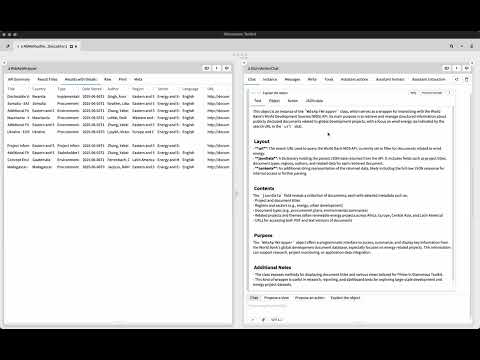
(Almost) vibe coding in Glamorous Toolkit. Highlights: chat about a snippet use tools to let AI explore code adjust and inspect code live chat about an object to create views youtu.be/-P83DjtSFvk?si…

English
1
2
9
907
feenk
feenk@feenkcom·
(Almost) vibe coding in Glamorous Toolkit. Highlights: chat about a snippet use tools to let AI explore code adjust and inspect code live chat about an object to create views youtu.be/-P83DjtSFvk?si…
YouTube video
YouTube
English
0
1
6
1.7K
feenk retweetledi
Craft Conference
Craft Conference@CraftConf·
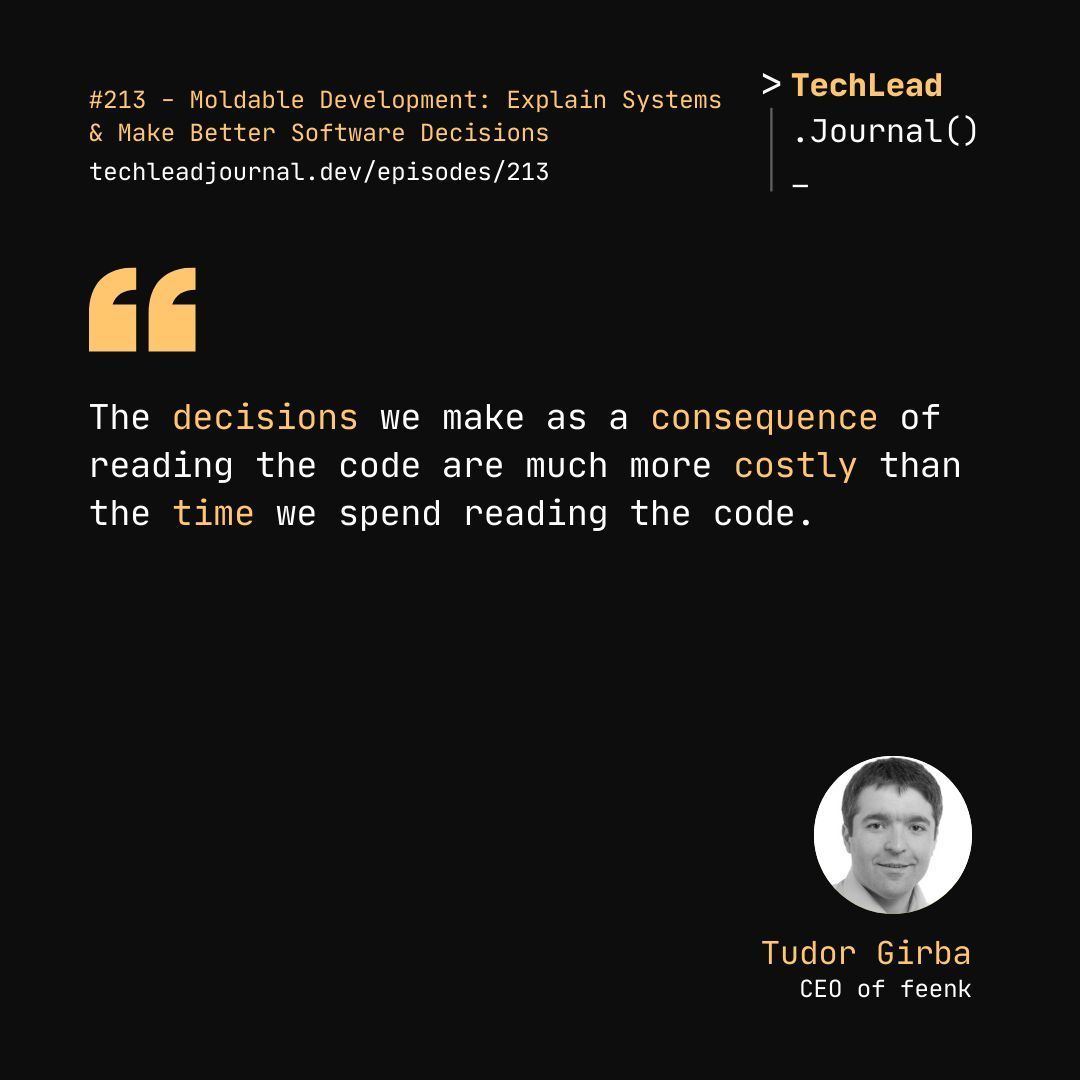
💡Understanding code costs more than writing it — especially in legacy systems. @girba showed how Moldable Development helps us read systems better by shaping thousands of contextual tools around them. 🛠️ #CraftConf
Craft Conference tweet media
English
0
3
4
487
feenk retweetledi
Tudor Girba
Tudor Girba@girba·
To vibe, or not to vibe, that is the question. Find the answer in chapter 5 of the Rewilding Software Engineering book that I am writing in the open with @swardley. medium.com/feenk/chapter-…
English
0
1
7
634
feenk retweetledi
GOTO
GOTO@GOTOcon·
🎙️ What if your codebase felt more like a workspace than a maze? #GOTOpodcast: @girba & @julian_wood dive into moldable development: 🔧 Custom tools for complex systems 🧠 AI that helps you think, not just code 🏠 Code that feels… livable 🎧 Listen: gotopia.tech/podcast
GOTO tweet media
English
0
4
8
808
feenk retweetledi
Prasanna K
Prasanna K@prasanna_says·
@girba @techleadjournal the latter is more and more important! Like having a gps in the car, instead of just a speedometer!
English
0
2
3
261