@FKThedesigner This is true, it can be game-changing and really ramp up the creator ecosystem. Truly hoping they don’t train AI on the designs in the marketplace though, as that would be an Adobe level disaster, plus we’ve had enough work stolen to train AIs in general without any consequence.
Everyone is saying Framer template sales are dropping because of Claude. I'm still betting on Framer.
Claude is not a design tool, even if they call it "Claude Design."
It's a great tool for design exploration and development.
You can build impressive apps with zero coding knowledge.
But when it comes to actual design, it's still a million miles away from being a native design tool.
So what does the end user actually need?
When you tell Claude "create me a landing page," it can do it in 5 minutes, but the result is far from aesthetic. To get the level of visual quality that any Framer template provides, you'd need to work on it for days, entering dozens of prompts for even the simplest changes.
So what happens when Framer and Claude combine their strengths?
Framer has thousands of templates that could be used to train a Claude agent.
This integration could fundamentally change things in several ways:
1. End User Scenario:
A user finds a template they like, tells Claude about their business through Framer's native Claude connection, and the template is customized in under a minute.
Any remaining changes can be made through Framer's interface, which is simple enough for a 10-year-old, or through Claude directly.
2. Advanced Wireframing:
Claude could be used like a wireframe tool to generate a native Framer layout.
The less technical work required, the more energy you can put into actual design.
3. Infrastructure Assistance:
If Claude gets full access to Framer, even people with zero technical knowledge can build sites with solid infrastructure.
If this integration happens fully, template sales and Framer's user base won't decline, they'll grow much faster.
What changes for designers and developers?
There are designers spending months just to get a single Framer template into the marketplace.
The problem isn't that they're bad designers, it's that the process demands technical knowledge and experience.
Here's what I personally experience:
I can design an original, enjoyable-to-use template in 12 hours.
But getting it marketplace-ready takes an extra 5 to 6 hours on top of that.
Different spacing for every breakpoint, technical error checks, accessibility labels, unnamed layers, elements without color tokens...
A few months ago, even unnamed stacks were a major headache.
With a native Claude connection, all of this becomes easy to audit: heading tag usage, accessibility, unnamed layers, elements missing color values.
I've actually already built a plugin for this, just haven't published it yet.
Current Framer MCP capabilities aren't powerful enough.
For example, you can't check accessibility labels, and when you ask Claude to audit a project, it can only see the desktop version.
But we're already getting partway there with the MCP connection, and when full integration arrives, the picture changes completely.
When all of this comes together, designers will be more powerful than ever. Because the less technical burden there is, the more room there is for creativity.
That's why I'm not afraid of AI, I'm embracing it.
Framer's market share is still low.
But a seamless Claude + Framer integration will make it the number one design tool.
This is what I mean when I say "show an existing brand in the best possible light, while still communicating clearly with the human on the other side."
Even before the first word is read, tell me the impact you feel on each of these product pages is not completely different!
After working with several DTC brands at the €200k-€600k/year stage, I'd say the stores that convert best are not the ones trying hardest to sell.
No fake urgency. No pop-ups. No "only 3 left."
Just a store that makes the visitor feel understood before asking for anything.
Then visitors naturally converting into customers.
Crazy, right?! Haha
I'm giving away our high-converting cart template. 🤑
The same cart design file we use for 8-figure Shopify brands. For free.
Including:
1️⃣ In-cart discount code fields
2️⃣ 3 different upsell designs
3️⃣ Free shipping threshold bars
4️⃣Bundle item breakdowns
5️⃣ Payment trust icons near CTA
6️⃣ Sticky checkout button
7️⃣ Variant details on product cards
8️⃣ Quantity adjustment dropdown
We've tested every single element in this template across dozens of A/B tests. It's not guesswork. It's data-backed design that actually converts.
Want it? It's easy:
1. Follow me
2. Retweet this post
2. Comment "CART" below
Then I'll DM you the download link.
When redesigning a digital flagship for a champagne house founded in 1785, the brief wasn't about sales.
It was about matching online what the brand had already become everywhere else.
That's the first thing I check when a DTC founder reaches out: does their Shopify store do this well?
I've seen it many times where fixing this alone is enough to push growth forward.
Now imagine that AND great messaging, while focusing on the human on the other side? : )
After 6+ years of custom DTC eCom projects, I'd say the ones that move the needle share one thing: nobody was chasing a number. Still: 34.3% revenue growth over three years on the LBG redesign.
The owners and I never set specific targets. I just asked myself: how can I best showcase the brand they'd become while speaking clearly to the person on the other side of the screen?
The results speak for themselves. : )
Another update I've made to my little app: this time a quality of life one for myself (not just for work hehe)
Habits can now be tagged to be for weekdays or weekends, or both.
Never thought I'd be building a tool for my own needs in such little time.
After working with several DTC founders at the €200k-600k/year stage, I'd say most already know their store needs work.
The hesitation isn't doubt. It's not wanting to repeat the last experience of working with a designer who never quite got it.
That fear is earned.
And it's the first thing I try to dissolve : )
Even after 6+ years of DTC eCom, I still shock myself at the difference between some of these before/afters of my redesigns.
Say what you will, but the truth is: the way your site feels communicates the brand before a word is even read.
Over the year, after several large-scale design projects, I've worked with brands that carry a hefty reputation.
And still, the first thing an importer, a retail buyer, or a journalist sees isn't the history or the awards. It's the site.
Most DTC founders trying to break the €500k/year ceiling underestimate how much positioning work their Shopify store is doing, or failing to do, every day.
After working with several DTC brands at the €200k-€600k/year stage, I'd say the most expensive gap I see consistently is this: the product keeps getting better, the store stays the same.
A client of mine had been on a pre-made template for 8 years. A customer walking into their physical boutique felt the brand immediately. A customer landing on the site just didn't.
I'd say that gap is where most of the revenue is hiding at this stage.
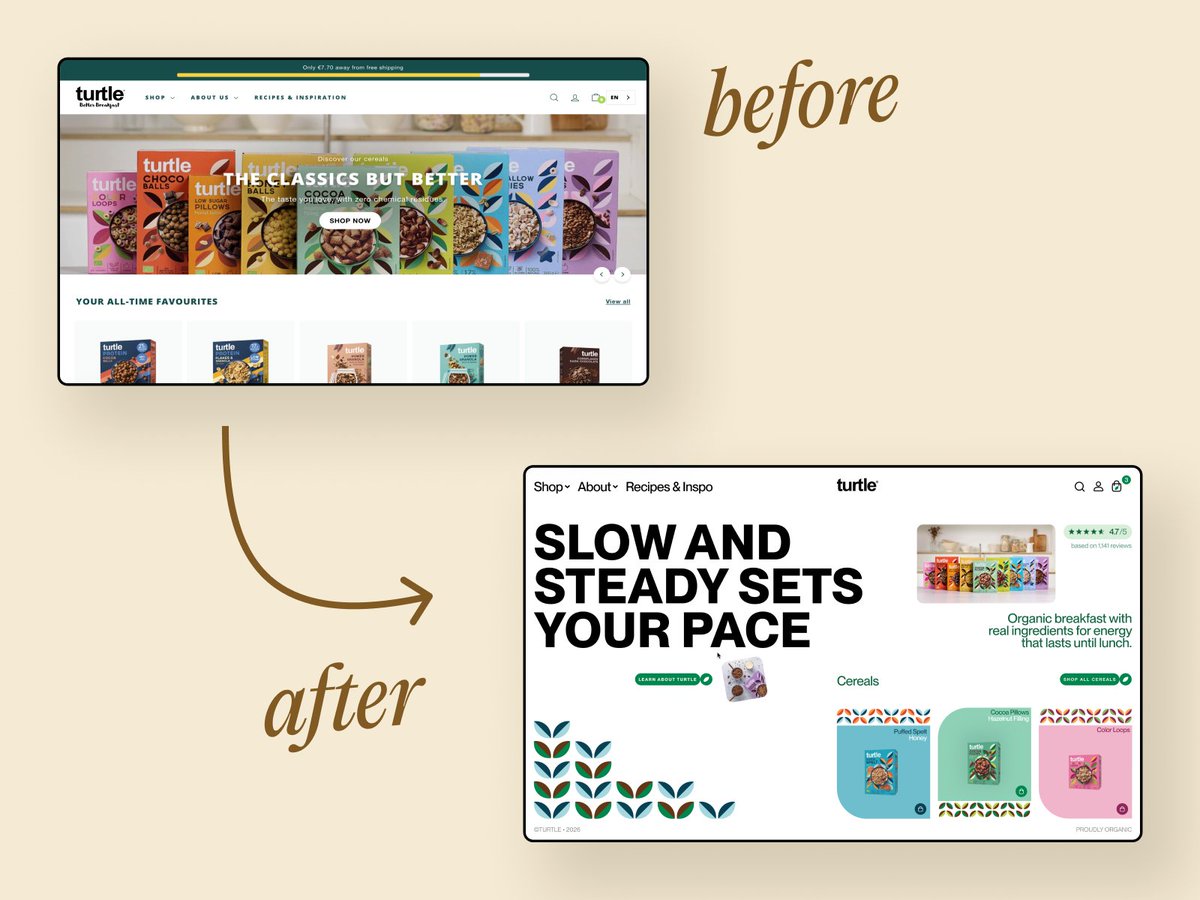
Before and after of a hero I worked on recently, a concept design for a DTC breakfast cereal brand.
Really digging the colorful vibe and the impact of the reworked messaging here!