Fernando G Gutiérrez

59.1K posts

Fernando G Gutiérrez banner
Fernando G Gutiérrez

Fernando G Gutiérrez

@fggutierrez

#Tecnologías #Bibliotecas #Educación #Bibliotecario #Profesor #Libros #IA #AI #InteligenciaArtificial

Luján (BA) Katılım Temmuz 2009
2.4K Takip Edilen3.4K Takipçiler
Fernando G Gutiérrez retweetledi
Jorge Vitali
Jorge Vitali@jorvitali·
¿Qué queda después de las quejas amargas por ver sus obras absorbidas por la mente de una IA sin apenas respeto por los derechos de autor? Cinco escritores e investigadores de inteligencia artificial debaten sobre el "futuro de la literatura". lareviewofbooks.org/article/artifi…
Español
0
2
6
186
Fernando G Gutiérrez retweetledi
elDiario.es
elDiario.es@eldiarioes·
Una investigación de The Washington Post desvela un proyecto secreto Anthropic, que opera la IA Claude, para “escanear y destruir todos los libros del mundo” eldiario.es/catalunya/mist… Por @polpareja
Español
26
527
947
528.8K
Fernando G Gutiérrez retweetledi
El Diaz
El Diaz@SoyDaniloDiaz·
Un día eres joven y al otro día andas calculando el horario exacto para acostarte y dormir por lo menos 7 u 8 horas.
Español
8
559
2.9K
32.6K
Fernando G Gutiérrez retweetledi
Years Progress
Years Progress@YearsProgress·
2026 is 39% complete.
Years Progress tweet media
English
11
396
1.7K
69.7K
Fernando G Gutiérrez retweetledi
Carlos A. Scolari
Carlos A. Scolari@cscolari·
"Si una IA recibe todos los textos literarios argentinos del siglo XX, ¿podrá llegar a conclusiones propias basadas en el aprendizaje automático que dejen obsoletas e inútiles los pequeños e incompletos patrones que han encontrado personas como Ricardo Piglia o Beatriz Sarlo?" 🤔👇
421 🌐@421Net

La IA procesa datos por su cuenta y detecta conexiones invisibles para el cerebro, revolucionando el método científico. ¿Será el fin de la teoría o nacerá una nueva forma de verdad híbrida? Por @frioconbotas 421.news/es/ia-metodo-c…

Español
4
11
52
10.1K
Fernando G Gutiérrez retweetledi
Progress Bar 2026
Progress Bar 2026@ProgressBar202_·
2026 is 38% complete.
Progress Bar 2026 tweet media
English
35
1.1K
7.1K
154.3K
Fernando G Gutiérrez retweetledi
Carlos A. Scolari
Carlos A. Scolari@cscolari·
Social media are not the cause of fertility decline; modernity is. But they are a very fast accelerator.
Jesús Fernández-Villaverde@JesusFerna7026

Smartphones are not the explanation for the recent decline in fertility. Instead, they are an accelerator of deeper forces already at work. Let’s start with the facts. Fertility is falling almost everywhere: in rich, middle-income, and poor countries; in secular and religious countries; and in countries with high and low levels of gender equality. The decline accelerated around 2014. So, no country-specific explanation will work unless you are willing to believe that 200 distinct country-specific explanations arrived at roughly the same time. Smartphones look like the obvious candidate: the first iPhone was released in 2007, and global adoption has been astonishingly fast. Economists understand the first major decline in fertility in advanced economies, from 6 or 7 children per woman throughout most of human history to about 1.8, that occurred between the early 1800s and roughly 1970, well before smartphones. The main drivers were a sharp fall in child mortality (effective fertility was rarely above 3 and often close to 2) and the shift from a low-skill, rural agrarian economy to a high-skill, urban industrial one. We have quantitative models that fit these facts well. Country-specific factors mattered too, of course. Proximity to low-fertility neighbors accelerated Hungary’s decline, while fragmented landowning structures accelerated France’s. But these were second-order mechanisms. This is also why most economists long considered Paul Ehrlich’s doom scenarios implausible. We forecast that fertility in middle- and low-income economies would follow the same path as in the rich, probably faster, because reductions in child mortality reached India or Africa at lower income levels (medical technology is nearly universal, and most gains come from handwashing and cheap antibiotics, not Mayo Clinic-level care). Much of what we see in Africa or parts of Latin America today is still that old story. But in the 1980s, a new pattern appeared. Japan and Italy fell below 1.8, the level we had thought was the new floor. By 1990, Japan was at 1.54 and Italy at 1.36. This second fertility decline began in Japan and Italy earlier than elsewhere, driven by country-specific factors, but the underlying dynamics were widespread: secularization, an education arms race, expensive housing, the dissolution of old social networks, and the shift to a service economy in which women’s bargaining power within the household is higher. The U.S. lagged because secularization came later, suburban housing remained relatively cheap, and African American fertility was still high. U.S. demographic patterns are exceptional and skew how academics (most of whom are in the U.S.) and the New York Times see the world. My best guess is that, without smartphones, Italy’s 2025 fertility rate would be about 1.24 rather than 1.14. I doubt anyone will document an effect larger than 0.1-0.2. Italy was at 1.19 in 1995, not far from today’s 1.14. The TFR is cyclical due to tempo effects, so I do not read too much into the rise between 1995 and 2007 or the decline from 1.27 in 2019 to 1.14 today. The direct effect of smartphones is not zero, but it is not, by itself, that large. Where social media, in general, and smartphones, in particular, matter is in the diffusion of social norms. What would have taken 25 years now happens in 10. Social media are not the cause of fertility decline; modernity is. But they are a very fast accelerator. That is why social media are a major part of the story behind Guatemala (yes, Guatemala) going from 3.8 children per woman in 2005 to 1.9 in 2025. Without them, Guatemala would also have reached 1.9, just 20 years later. Modernity, in its current form, is incompatible with replacement-level fertility. By modernity, I do not mean capitalism: fertility fell earlier and faster in socialist economies than in market economies. Socialist Hungary fell below replacement in 1960, and socialist Czechoslovakia in 1966 (both experienced small, short-lived baby booms in the mid-1970s). By modernity, I mean a society organized around rational, large-scale systems and formalized knowledge. Countries will not converge to the same fertility rate. East Asia is likely stuck near 1, possibly below, given its unbalanced gender norms and toxic education systems. Latin America faces the same gender problem plus weak growth prospects, so I expect something around 1.2. Northern Europe has more egalitarian family structures and might hold near 1.5. The very religious societies are probably the only ones that will sustain 1.8. All of this could change with AI or changes in population composition. We will see. But on the current evidence, deep sub-replacement fertility is the “new new normal.” Unless we reorganize our societies, better learn to handle it as best we can.


English
1
11
28
2.7K
Fernando G Gutiérrez retweetledi
Primo Louis
Primo Louis@primolouis·
Un tipo que habla con perros muertos puede dar clase en la carrera de economia de la Universidad de San Andrés. No hay nada más que agregar.
Español
9
55
500
121.3K
Fernando G Gutiérrez retweetledi
Ezequiel Adamovsky
Ezequiel Adamovsky@EAdamovsky·
No es tan difícil, amigos. Si no puede siquiera acercarse a una universidad pública ni caminar por la calle pero lo reciben con vivas y abrazos en la universidad más cara del país., es porque no está gobernando para los que viven de su trabajo.
Español
74
1K
7.3K
52.4K
Fernando G Gutiérrez retweetledi
Alberto Venegas
Alberto Venegas@Albertoxvenegas·
¿Qué ocurre cuando la inteligencia artificial fabrica representaciones del pasado sin archivos, fuentes o historiadores? Intento responder a esta pregunta en mi nuevo libro: “Pasado sintético: el desafío de la inteligencia artificial a la historia y la memoria”, en @marcialpons
Alberto Venegas tweet media
Español
24
168
523
63K
Fernando G Gutiérrez retweetledi
Manuel J. Becerra
Manuel J. Becerra@CheMendele·
Dicho lo cual, hay una dinámica ALARMANTE en las escuelas públicas que jamás vi pasar en un tuit, post de nada o en ningún evento: cuando la directora de una escuela tiene que acompañar a un/a menor a una comisaría o guardia de hospital porque no hay adultos responsables.
Español
22
146
1.4K
36.8K
Fernando G Gutiérrez retweetledi
Ketoda
Ketoda@peroketoda1·
CA7RIEL & Paco Amoroso
Ketoda tweet media
Italiano
13
1.2K
16.6K
142.4K
Irina Sternik
Irina Sternik@Ladob·
Los estudiantes que odian la IA son cada vez más. El 70% de los estadounidenses cree que la IA avanza demasiado rápido, más del 50% tiene una visión negativa de ella y solo el 18% de los jóvenes se muestra optimista al respecto. El otro día, abuchearon al ex CEO de Google al mencionarla en un acto de colación universitario.
Irina Sternik tweet media
Español
4
14
53
2.8K
Fernando G Gutiérrez retweetledi
Year Remaining
Year Remaining@year_remaining·
░░░▓▓▓▓▓▓▓ 62%
1
42
149
1.3K
Fernando G Gutiérrez retweetledi
Ezequiel Adamovsky
Ezequiel Adamovsky@EAdamovsky·
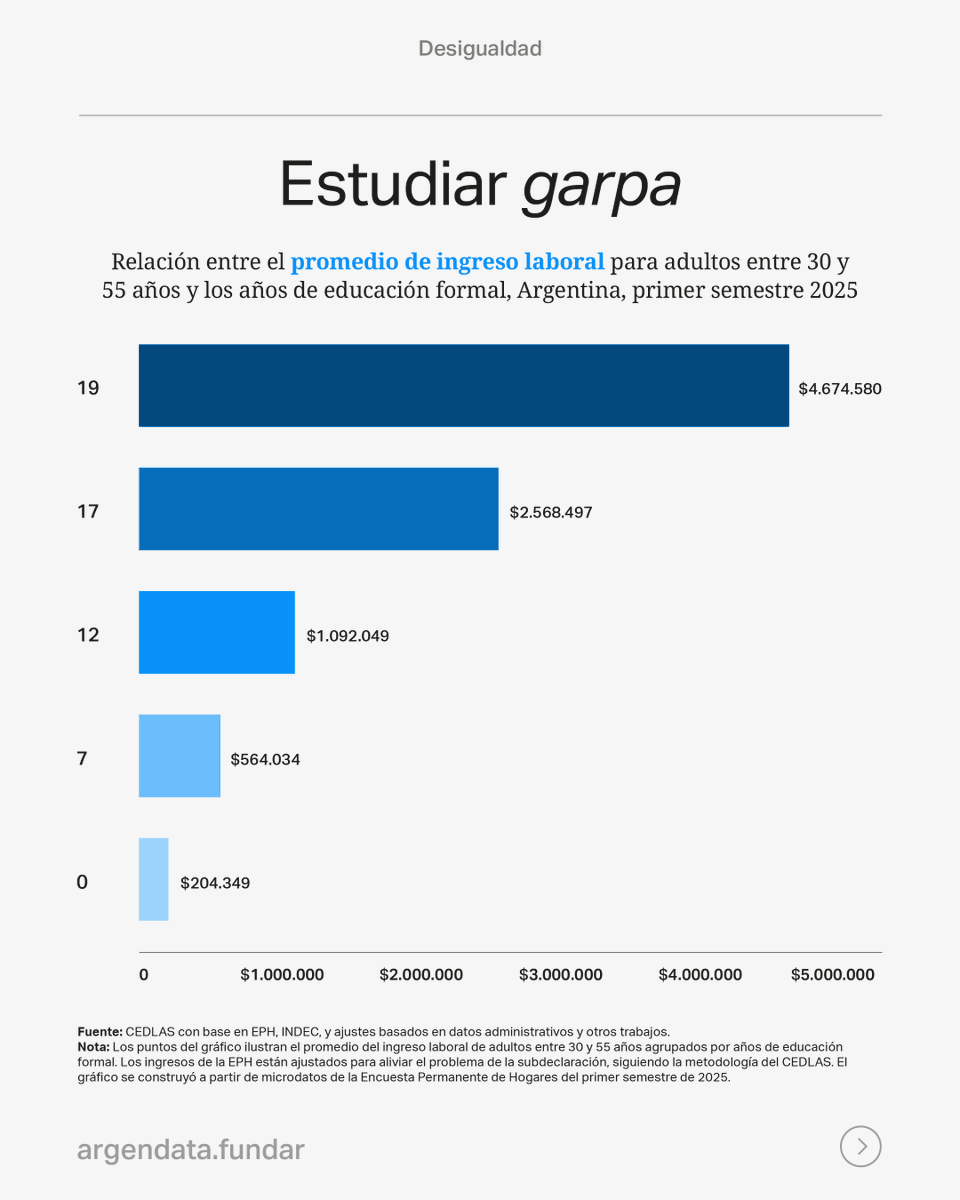
Me impresiona cómo circula entre adolescentes la campaña de la derecha contra el estudio. Muchos ya creen que ir a la universidad no mejora las perspectivas de tu vida. Los datos muestran que es falso: incluso en términos estrictamente monetarios, estudiar te cambia la vida.
Ezequiel Adamovsky tweet media
Español
21
249
629
25.3K
Manuel J. Becerra
Manuel J. Becerra@CheMendele·
Hay EVIDENCIA POR TODOS LADOS de que en Argentina el estudio, aún en este escenario catastrófico, sigue siendo un camino de ascenso social -además de una forma de aprender a mirar el mundo. Estoy bastante harto del discursito, incluso "de este lado", de que ya no es así.
Ezequiel Adamovsky@EAdamovsky

Me impresiona cómo circula entre adolescentes la campaña de la derecha contra el estudio. Muchos ya creen que ir a la universidad no mejora las perspectivas de tu vida. Los datos muestran que es falso: incluso en términos estrictamente monetarios, estudiar te cambia la vida.

Español
6
75
397
9.4K
Fernando G Gutiérrez retweetledi
Year Remaining
Year Remaining@year_remaining·
░░░▓▓▓▓▓▓▓ 63%
0
38
128
1.4K