fiddy.dime - priv/acc 🦡

7.4K posts

fiddy.dime - priv/acc 🦡 banner
fiddy.dime - priv/acc 🦡

fiddy.dime - priv/acc 🦡

@fiddybps1

darklord of $DIME founder @tradeparadigm, @paradex

Maia Katılım Kasım 2015
2.4K Takip Edilen27.5K Takipçiler
Sabitlenmiş Tweet
fiddy.dime - priv/acc 🦡
fiddy.dime - priv/acc 🦡@fiddybps1·
ADL is a relic of isolated margin systems copied from @BitMEX. It doesn’t work for options, and at best is a terrible experience for cross-margin users. Paradex deliberately chose not to implement ADL. It breaks cross-platform hedges, adds a lot of unpredictability to users’ risk management, and fails for complex assets and portfolio-margin setups. There’s also no guarantee of finding profitable ADL counterparties under cross margin, without further amplifying liquidations. @DeribitOfficial also operates without ADL. Socialized loss (SL) is a far better experience for users and scales easily to more complex assets and margin types 👇 Portfolio-Level Integrity ADL operates at the single-market level, without considering the user’s overall account exposure. The trader who is high on the ADL queue due to a highly profitable/leveraged position on one market isn't necessarily profitable on an account level. Example: BTC = $100,000, ETH = $4,000 Insurance Fund (IF) = $100,000 collateral + short 40 BTC perps. Alice has a $4M BTC-ETH spread on, i.e. +40 BTC perps (long) and –1,000 ETH perps (short) → Both BTC and ETH rally +5% → BTC to $105,000, ETH to $4,200. Under a normal scenario, Alice’s BTC and ETH positions offset, leaving her with flat PnL. But the insurance fund’s bankruptcy price is $102,500. To protect the fund, ADL is triggered and forces Alice’s BTC leg to be closed at $102,500 as it cannot afford a loss that is higher than $100,000. Alice realizes BTC profits based on a 2.5% move while her ETH short continues to lose 5%, leaving her with a $100,000 loss. This can, in theory, lead to an unfair liquidation of Alice's account. "Ethena" Risk The same is true for a trader that could be holding the opposite position on a different exchange. If the position is subject to ADL, it closes the profitable leg, leaving the user with a naked losing leg. This destroys the intended hedge and amplifies risk exposure. @ethena smartly negotiated this provision away for it's trading on CEXs but that now means the risk of ADL is being unfairly borne by the exchange's other users. Smart for Ethena but not scalable for the exchange. Given the potential market exposure imposed on affected accounts, ADL often triggers a forced unwind of positions, leading to fire-sale behavior that further amplifies market volatility and erodes liquidity. This mechanism is particularly unsuitable for exchanges with options, where users frequently hold multiple correlated instruments on the same underlying asset for hedging or risk-neutral strategies. In such environments, forcibly closing a single profitable leg through ADL can break portfolio hedges, destabilize the portfolio and, by extension, the market. To our knowledge, NO EXCHANGE discloses how cross-instrument exposures are handled under ADL. Conditional + Reversible Under a SL mechanism, losses are conditional, deferred (not immediately realized) and give users a choice. They are applied only upon withdrawal, and only if the platform is still experiencing a solvency deficit at that time. If the market rebounds, or if the insurance fund grows (either through profitable liquidations or additional allocations) and covers the deficit, the shortfall is erased and no SL is applied. By contrast, ADL crystallizes losses instantly and doesn’t give the user a choice. If a sudden market move causes insurance fund depletion, the system immediately closes profitable positions via deleveraging. Those users now permanently lose their realized profits. SL introduces time, and recovery potential into the loss-allocation process while giving users a choice. It penalizes only those who exit during insolvency, while long-term users benefit if solvency is later restored. Fair + Predictable Risk Distribution ADL targets specific traders (often highly leveraged and profitable ones), forcibly closing their positions to cover the platform shortfall. It penalizes traders for system-level insolvencies outside their control. SL by comparison avoids arbitrary targeting and maintains fairness. All users share the risk evenly and only when a persistent shortfall exists. Transparency ADL is a complex, queue-based mechanism that is very hard to anticipate for users. In contrast, a SL adjustment is a simple, transparent function of the insurance fund shortfall relative to the platform’s TVL. As it affects users only when they withdraw, it ensures predictability and transparency in the loss allocation. Compute Efficient = "Chain Friendly" SL simplicity makes it straightforward to implement on-chain in a trustless manner. There is less compute complexity which means cost and throughput constraints are alleviated. ADL’s dynamic queue logic is computationally heavy as it requires scanning all accounts on the platform, making it very expensive and error-prone. It also adds congestion to a system that is likely to already be congested when ADL is triggered. October 10 = Wake Up Call If your CEX can’t guarantee portfolio integrity under stress, it’s the architecture that’s broken. Switch to DEXs with intelligent loss-allocation that protects hedges, distributes risk fairly while staying conditional and predictable. Paradexio
Stablecoin Sean@seanlippel

This is so highly misleading by only focusing on the ADL on the largest coins, which suffered from far less price discolation and ADL overall than other coins If you are running a long / short book as I was, you are long these assets below, not short them This also looks at ADL in a vacuum, and without regard to anything else in an account Your larger shorts are going to be in the other top 50 alts that are dog shit imo (ATOM, STX, APT, FET) - those shorts closed much earlier and blew you out leaving with only longs to liquidate your account There are so many other places where the @HyperliquidX platform is broken for perps (no ADL transparency / queue, no flash crash protection, one touch price oracles for liquidation (non time based), no whale risk blocker, and zero insurance fund is laughable for someone at $hype scale So please get this propaganda off my timeline, it is insulting. I can assure you @HyperliquidX did not perform well for anyone running a larger profitable long / short book, or even any sort of mild leverage on just longs. I cannot recommend to anyone serious or an instó to trade on hype when they don't even acknowledge these issues. In fact, between @DriftProtocol and @dYdX where I run very similar books, only @HyperliquidX blew me out. Still waiting for my @chameleon_jeff chat 🫡


English
146
67
521
176.5K
artlover11
artlover11@artlover_111·
MoneyBadgers by @paradex. Super cheap NFTs, already have utility (fee discounts). I also believe that down the road there is gonna be a $MONEY memecoin airdrop given out proportionally to Moneybadger holders (rarity will matter). Good long shot bet.
artlover11 tweet media
English
3
0
3
48
fiddy.dime - priv/acc 🦡
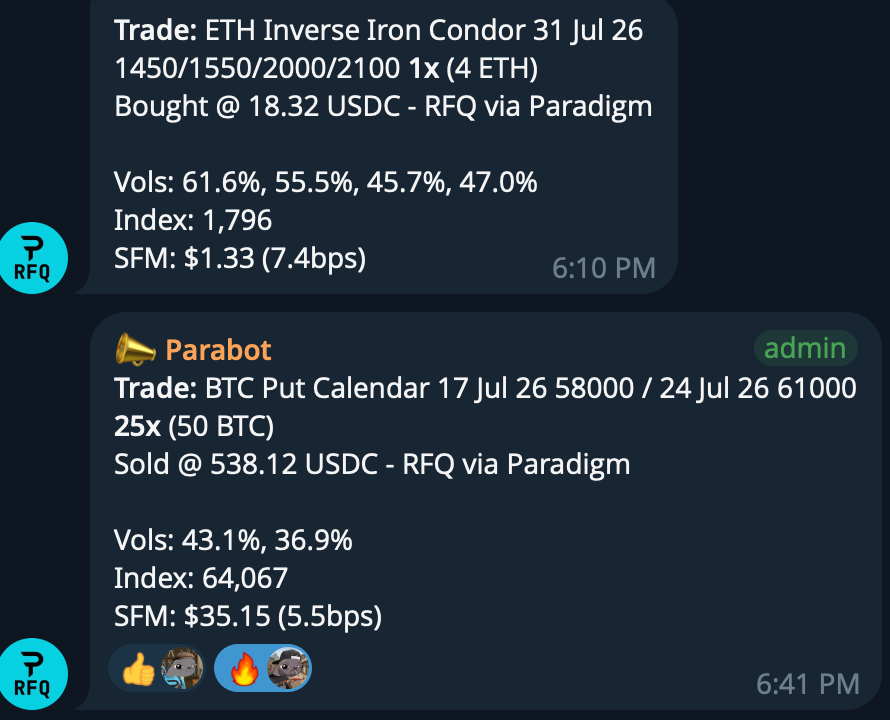
eating good on my short put spreads will keep rolling these as market grinds higher would not be possible for me to keep these trades on without dime terminal
fiddy.dime - priv/acc 🦡 tweet media
English
3
0
11
1.3K
fiddy.dime - priv/acc 🦡
the internet has a verification problem platform X wants / needs to verify user Y for credentials A, B and C how do you solve this at internet scale while preserving privacy permissionlessness decentralization
English
3
0
9
1K
fiddy.dime - priv/acc 🦡
fiddy.dime - priv/acc 🦡@fiddybps1·
should we do prediction market blocks on @tradeparadigm next?
Tarek Mansour@mansourtarek_

The historical bottleneck for institutional risk transfer is liquidity. The bottleneck for liquidity is having a price benchmark for each relevant risk (eg. WTI for oil). Kalshi has built a large community of superforecasters who are the best in the world at pricing risk. This enables us to have a price benchmark for a much broader set of questions that people and institutions face. Institutional adoption has started through ingesting these price benchmarks into traditional asset pricing model. While there is more work to be done, we're seeing a rapid expansion of data use-cases and integrations. The next phase is using price benchmarks to offload risk through block trades and RFQ. This phase is in its early innings but it's starting to take shape. It is hard to estimate the size of the market for risk transfer on non-traditional financial underlyings. The closest proxies are the re-insurance market and derivative desks at banks: - re-insurance ~700B - insurance-linked securities and parametric insurance (eg. cat bonds) ~$120-135B - bank derivatives (structured products, dealer-to-dealer, exotics, etc.) ~200-400B The current market is in the 1-1.5T range, but it's mostly illiquid and over-the-counter (OTC ie. you're trading against one counterparty). Every time a major OTC market moved to exchange-traded, the market grew because a price benchmark got established, big-ask spreads collapsed, access stops being gated by Wall Street elites, and entirely new classes of participants enter: interest rate swaps (10-15x), equity options (20-30x), energy derivatives (5-8x). The institutional use case for prediction markets could be a 10-15T market, with upside beyond that depending on how much they democratize access to products that are currently exclusive to Wall St.

English
5
0
13
1.9K
fiddy.dime - priv/acc 🦡
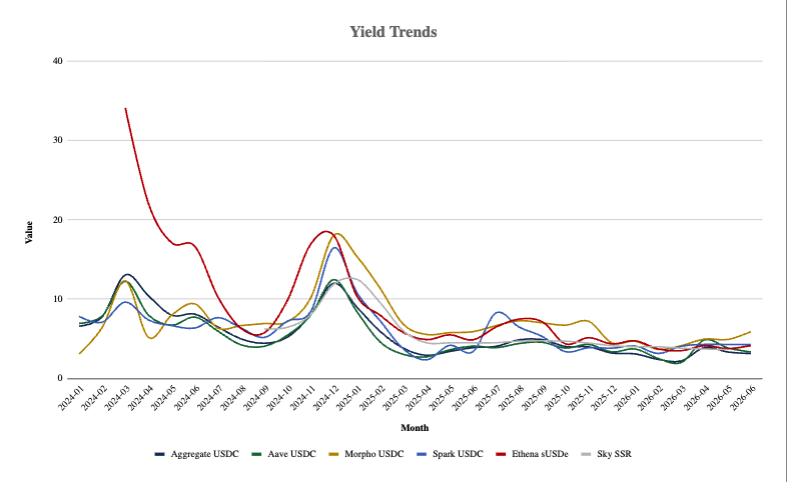
Gigavault 7D APR trending back closer to 10% mainly driven by the BTC options yield strategy this should grow comfortably to 12-13% with a target 2-3% drawdown link to deposit in comments
fiddy.dime - priv/acc 🦡 tweet media
English
3
0
13
1.2K