Finimize

7.1K posts

Finimize banner
Finimize

Finimize

@finimize

Investment research for those short on time. 1M+ community worldwide. Apple: https://t.co/0p21ytqB6X Android: https://t.co/LIix0Ka3YI

🌎 Katılım Ekim 2014
518 Takip Edilen25.2K Takipçiler
Sabitlenmiş Tweet
Finimize
Finimize@finimize·
Once a month, we put all our investment ideas back under the bright lights and see what the market has made of them. It's the Finimize Research Performance Update: every open trade tracked, every result checked, and every link gathered in one place, so our users can see exactly how the picks and strategies have held up. Since their launch in October 2024, our ideas have delivered an average return of 32%, beaten their benchmarks by 18 percentage points, and posted a 69% “hit rate” – meaning most of our calls made money. Full update here: finimize.substack.com/p/how-our-rese…
Finimize tweet media
English
0
0
2
464
Finimize
Finimize@finimize·
The Finimize chart of the day shows the yield on the 30-year Treasury reached its highest level since 2007. And that’s a problem for the Fed. After policymakers left interest rates unchanged for a seventh straight meeting, investors sent long-term Treasury yields soaring while shorter-dated yields fell, creating one of the sharpest yield-curve steepenings seen after a Fed decision in decades. The move suggests markets believe inflation will stay elevated for longer – and that Fed Chair Kevin Warsh’s hawkish rhetoric isn’t being matched by action. The central bank voted 9-3 to keep rates at 3.5% to 3.75%, with three officials pushing for an immediate hike. Traders trimmed bets on a September move but continue to expect tighter policy later this year if inflation and labor market data remain firm. The market reaction was telling. Inflation expectations rose, the dollar weakened, and stocks fell as investors questioned whether the Fed is falling behind the curve. Warsh defended the decision, arguing that higher market interest rates are already tightening financial conditions. But investors appear unconvinced, demanding higher compensation to hold long-term government debt. In other words, if the Fed won’t tighten policy, the bond market may do it instead. #Fed #Bonds #Yields
Finimize tweet media
English
0
0
0
193
Finimize
Finimize@finimize·
@zerohedge $NBIS $CORZ $BE $IREN all bouncign ahrd today 25% plus... as that nasty margin call/liqudiation event is in rear view mirror.. alongside with sellign pressure - also increasing position in $FLKR back to 100% after trimming in early June. app.finimize.com/content/why-it…
English
0
0
0
264
zerohedge
zerohedge@zerohedge·
SITUATIONAL AWARENESS HAS EXITED ALL OF ITS PUBLIC EQUITY TRADES: CNBC
English
241
246
3.8K
1.5M
Finimize
Finimize@finimize·
Bitcoin and gold are both having a tough year, and that got me thinking about JPMorgan’s “fair value” model. The framework essentially benchmarks the world’s biggest crypto against the most trusted precious metal as a way of checking its price. The approach – which the bank first floated back in 2022 – is far from perfect, but it’s a useful way to think about the price of a single Satoshi and how that stacks up against the market’s shiniest old-school asset. Full breakdown here: finimize.com/content/bitcoi… #Gold #Bitcoin @jpmorgan
Finimize tweet media
English
0
0
1
245
Finimize
Finimize@finimize·
What you need to know about markets today 👇 1️⃣ Microsoft’s strong cloud growth and improving AI traction made for a good last quarter, while Meta’s heavier spending and softer outlook left investors with more questions than answers. Meanwhile, the real AI winners may not be the companies with the best models… 2️⃣ The Fed kept interest rates steady, catching those investors who’d priced in a hike off guard – the new chair’s tight-lipped style is leaving markets to guess what comes next.
English
0
0
1
475
Finimize
Finimize@finimize·
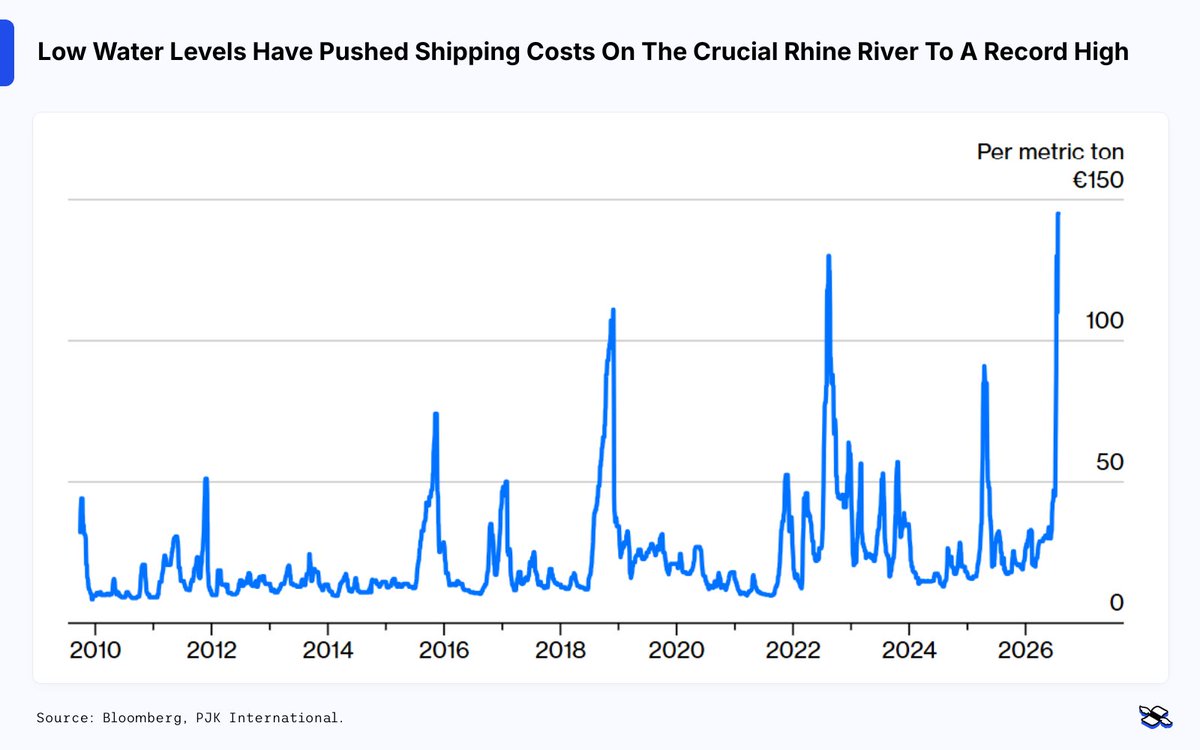
Oil markets have been fixated on geopolitical chokepoints like the Strait of Hormuz and the Red Sea. But Europe’s next supply disruption could come from something much less dramatic: a river running dry. The Rhine – Europe’s industrial artery – is nearing critically low water levels after an extreme drought, threatening to choke off a vital route linking Rotterdam’s ports with factories and refineries across Germany, France, and Switzerland. Barges that normally carry over 5,000 tonnes of cargo are now transporting just 800, while freight costs have surged to record highs of nearly €150 per tonne. The consequences could ripple well beyond shipping. Germany faces the risk of local fuel shortages and production cuts at chemical plants and steel mills, while Switzerland may need to tap its strategic oil reserves if fuel deliveries are disrupted. The timing couldn’t be worse: businesses are already running lean inventories after months of elevated energy prices. There are workarounds, but none are ideal. Low-water barges can carry only a fraction of their usual loads, rail capacity is constrained by major engineering works, and replacing one barge requires around 100 trucks. The whole episode shows how climate change is turning extreme Rhine droughts from once-in-a-generation events into a recurring economic risk. Just as wars can disrupt global trade, a warming world is making critical infrastructure increasingly vulnerable to nature itself. #Commodities #Rhine #Oil #Europe
Finimize tweet media
English
1
0
1
335
Finimize
Finimize@finimize·
What you need to know about markets today 👇 1️⃣ Europe's record heatwave is turning into an economic problem, not just an environmental one. Surging energy demand, damaged infrastructure, and crop losses are adding fresh inflationary pressure just as the region tries to get price growth under control. 2️⃣ Mercedes-Benz beat earnings expectations, but its warning on China reinforces a growing reality for global automakers: the world's biggest car market is buying fewer cars – and increasingly choosing domestic brands over foreign rivals.
English
0
0
0
425
Finimize
Finimize@finimize·
Tech stocks have recently sold off. And the bigger question now is whether that was a routine shakeout – or the start of a more severe drop. There are good reasons to think it’s the latter: the sector’s valuations look genuinely stretched, inflation seems determined to run hotter, and the AI boom is nowhere near justifying its enormous price tags. Even so, before you step to the sidelines, it’s worth taking a look at what history says about trying to swerve the market’s falls, when cash earns its place in a portfolio (and when it doesn’t), and the moves that can shrink your risk without taking you out of the game. Full research here: finimize.com/content/cash-h… #Stocks #Cash #Hedge
Finimize tweet media
English
0
0
0
268
Finimize
Finimize@finimize·
What you need to know about markets today 👇 1️⃣ CXMT's blockbuster stock market debut shows China is rapidly building a homegrown AI chip champion. With fresh capital and growing interest from major tech firms, the memory-chip maker could intensify competition for industry leaders Samsung, SK Hynix, and Micron. 2️⃣ Nvidia is reportedly backing OpenAI's massive data center expansion with financing and loan guarantees, highlighting just how entangled the AI ecosystem has become. Investors will be watching this week's Big Tech earnings for signs that the industry's enormous AI spending remains sustainable.
English
0
0
0
433
Finimize
Finimize@finimize·
Alphabet, Nebius, SK Hynix, Humanoids – And The Tech Rotation Tech and growth stocks have been under pressure all month, but it mostly seems like a typical pullback after a stellar run. Alphabet’s decision to continue raising its capex has sent its cash flow negative for the first time since it debuted on the stock exchange. And that’s caused its share price to fall below some key technical levels. So it’s out of the Finimize Portfolio, at least for now. Meanwhile, Russell’s other tech picks – Nebius, a South Korean ETF, SK Hynix, Harmonic Drive, and a humanoid ETF – will stay in the Finimize Portfolio. app.finimize.com/content/alphab…
Finimize tweet media
English
1
0
1
436
Finimize
Finimize@finimize·
🚨 Big Tech isn’t leading the market anymore. US small-caps and emerging markets have surged ahead in 2026, while the Magnificent Seven have lost some of their grip on market leadership. 📈 But chasing the new winners could be a mistake. This Insight looks at: 🤖 How the AI boom is spreading beyond mega-cap tech 🌍 Why small-caps and emerging markets are outperforming ⚠️ Why owning both may not diversify your portfolio as much as you think 🔎 The signals that could tell you when the trend is starting to crack Is this a lasting change in market leadership – or just another temporary rotation away from Big Tech? 👇 finimize.com/content/the-ma…
English
0
0
1
390
Finimize
Finimize@finimize·
Google’s AI Spending Spree Is Starting To Bite. Alphabet reported its first quarter of negative free cash flow since going public over two decades ago, burning through $5.9 billion as surging investment in AI infrastructure outweighed its hefty profits. The company also raised its 2026 capital expenditure guidance to as much as $205 billion – up from a previous forecast of $190 billion – underlining just how expensive the race to AI leadership has become. This ties directly into one of the key arguments in Finimize analyst @Reda_Farran's latest research piece, where he explains why he's becoming more cautious on markets. While AI investment continues to accelerate, the path to meaningful monetization remains uncertain. Between 2024 and 2030, the five biggest hyperscalers could spend a cumulative $5 trillion to $6 trillion. Last year, a team of consultants at Bain estimated that AI firms will need to generate $2 trillion per year in revenue by 2030 just to pay for all their computing power. That’s the bare minimum needed to cover the bills. Once you factor in other costs and a reasonable return on invested capital, Panmure Liberum figures the required revenue climbs to around $5 trillion. For context, their combined revenue in 2025 was just $1.6 trillion. The required growth is extraordinary, and investors are underestimating how difficult it could be to make money off AI at that scale. For one, competition is ramping up fast. Microsoft, Google, Meta, OpenAI, Anthropic, xAI, and others are battling hard for customers – and price is becoming one of the main weapons. For all but the most demanding tasks, many businesses are treating AI models as interchangeable. They’re shopping around for the cheapest option that gets the job done. Some are also using model-routing services, which automatically pick the best model for each job based on price and performance. At the same time, businesses have been taking a much harder look at their AI bills. The biggest threat to these giants, though, is coming from China, where several firms have built highly capable AI models. Many of them are released as “open-weight” systems, meaning anyone can download, modify, and run them themselves. They're also priced well below their Western rivals. As a result, businesses from Silicon Valley to Europe are flocking to Chinese AI. According to OpenRouter, Chinese models have already overtaken US rivals in token consumption this year. It’s not just about cost, either: some companies point to last year's US trade tensions and this year’s export restrictions on Anthropic's models as reasons to diversify away from American AI providers. Mind you, there’s another possible path for the hyperscalers: instead of making money from selling AI products directly, they could rent out their data centers. Thing is, it doesn't solve the problem – it just shuffles it around. See why here: finimize.substack.com/p/how-to-hedge… #AI $GOOGL #DataCenters
Finimize tweet media
English
0
0
2
456
Finimize
Finimize@finimize·
What you need to know about markets today 👇 1️⃣ Alphabet’s results show Google is still humming along, but the real story is whether its now even-bigger AI spend will be worth it. 2️⃣ The US is giving generic drugmakers until 2028 to move production stateside or face tariffs of up to 200%, ramping up pressure on an industry that supplies 90% of America's prescriptions. The move could accelerate US manufacturing – but also mean fewer suppliers and higher medicine prices.
English
0
0
0
275
Finimize
Finimize@finimize·
AI Rebrands: Great For The Hype, Less So For The Long Haul Wall Street loves a hot trend – and AI is the latest one. Since 2023, at least 28 US-listed companies have rebranded or pivoted toward AI, hoping to cash in on investors' enthusiasm. The strategy often works at first: at their peak after rebranding, the companies were worth a combined $8.7 billion more than they were the week before the announcements – a 106% jump in market value. But more than half those gains have since disappeared, and seven companies are now worth less than they were before their AI makeover. Many of the companies making the switch were already struggling, with several microcaps using AI branding as a lifeline rather than reflecting a fundamental business transformation. That said, there are exceptions. Former crypto miners like Cipher Digital have found more durable success by pivoting into AI infrastructure, where demand from hyperscalers offers a clearer commercial case. The trend echoes previous market manias, from the dotcom boom to the crypto craze, when adding a fashionable buzzword to a company name briefly sent shares soaring before fundamentals caught up. Regulators are also paying closer attention: the SEC has stepped up enforcement against "AI washing", warning companies against exaggerating their AI credentials. Ultimately, investors may reward genuine AI businesses – but a shiny new name alone isn't enough to sustain a higher valuation. #AI
Finimize tweet media
English
0
0
0
393
Finimize
Finimize@finimize·
Morgan Stanley’s Message To Investors: Keep Climbing The Wall Of Worry, But Don’t Get Too Cocky 🙌 Morgan Stanley's basic message: stay constructive about the outlook for assets, but don't get smug. The bank still sees upside for asset prices, but it also sees risks. ⚠️ Valuations are rich, positioning is crowded, corporate debt is piling up, and geopolitics are still tense. But Morgan Stanley doesn't expect those things to undermine the bullish case for stocks and other risk assets. 🚀 The bank likes stocks, especially US ones, thanks to their exposure to AI, the still-resilient American consumer, and the potential for the investment boom to spread beyond AI. app.finimize.com/content/morgan…
Finimize tweet media
English
0
0
0
385
Finimize
Finimize@finimize·
What you need to know about markets today 👇 1️⃣ The US is threatening fresh tariffs on Canada and dozens of other trading partners, but the bigger battle may be over AI. As Chinese models rapidly close the performance gap, Beijing is reportedly considering export curbs to protect its homegrown technology. 2️⃣ The London Stock Exchange is moving toward near-24-hour trading, joining a global push to keep markets open for longer. But extended hours won't solve its bigger problem: companies are leaving the UK market faster than new ones are joining.
English
0
0
0
388
Finimize
Finimize@finimize·
Chip stocks are swinging more wildly than the broader market than at any point in the past 30 years. The @Finimize chart of the day compares the day-to-day moves in the Philadelphia Semiconductor Index (SOX) with those in the S&P 500. The ratio shows how much more volatile chip stocks are than the wider market. A reading of one means they're swinging roughly in lockstep. Today, that figure sits at 4.9 – meaning semiconductor stocks are almost five times as volatile as the S&P 500. The closest comparison came after the dotcom bubble burst. Back in 2000, the ratio peaked at 4.2 as investors dramatically repriced the sector. At the other end of the spectrum, it fell to around one during the 2007-08 financial crisis, when volatility spread across the entire market and chip stocks no longer stood out. Semiconductors have always been a cyclical business, with profits closely tied to the health of the economy. But this year's extreme volatility has more to do with the AI boom than the economic cycle. Even after this month's sharp pullback, the SOX index is still up 66% year to date, fueled by relentless demand for the "picks and shovels" powering AI. The catch is that lofty valuations leave little room for disappointment, so even seemingly minor headlines can spark outsized moves. #Chips #AI #SOX $SOXX
Finimize tweet media
English
0
0
0
351
Finimize
Finimize@finimize·
The 2026 World Cup marked a turning point for prediction markets, with platforms like Kalshi and Polymarket capturing an estimated 27% of legal US sports-betting volume, up from just 9% at the start of the year. Kalshi, in particular, smashed trading records throughout the tournament, while its app overtook DraftKings and FanDuel in daily active US users – a sign that prediction markets are no longer a niche alternative but a genuine competitor to traditional sportsbooks. That shift is forcing incumbents to respond. Analysts say sportsbooks now face mounting pressure to launch similar products, especially as regulators have allowed prediction exchanges to offer sports contracts nationwide, including in some states where sports betting remains illegal. Their broader appeal is also helped by a lower minimum age and the ability to trade on everything from elections to weather alongside sporting events. Still, sportsbooks aren't down for the count. Companies like FanDuel and DraftKings are developing their own prediction-market offerings, and analysts argue their established brands and customer bases could prove a lasting advantage. But for now, the World Cup has shown that prediction markets have moved from regulatory curiosity to mainstream financial product – and they're starting to reshape how Americans bet on sports. #PredictionMarkets #Betting #Sports #Kalshi #Polymarket
Finimize tweet media
English
0
0
0
334
Finimize
Finimize@finimize·
What you need to know about markets today 👇 1️⃣ Prysmian has landed a $6.3 billion AI infrastructure deal, adding fresh evidence that Big Tech's data center spending is flowing through to the wider supply chain – and giving investors another real-world test of the AI investment boom. 2️⃣ Ryanair's profit slump shows geopolitical tensions are already feeding into corporate earnings, with higher fuel costs threatening airlines and other energy-intensive businesses if oil prices stay elevated.
English
0
0
1
257