Thorvald Grung Moe

15.9K posts

Thorvald Grung Moe banner
Thorvald Grung Moe

Thorvald Grung Moe

@finstab

Former central banker; Research Associate Levy Economics Institute, Bard Collage. Have also worked for the Norwegian Treasury, IMF and the World Bank.

Oslo, Norway Katılım Eylül 2011
1.2K Takip Edilen1.2K Takipçiler
Thorvald Grung Moe retweetledi
Ihtesham Ali
Ihtesham Ali@ihtesham2005·
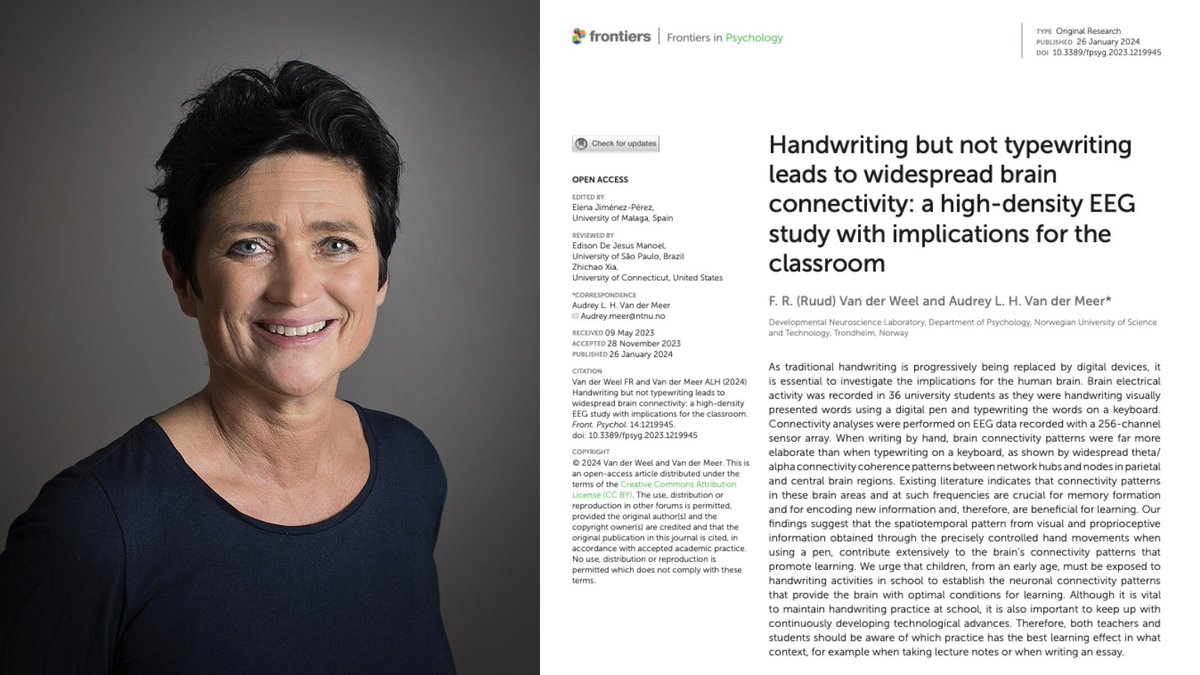
A Norwegian neuroscientist spent 20 years proving that the act of writing by hand changes the human brain in ways typing physically cannot, and almost nobody outside her field has read the paper. Her name is Audrey van der Meer. She runs a brain research lab in Trondheim, and the paper that closed the argument was published in 2024 in a journal called Frontiers in Psychology. The finding is brutal enough that it should have changed every classroom on Earth. The experiment was simple. She recruited 36 university students and put each one in a cap with 256 sensors pressed against their scalp to record brain activity. Words flashed on a screen one at a time. Sometimes the students wrote the word by hand on a touchscreen using a digital pen, and sometimes they typed the same word on a keyboard. Every neural response was recorded for the full five seconds the word stayed on screen. Then her team looked at the part of the data most researchers had ignored for years, which is how different parts of the brain were communicating with each other during the task. When the students wrote by hand, the brain lit up everywhere at once. The regions responsible for memory, sensory integration, and the encoding of new information were all firing together in a coordinated pattern that spread across the entire cortex. The whole network was awake and connected. When the same students typed the same word, that pattern collapsed almost completely. Most of the brain went quiet, and the connections between regions that had been alive seconds earlier were nowhere to be found on the EEG. Same word, same brain, same person, and two completely different neurological events. The reason turned out to be something nobody had really paid attention to before her work. Writing by hand is not one motion but a sequence of thousands of tiny micro-movements coordinated with your eyes in real time, where each letter is a different shape that requires the brain to solve a slightly different spatial problem. Your fingers, wrist, vision, and the parts of your brain that track position in space are all working together to produce one letter, then the next, then the next. Typing throws all of that away. Every key on a keyboard requires the exact same finger motion regardless of which letter you are pressing, which means the brain has almost nothing to integrate and almost no problem to solve. Van der Meer said it plainly in her interviews. Pressing the same key with the same finger over and over does not stimulate the brain in any meaningful way, and she pointed out something that should scare every parent who handed their kid an iPad. Children who learn to read and write on tablets often cannot tell letters like b and d apart, because they have never physically felt with their bodies what it takes to actually produce those letters on a page. A decade before her, two researchers at Princeton ran the same fight using a completely different method and ended up at the same answer. Pam Mueller and Daniel Oppenheimer tested 327 students across three experiments, where half took notes on laptops with the internet disabled and half took notes by hand, before testing everyone on what they actually understood from the lectures they had watched. The handwriting group won by a wide margin on every question that required real understanding rather than surface recall. The reason was hiding in the transcripts of what the two groups had actually written down. The laptop students typed almost word for word, capturing more total content but processing almost none of it as they went, while the handwriting students physically could not write fast enough to transcribe a lecture in real time, which forced them to listen carefully, decide what actually mattered, and put it in their own words on the page. That single act of choosing what to keep was the learning itself, and the keyboard had quietly skipped the choosing and skipped the learning along with it. Two studies. Two countries. Same answer. Handwriting makes the brain work. Typing lets it coast. Every note you have ever typed instead of written went into your brain through a thinner pipe. Every meeting, every book highlight, every idea you captured on your phone instead of on paper was processed at half depth. You did not forget those things because your memory is bad. You forgot them because typing never woke the part of the brain that would have made them stick. The fix is the thing your grandmother already knew. Pick up a pen. Write the thing down. The slower road is the faster one.
Ihtesham Ali tweet media
English
2.3K
42.2K
113.8K
8.3M
Thorvald Grung Moe retweetledi
Mayank Vora
Mayank Vora@aiwithmayank·
Billionaires think they're untouchable. ShadowBroker is a free open source dashboard that tracks their private jets, superyachts, and corporate aircraft in real time on one screen alongside 2,000+ spy satellites, all 11 US Navy carrier strike groups, active conflict zones, and GPS jamming signals. One docker command. Runs on your laptop. Looks like a CIA ops center. - 60+ live intelligence feeds aggregated into a single dark-ops map interface - Visual modes: DEFAULT, SATELLITE, FLIR thermal, NVG night vision, CRT retro terminal - Right-click anywhere on Earth for a country dossier, head of state, and the latest satellite photo at 10m resolution - Connect an AI agent as a co-analyst with full read/write access to all 35+ data layers 100% Opensource. AGPL-3.0 License.
English
4
22
53
3.5K
Thorvald Grung Moe retweetledi
POLITICOEurope
POLITICOEurope@POLITICOEurope·
Italian PM Giorgia Meloni is pressing Brussels to loosen the EU’s fiscal rules to help governments absorb the economic shock unleashed by the Iran war and soaring energy prices. politico.eu/article/giorgi…
English
12
44
106
14.2K
Thorvald Grung Moe retweetledi
Jesús Fernández-Villaverde
Jesús Fernández-Villaverde@JesusFerna7026·
Smartphones are not the explanation for the recent decline in fertility. Instead, they are an accelerator of deeper forces already at work. Let’s start with the facts. Fertility is falling almost everywhere: in rich, middle-income, and poor countries; in secular and religious countries; and in countries with high and low levels of gender equality. The decline accelerated around 2014. So, no country-specific explanation will work unless you are willing to believe that 200 distinct country-specific explanations arrived at roughly the same time. Smartphones look like the obvious candidate: the first iPhone was released in 2007, and global adoption has been astonishingly fast. Economists understand the first major decline in fertility in advanced economies, from 6 or 7 children per woman throughout most of human history to about 1.8, that occurred between the early 1800s and roughly 1970, well before smartphones. The main drivers were a sharp fall in child mortality (effective fertility was rarely above 3 and often close to 2) and the shift from a low-skill, rural agrarian economy to a high-skill, urban industrial one. We have quantitative models that fit these facts well. Country-specific factors mattered too, of course. Proximity to low-fertility neighbors accelerated Hungary’s decline, while fragmented landowning structures accelerated France’s. But these were second-order mechanisms. This is also why most economists long considered Paul Ehrlich’s doom scenarios implausible. We forecast that fertility in middle- and low-income economies would follow the same path as in the rich, probably faster, because reductions in child mortality reached India or Africa at lower income levels (medical technology is nearly universal, and most gains come from handwashing and cheap antibiotics, not Mayo Clinic-level care). Much of what we see in Africa or parts of Latin America today is still that old story. But in the 1980s, a new pattern appeared. Japan and Italy fell below 1.8, the level we had thought was the new floor. By 1990, Japan was at 1.54 and Italy at 1.36. This second fertility decline began in Japan and Italy earlier than elsewhere, driven by country-specific factors, but the underlying dynamics were widespread: secularization, an education arms race, expensive housing, the dissolution of old social networks, and the shift to a service economy in which women’s bargaining power within the household is higher. The U.S. lagged because secularization came later, suburban housing remained relatively cheap, and African American fertility was still high. U.S. demographic patterns are exceptional and skew how academics (most of whom are in the U.S.) and the New York Times see the world. My best guess is that, without smartphones, Italy’s 2025 fertility rate would be about 1.24 rather than 1.14. I doubt anyone will document an effect larger than 0.1-0.2. Italy was at 1.19 in 1995, not far from today’s 1.14. The TFR is cyclical due to tempo effects, so I do not read too much into the rise between 1995 and 2007 or the decline from 1.27 in 2019 to 1.14 today. The direct effect of smartphones is not zero, but it is not, by itself, that large. Where social media, in general, and smartphones, in particular, matter is in the diffusion of social norms. What would have taken 25 years now happens in 10. Social media are not the cause of fertility decline; modernity is. But they are a very fast accelerator. That is why social media are a major part of the story behind Guatemala (yes, Guatemala) going from 3.8 children per woman in 2005 to 1.9 in 2025. Without them, Guatemala would also have reached 1.9, just 20 years later. Modernity, in its current form, is incompatible with replacement-level fertility. By modernity, I do not mean capitalism: fertility fell earlier and faster in socialist economies than in market economies. Socialist Hungary fell below replacement in 1960, and socialist Czechoslovakia in 1966 (both experienced small, short-lived baby booms in the mid-1970s). By modernity, I mean a society organized around rational, large-scale systems and formalized knowledge. Countries will not converge to the same fertility rate. East Asia is likely stuck near 1, possibly below, given its unbalanced gender norms and toxic education systems. Latin America faces the same gender problem plus weak growth prospects, so I expect something around 1.2. Northern Europe has more egalitarian family structures and might hold near 1.5. The very religious societies are probably the only ones that will sustain 1.8. All of this could change with AI or changes in population composition. We will see. But on the current evidence, deep sub-replacement fertility is the “new new normal.” Unless we reorganize our societies, better learn to handle it as best we can.
Jesús Fernández-Villaverde tweet media
English
209
879
3.5K
821.3K
Thorvald Grung Moe retweetledi
Jostein Hauge
Jostein Hauge@haugejostein·
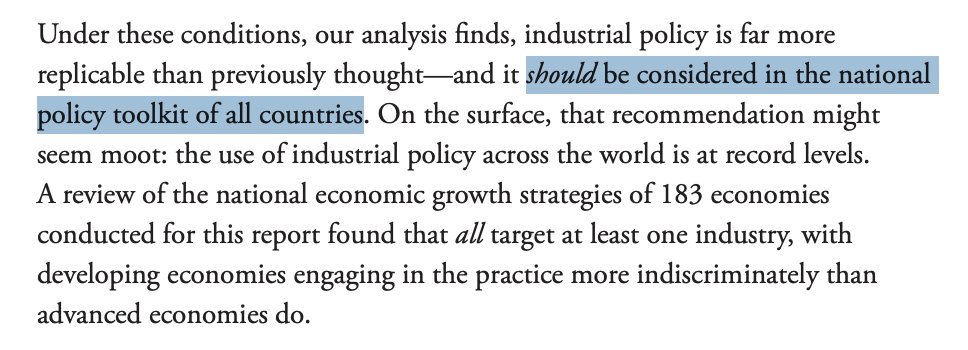
In its new major report on industrial policy, the World Bank states that industrial policy "should be considered in the national policy toolkit of all countries." What a turnaround for an institution that once treated industrial policy as economic heresy.
Jostein Hauge tweet media
English
6
57
153
5.5K
Thorvald Grung Moe retweetledi
jamiemcintyre
jamiemcintyre@jamiemcintyre21·
Can anyone explain to me why Israel and only Israel is able to order people from another country to evacuate their home? Anyone? Israel has issued an evacuation order for Tyre, Lebanon, displacing 200,000 more people. Tyre is an ancient Phoenician city with Roman ruins and a hippodrome.
jamiemcintyre tweet media
English
2.5K
18.3K
36.4K
669.1K
Thorvald Grung Moe retweetledi
Isabel Oliveira
Isabel Oliveira@IsabelO20183051·
Remember they refused Eurobonds to save Greece, Ireland and Portugal but they issued Eurobonds to give to Ukraine.
English
133
1.8K
8.2K
134.6K
Thorvald Grung Moe retweetledi
GBX
GBX@GBX_Press·
🇫🇷 Former French Ambassador to Israel and the US, Gerard Araud: “What is happening in the West Bank right now is an absolute scandal.” “What is actually happening is ethnic cleansing carried out by ‘settler’ Israelis.” “Europe’s silence on this is also a scandal.”
English
176
8.6K
18.4K
273.6K
Thorvald Grung Moe retweetledi
Philipp Heimberger
Philipp Heimberger@heimbergecon·
This IMF paper finds that during and after the 2022 global inflation surge - largely driven by supply shocks -inflation outcomes in inflation-targeting countries were no better than in non-targeting countries, despite the former implementing more aggressive interest rate hikes.
Philipp Heimberger tweet media
English
5
110
288
31.3K
Thorvald Grung Moe retweetledi
Philip Pilkington
Philip Pilkington@philippilk·
European diesel reserves are in freefall. There will be nothing left in a few weeks. 🇪🇺🛢️
Philip Pilkington tweet media
English
29
278
729
92.4K
Thorvald Grung Moe retweetledi
Hala Jaber
Hala Jaber@HalaJaber·
Apocalyptic scenes from Tyre this afternoon. Terrified children emerging through smoke & rubble after another vicious wave of Israeli strikes hit residential neighbourhoods. Homes shattered. Streets buried in debris. Families running through clouds of dust carrying children in their arms. The areas struck are well-known civilian residential districts. And still this is all cynically packaged and justified as targeting “Hezbollah infrastructure.”
Hala Jaber tweet media
English
93
2.8K
3.3K
59K
Thorvald Grung Moe retweetledi
RT
RT@RT_com·
Iran was NOT the country that created the Hormuz Strait problem — Lavrov 'Root cause is unprovoked aggression by the US and Israel against Iran Before the start of this aggression... safe navigation was ensured 100%'
English
106
2.4K
7.3K
93.1K
Thorvald Grung Moe retweetledi
Agnes Callamard
Agnes Callamard@AgnesCallamard·
Utterly shameful. This got to stop. Finland’s international obligations and credibility are at stake. Surely, and sadly, Israel is not the only country capable of providing Finland with the weapons it believes it requires to defend itself. So why go for a genocidal State? Finnish people and their political representatives must stand up for what is right. Purchasing Israeli weapons is not. And it may too violate international law.
Frank Johansson (frankdj.bsky.social)@FrankAmnesty

Aivan käsittämätöntä ja häpeällistä. Suomi kutsuu kansanmurhaan syyllistyvän Israelin aseteollisuuden firmoja Helsinkiin keskustelemaan yhteistyöstä. Nyt on kyllä @DefenceFinland ja @anttihakkanen moraalinen kompassi pahasti hukassa. yle.fi/a/74-20226049?…

English
26
165
512
16.4K
Thorvald Grung Moe retweetledi
Daniela Gabor
Daniela Gabor@DanielaGabor·
Shocking - @FT long read on UK bond market with v little analysis beyond 'a lot of debt, powerful investors' Nothing on linkers, one sentence on Bank of England actively selling gifts when no other central bank does. ft.com/content/681c03…
English
10
50
193
38.8K
Thorvald Grung Moe
Thorvald Grung Moe@finstab·
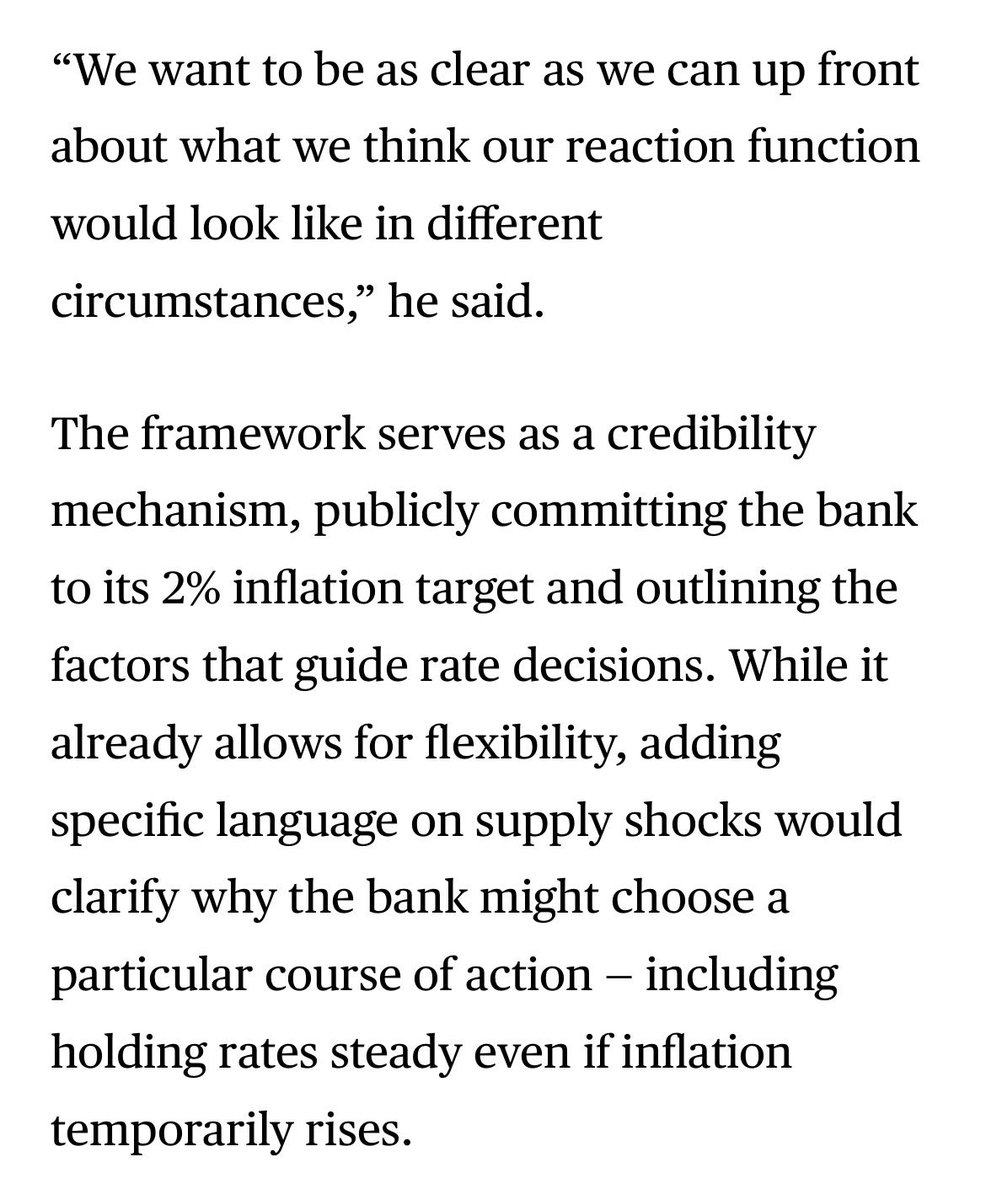
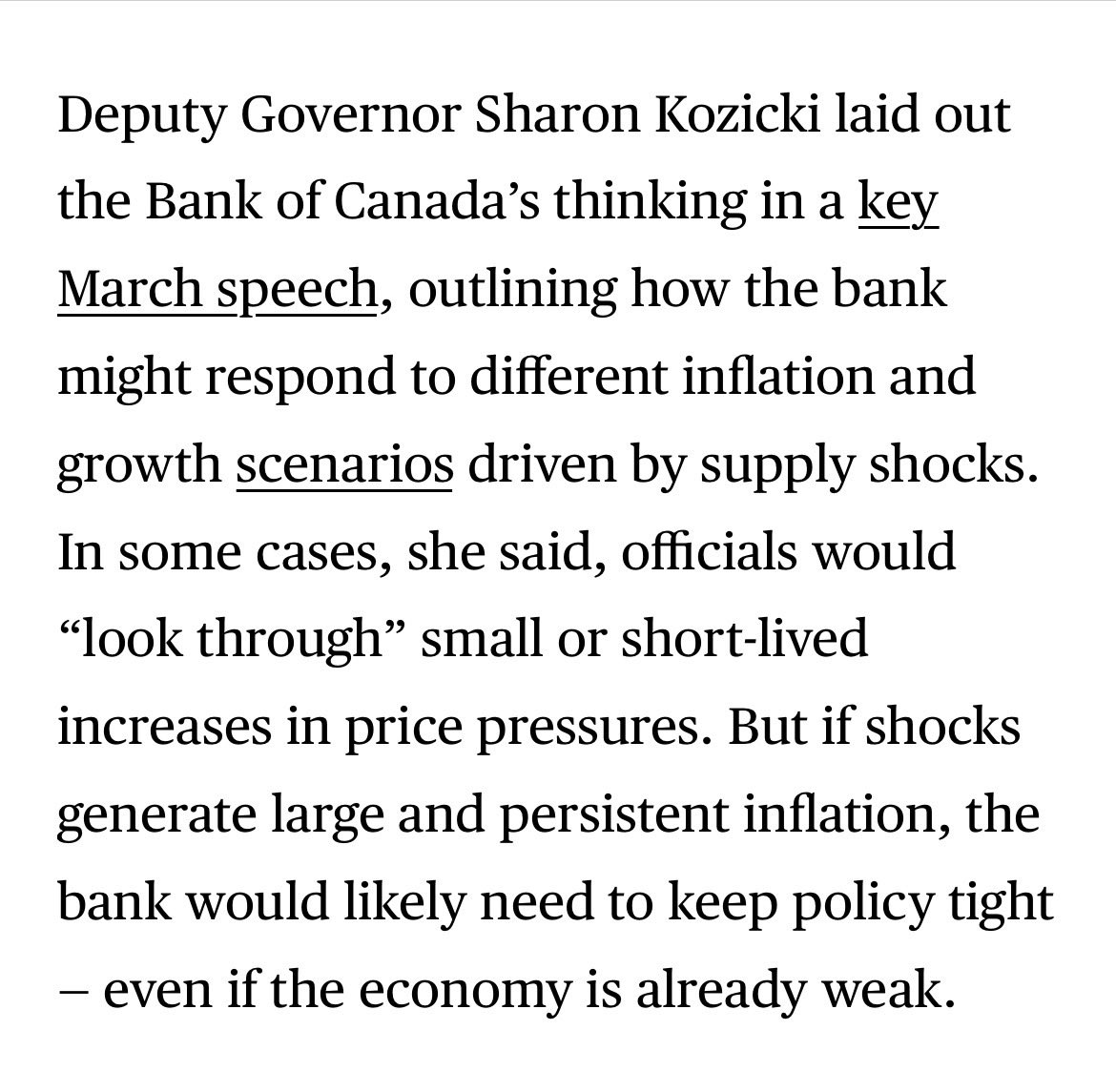
@MaxJerneck Takk for det, men er vel egentlig ikke noe nytt her? De fortsetter å være overfokusert på inflasjonen, riktignok med et sideblikk på output gap. Men merk at arbeidsledigheten i Canada er rundt 7% (!). Så jeg kanskje se at kursen er endret særlig mye. Se også editorial fra FT
Norsk
0
0
0
10