C.J Mitchell

12.1K posts

C.J Mitchell banner
C.J Mitchell

C.J Mitchell

@flawlesstracks

A.I Product Manager | A.I Safety Expert | Adjunct Professor | Algorithmic Bias Advocate | Music Producer | #HowardU | #HarvardU

Atlanta Katılım Mart 2009
261 Takip Edilen6.6K Takipçiler
C.J Mitchell
C.J Mitchell@flawlesstracks·
Another dead scientist?! Albert Zisook MIT undergrad in math/physics, University of Chicago PhD, Harvard Society of Fellows,11 published papers. Obituary states he "applied his physics to defense" Found dead July 2023 while hiking in Altadena, <2 miles from JPL's main campus.
English
0
0
0
28
C.J Mitchell
C.J Mitchell@flawlesstracks·
@RedPandaKoala Richard L. McKinley — 40-year career at AFRL 711th Human Performance Wing, Wright-Patterson. Military bioacoustics, ANR systems. Died Feb 13, 2026.
English
0
0
0
44
C.J Mitchell
C.J Mitchell@flawlesstracks·
@RedPandaKoala Ryan B. Bond (AIAA memorial) — Sandia National Labs, manager of Computational Fluid and Thermal Sciences. NNSA Advanced Strategic Computing Program (nuclear weapons sustainment). Died Jan 16, 2026, age 50.
English
0
0
0
16
C.J Mitchell
C.J Mitchell@flawlesstracks·
@RedPandaKoala The Cancer Cluster (Dec 2025 – Feb 2026): Three men with deep defense/aerospace died of cancer within 3 months of each other: Hugh Pohle 40-year career AFRL Directed Energy Directorate, Kirtland AFB. EMP & high-power microwave weapons effects. Died Dec 2, 2025
English
0
0
0
29
C.J Mitchell
C.J Mitchell@flawlesstracks·
@RedPandaKoala Harvard Society of Fellows (1982-85), 11 published papers. Obituary states he "applied his physics to defense" before transitioning to Citi as Managing Director. Found dead July 2023 while hiking in Altadena, less than two miles from JPL's main campus.
English
0
0
0
11
C.J Mitchell
C.J Mitchell@flawlesstracks·
@RedPandaKoala Adding to the ongoing list of anomalous deaths in defense/aerospace/scientific research personnel. None of these are confirmed connections — just names worth examining. Albert Zisook (obituary) — MIT undergrad in math/physics, University of Chicago PhD,
English
0
0
1
45
C.J Mitchell
C.J Mitchell@flawlesstracks·
Wow…ai is crazy
English
0
0
0
38
C.J Mitchell
C.J Mitchell@flawlesstracks·
@BrandonStraka What did the manager say at the end of the video? Why he blank it out? 🤔
English
0
0
1
19
Brandon Straka #WalkAway
Brandon Straka #WalkAway@BrandonStraka·
Footage shows an aggressive man harassing workers at a pizza shop until the owner steps in and shuts it down. “My guys work 7 days a week… get out with that BS.” He handles it himself and escorts the man out without calling police.
English
1.1K
2.2K
29.5K
427.9K
C.J Mitchell
C.J Mitchell@flawlesstracks·
Yeah… this dude needed a wife/husband and kids…. He love being online too much… money can’t unlame you
Kevin Durant@KDTrey5

English
0
0
0
195
C.J Mitchell
C.J Mitchell@flawlesstracks·
@PaddyG96 bro I done applied to your accelerators multiple times and never get a call back. What’s good?
English
0
0
0
18
Mario Joos
Mario Joos@MarioJoos·
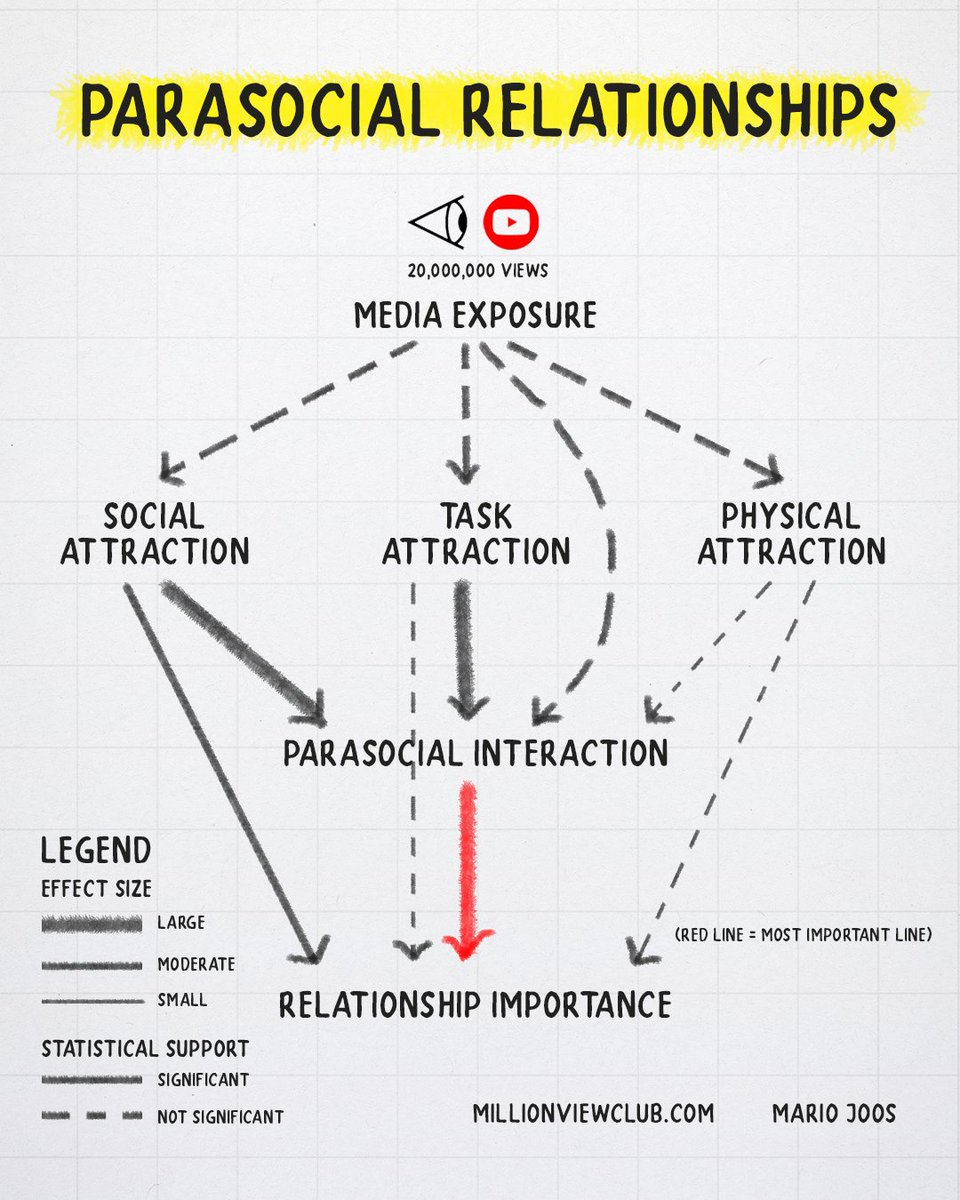
🧵How to build a parasocial relationships with your audience There is so much conversation around how to build a parasocial relationship with your audience, and many creators struggle to do so. That’s why my team and I have looked at 70 years of research to figure out exactly what contributes to parasocial relationships. Let’s talk about this. Part 1: What Is a Parasocial Relationship and Parasocial Interactions To get straight into the definition: a parasocial relationship is a one-sided relationship that your audience feels they have with you. This goes through a series of interactions called parasocial interactions that eventually lead to the viewer feeling a sense of connection with the creator. Simple, right? Not quite, let’s look deeper. What is a parasocial interaction? A parasocial interaction is a moment where something happens that helps build that parasocial relationship. If we look into research, we can find that there are four main components needed for something to qualify as a parasocial interaction. The 4 components behind Parasocial Interactions 1. First, we have intimacy. Relationships don’t form unless there is a perception of directness from host (creator) to receiver (viewer). What we’re looking for is whether we have moments where we’re directly addressing the audience with a conversational tone that creates that sense of personal connection. Where a lot of people go wrong here is that they’re talking at the audience rather than talking to the audience. It’s a subtle nuance, but viewers are smart enough to catch on. The other mistake is that a lot of creators tend to yell toward their audience, but this does not help build that emotional connection. We often call it the YouTuber voice. The trick here is to mix your YouTuber voice with a more authentic voice that allows the viewer to get a sense of your real self. 2. Second is simulated reciprocity. While you may be talking to the audience, it still doesn’t instantly guarantee that this is going to lead to a parasocial interaction. Again, it’s a small nuance, but it’s important that when we’re talking to the audience, the audience believes that we actually care, react, or respond to their own thoughts. The viewer needs to have a sense that we actually care about what they think about what we say. It’s very subtle, but viewers can catch on if you don’t care. One of the biggest examples is when you see an explosion and you’re reacting. You’re talking to the audience, you’re reacting in a normal way, but the viewer knows that you actually don’t care how they would feel about that explosion. Then you’re lacking simulated reciprocity. The reason we add the word simulated here is because we don’t have to actually care. There just needs to be the perception of care. 3. Third is consistent identity or persona. We all build a persona online that may align with our own persona or not. We need to think about what persona the audience is constantly seeing. If this persona stays consistent across many videos, then audiences build enough trust that they can care. However, if the persona that has been crafted changes too much, then it will be harder to build a parasocial relationship. This doesn’t mean that you as a person cannot evolve, but growth tends to happen slowly. One of the prime examples of a person who has stayed super consistent in his persona is PewDiePie. This is something that a lot of people respect, and they tend to build stronger parasocial relationships because of it. 4. Lastly, we have continuity. Parasocial relationships don’t build themselves through singular moments. It’s the repeated exposure to these moments that helps parasocial interactions turn into parasocial relationships. Just because you ask once in your video for people to subscribe does not mean that they are automatically connecting with you as a creator. Now, how you touch on all four of these factors, I’ll leave up to you. I do have a masterclass on this, but I know that by just giving the knowledge, a lot of you can come up with your own ways to create these moments. One trick that I often discuss with the people I work with is using narration as a way to create a parasocial interaction. This way, we don’t break up the main content, and we still connect with the viewer. It’s a very subtle way to do so, but there are many tactics you can come up with. Part 2: The Importance of Attraction One of the things that research has looked at is the similarities between normal relationship building and parasocial relationship building. One thing kept coming up in research over and over again, which is the importance of attraction. Attraction is a quality that evokes liking or desire toward a certain person. There are three main types of attraction we can identify when we analyze attraction as a concept. 1. First, we have social attraction. Social attraction looks at our liking toward someone’s personality. This attraction is built through seeing somebody being funny or seeing somebody being selfless. It’s the type of attraction that brings a lot of pleasure and joy, where we can say, that’s a likable person. 2. Second, we have task attraction. We don’t just feel liking toward a person because they have likable character traits. We also feel good towards people because we respect their competence or skill. This is often present with late-night hosts, who tend to be quite skilled at a lot of things. They can sing, they can dance, and they can perform these small things that require a bit of skill. Another example is IShowSpeed, who has shown that he is quite skilled at a lot of things he does. This makes people feel a sense of task attraction toward him as a character. 3. Lastly, we have physical attraction. This is the type of attraction most people think about when we talk about attraction, but it’s not the only one. Physical attraction is when a person is drawn toward someone’s appearance. If someone is good-looking, we tend to form liking toward them. If they aren’t as good-looking, or their overall hygiene is perceived as bad, then we may feel lower degrees of attraction toward that person. There are certain universally felt ways to create each type of attraction. For example, being selfless is a universal way to create social attraction. Being great at something that is broadly respected, such as a sport, is universally known to create a lot of task attraction. There are certain physical traits that also lead to a lot of physical attraction. I’m saying this because we often forget that there are universal traits within each of these categories. This does not mean that you cannot have something that is specifically attractive to a certain type of audience. But which type of attraction is more important for parasocial relationships? This is where most people get it wrong. When we look at research, we find that social attraction and task attraction have the strongest connection to building parasocial relationships. This means that being likable and being competent are great ways to build initial attraction that can lead to parasocial relationships. However, this is where physical attraction takes a different turn. In research, we actually find that physical attraction has a very weak connection to parasocial relationships. This is also why you often notice that attractive people who never put effort into being likable or competent don’t tend to have strong fan bases. But not all is bad for people who are physically attractive. Physical attraction often leads to people wanting to spend more time looking at you, which can then lead to more exposure to moments where they see you in socially attractive or task-attractive situations. That’s where exposure comes into play. Part 3: The Essence of Exposure As I’ve discussed in the previous part, physical attraction can lead to exposure. Exposure can provide opportunities for more social attraction, task attraction, and physical attraction. Exposure also leads to continuity, which is what we discussed in Part 1, where people repeatedly see you in certain settings that can create parasocial interactions. The key idea is that exposure by itself does not lead to parasocial relationships. Just because you have a lot of views does not mean that you’re going to build a relationship with your viewers. I’ve seen this firsthand. A creator I worked with scored over 100 million views in a single month, and when they sold a t-shirt, they sold about three pieces total. Not 300, not 3,000, but three. They put very little effort into turning that exposure into moments where they could build a genuine connection with their audience. As a result, no parasocial relationship was built. So the lesson here is very simple. Create exposure that allows people to build attraction toward you, and create situations where you can insert moments that build parasocial relationships through parasocial interactions. That is the main key to building parasocial relationships. There is a lot more to parasocial relationships than this, but I wanted to condense it into a simple article that gets the conversation going. There is often a lot of discussion around how authenticity plays a role in parasocial relationship formation. Authenticity often leads to more social attraction, so while it can help, it is not necessary for authenticity to be the only thing that leads to parasocial relationships. Hopefully, this quick introduction to parasocial relationships taught you a thing or two. If you want to see the entire masterclass, it’s available on Million View Club. But, what’s discussed in this article captures the main lessons from that masterclass already. Hope you like this post.
Mario Joos tweet media
English
9
11
107
5.5K
FearBuck
FearBuck@FearedBuck·
Jaden Smith walks away when asked a question about Ye
English
408
189
5.5K
3.4M
C.J Mitchell
C.J Mitchell@flawlesstracks·
Anybody else not able to generate music on Suno right now? @suno #suno Are you getting a “pro subscription only” flag when you are?
English
1
0
0
87
#TrippySpaceGang
#TrippySpaceGang@TrippySpaceDoe·
@suno why the fuck your website not working when I’m pro? I didn’t pay for this shit for it not to work fix this shit now bro!
English
1
0
0
20
C.J Mitchell
C.J Mitchell@flawlesstracks·
@suno it’s saying it won’t generate my music when I’m on pro subscription but I am. What’s going on?
English
0
0
0
40
C.J Mitchell
C.J Mitchell@flawlesstracks·
@bilawalsidhu Ikr?! Hey do you have a Patreon for how you’re creating some of these vids?
English
1
0
1
104
Bilawal Sidhu
Bilawal Sidhu@bilawalsidhu·
All I really wanted for Christmas was Veo 4
English
7
1
26
4.3K