Thomas Pape
67 posts

Thomas Pape
@fleshflies
Natural History Museum of DK Katılım Aralık 2011
28 Takip Edilen469 Takipçiler

@CaterinoLab Requiring taxa to be monophyletic would go against the aim of the Code, which is to ensure that the name of each taxon is unique and distinct without restricting the freedom of taxonomic thought or actions. Monophyly is hypothetical and strongly dependent on the evidence.
English

@fleshflies Valuable starting point for discussion. I'm surprised there's no consideration of monophyly. Species diagnosed as members of a clade are not tied to any specific supposedly invariant nucleotides. This would stray further from character-based diagnoses, but closer to reality...
English

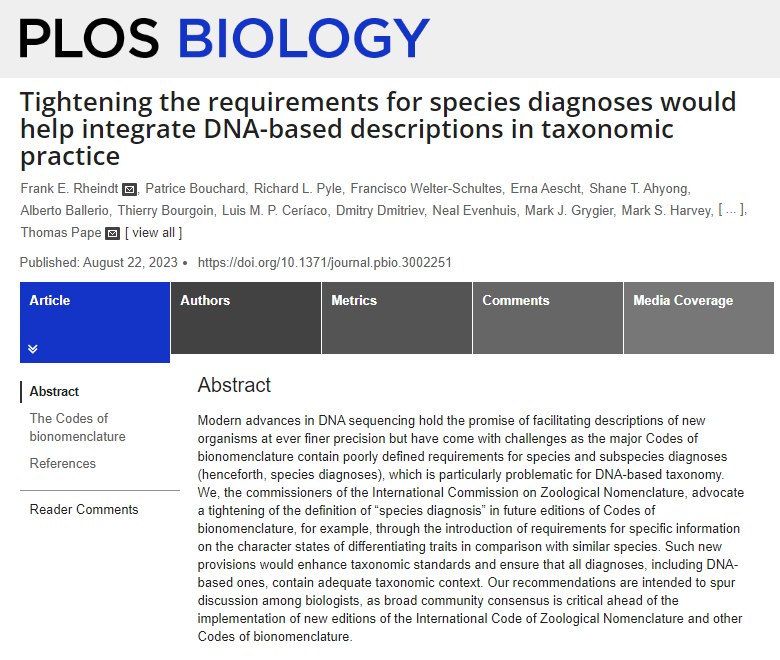
ICZN advocates tightening of “species diagnosis” in future Codes, to enhance taxonomic standards and ensure that diagnoses, incl. DNA-based ones, contain adequate taxonomic context. We hope to spur discussion, as broad community consensus is critical. doi.org/10.1371/journa…

English

The Swedish Taxonomy Initiative and ForBio are offering a three-day course on what to consider when naming and describing taxa: “Nomenclature codes in biology” (tinyurl.com/3cyu4ntk).

English

@LegoMoth Det tog tid at grave frem, men her kommer svaret:
Den oprindelige bog var på tysk:
Stümpke, H. (1957). Bau und Leben der Rhinogradentia.
--- og den vi har set må have været den engelske oversættelse:
Stümpke, H. (1967). The Snouters: Form and Life of the Rhinogrades
Dansk

@fleshflies
Hjælp, hvad hed den bog vi blev introduceret for i Uni hvor en forfatter beskriver biologi og økologi af en opfundet dyregruppe?
Jeg er rimelig sikker på det var en dansk bog.
Dansk

@LegoMoth Ha! Det tog mig mere end to måneder at finde den -- men her er den: Harald Stümpke: "The Snouters: Form and Life of the Rhinogrades" (original-version på tysk fra 1957).
Dansk

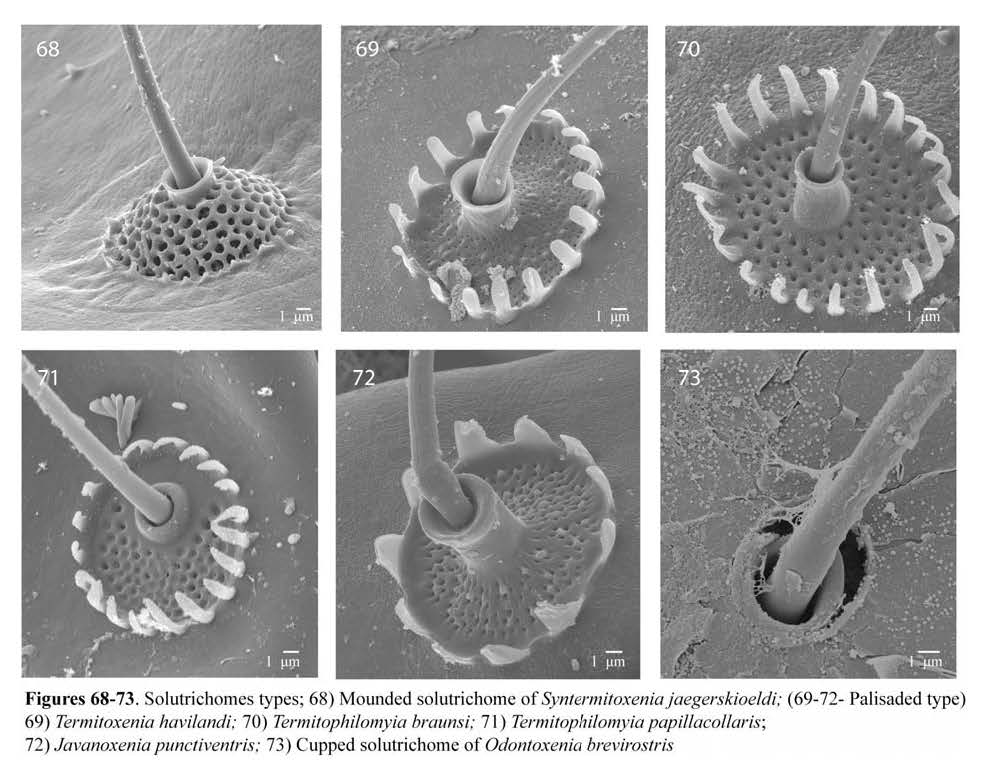
Inspired by @flygirlNHM and @NHM_Diptera, I dug out these wonderful SEM-images of specialised abdominal setae – known as solutrichomes – from physogastric females of termitoxeniine scuttle flies. Produced some 15 years ago by @LegoMoth in his MSc-thesis.

English

@DevoEvoMed Indeed, we make the rules, because rules are needed for meaningful communication. Nomenclature does not determine inclusiveness or exclusiveness or the rank of any taxon, but rules on the name that is to be used for a taxon whatever taxonomic limits and rank are given to it.
English

@DevoEvoMed This confuses nomenclature with taxonomy, which overlap in only one point: the name-bearing type. Taxonomists pursue their science; nomenclature regulates, that the name to use is decided by the type considered to be conspecific. Given two types, the oldest name is to be used.
English

@saniquest Scientific names act as the primary labels for taxa and are for that reason fundamental to biological sciences. Stability and universality in those labels promote clear and unambiguous data-sharing. That remains our top priority.
English

I understand the argument, and I disagree. Taxonomy isn’t rigid, it’s flexible when it comes to reassigning species/genera/etc. as newer information becomes available, names shouldn’t be any different.
Thomas Pape@fleshflies
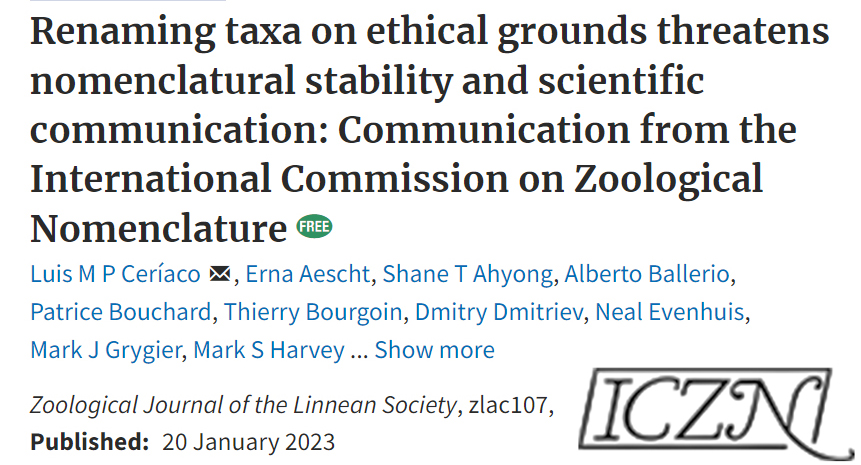
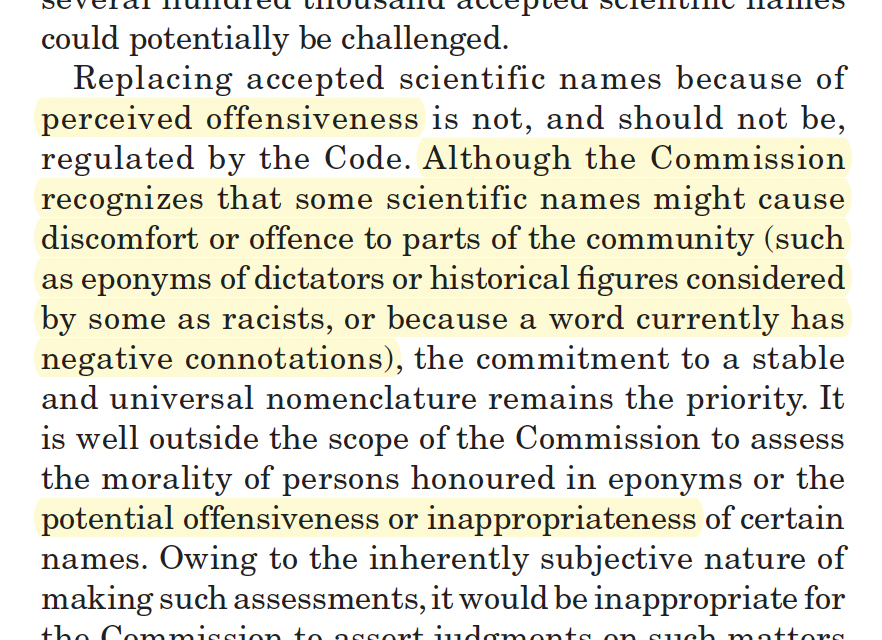
Replacing accepted scientific names because of perceived offensiveness is not, and should not be, regulated by the International Code of Zoological Nomenclature: doi.org/10.1093/zoolin…

English

@saniquest Taxonomy is science, nomenclature is legislation. Quite different disciplines, overlapping in one point: the name-bearing type specimen. Nomenclature is not inherently rigid, and nomenclatural legislation should be responsive to societal needs, but not at any price.
English

@yatachelys Whether or not a name is perceived as offensive, and whether or not a Latin adjective like "niger" evokes negative connotations, is immersed in culture and subjectivity. Such will usually differ between communities and vary over time.
English

🙋🏻♂️I just cannot put my mind around these statements...
A scientific name based on a dictator (e.g., Rochlingia hitleri) or on a word with negative connotations (e.g., Chelonoidis niger) should cause offense to the entire community not just a "part" of it.

Thomas Pape@fleshflies
Replacing accepted scientific names because of perceived offensiveness is not, and should not be, regulated by the International Code of Zoological Nomenclature: doi.org/10.1093/zoolin…
English

@irisgorgona ICZN regulates the formation and use of scientific names of animals and aims for universality without interfering with taxonomic judgments. ICZN does not assess or regulate based on ethical merits of names.
English

@fleshflies Not sure I understand what is the offensiveness here. The code needs to regulate the names otherwise the mess is unbearable.
English

Replacing accepted scientific names because of
perceived offensiveness is not, and should not be,
regulated by the International Code of Zoological Nomenclature: doi.org/10.1093/zoolin…
English
Thomas Pape retweetledi

Pass after pass, the #TETTRIsEU ball ⚽ is helping all the people from the 17 partners to get to know each other a bit better! It will be fundamental to maximize linkages and collaborations to make this #HorizonEU project working for the sake of #taxonomy!

English

Today @NiklasDreyer2 @NHM_Denmark gave very convincing reasons whY-larvae are worth studying😀

English
Thomas Pape retweetledi

Our lambs have sheep keds (Melophagus ovinus, #Hippoboscidae). That's probably not something I should brag about. But I know that some dipterologists would be happy to encounter this species alive and in action.
@fleshflies @DipteristsForum @LeivurJanus

English

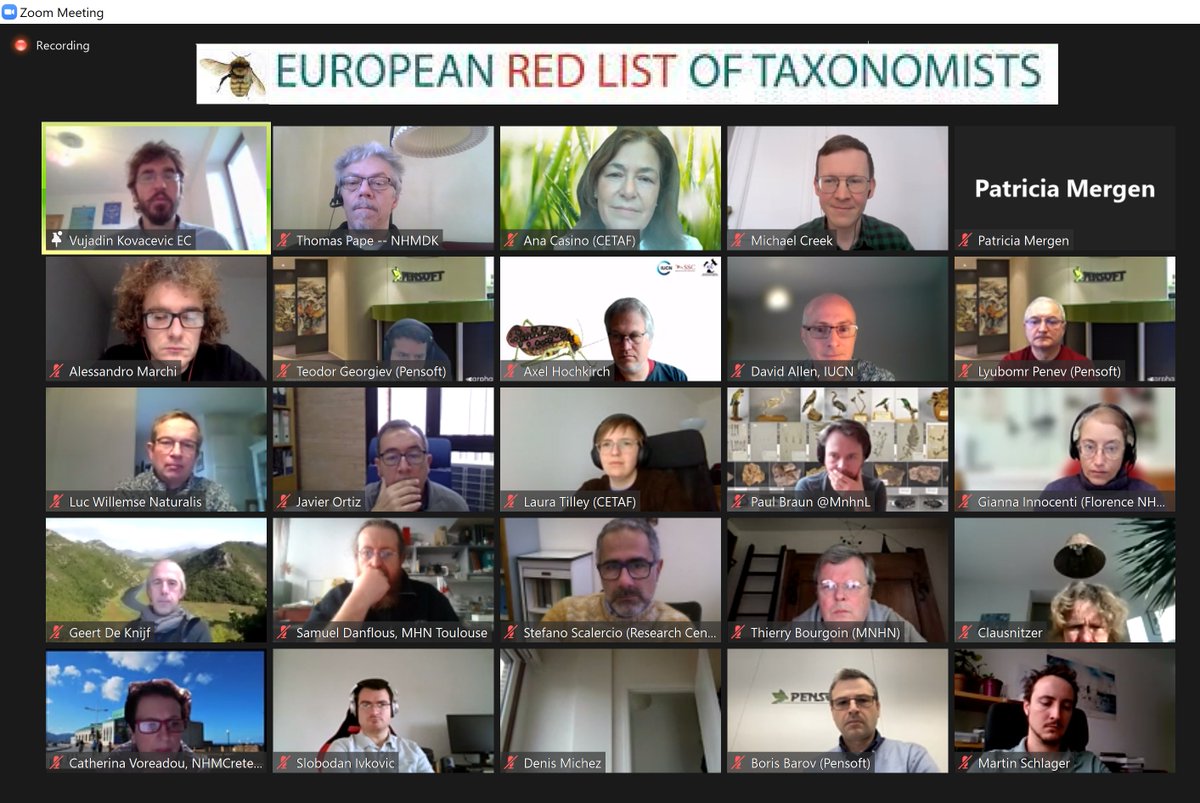
Insects are in decline due to increasing threats, but also those studying insects are declining. We are right now discussing status, trends, and supporting actions for the taxonomic expertise in Europe #RedListTaxonomists

English

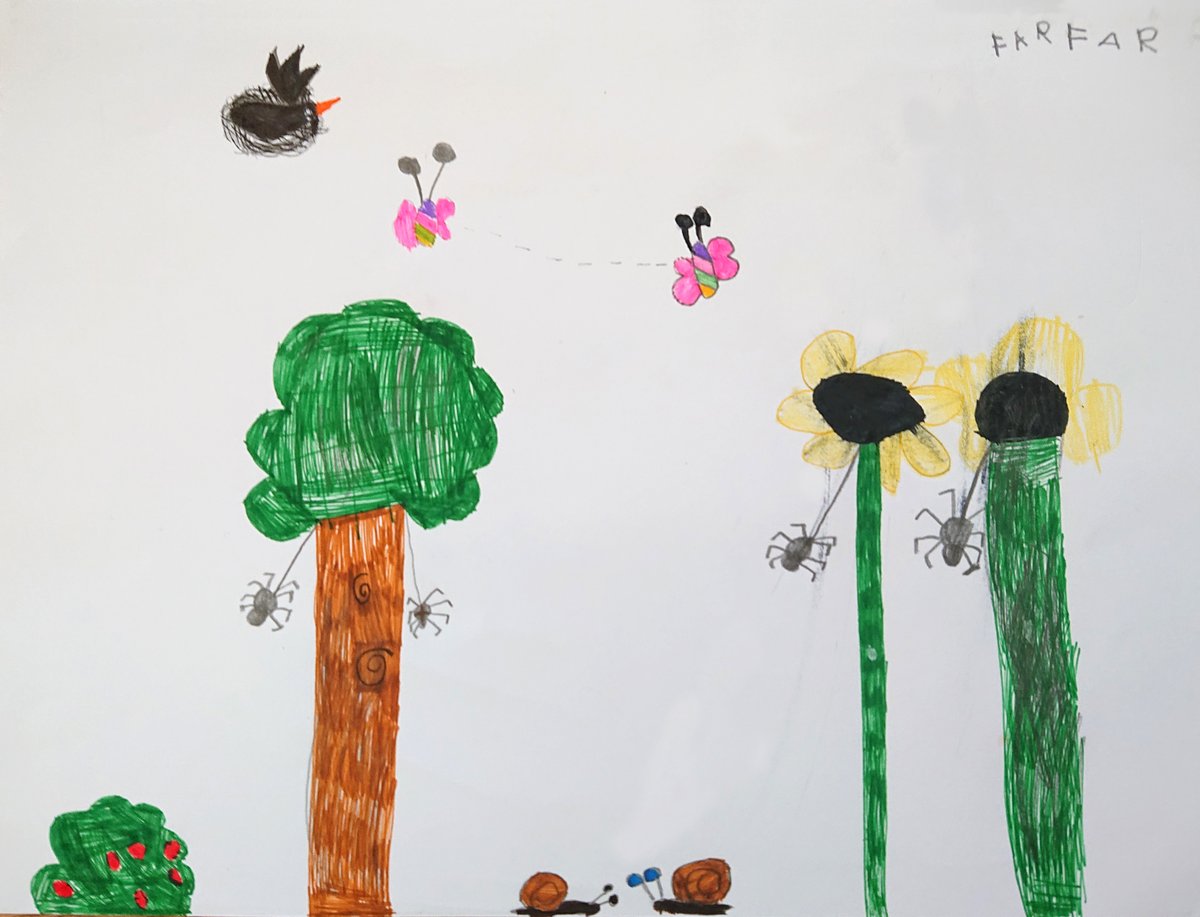
Thank you, #EOWilson, for the Biophilia Hypothesis and much, much more. This drawing by my six-year-old granddaughter is evidence of our innate fascination for nature – and gives a bit of hope for her future.

English