Francesc Llobet
3K posts

Francesc Llobet
@fll_cat
Entrepreneur, professor & mentor. Crypto economy and AI for Business. Personal opinions. RT not endorse. From Catalonia. Volar i ser lliures. President @sijcat

Revolut yields to the pressure; it makes Catalan the default language on its ATMs in Catalonia for its 1.2 million local customers. Revolut has informed the media that Catalan is now the default language on its cash machines (ATMs) across Catalonia. The change affects all 57 Revolut ATMs currently operating in the region. Revolut, which has more than 1.2 million clients in Catalonia, will also incorporate Catalan into its website and mobile app during the first half of 2027. Revolut faced years of public pressure on social media from Catalan users and language organisations. I followed this with interest, and the action culminated in a celebration for supporters when Revolut posted a job ad seeking a Catalan-language translator. Good win for the local culture, but not easy for Revolut. Every language pack and every local feature added to the Revolut app is present on every user's app. For example, Lithuanian Revolut customers will have the Catalan language pack in the app, and Catalans now have Lithuanian mortgage application and management features, but these features aren't accessible. Another thing worth mentioning is that for the first time, Revolut has released customer numbers for the region of Catalonia. Based on a simple calculation, Catalonia has a Revolut customer penetration rate of 14.62%. That is higher than Spain's total, at 13%. Catalonia could be the region that has the highest penetration in Spain. Image: @llenguacatalana #Catalan #Catalonia

🇮🇷 Iran is charging $2M per ship to cross the Strait of Hormuz and they want it in Bitcoin. 😳 At $72,000 per $BTC, each ship = 27.7 BTC. Pre-crisis, 130 ships crossed daily. • Daily: 3,611 BTC • Monthly: 108,333 BTC • Yearly: 1.3 million BTC The entire Bitcoin network only mines 450 BTC per day. Iran would accumulate 8x the monthly mining supply. Every month. A sanctioned nation building a Bitcoin treasury through a toll booth. This is the most important geopolitical Bitcoin story nobody is talking about. 🔥


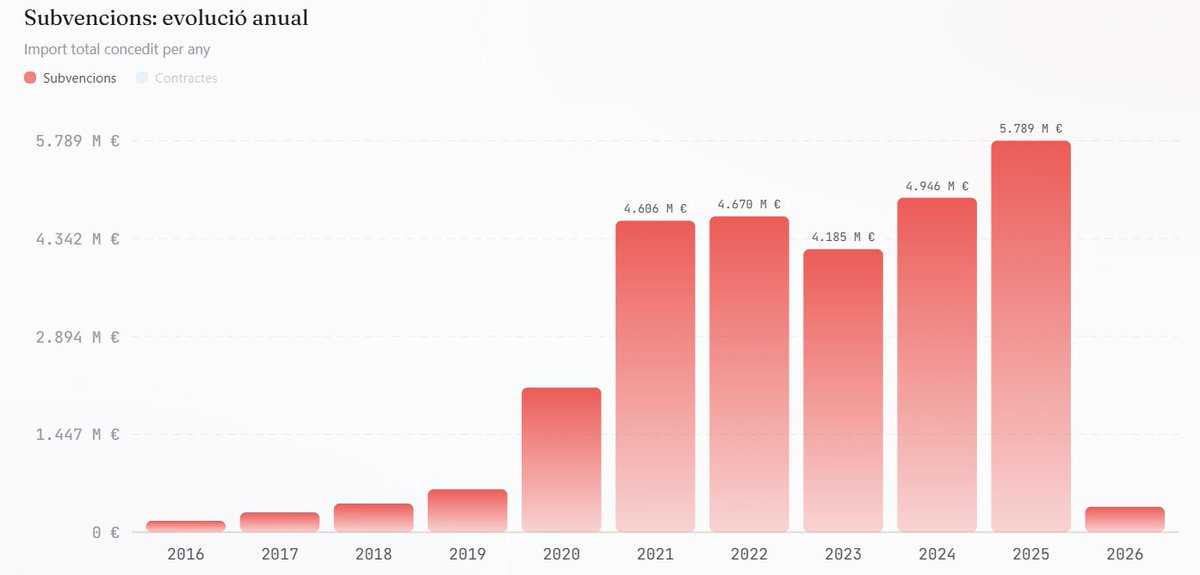
Ara resulta que: - La Generalitat fa pública una base de dades - Un tercer (subvencions.cat) crea una web per què tothom pugui accedir a la dita base de dades de forma fàcil - La web té èxit, en tant que permet accedir a informació rellevant, fins llavors, no accessible - La Generalitat se n'adona que perd el control de la narrativa (5,000M€en subvencions!). Talla l'accés a la base de dades i n'elimina 1 milió de registres - Es genera polèmica: La Generalitat limita l'accés a dades públiques - En un alarde de periodisme d'investigació, TV3 diu que les dites webs són vehicles de l'extrema dreta - Es genera encara més polèmica: Fiscalitzar, auditar és extrema dreta? Sembla que la Unió Europea no pensa el mateix - Com es resol? Doncs de nou la Generalitat es val de TV3 per anunciar que la base de dades tenia informació privada, i de forma vetllada s'amenaça amb accions legals, no contra la pròpia Generalitat per publicar info privada de forma negligent, sino contra qui ha fet una simple web (interface) d'accés ... és tot tan inacceptable. 2 coses que podeu tenir clares: 1) D'extrema dreta res. La pròpia Europea propugna i promou l'Open Data. Fiscalitzar i auditar és la base d'una democràcia sana. 2) Qui publica i dóna accés a les dades és el responsable últim de garantir que no es vulnera la privacitat de ningú (en terminologia legal, és qui fa el tractament de les dades). Ho diu la legislació europea i ho diu el RGPD. L'intermediari ni tracta, ni reorganitza, ni amplifica les dades; només publica. Amenaçar-lo, intimidar-lo amb accions legals, com s'està insinuant, és francament anti-democràtic...


I was one of the early users of the Internet back in 1993, I've been part of 3 tech companies that exited, and helped another 4 achieve exits. I've personally seen close to 1000 different technology ideas pitched over a 20 year period. But nothing, including the Internet comes remotely close to Bitcoin and Bitcoin mining, which are by some distance the most innovative and promising technologies for humanity in the last 100 years. Nothing else comes remotely close. Bitcoin mining is incentivizing renewable energy, mitigating methane, stabilizing grids, obviating gas peaker plants around the world at a pace that almost no other climate technologies have been able to replicate even across one sector source: x.com/DSBatten/statu… Bitcoin's usecases are not simply about more efficiency convenience or faster commerce, but existential need: it is already helping 100s of millions of people around the world who before bitcoin were stuck with high inflation and hyperinflation, unbanked, or lived in autocratic regimes source: x.com/DSBatten/statu… Bitcoin is also the first technology I've ever seen that helps the Global South first, the West second (which is why so many in the West don't see it's utility: ie, a lack of empathy and imagination on the part of the evaluator, not a lack of value in Bitcoin) It's the most inspirational technology I've seen in 20 years of technology investment by some distance across a range of social and environmental metrics. But, as with all other disruptive technologies, you'll unthinkingly retort things that make you look stupid in years to come if your source of information on Bitcoin is either : a. the media (who have a 100% perfect track-record of dismissing every disruptive technology since the Telegraph) b. other people who have also not used or researched Bitcoin (of which a. above is a subset) The predominant media narratives on Bitcoin typically have only one common denominator: stupidity. As soon as one stupid narrative fails ("will use all the world's energy", a new stupid narrative like "uses a swimming pool of water" is already in the queue to replace it. Once that is debunked, another stupid narrative will replace that. The narratives are never true, but they are funny, and they do fool people tend to have poor filters for information quality. Would you have been one of the laggards who trusted the opinions of others about the Internet who had never used it, or would you have talked to people who used it and then tried it yourself? Rather than digesting new flavors of stupid from the media and others who have never used Bitcoin, you could try this crazy wacky idea: listen to the opinions of people who have used actually Bitcoin and know something about it. Paul Krugman saying "The Internet will be no more valuable than the fax machine" in 2005 was a statement about the value of his opinion, not the value of the Internet Similarly, the opinions of those who have never studied, never used, or have a vested interest in opposing Bitcoin are a statement about the value of their opinions, not the value of Bitcoin. Onwards!


Today is my last day at Anthropic. I resigned. Here is the letter I shared with my colleagues, explaining my decision.