@flowshed60809@Dexerto I have a dozen stories of how they screwed me to your one shady claim. So, no, they don't really care. You're either lying or a one-in-a-million outlier that they don't deserve credit for.
A dad was given a free replacement Steam Deck case by Valve after his baby threw up on the original case
He said they have a "customer for life" after he contacted support to ask about buying a replacement
@ISapphired@overtintrospect@Zoroarts@Steam@ISapphired sadly you blocked me. But you perfectly descriped Paddle Paddle Paddle in your last comment: "buggy, graphically ugly, barebones version". This "Game" is nothing more than this 😅
@ISapphired@overtintrospect@Zoroarts@Steam Sorry to say this, but Paddle Paddle Paddle ist literally what it is called a prototype in the Game Development. Did you played it?
Also, it is easy to add more Levels to increase the playtime.
This should not be possible @Steam
Would be cool if you could finally do something about your refund policy... Got dozens of reviews like that and 21% refund rate even though the Reviews are 90% very positive...
Thats over 55,000 Refunds btw...
@Zoroarts@Steam Bro, it seems like you made more than half a million euros from that game. It's a short game that's not really worth replaying. Instead of complaining to Steam and your customers, get your act together and add more levels and features. You have a lot money and time.
@DNA_Doesnt_Lie@Dexerto Not really. My Steam Controller was delayed by one week, and they gifted me an fullprice title I was able to choose as apologize. They really care, and thats the difference.
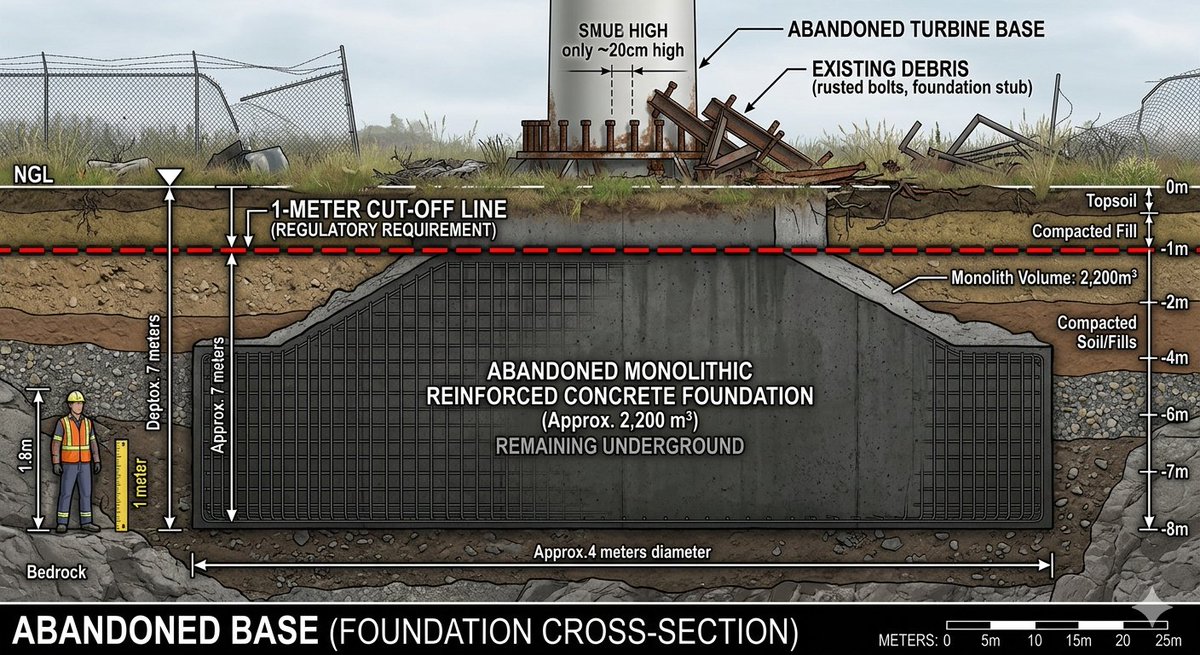
Tens of thousands of slabs of reinforced concrete weighing up to 1,000 tonnes are being abandoned in the ground as turbines hit the end of their working lives.
The reinforced concrete base of a typical 2-3 MW wind turbine can weigh anywhere from 400 to 800 tonnes. But the concrete foundations of even bigger turbines (5 MW+) can exceed 1,000 tonnes. As lifespans end these massive concrete monoliths are abandoned where they lie. This is an issue of significant contention.
In many jurisdictions, including Australia and the US, decommissioning regulations only require the operator to ensure the concrete foundation stays at a depth of 1 meter (approx. 3.3 feet) below the surface.
The remaining 3-plus metres of these steel-reinforced concrete fossils are typically left in the ground indefinitely. Over the decades, they can interfere with deep-soil hydrology or remain as a permanent industrial remnant in rural landscapes.
Contracts usually say operators are responsible for decommissioning. But the financial reality is complex. Bank guarantees or bonds set aside for removal (around €50,000 or $100,000 per turbine) are frequently far too low. Real-world estimates for total removal and site restoration can exceed $200,000 to $400,000 per unit.
If the cost of total removal ($200k–$400k) exceeds the bond set aside by the operator ($50k–$100k), there is a strong financial incentive for companies to declare bankruptcy . Or they sell the asset to a shell company as the turbine nears its end-of-life, leaving a landowner with the bill.
While the steel towers are more easily recyclable, their triple fibreglass blades are notoriously difficult to process and often end up in turbines blade graveyards.
The theoretical benefits from renewable technology are meaningless compared with the staggering environmental costs.
@PeterDClack More cheap anti-wind propaganda using half-truths. Decommissioning is strictly regulated. Fully digging up foundations would damage the soil further; deep concrete stays inert. Against bankruptcies, operators are legally forced to provide financial bonds. #FactCheck