Samatalis Haille, MA LPCC

17.4K posts

Samatalis Haille, MA LPCC banner
Samatalis Haille, MA LPCC

Samatalis Haille, MA LPCC

@foritssake

Researcher, speaker, & writer of Somalia’s security, clan politics, ideologies, Also practicing Licensed professional clinical counselor in MN.


Minneapolis and Mogadishu Katılım Eylül 2010
560 Takip Edilen4.4K Takipçiler
Sabitlenmiş Tweet
Samatalis Haille, MA LPCC
Samatalis Haille, MA LPCC@foritssake·
Deedimayno Geerida, mana ogolin Gumaysi. We do not refuse death, and we do not accept colonialism. War songs as members of the army leave Mogadishu to frontlines.
English
10
21
136
30K
Samatalis Haille, MA LPCC
1656 Rest, Running, and the Problem of Behavioral Inertia Liban was not fully remaining in the present moment, which was quite different from what had occurred the previous day. Much of his attention had been absorbed by the practical difficulty of trying to put the children to sleep, a task he was unable to complete successfully. Alongside this, he carried out household chores, which meant that his attention was dispersed between duty, fatigue, and the desire to regain inner composure. During the final two hours, however, Liban deliberately attempted to return to the present moment through relaxation practices. What he began to notice was that relaxation may not function best as an isolated practice. Progressive muscle relaxation, for example, has empirical support as a method for reducing stress, anxiety, and depressive symptoms, and its effects may be stronger when combined with other interventions.[nih] This led Liban to consider whether progressive muscle relaxation needed to be combined with running or some other form of bodily activation. The thought was not simply that running “fixes” restlessness, but that movement may create a psychological and physiological transition that makes rest more available. Physical activity has been associated with lower risk of depression, even at levels below standard public health recommendations.[nih] There was also a behavioral logic to this observation. When Liban runs and feels better afterward, he becomes more inclined to run again. When he works and feels productive, he becomes more inclined to continue working. The same logic may apply to rest: once he rests and feels slightly better, he may become more inclined to keep resting. This pattern resembles the idea of behavioral momentum. Behavioral momentum theory explains how behavior can become more resistant to change when it occurs in contexts with a history of reinforcement. In Liban’s case, rest may not only be recovery; it may also become a behavioral state with its own inertia.[nih] The question, then, is whether Liban is genuinely tired or whether the act of resting begins to pull him further into rest. He is not especially inclined toward the explanation that he simply needs more rest. Rather, he suspects that inertia may be at work: the more he rests, the more rest invites itself to continue. This does not mean rest is bad. It means rest, like work and exercise, may have momentum. The body does not merely obey intention; it often follows the direction in which it has already begun moving. For Liban, the practical insight is that presence may require sequencing. Relaxation may need to be preceded by movement. Running may help interrupt lethargic inertia, while progressive muscle relaxation may then help the body settle into a calmer state. The aim is not to choose between activation and rest, but to understand how each prepares the other. References Khir, S. M., Wan Mohd Yunus, W. M. A., Mahmud, N., Wang, R., Panatik, S. A., Mohd Sukor, M. S., & Nordin, N. A. (2024). Efficacy of progressive muscle relaxation in adults for stress, anxiety, and depression: A systematic review. Psychology Research and Behavior Management, 17, 345–365. doi.org/10.2147/PRBM.S…] Nevin, J. A., & Shahan, T. A. (2011). Behavioral momentum theory: Equations and applications. Journal of Applied Behavior Analysis, 44(4), 877–895. doi.org/10.1901/jaba.2…] Pearce, M., Garcia, L., Abbas, A., Strain, T., Schuch, F. B., Golubic, R., Kelly, P., Khan, S., Utukuri, M., Laird, Y., Mok, A., Smith, A., Tainio, M., Brage, S., & Woodcock, J. (2022). Association between physical activity and risk of depression: A systematic review and meta-analysis. JAMA Psychiatry, 79(6), 550–559. doi.org/10.1001/jamaps…]
English
0
0
0
28
Samatalis Haille, MA LPCC
1449 How Liban Learned to Prepare His Mind for Work One of Liban’s most important realizations is that productivity is not only a matter of discipline or willpower. It is also a matter of physiological and emotional preparation. He has noticed that when he feels tired, bored, mentally foggy, or unable to begin work, high-intensity running can shift him into a more positive mood that is conducive to work. After running, the tiredness often disappears. The boredom becomes less powerful. The sense of being unable to supervise, train, think, or complete tasks begins to lift. In its place, Liban experiences greater clarity, energy, and readiness to do what needs to be done. This is consistent with research showing that acute exercise can improve mood, reduce fatigue, and influence cognitive functioning through neurophysiological and neurochemical pathways (Basso & Suzuki, 2016). Exercise does not merely strengthen the body; it can also help organize the mind. Liban has also learned that running is only one part of a broader self-regulation system. Rest, naps, progressive muscle relaxation, breathing techniques, and meditation can also help him move from internal resistance into a state of calm readiness. Research supports the use of slow breathing and progressive muscle relaxation for reducing stress, physiological arousal, and anxiety (Pathan et al., 2023). This realization is profound because Liban is learning to intentionally oscillate between activation and recovery. When he needs energy, he may use running, exercise, movement, or coffee. When he needs calm, he may use rest, breathing, meditation, or progressive muscle relaxation. When he needs long-term stability, he must also attend to sleep, hydration, fruits, vegetables, and general nutrition. In other words, Liban is learning that work readiness can be prepared. He does not always have to force himself to work from a state of depletion. Instead, he can first create the conditions that make work possible. This is especially important when the work requires patience, supervision, teaching, emotional regulation, and clear thinking. Tasks such as supervising and training children require more than physical presence. They require attention, emotional steadiness, and cognitive flexibility. Liban’s insight is that the body can become an entry point into the mind. By changing his physical state, he can change his emotional state. By changing his emotional state, he can improve his ability to think, organize, supervise, and act. This does not mean that exercise, rest, or relaxation will solve every problem. But it does mean that Liban now has tools. He can observe his internal state, intervene early, and prepare himself for meaningful work. That is the deeper lesson: productivity begins before the task. It begins with preparing the person who must do the task. References Basso, J. C., & Suzuki, W. A. (2016). The effects of acute exercise on mood, cognition, neurophysiology, and neurochemical pathways: A review. Brain Plasticity. Pathan, F. K. M., Pandian, J. S., Shaikh, A., Ahsan, M., Nuhmani, S., Iqbal, A., & Alghadir, A. (2023). Effect of slow breathing exercise and progressive muscle relaxation technique in the individual with essential hypertension: A randomized controlled trial. Medicine. Pellicer-Caller, R., Vaquero-Cristóbal, R., González-Gálvez, N., Abenza-Cano, L., Horcajo, J., & de la Vega-Marcos, R. (2023). Influence of exogenous factors related to nutritional and hydration strategies and environmental conditions on fatigue in endurance sports: A systematic review with meta-analysis. Nutrients. Kaliyaperumal, D., Elango, Y., Alagesan, M., & Santhanakrishanan, I. (2017). Effects of sleep deprivation on the cognitive performance of nurses working in shift. Journal of Clinical and Diagnostic Research.
English
1
0
0
70
Samatalis Haille, MA LPCC retweetledi
SONNA
SONNA@SONNALIVE·
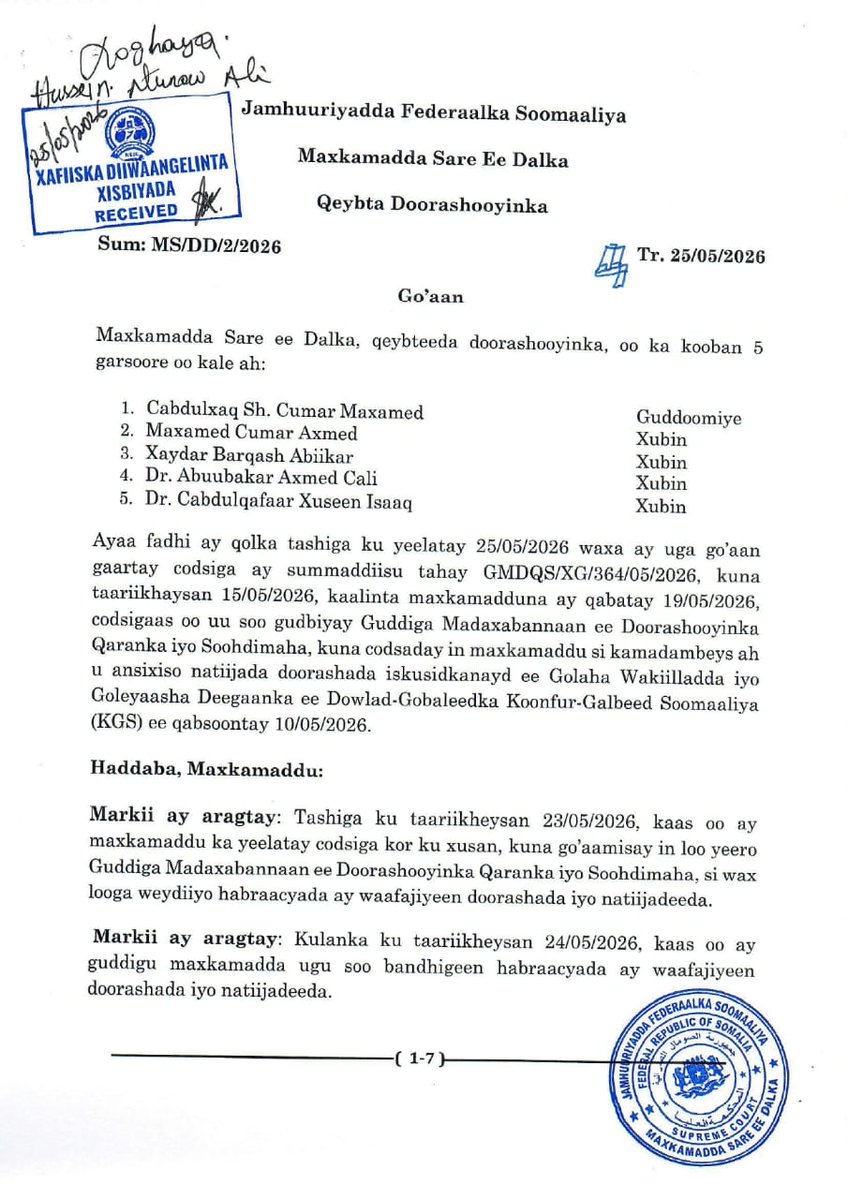
The Supreme Court of Somalia has officially ratified the final results of the South West State local council and legislative elections. Following a formal submission and verification process by the @NIEBCSomalia the apex court cleared the outcomes, establishing full legal legitimacy for the newly elected regional administration. #Somalia #Mogadishu #Baidoa #SouthWestState #NIEBC #RuleOfLaw #SONNA
SONNA tweet mediaSONNA tweet mediaSONNA tweet mediaSONNA tweet media
English
0
7
24
2.3K
Samatalis Haille, MA LPCC
What is truly troubling is a regional leader visiting a country seen as dividing Somalia. I guess that does not sit well with the opposition and its allies. It is best that we keep that quiet, lest we be accused of treason.
Hodan Ali@hodansomali

The turkish spy works for @TheVillaSomalia. He’s fed/paid by a Somali jaajuus Minister. It’s not rocket science that be has info/intel to support Turkish interests.

English
0
0
6
531
Samatalis Haille, MA LPCC
Umut appears to have a stronger understanding of developments in Puntland than some X resident analysts. The evidence is presented below. The Turkish analyst was aware that President Deni had traveled to Ethiopia and the United Arab Emirates, while many others appeared unaware of this development. Local sources had already been reporting the same information. It appears Deni is consulting with UAE on way forward on matters of mutual interest, elections, Somaliland recognition, and relevant strategies.
Samatalis Haille, MA LPCC tweet mediaSamatalis Haille, MA LPCC tweet media
Umut Çağrı Sarı@umutcagrisariii

Said Deni, the President of Somalia's autonomous Puntland region, traveled to Dubai yesterday afternoon. Deni went to Dubai to meet with UAE and Israeli intelligence officials. The purpose of this meeting is to instigate chaos within Somalia and provide direct support for the country's fragmentation. Deni is conducting these high-level meetings to secure further bribes and financial backing from the UAE and Israel, aiming to systematically escalate the ongoing destabilization in Somalia.

English
6
5
15
11.3K
Samatalis Haille, MA LPCC
Your question was not specific enough. Also, consider the circumstantial evidence: •UAE-based analysts, and even some lawmakers, discuss dividing Somalia before Somalis themselves have agreed on separation. •The regional president insists on indirect elections, opposes direct elections agreed by all parties, according to Mowlid Haji Abdi, a reliable source. •People who oppose Somaliland support in Garowe have reportedly been arrested. •Given these points, is it not reasonable to believe that he may meet with Israeli and UAE officials to discuss these matters and advance shared interests in these areas? Is he not consulting with his allies who are dividing the country •Umut appeared to be referring to issues that are already known to many people.
English
0
1
6
344
Samatalis Haille, MA LPCC
Your question was not specific enough. Also, consider the circumstantial evidence: •UAE-based analysts, and even some lawmakers, discuss dividing Somalia before Somalis themselves have agreed on separation. •The regional president insists on indirect elections, opposes direct elections agreed by all parties, according to Mowlid Haji Abdi, a reliable source. •People who oppose Somaliland support in Garowe have reportedly been arrested. •Given these points, is it not reasonable to believe that he may meet with Israeli and UAE officials to discuss these matters and advance shared interests in these areas? Is he not consulting with his allies who are dividing the country •Umut appeared to be referring to issues that are already known to many people.
English
2
0
0
178
Ali dafar
Ali dafar@Alidafarr·
@foritssake Try to understand the question. @PhiloSomalia asked the Turkish kebeb boy how he knows that Deni traveled to the UAE to meet Israel intelligence officers. Turkey is good and the UAE is bad doesn’t make sense. Former President Hassan travels to Turkey so what’s the difference.
English
2
0
3
248
Samatalis Haille, MA LPCC
Your question was not specific enough. Also, consider the circumstantial evidence: •UAE-based analysts, and even some lawmakers, discuss dividing Somalia before Somalis themselves have agreed on separation. •The regional president insists on indirect elections, opposes direct elections agreed by all parties, according to Mowlid Haji Abdi, a reliable source. •People who oppose Somaliland support in Garowe have reportedly been arrested. •Given these points, is it not reasonable to believe that he may meet with Israeli and UAE officials to discuss these matters and advance shared interests in these areas? Is he not consulting with his allies who are dividing the country •Umut appeared to be referring to issues that are already known to many people.
‏Abdrhmn Sāmāwādē@PhiloSomalia

This is a prime definition of cherry picking, quote mining, selective reporting, and confirmation bias all in one. With a little bit of research on X, you can see that Umut was not the first to report about the alleged trip. However, he was the first one to add additional details to the story. I asked him how he knew about his reporting because he accused the president of something unknown to me. Check out the timestamps below. 👇

English
1
0
1
536
Samatalis Haille, MA LPCC
058 Liban keeps logging in the last minute. He will refocus this holiday on various issues
English
0
0
0
35
Samatalis Haille, MA LPCC
Maintaining Sleep Discipline During Scheduled Days Off Liban recognized that Memorial Day was a scheduled day off, which may have contributed to a disruption in his usual nighttime routine. The previous night, he remained engaged with a social media program until approximately 12:40 a.m. While listening to the program, he eventually fell asleep and obtained approximately six hours of sleep. Although Liban appeared to have received a reasonable amount of rest, the situation was still unfortunate because the late-night media engagement interfered with his intended sleep schedule. From a reflective standpoint, Liban may need to develop clearer strategies to prevent similar situations in the future, including setting firm limits on nighttime social media involvement, establishing a consistent bedtime routine, and ensuring that leisure or online activities do not compromise his rest and daily functioning.
English
3
0
0
97
Samatalis Haille, MA LPCC
Title: Recognizing the Limits of Argument in Politically Motivated Discourse One important lesson Liban learned from the previous day was the need to avoid extended argumentation with salaried representatives or committed defenders of the Somali political class. In his observation, some individuals who participate in social media programs on behalf of political actors are not necessarily entering the discussion for the purpose of open inquiry, logical reasoning, or factual analysis. Rather, they may be operating from a predetermined script designed to defend a political position, promote a particular cause, or protect an existing narrative. Liban came to recognize that arguing with such individuals can become unproductive because the discussion is not always governed by the standards of evidence, reason, or mutual examination. Instead, the person may already be committed to a conclusion before the exchange begins. In such cases, even strong logical arguments or factual corrections may have little effect, because the aim of the discussion is not truth-seeking but narrative defense. This realization marked a departure from Liban’s earlier assumption that political disagreement could be resolved through clearer reasoning, better evidence, or more careful analysis. He observed that some participants are not primarily interested in evaluating whether an argument is sound. Rather, they are committed to advancing their own position regardless of the strength of opposing evidence. This lesson is supported by the concept of motivated reasoning. Psychologist Ziva Kunda argued that people often process information in ways that help them reach conclusions they prefer, rather than conclusions required by neutral evidence. This framework helps explain why political discussions can become resistant to logic: when identity, loyalty, or political interest is involved, individuals may selectively accept evidence that supports their position while dismissing evidence that challenges it.[apa]. Therefore, Liban’s conclusion was that he must become more selective about when and with whom he engages in political debate. Rather than investing time in discussions with individuals committed to scripted political defense, he may benefit from reserving his attention for spaces where participants demonstrate intellectual honesty, willingness to question assumptions, and openness to factual analysis.
English
0
0
0
25
Samatalis Haille, MA LPCC
0704 Protecting Evening Discipline and Cognitive Performance Liban spent a significant portion of the previous day engaged in restorative and performance-supporting activities, including running, resting, meditation, breathing exercises, and other forms of self-regulation. Up until approximately 7:00 p.m., his conduct reflected a productive alignment with the principles of health, focus, and intentional recovery. However, between approximately 7:00 p.m. and 1:00 a.m., Liban departed from this constructive pattern by becoming absorbed in extended social media discussions. These discussions included topics such as the status of the Somaliland embassy in Jerusalem and the elections in Somalia. Although these subjects may have intellectual and political relevance, the format of the conversations appeared largely unproductive. Participants often spoke at length, sometimes for 10 to 15 minutes, while meaningful questioning, careful analysis, and strong evidence-based arguments were not consistently presented. This episode represented a clear departure from what Liban had recently observed and learned about performance, rest, and higher productivity. Rather than preserving his evening for recovery, reflection, or other personally important responsibilities, he redirected several hours toward conversations that did not appear to produce significant practical benefit. In this sense, the issue was not merely the use of social media itself, but the loss of intentional control over time, attention, and priority. From an academic perspective, this pattern may be understood through Cal Newport’s concept of deep work and attention management. Newport argues that cognitively valuable work requires distraction-free concentration, while frequent engagement with social media and reactive digital environments can weaken sustained attention and reduce productive focus. This framework supports the conclusion that Liban’s evening social media engagement conflicted with his broader goal of improving rest, discipline, and high-level performance.[calnewport] Accordingly, Liban may need to establish a firm evening boundary to prevent similar incidents in the future. One practical strategy would be to designate the period from approximately 6:00 p.m. until 6:00 a.m. as a social media-free period. By removing access during these hours, he would reduce the likelihood of accidental over-engagement and protect the conditions necessary for rest, reflection, and sustained productivity.
English
0
0
0
23