

Frank Wan
67 posts
Frank Wan
@frankwan
Finance @Gensynai | Prev @Offchain / @arbitrum, PE/IB
Katılım Ekim 2013
676 Takip Edilen282 Takipçiler
Frank Wan retweetledi

Assets added to the roadmap today: Gensyn (AI)
coinbase.com/blog/increasin…
English
Frank Wan retweetledi

Frank Wan retweetledi

the biggest bottleneck to AI scaling isn’t compute any more, it’s information
few understand
English
Everyone thinks AI will permanently reduce hiring. What’s actually happening:
AI is increasing productivity before companies know how to reorganize around it
So layoffs are the rational move today
But once orgs redesign for AI-native workflows, we’ll likely see a mass hiring wave in 2–3 years.
unusual_whales@unusual_whales
BREAKING: Meta, $META, is planning sweeping layoffs that could affect 20% or more of the company, per Reuters
English
Block increased its share buyback program by $5B in Nov 2025.
A strategic capital allocation shift ahead of a larger reset...
If other big tech names start expanding buybacks, pay attention. 🧐
jack@jack
we're making @blocks smaller today. here's my note to the company. #### today we're making one of the hardest decisions in the history of our company: we're reducing our organization by nearly half, from over 10,000 people to just under 6,000. that means over 4,000 of you are being asked to leave or entering into consultation. i'll be straight about what's happening, why, and what it means for everyone. first off, if you're one of the people affected, you'll receive your salary for 20 weeks + 1 week per year of tenure, equity vested through the end of may, 6 months of health care, your corporate devices, and $5,000 to put toward whatever you need to help you in this transition (if you’re outside the U.S. you’ll receive similar support but exact details are going to vary based on local requirements). i want you to know that before anything else. everyone will be notified today, whether you're being asked to leave, entering consultation, or asked to stay. we're not making this decision because we're in trouble. our business is strong. gross profit continues to grow, we continue to serve more and more customers, and profitability is improving. but something has changed. we're already seeing that the intelligence tools we’re creating and using, paired with smaller and flatter teams, are enabling a new way of working which fundamentally changes what it means to build and run a company. and that's accelerating rapidly. i had two options: cut gradually over months or years as this shift plays out, or be honest about where we are and act on it now. i chose the latter. repeated rounds of cuts are destructive to morale, to focus, and to the trust that customers and shareholders place in our ability to lead. i'd rather take a hard, clear action now and build from a position we believe in than manage a slow reduction of people toward the same outcome. a smaller company also gives us the space to grow our business the right way, on our own terms, instead of constantly reacting to market pressures. a decision at this scale carries risk. but so does standing still. we've done a full review to determine the roles and people we require to reliably grow the business from here, and we've pressure-tested those decisions from multiple angles. i accept that we may have gotten some of them wrong, and we've built in flexibility to account for that, and do the right thing for our customers. we're not going to just disappear people from slack and email and pretend they were never here. communication channels will stay open through thursday evening (pacific) so everyone can say goodbye properly, and share whatever you wish. i'll also be hosting a live video session to thank everyone at 3:35pm pacific. i know doing it this way might feel awkward. i'd rather it feel awkward and human than efficient and cold. to those of you leaving…i’m grateful for you, and i’m sorry to put you through this. you built what this company is today. that's a fact that i'll honor forever. this decision is not a reflection of what you contributed. you will be a great contributor to any organization going forward. to those staying…i made this decision, and i'll own it. what i'm asking of you is to build with me. we're going to build this company with intelligence at the core of everything we do. how we work, how we create, how we serve our customers. our customers will feel this shift too, and we're going to help them navigate it: towards a future where they can build their own features directly, composed of our capabilities and served through our interfaces. that's what i'm focused on now. expect a note from me tomorrow. jack
English

Browser Company acquisition by Atlassian for $600M in cash was well timed!
Who else is in the market timing hall of fame? Afterpay/Square (acquired for $29B when Square was worth $130B, now worth $31B)
Divvy/Bill (acquired for $2.5B when Bill was worth $15B, now worth $4B)
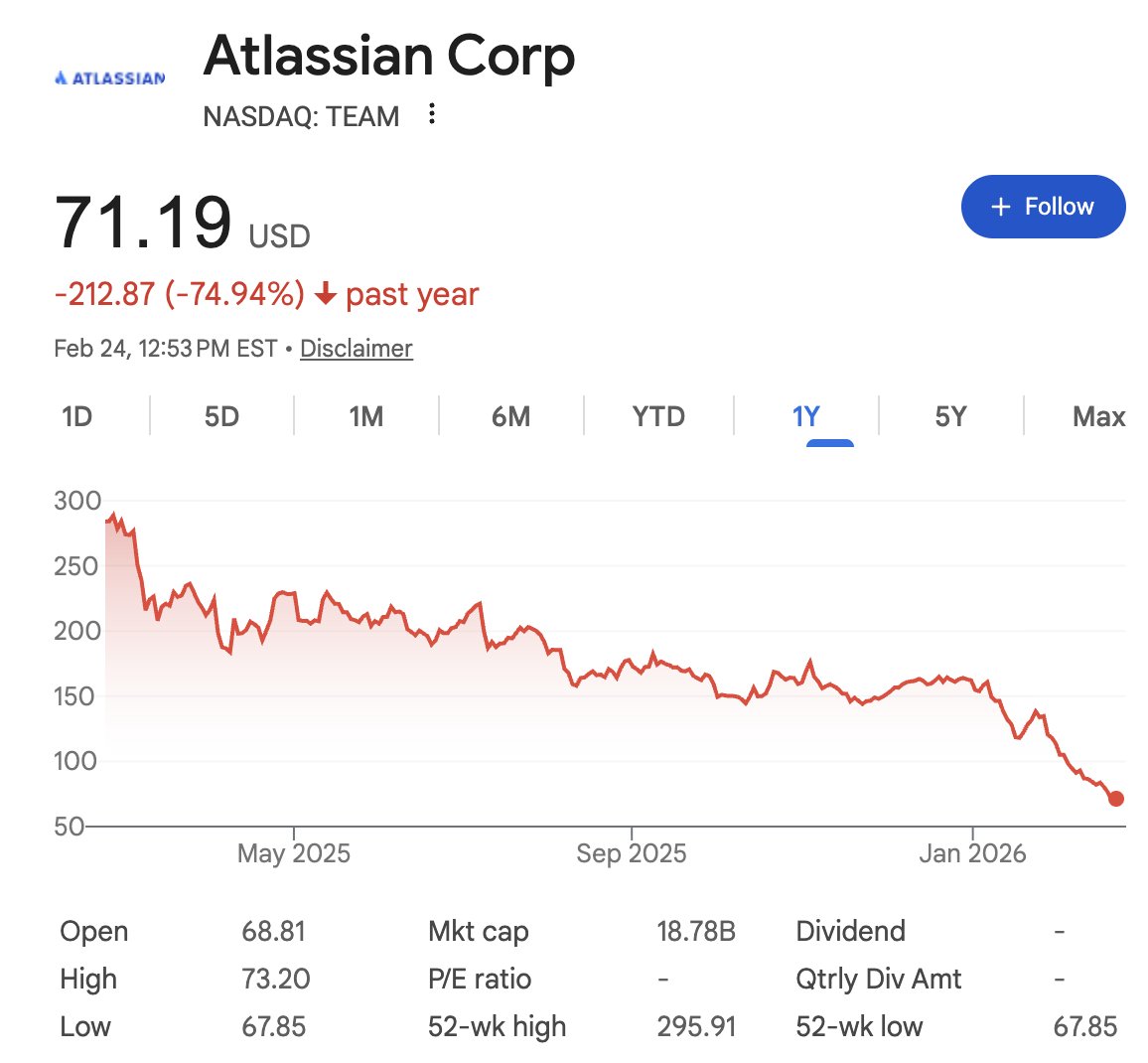
English
The OP → Base grant (~$185M at agreement) is a useful case study in ecosystem capital allocation
~47% vested (~$71M notional at vest)
~53% remaining (~$11M at current prices)
~$190M of lifetime revenue, ~$29M paid to the Superchain in revenue share
The broader point isn’t about any one protocol. It’s that crypto as an industry needs to start underwriting token incentives through a true ROI lens.
• What incremental revenue was created?
• What durable value accrued to token holders?
• What would have happened absent the grant?
As traditional financial institutions enter crypto, capital allocation discipline becomes mandatory. Protocols that treat token grants as marketing spend will struggle. Protocols that view them as long-duration investments will have a better shot at surviving. The industry is maturing. Incentive design needs to mature with it.
zoomer@zoomerfied
[ ZOOMER ] COINBASE'S BASE NETWORK MOVES AWAY FROM OPTIMISM STACK TO CREATE THEIR OWN: BLOG
English
If I was the CFO of @nytimes or other legacy newspaper companies, I’d start exploring how to utilize prediction markets as a treasury yielding strategy asap
Leading Report@LeadingReport
BREAKING: Plans for Maduro’s capture were allegedly leaked to the Washington Post and New York Times before it happened, but both decided not to publish to protect U.S. troops.
English
Frank Wan retweetledi

SOFR just hit a 3-year low.
Private equity lives on SOFR+.
Are we about to see a PE bull market?
Value trade back on?
Barchart@Barchart
Secured Overnight Financing Rate (SOFR) falls to 3.9%, its lowest level in 3 years 📉📉
English
The crypto space continues to legitimize. Congrats to Circle, Ripple, BitGo, Fidelity Digital and Paxos!
Jeremy Allaire - jerallaire.arc@jerallaire
Very proud of this moment. Many years ago we talked about our vision for full-reserve dollar digital currency, the need to enshrine that into law, and our intention to become the First National Digital Currency Bank with this core aim. Today’s conditional approval for Circle’s new National Trust Bank, is a huge step in making USDC a foundational technology for the global financial system.
English
Order-book prediction markets fall apart when liquidity dries up. Odds get messy fast. LMSR fixes that: one cost function, always-on liquidity, coherent probabilities, predictable slippage, machine resolution. Delphi is the next evolution of what prediction markets should look like when you design them for information, not order flow.
gensyn@gensynai
Delphi runs a fully on‑chain automated market maker (AMM) for prediction markets, using the Logarithmic Market Scoring Rule (LMSR). Unlike other prediction markets based on order books, LMSR guarantees continuous liquidity. Learn more: blog.gensyn.ai/lmsr-logarithm…
English
For years, AI model ownership was limited to funds and institutions. Today, we’re testing what happens when anyone—not just the insiders—can align with models and participate in upside.
gensyn@gensynai
Introducing Delphi - the open market for machine intelligence Models compete. Users buy and sell. Prices react instantly It’s the first real-time market signal for model intelligence
English
I think the problem with these debates right now is that many people take a one sided view of ETH. Is it money? Is it a dcf business? Is it a commodity?
I think ultimately ETH is somewhere in the middle of it all. When you strip ETH down to its cores demand properties, people buy it because (I) it’s a yielding asset (dcf valuation), (ii) people think it’s a store of value (money type valuation) and (iii) it’s needed to access block space (transaction demand). When looking at it as a yielding asset, eth its over valued. When looking at ETH as digital money, it’s under valued.
When you blend these components and weight them based on how the market behaves now vs the future, you get closer to reality. As demand drivers change, so should your weighting.
ETH is a sum-of-the-parts asset — not a single model asset.
Santiago R Santos@santiagoroel
Most of you wouldn’t make it past the first-round interview at a major investment bank, let alone PE or a hedge fund. You punted some crypto in a bull market, made a bag, and now think you’re a genius. You were mostly lucky What’s wrong with his argument? Oh, checks notes… JPMorgan generated $178B in net revenue and $57B in net income on $2.5T of deposits. He probably thought he was making a stronger point by dismissing my MAUs benchmarking of tech companies crypto tries to emulate on network effects to justify absurd valuations. And when that doesn’t stick, they pivot to TradFi to see if those multiples magically make crypto make sense. “Bro, crypto is growing faster. The market pays for growth, not value” On what metric? - Active users? No - TVL? Mostly stablecoins The lazy “TAM is huge” analysis collapses in the absence of monetization (and increasing infra competition). Once you actually look at protocol-level metrics, you see: - High user churn - Weak monetization - TVL growth that doesn’t translate into real economics for L1s JPMorgan monetizes its deposits. Crypto L1s? Nowhere close to monetizing near the value they’re implicitly claiming. And yes, maybe this kind of logic flies when you’re doing early-stage venture. But Ethereum at $380B or Solana at $80B isn’t early-stage and it isn’t exactly venture These are mature-stage valuations being justified with seed-stage reasoning No matter how you slice the math, valuations don’t make sense for most protocols at this point - especially L1s It’s lazy analysis, sexy but constantly evolving narratives on analogies layered on top of bag bias over and over again
English