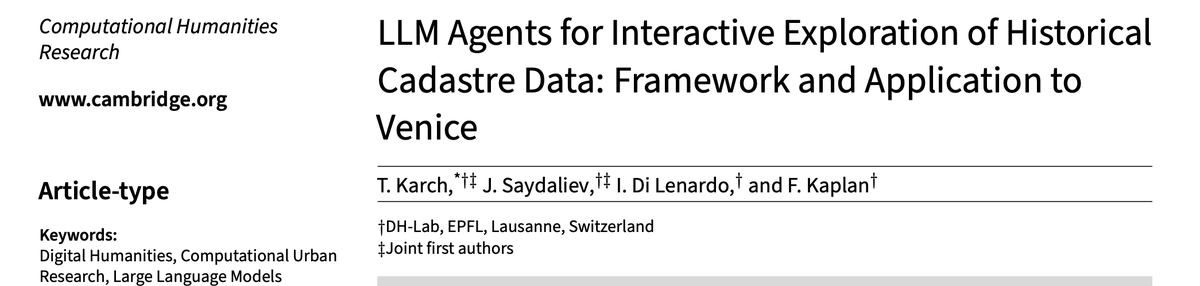
New paper accepted in Computational Humanities Research (Cambridge University Press)!
We show how Large Language Models can help historians query and analyze centuries-old cadastral data — starting with Venice (1740–1808).
Join us for Venice Data Week 2025 at EPFL (June 25-27) — a three-day workshop dedicated to exploring, interpreting, and enriching historical datasets on the city of Venice.
👉 Details & registration: epfl.ch/schools/cdh/ti…#DigitalHumanities#VeniceTimeMachine#EPFL
Sven Najem-Meyer's research exemplifies the exciting intersection of AI and classical studies. It focuses on advancing document processing for commentaries on Ancient Greek texts. His PhD Thesis, which I co-supervised with Matteo Romanello, addresses the unique challenges of working with low-resource, domain-specific environments and its impacts go beyond this specific domain of application. actu.epfl.ch/news/the-front…
The creation of 3D assets for cultural heritage is accelerating, bringing us closer each day to a European Time Machine—an open 4D mirror world that enables the exploration of places across space and time. This week marks the launch of two decisive projects, with joint kick-off meetings in Trento, Italy, at the Fondazione Bruno Kessler (FBK): 3DBigDataSpace, coordinated by the Time Machine Organisation, and 3D-4CH, in which the Time Machine Organisation actively participates.
These initiatives bring together a strong network of European partners who have been at the forefront of 3D cultural heritage for decades, now forming a solid ecosystem, implementing standards and pipelines to process massive 3D datasets. This effort comes at a crucial moment, as the production of 3D models is accelerating—exemplified by datasets such as Objectverse XL, featuring 10 million 3D models, or the Scan the World initiative.
Beyond standardization, curation, and interoperability—ensuring that these datasets can be accessed via browsers, mobile devices, and augmented reality platforms—these projects are laying the foundation for a new generation of AI-powered pipelines. These advancements will enable large-scale spatiotemporal alignment, the simulation of new objects and buildings based on analyzed patterns, and the creation of an accelerating positive feedback loop that may transform the 4D mirror world into reality.
Major challenges remain in curation, quality control, and standardization. Yet, thanks to a well-established network of academic and industrial partners, and the continuous support of the European Commission, there is strong reason to believe that Europe can lead this critical transformation of the Internet.
timemachine.eu/3dbigdataspace…
Apple gets it. Robots are going to be everywhere, but they won’t look like robots. Check out their new paper ELEGNT.
I believe this is the future of everyday objects: helpful and human.
New Publication (in French) : Linguistic Prostheses: Typology, Authorship, and Proletarization. In Gefen Alexandre & Huneman Philippe (Eds), Philosophies of AI: thinking and writing with LLMs, Intellectica, 81, (pp.135-161)
intellectica.org/en/linguistic-…
This article proposes a classification of linguistic prostheses, which are tools, devices, or technologies that transform the writing process. The concept of linguistic prosthesis brings together a wide variety of mediation devices under a single name. What they all have in common, however, is that they open up questions of authorship and the possible proletarianization of writing skills. Questions of authorship are central to many economic and legal processes involving the rights and responsibilities of authors. Questions of proletarianization touch on social issues of great importance linked to inequalities in writing skills, indirectly affecting questions as vast as the future of work or representativeness in democracy
One of the conclusions of the article is that the issue of extending or supporting linguistic capabilities with prostheses is essentially linked to the fact that the user generally doesn't own them, but at best, simply rents access to them. The behavior of the prosthesis may change depending on the subscription taken out, or just when the underlying language model is updated. In the long term, the user has no guarantee of either their accessibility or the quality of their performance. The coupled system is therefore fundamentally unstable. Given these intrinsic fragilities, it seems important that the user should be able to maintain autonomous control over his or her linguistic skills, regardless of their extension by the prostheses.
The article also stresses that the use of prostheses should be studied from the more specific angle of a loss of critical knowledge and the risk of new forms of control and influence made possible by their intermediation in linguistic flows. This more subtle form of proletarianization - a control of society through a control of linguistic devices - can be understood as the implementation by machines of linguistic politics of which there are examples in history. Given the nature of the entities that today control the most linguistic capital, forms of commercially motivated bias must also be considered. If these fears are well-founded, in this second perspective, the possibility of decoupling with the prosthesis is no longer a risk, but a possible escape from a control device.
—
Check also the other articles (some in French, some in English) of the issue curated by Alexandre Gefen & Philippe Huneman
Philosophy of AI: Thinking and Writing with LLMs by Alexandre Gefen and Philippe Huneman :
intellectica.org/en/philosophy-…
On the Semantics of Large Language Models by Martin Schüle intellectica.org/en/semantics-l…
The Human and the Mechanical: logos, Veridicality Judgment, and GPT Models by Anastasia Giannakidou and Alda Mari
intellectica.org/en/human-and-m…
About a Pseudo-Knowledge: Large Language Models and the Replika Hypothesis by Philippe Huneman
intellectica.org/en/about-pseud…
Knowing with Large Language Models: a Paradigmatic Break by Stéphan-Eloïse Gras and Gaël Varoquaux
intellectica.org/en/knowing-lar…
Generative Grammars, Minimal Operations and LLMs: True and False Problems by Pierre-Yves Modicom
intellectica.org/en/generative-…
The artificial image: Portrait of Edmond de Belamy by Alexandre Gefen
intellectica.org/en/artificial-…
Artificial Agency and Large Language Models
by Maud van Lier and Gorka Muñoz-Gil
intellectica.org/en/artificial-…
Playing with à Chat(GPT)? the Ludic Side of Appropriating AI Technologies by Lionel Obadia
intellectica.org/en/playing-cha…
To Understand AI Sentience, First Understand it in Animals by Jonathan Birch and Kristin Andrews
intellectica.org/en/understand-…
Generation of LOD4 models for buildings towards the automated 3D modeling of BIMs and digital twins. New article by Bryan German Pantoja-Rosero, Alexander Rusnak, Katrin Beyer and myself. One step closer to the Mirror World. sciencedirect.com/science/articl…
Kazuo Sejima architect of the Rolex Learning Center receives a Dr Honoris Causa from EPFL and explains that SANAA’s intention was to create for students « a new type of learning experience not only by books and teachers but also by each others » @EPFL_en
AI is about to profoundly change the way we build 3D models and manipulate them.
New paper : "Automatic Removal of Non-Architectural Elements in 3D Models of Historic Buildings with Language Embedded Radiance Fields" by Alexander Rusnak, Bryan G. Pantoja-Rosero, Katrin Beyer and myself.
The article explores how language-embedded radiance fields can be used for the automatic generation of point clouds from images and for the removal of non-structural elements from those point clouds. This research enables faster, simpler modeling of the interior of buildings.
The research is a collaboration between the EPFL's Earthquake Engineering and Structural Dynamics Laboratory (EESD) and Digital Humanities Laboratory (DHLAB), supported by the EPFL Center for Imaging.
Read the paper here : mdpi.com/2571-9408/7/6/…
Today, we launch "H".
You can read it online or order the print version for free.
epfl.ch/schools/cdh/ma…
“H” is first and foremost about the future of the Humanities. And, specifically for this first edition, H refers to two major cross-disciplinary transformations in the field of knowledge: "Hyperscience" and "Hyperreality".
"Hyperscience". Over the next twenty years, a hyperscientific core of unified methods and knowledge will undoubtedly emerge, including the humanities and social sciences, and with research into the “science of science”. Transdisciplinarity is becoming the norm rather than the exception, recomposing a fluid and continuous knowledge landscape far removed from the old silos, forging a fertile ground for innovation and discovery.
“Hyperreality”. At the same time, we are entering the regime of “Hyperreality”, a territory in which the boundaries between the real and the virtual, documentary and fiction, are blurring. Hyperreality is characterized by the gradual obsolescence of truth and falsity as foundational concepts of discourse, a continuum between the natural and the artificial, a normalization of simulation as an experience of the world, and a new realm of creative expression, a canvas onto which the future can be painted.
The generation born at the dawn of the year 2000 is the one that is experiencing these two convergences. If they are introduced to these new dynamics early enough, they will not only participate in the existing global game; they may well rewrite its rules.
You can read my full interview about H here : actu.epfl.ch/news/h-a-new-p…
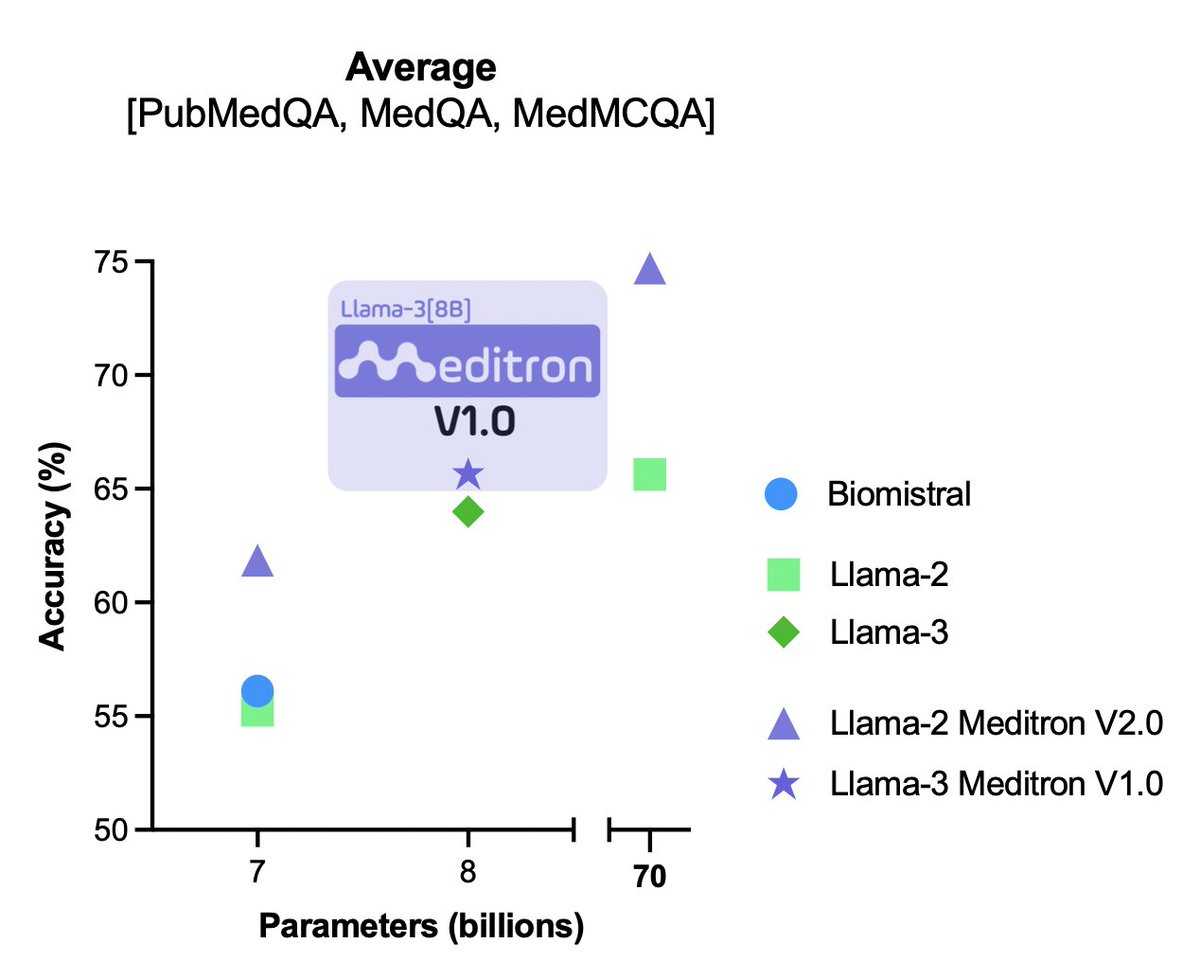
⏰ New state-of-the-art LLM for medicine within 24h of the #Llama3 release
Meet Llama-3[8B]#Meditron: The first fine-tuned Llama3[8B] for medicine!
More here: lnkd.in/e5PRgeZk (updates soon!)
A magnificent all-nighter effort ☕️🍕by the Meditron team @EPFL@YaleBIDS
"Machine Learning for Ancient Language" is gaining traction. Sources from the inception of writing systems in ancient Mesopotamia and Egypt (3400 BCE) to the late 1st millennium CE are becoming the new precious datasets to explore. ml4al.com
For the 2024/25 EPFL CDH Artist-in-Residence program "Enter the Hyper-Scientific," five outstanding artists have been selected from 200+ applications: Alice Bucknell, Josua Putzke, Sahej Rahel, and the duo Matthew C. Wilson & Emilia Tapprest. Check their previous work!
actu.epfl.ch/news/enter-the…
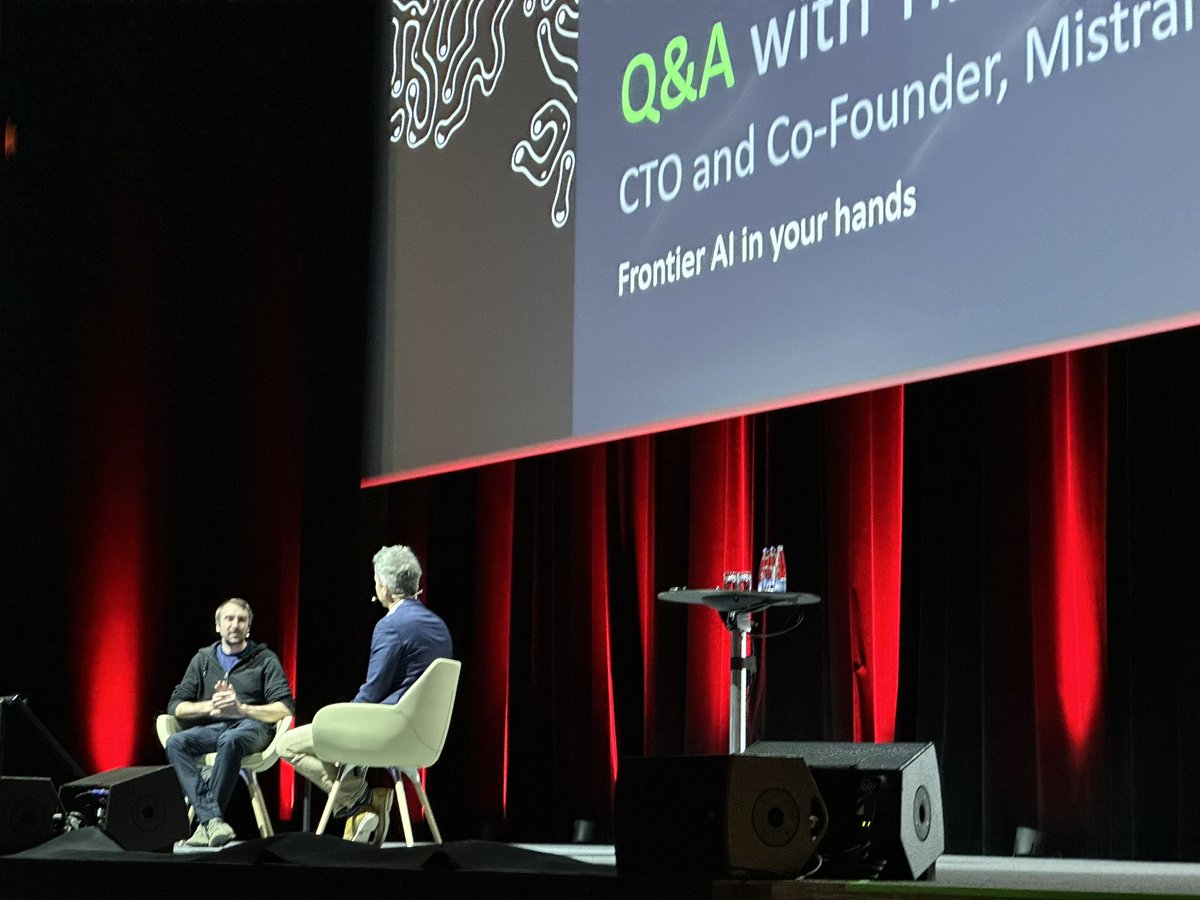
Timothée Lacroix @MistralAI’s CTO
and cofounder about the key architectural insight behind the company models « the intuition behind Mixtral and sparse mixture of experts is that processing for different tokens should involve different parts of the network » #AMLDEPFL2024
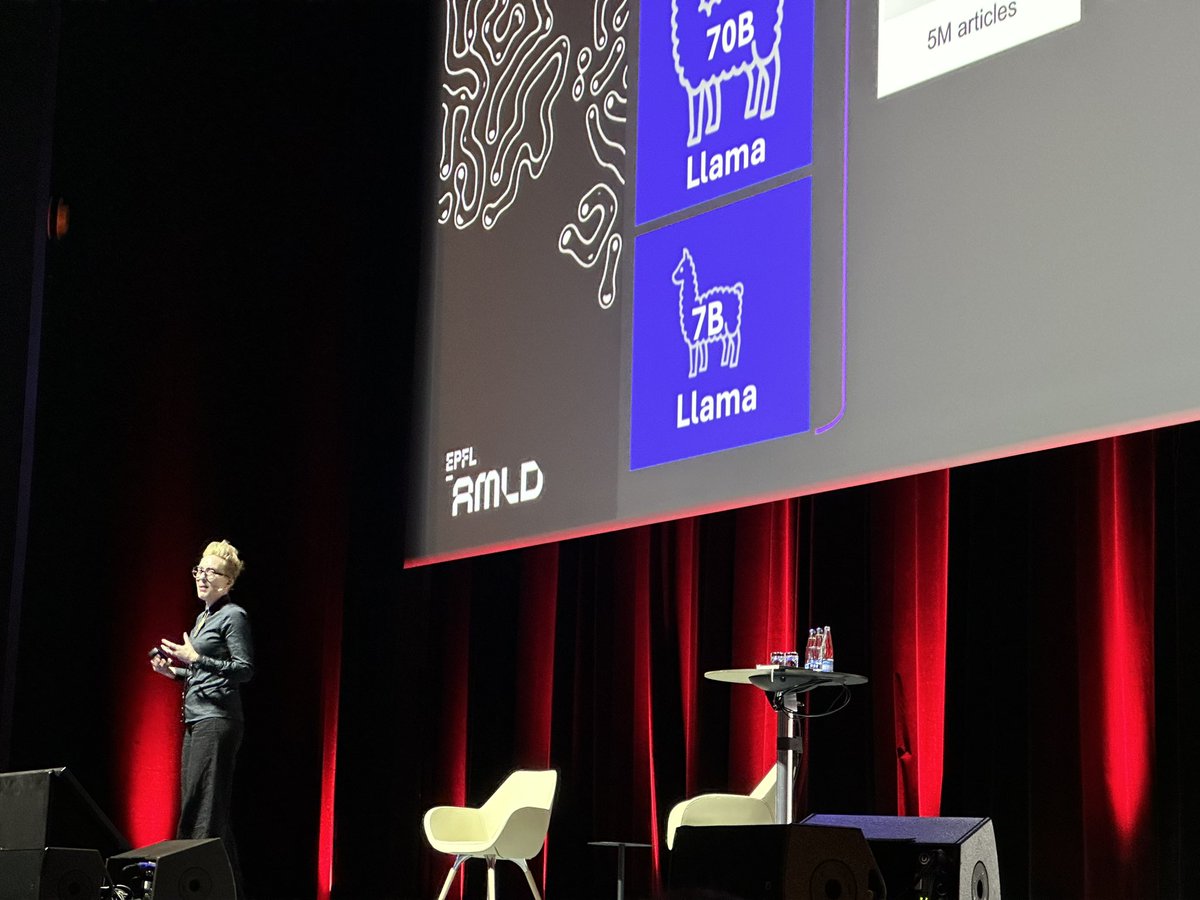
Meditron 70B is an example of Humanitarian foundational model. It is open source, accessible, transparent, local and has no dependency. It was trained on 128 GPUs for 13 days on EPFL clusters. It shows remarkable performances on benchmarks and was also challenged by doctors with adversarial questions. No commercial interest to stay neutral. @anniehartley_#AMLDEPFL2024