Sabitlenmiş Tweet

“The test of a first-rate intelligence is the ability to hold two opposed ideas in the mind at the same time, and still retain the ability to function.”
― F. Scott Fitzgerald, The Crack-Up
English
fried eggs
9.9K posts

@friedeggs
Considering points of view. (Some retweets are just me broadcasting data points or others' perspectives that I find notable. Some are endorsements.)
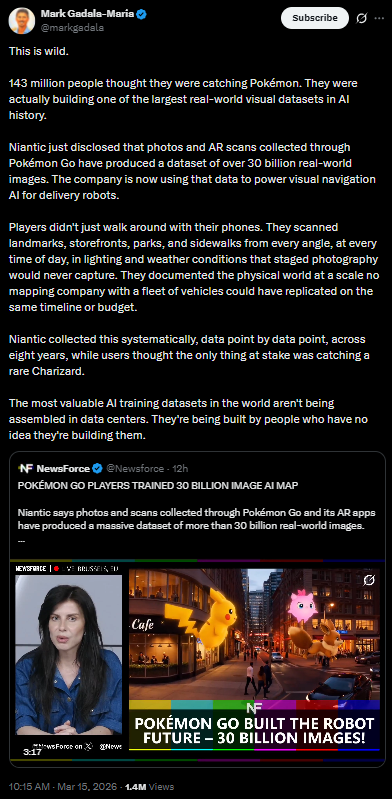
This is wild. 143 million people thought they were catching Pokémon. They were actually building one of the largest real-world visual datasets in AI history. Niantic just disclosed that photos and AR scans collected through Pokémon Go have produced a dataset of over 30 billion real-world images. The company is now using that data to power visual navigation AI for delivery robots. Players didn't just walk around with their phones. They scanned landmarks, storefronts, parks, and sidewalks from every angle, at every time of day, in lighting and weather conditions that staged photography would never capture. They documented the physical world at a scale no mapping company with a fleet of vehicles could have replicated on the same timeline or budget. Niantic collected this systematically, data point by data point, across eight years, while users thought the only thing at stake was catching a rare Charizard. The most valuable AI training datasets in the world aren't being assembled in data centers. They're being built by people who have no idea they're building them.
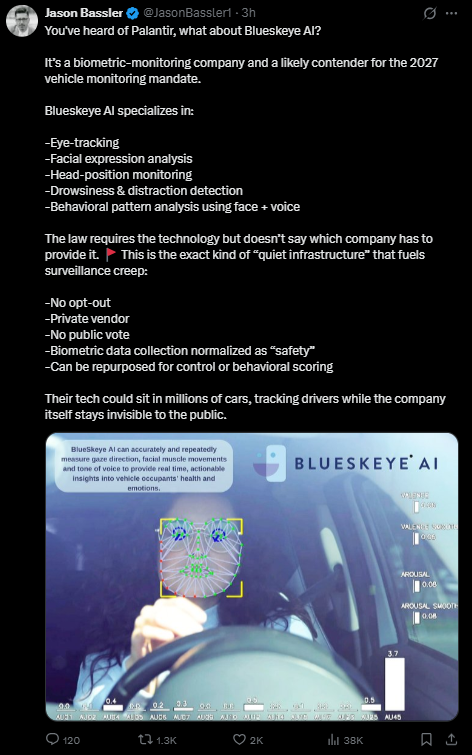
You've heard of Palantir, what about Blueskeye AI? It’s a biometric-monitoring company and a likely contender for the 2027 vehicle monitoring mandate. Blueskeye AI specializes in: -Eye‑tracking -Facial expression analysis -Head‑position monitoring -Drowsiness & distraction detection -Behavioral pattern analysis using face + voice The law requires the technology but doesn’t say which company has to provide it. 🚩 This is the exact kind of “quiet infrastructure” that fuels surveillance creep: -No opt‑out -Private vendor -No public vote -Biometric data collection normalized as “safety” -Can be repurposed for control or behavioral scoring Their tech could sit in millions of cars, tracking drivers while the company itself stays invisible to the public.

There's a rule of thumb about losing competence in an organization. I learned this through change management and watching PE firms and venture capitalists gut organizations. It used to be formally taught but... CFO don't care. It starts with lay offs for financial reasons. 3 months is how long it takes before systemic issues hit where sustaining and experienced personnel took care of systems in ways not formally documented. Often the folks replaced took it for granted that it was obvious these operations, tasks, and procedures were necessary. The system will hobble along but the clock starts kicking now the 40% rule takes over. Any organization that replaces more than 40% of it core personnel will go into intellectual bankruptcy starting two years from that point. By years 3 complete collapse of institutional know-how is irreversible and the organization will decompose into silos that do nothing but firefight until competition takes them over or takes their customers. Amazon is tracking this perfectly. It's inevitable. It's hitting every institution in lock-step. Microsoft, imo passed it a while back. This isn't the first time either, many large corporations have suffered this over the last century - cycle of life when finance or HR take over hiring and firing.