@realMaalouf Norway and Greece. Both have great natural settings/places. Avoid Athens or spend little time there. For Greece the islands and the northern half are the most interesting. For Norway be sure to check out Alesund, Bergen and Lofoton area at a min.
@KhopeshEnjoyer@oliveegirl Yes I don’t disagree with that, but the amount of cat calling that my wife experienced in Cairo is disgusting. To add to that; I‘ve never seen such obvious scam attempts like in Egypt. Not even Marocco comes close, and that says something. Been there once, enough for this life.
idk about Cairo but I'm a petite woman who has walked alone in Alexandria at 2am many times & i was ok.
Surely we have a harrassment problem & i am NOT minimizing it (don't accuse me of that). I have a friend who was stalked by a creep in Croatia!!
I know this is unpopular, but it will always be unattractive for a grown man to play video games.
Some women might be understanding or pretend like they don’t care that you spend hours playing, but they do.
It is extremely unattractive to women and will never not be. 🤷🏼♀️
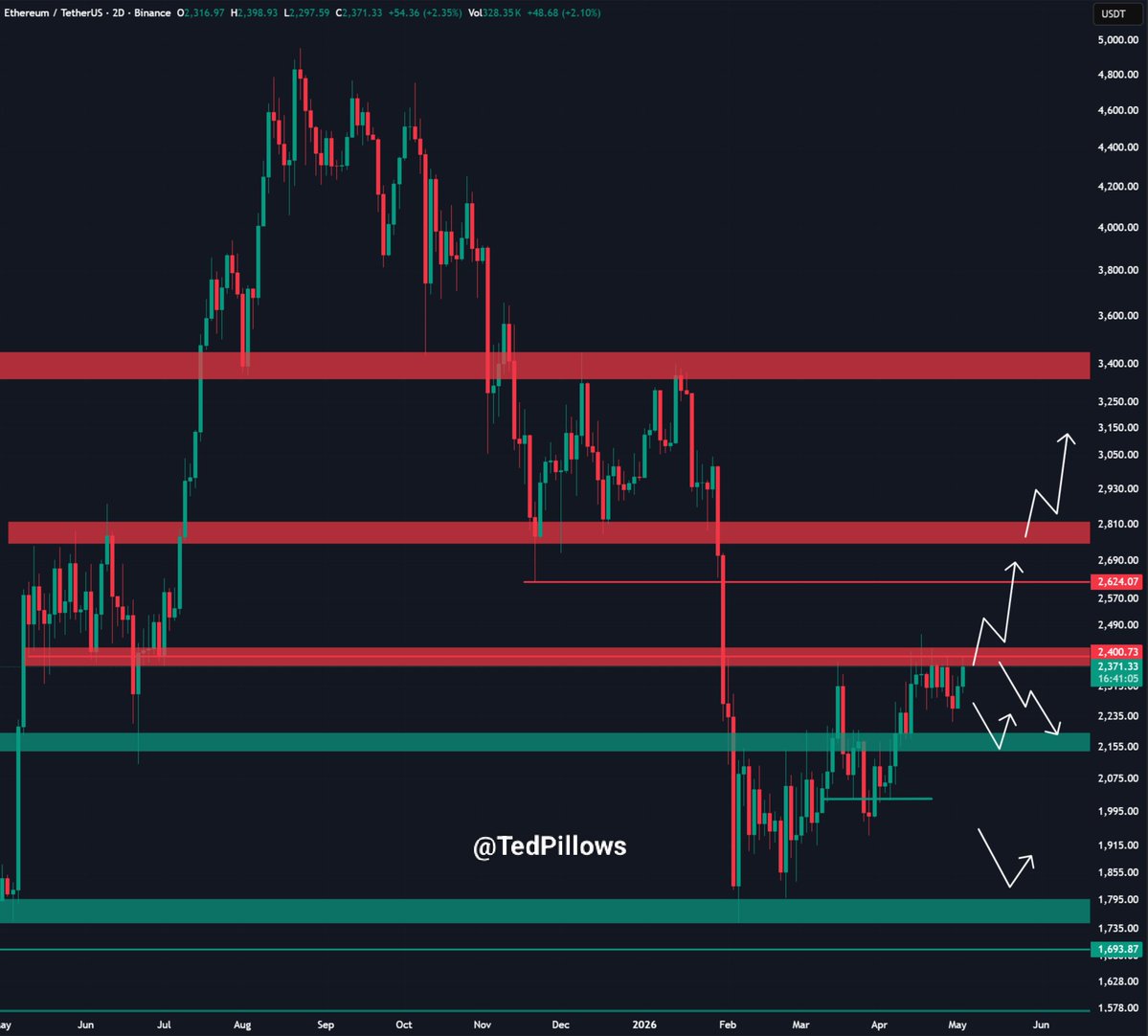
@TedPillows If it pushes above $2,400 it can go to $2,500. If rejected below can go to $2,300. Stellar analysis. Never could’ve figured that out by myself.
$ETH tried to break above the $2,400 level but failed.
This is an important zone for Ethereum.
A reclaim above this level could push ETH above the $2,500 zone.
A rejection means ETH will drop below the $2,300 level again.
@denisyurchak But that is how they manage to keep the prices down and increase the quality of chains and products. Because they can plan long term with consistent revenue.
One thing that annoys me about German-speaking countries (Germany, Austria, Switzerland) is how long-term everything here is
What to go to a gym? Minimum one-year contract with a 3-months cancellation notice period
Want to quit a job? Notice 3 months in advance
Rent an apartment? One year minimum rent period, and you guessed it - 3 months cancellation notice
Want to have a decent massage, have a grill in a park, access government services - be ready to book 4-5 weeks in advance (best case scenario)
That is super unfriendly to remote workers, nomads and in general people who don’t want to plan too much in advance and live spontaneously (the energy I vibe with)
This is why living in a German-speaking country may be great if you are rich and 60+, but terrible if you are young and entrepreneurial
For young high energy people intense capitalist countries like Poland, Thailand, or the US might be a better choice
@wutruxbt@trader1sz It is currently 50B mcap buddy. I think this coin is at least deserving similar mcap as ETH in a proper bull run. And that would be 4-5x from here. That is how I analyse things.
How many push-ups (all the way down and up, zero cheating) do you think the average guy can do?
Not gym rat. AVERAGE guy.
If I had to guess, I would set the over/under at 8.5.
Maybe lower.
@solo_levelingx False! Machines are pretty limiting in movement plus they are created for average people and not fitting everyone. Free weights when used with proper technique are customised for each body
At the gym you need to be using machines as much as possible
Never use free weights unless you absolutely have to
Machines were literally created for optimal muscle development
Ppl using free weights are LITERALLY retarded
@denisyurchak Because longer subscriptions ensure consistent money all over the year. Big chains reinvest and expand this way. It is a safety mechanism for profits. Gyms in Germany are cheap as chains and that is the sole reason why are they doing that strategy and ensure attractive price
I don't understand one thing about Austria and Germany – why gym memberships start from 6 months minimum and have 1-month notice periods to cancel?
And single-entry tickets usually cost 1/3 to 1/2 of a whole month subsription!
This is super unfriendly to tourists and digital nomads.
Meanwhile, the boxing gym in Warsaw I go to has both cheap single-entry cards and 1-month subscriptions
So you can train when you are in a city and then not commit to it like to a job
Elon Musk avait dit un truc qui m'avait marqué sur l'allocation de ressources. En substance : passé un certain niveau de richesse, l'argent n'est plus de la consommation, c'est de l'allocation de capital.
Cette phrase change tout.
L'économie, dans le fond, c'est juste un problème d'allocation. Tu as des ressources finies et des usages infinis. Qui décide où va quoi ?
Imagine une cour de récré. 100 enfants, des paquets de cartes Pokémon distribués au hasard. Tu laisses faire. Très vite, un ordre émerge. Les bons joueurs accumulent les cartes rares, les collectionneurs trient, les négociateurs trouvent des deals. Personne n'a planifié. Et pourtant chaque carte finit dans les mains de celui qui en tire le plus de valeur. Le système maximise le bonheur total de la cour. C'est ça, la main invisible.
Maintenant fais entrer la maîtresse. Elle trouve ça injuste. Léo a 50 cartes, Tom en a 3. Elle confisque, redistribue, impose l'égalité. Trois effets immédiats. Les bons joueurs arrêtent de jouer, à quoi bon. Les mauvais n'ont plus de raison de progresser, ils auront leur part. Les échanges s'effondrent. La cour est égale, et morte. Elle a maximisé l'égalité, elle a détruit le bonheur.
Le problème de la maîtresse, c'est qu'elle ne peut pas avoir l'information que la cour avait collectivement. C'est le problème du calcul économique de Mises, formulé en 1920. L'URSS a essayé de le résoudre pendant 70 ans avec le Gosplan. Résultat : pénuries, queues, effondrement. Pas parce que les Soviétiques étaient bêtes, parce que le problème est mathématiquement insoluble en mode centralisé.
Quand Musk a 200 milliards, il ne les consomme pas, il les alloue. SpaceX, Starlink, Neuralink, xAI. Chaque dollar est un pari sur le futur. Et lui a un track record. PayPal, Tesla, SpaceX. Il a démontré qu'il sait identifier des problèmes immenses et y allouer des ressources avec un rendement spectaculaire.
L'État aussi a un track record. Hôpitaux qui s'effondrent, éducation qui décline, dette qui explose, services publics qui se dégradent malgré des budgets en hausse constante. Le marché identifie les bons allocateurs, la politique identifie les bons communicants.
Le profit n'est pas une finalité, c'est un signal. Il dit : tu as alloué des ressources rares vers un usage que les gens valorisent suffisamment pour payer. Plus le profit est gros, plus la création de valeur est grande. Quand Starlink est rentable, ça veut dire que des millions de gens dans des zones rurales ont enfin internet. Quand un ministère est en déficit, ça veut dire qu'il consomme plus qu'il ne produit. L'un crée, l'autre détruit, et on appelle ça redistribution.
Dans nos sociétés il y a deux catégories d'acteurs. Les entrepreneurs et les bureaucrates. L'entrepreneur prend un risque personnel pour identifier un problème, mobiliser des ressources, créer une solution. S'il se trompe il perd. S'il a raison, ses clients gagnent, ses employés gagnent, ses fournisseurs gagnent, l'État collecte des impôts. Il est la cellule de base du progrès humain.
Le bureaucrate ne prend aucun risque personnel. Son salaire est garanti. Au mieux il maintient une rente existante. Au pire il la détruit par excès de réglementation, mauvaise allocation forcée, incitations perverses qui découragent ceux qui produisent. Mais dans aucun cas il ne crée.
Regarde les 50 dernières années. iPhone, internet civil, SpaceX, Tesla, Google, Amazon, Stripe, mRNA, ChatGPT. Toutes des inventions privées, portées par des entrepreneurs, financées par du capital risque. Pas un seul ministère n'a inventé quoi que ce soit qui ait changé ta vie au quotidien.
La France est devenue le laboratoire mondial de la dérive bureaucratique. 57% du PIB en dépenses publiques, record absolu. Une administration tentaculaire, une fiscalité qui pénalise la création de richesse. Résultat : décrochage face aux États-Unis, à l'Allemagne, à la Suisse. Fuite des cerveaux. Désindustrialisation. Dette qui explose.
Et le pire c'est que la mauvaise allocation s'auto-renforce. Plus l'État prélève, moins les entrepreneurs créent. Moins ils créent, moins il y a de base fiscale. Plus l'État s'endette et taxe. Boucle de rétroaction négative parfaite. La maîtresse pense qu'elle aide, et chaque année la cour produit moins.
Dans nos sociétés, ce sont les entrepreneurs, toujours, qui font avancer la civilisation. Les bureaucrates au mieux maintiennent une rente, au pire la détruisent. Aucune société n'a jamais progressé en taxant ses créateurs pour subventionner ses gestionnaires.
La question n'est jamais qui a combien. C'est qui alloue le mieux la prochaine unité de ressource pour maximiser le futur de l'humanité. La réponse depuis 200 ans n'a jamais changé. Ce ne sont pas les fonctionnaires.