Felix Rau

1.3K posts

Felix Rau banner
Felix Rau

Felix Rau

@fxru

research data juggler, part-time archivist, linguistic fieldwork and data fancier, data whatchamacallit wannabe @dch_cologne ...also at https://t.co/4gbcMfAEAV

Cologne Katılım Temmuz 2009
2.1K Takip Edilen560 Takipçiler
Felix Rau
Felix Rau@fxru·
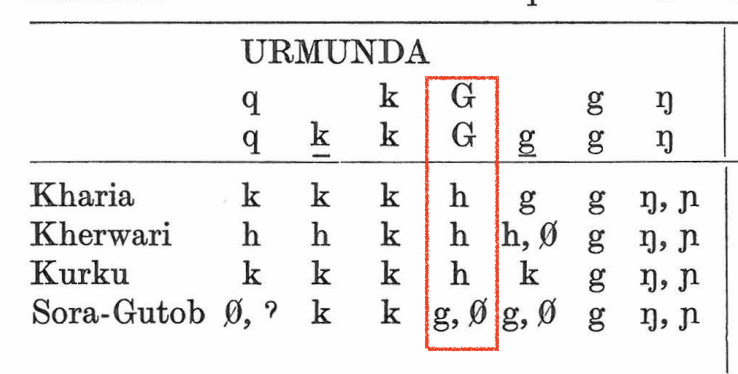
@subapicarl @avzaagzonunaada @KroonenGuus What I don't like about Pinnow's *q solution is that pAA *q is unlikely, in our current understanding. So we need a split of pAA *k into pM *k and *q and then we have to have a *q-*k merger in Kharia and Korku.
English
2
0
2
107
Sā́mapriyaḣ
Sā́mapriyaḣ@avzaagzonunaada·
According to @fxru & Sidwell (2019), this is (roughly) the Proto-Munda Urheimat. Wonder if we can reconstruct a Proto-Munda for ‘sea turtle’. Today, Munda-speaking populations are inland peoples, the coastline is thoroughly Indo-Aryanized, but 1 wonders what it was historically.
English
5
1
46
2.4K
Felix Rau
Felix Rau@fxru·
@subapicarl @avzaagzonunaada @KroonenGuus Honestly, I don't know. I have nothing in my notes that fits and I just tried to reconstruct what Pinnow thought, but I don't understand his text there and I can't identify any of his groups in his text that he associates with *G.
English
0
0
2
51
Felix Rau
Felix Rau@fxru·
@subapicarl @avzaagzonunaada @KroonenGuus When Pinnow was writing, everyone assumed that there was a top-level split Munda vs Mon-Khmer (i.e. SEA AA). So propagating something from pM to pAA was relatively straightforward. If Munda is just one of 13 brances in a rake, it becomes less straightforward.
English
1
0
2
81
Felix Rau
Felix Rau@fxru·
@KroonenGuus @avzaagzonunaada I would generally agree, that there is nothing specifically maratime about this word. As a general caveat: MKCD 200 kluuʔ isn't good attested and already considers Sora kulu. For me, that makes it far less strong than entries where Shorto had no Munda counterpart.
English
1
0
2
47
Felix Rau
Felix Rau@fxru·
@subapicarl @avzaagzonunaada @KroonenGuus Mostly, back vowels (including a), but also schwa and epenthetic schwa. But these contexts also occur with *k. I was not able to identify what is specific about these contexts.
English
1
0
2
101
subapicaɭ
subapicaɭ@subapicarl·
@fxru @avzaagzonunaada @KroonenGuus What do we know about the distribution of *k₂ with respect to surrounding vocalic environment, as compared to *k? Any immediately discernable trends?
English
1
0
1
95
Felix Rau
Felix Rau@fxru·
@subapicarl @avzaagzonunaada @KroonenGuus My last stand was, that there is no clear affinity to any other branch. From PAA it's surprisingly rake-like. Paul Sidwell would be the one to ask. He might have newer insights.
English
0
0
1
37
Felix Rau
Felix Rau@fxru·
@subapicarl @avzaagzonunaada @KroonenGuus In the uvular scenario, we first need to decide whether *k₂ was *q. Then Kharia and Juang would have a k > q > k change, while others have k > q > h (> ∅) or whether it was PM *k and the change to *q happened in a subgroup, we have to establish or independently in 3 branches.
English
1
0
1
58
Felix Rau
Felix Rau@fxru·
@subapicarl @avzaagzonunaada @KroonenGuus I would argue that in both cases we need a context that explains why PM *k and *k₂ changed differently. In my currently preferred scenario, in a few languages it stayed k and we have lenition to h in some and a further to zero in some more.
English
1
0
1
24
Felix Rau
Felix Rau@fxru·
@subapicarl @avzaagzonunaada @KroonenGuus I'm not aware of any further support, but it might be just for the lack of trying. When I wrote the PM syntax/morphology paper, everyone would probably have guessed that Khasi/Palaungic were the closest relative to PM, but Paul's work on Palaungic made that less and less likely.
English
1
0
1
58
Felix Rau
Felix Rau@fxru·
@subapicarl @avzaagzonunaada @KroonenGuus However, Paul and I assume in the Munda Maritime Hypothesis that PM changed do to contact with an unknown substratum and then later contact with Dravidian (and Indo-Aryan). So if historical Dravidian evidence can provide motivation, and flesh out a scenario, that would be nice.
English
1
0
2
66
Felix Rau
Felix Rau@fxru·
@subapicarl @avzaagzonunaada @KroonenGuus In my head, it was always connected to the Palaungic reciprocal kʌr (Mak 2012), kər- Shorto (1963), but this is just an idée fixe. The similarity in form and function is obvious, but no firm connection is established. So, coming up with alternative scenarios is interesting.
English
1
0
1
49
Felix Rau
Felix Rau@fxru·
@subapicarl @avzaagzonunaada @KroonenGuus Motivating uvular from Dravidian would solve the source of this otherwise highly unexpected place of articulation, but it wouldn't motivate, why only these reflexes of PAA *k changed. (Or we have to posit uvular for PAA, but then the Dravidian motivation would fall away.)
English
1
0
3
88
Felix Rau
Felix Rau@fxru·
@subapicarl @avzaagzonunaada @KroonenGuus In Shortos' MKCD all the reconstructions that would include Munda *k₂ are all correspondences are simply velar *k. In my current understanding, it is still a variant of *k whose context isn't understood.
English
1
0
3
85