Gary Alder
5.7K posts

Gary Alder retweetledi

For 28 years, Michael O'Leary ran Ryanair like a man who couldn't stand his own customers. People kept flying because the tickets were so cheap. Then in 2014 he tried being nice to them. Profits jumped 37 percent. The share price jumped 55.
He told the whole story in a one-hour lecture at the Royal College of Surgeons in Dublin in late 2015. It's the Carmichael Lecture, watch the full thing if you can, because there is more useful business teaching in that hour than in most full MBAs. On the third rewatch, these are the parts that stuck with me the most.
The single biggest secret of Ryanair has nothing to do with marketing. It is a 25-minute turnaround. Once a Ryanair plane lands, the crew has it cleaned, refueled, reboarded, and back in the air in 25 minutes. Aer Lingus needs about an hour to do the same thing. After three flights in a day, Ryanair has banked two hours, which is enough time to fit in two extra flights. Every single Ryanair plane flies more flights per day than every single Aer Lingus plane. That gap is where the entire profit margin of European cheap flying comes from. Long flights to other continents don't work the same way. A faster turnaround at JFK doesn't let you squeeze another flight to America into the day, so the saved time gets wasted. This is why O'Leary thinks Ryanair will never fly across the Atlantic but will dominate short flights inside Europe for decades.
The second thing he learned was that you can get unlimited free press by saying the opposite of whatever business school is teaching that year. Ryanair had no advertising budget through the 80s and 90s. So O'Leary went on television and said things like, "customers are always right? No, they're always wrong." And, "people are your most important asset? No, they're your biggest expense." Every interview produced more coverage than a paid campaign would have. The peak came in 2009 when The Sun newspaper asked if Ryanair would allow porn on the in-flight wifi. He said yes. Within 24 hours the website got 28 times its normal traffic, and bookings quadrupled for three days straight.
The third lesson is the one he was slowest to learn, and it is the most painful. The shift to being polite to customers was led by his own staff. He was the bottleneck. A Dublin Airport survey found that when Ryanair gate agents pulled passengers out of the queue to size-check their carry-on bags, 77 percent of those bags ended up fitting just fine. His own gate agents had invented rules like "the bag must fit comfortably in the sizer" so they could reject bags that technically fit. Staff were exhausted from being forced into pointless fights with customers. They wanted permission to stop. Once O'Leary gave it, they started bringing him most of the new ideas.
Lesson four is about admitting you were wrong, and treating that as a press strategy. After the change, O'Leary toured Ireland, the UK, and Germany telling journalists he had been wrong about customer service for 25 years. The coverage was endless because almost no executive ever does this in public. Owning a mistake loud enough becomes its own news cycle.
Lesson five is the one I think every government should tape to the wall. Ireland brought in a tax on flights during the 2009 recession. It raised about 26 million euros a year. Visitor numbers fell from 30 million to 20 million over three years. The state lost roughly 250 million euros a year in sales tax it would have collected from the visitors who never came. So Ireland was earning a tenth of what it was losing. Once Michael Noonan repealed the tax in 2014, tourism boomed and Ryanair alone accounted for 74 percent of the new traffic to and from the island. The lesson goes way beyond Ireland. Tax visitors once they're inside your country. Don't tax them at the airport, because at the airport they'll just pick somewhere else to fly.
The sixth lesson is the strangest one. The average Ryanair fare is about 35 euros. O'Leary's actual long-term goal is for the ticket to be free, paid for entirely by side revenue from bag fees, snacks, wifi, and on-board gambling. The cheaper the ticket, the more passengers fly. The more passengers fly, the more side money he makes. That side money lets him cut the ticket again next year. The wheel only turns one direction, and the gap between Ryanair and every other European airline gets wider every year.
Lesson seven is about why public services keep failing. The Irish health service has a politics problem. Whenever the unions are unhappy, they bypass management and go straight to the Minister for Health, who has no real power to push back. American federal workers lost the right to strike in 1947, and the United States has functioning public services almost in spite of itself as a result. No government anywhere can run a real operation while its workforce can paralyze that operation on demand. The same logic explains almost every broken public bureaucracy.
The eighth lesson is a pushback against doomsday thinking. O'Leary was openly skeptical of people warning that the world was running out of oil, and skeptical of climate-change politics. His reasoning was simple and pragmatic. People are extraordinarily good at working around shortages of energy and raw materials. He tells a story he half-remembers about General Motors commissioning a study in the early 1900s that concluded car demand would top out at 900,000 cars worldwide because there were not enough chauffeurs to drive them. Henry Ford solved that within a few years by making cars cheap enough for owners to drive themselves. Markets find new oil whenever the price climbs high enough to make new drilling profitable. American oil producers came online with new techniques, flooded the market, and replaced OPEC, the alliance of oil-exporting countries, as the force that sets global oil prices. Whatever the next bottleneck is, somebody will route around it. The trick is to never bet against human ingenuity over a long enough time horizon.
The ninth lesson is about how leaders rot. O'Leary refuses awards, honorary doctorates, and invitations to the dinner circuit. His reasoning is that the moment you start believing you are irreplaceable, you stop listening to the people who actually run the business. Customers write to him every day complaining about Ryanair. Those daily complaints are the only thing keeping the company grounded.
The deepest lesson in the talk is the one he drops almost in passing. He spent four years studying business at Trinity College in Dublin. At no point during those four years did anybody suggest that being nice to customers might be part of a winning strategy. The single most profitable change he ever made to Ryanair was something his entire formal education had trained him not to consider.
English

Gary Alder retweetledi

James Geoghegan, an agricultural contractor from Westmeath and one of the organisers of the recent fuel protests, believes that there is a house building crash and we are currently in a encomic slow-down.
It comes as The High Court has appointed provisional liquidators to 13 construction companies with several sites, including for approved housing bodies.
Twenty individual companies in the Torca Homes group, which have faced a number of difficulties in recent years, are insolvent.
🎥 James Geoghegan
English
Gary Alder retweetledi

Today in 1916 was the Battle of Ashbourne, the only large-scale engagement fought outside the capital during Easter Week, and one of the rebellion’s few clear victories. Commandant Thomas Ashe, led the depleted Fingal Battalion of the Irish Volunteers. Under his command, and with Vice-Commandant Richard Mulcahy at his side, were just forty men. Yet Ashe had a bold plan, to seize the Royal Irish Constabulary barracks at Ashbourne.
The barracks, normally better defended, housed only ten constables that morning. Two men were spotted outside, fortifying a barricade, they were quickly captured and disarmed. Inside, the remaining eight policemen refused to surrender, and a frantic gun battle broke out across the sleepy town.
Word of the rebel attack spread. Soon, a convoy of twenty-four motorcars roared into Ashbourne, packed with around eighty RIC reinforcements drawn from Slane, Navan, and beyond. The Volunteers were now outnumbered two to one.
Rather than retreat, Ashe and Mulcahy calmly set an ambush exploiting every hedge, ditch, and stone wall for cover. What followed was a brutal firefight that raged amid fields and along country roadways. When the smoke cleared, six policemen lay dead, alongside two innocent travelling salesmen and a police chauffeur caught in the crossfire. Around seventy RIC men surrendered their weapons.
The Battle of Ashbourne was not just a skirmish; it was a blueprint for fucture Volunteers' tactics. Utilising flexible command, rural ambushes, maximum exploitation of terrain. The incident prefigured the guerilla warfare that would later define the War of Independence.
Yet victory was short-lived. Two days later, Ashe received a dispatch from Padraig Pearse, the Rising had been called off. So Ashbourne, for all its success, would not change the rebellion’s outcome.
Arrested and sentenced to death, later commuted to penal servitude, Ashe would not survive the year. After enduring brutal force-feeding while on hunger strike at Mountjoy Prison, he died in 1917, becoming a martyr of the Irish revolutionary cause. While imprisoned at Lewes Jail in England, he had composed a haunting poem: "Let me carry your Cross for Ireland, Lord!" Its spirit would be commemorated decades later, when President Seán T. O'Kelly unveiled a plaque in Ashbourne on Easter Sunday, 1959.
Buy the Dublin Time Machine a pint and support the DTM Book ko-fi.com/buchanandublin…


English

@fergalreid But sure I thought we were all told the sea levels would rise by a couple of metres (ye know with global warming) and this would all be under water?? 🤷
English
Gary Alder retweetledi

Between 1848 and 1850, thousands of young Irish girls, some as young as 14, were shipped off to Australia under the Earl Grey Scheme. Named after Earl Grey, the British Secretary of State for the Colonies, this scheme was pitched as a solution to Ireland’s overcrowded workhouses and Australia’s labour shortage.
In reality, it was a desperate attempt to offload destitute girls from famine-ravaged Ireland and supply the Australian colonies with domestic servants and potential wives.
Around 4,000 girls, mostly from counties like Cork, Galway, Clare, and Dublin, were selected based on their perceived "moral character" and health, though after years in the brutal workhouse system, many were frail and malnourished.
Between 1848 and 1850, the Earl Grey Scheme shipped over 4,000 young Irish girls to Australia to solve two crises: Ireland's overcrowded workhouses and the colonies' chronic female shortage.
Named after the British Secretary of State, the scheme was a "tidy" administrative fix for a famine-ravaged surplus of destitute girls, some only 14.
They were not volunteers. Selected via Victorian hypocrisy, they were required to be "morally pure" and skilled in domestic work, despite years spent in brutal institutions that offered no such training.
After receiving a basic outfit and a religious text, they endured an 85 day voyage to a society that viewed them with suspicion. In Australian ports, they were held in depots and selected by employers or husbands in what was essentially a market.
One such girl was 17-year-old Eliza Dooley from King’s County. An orphan, she arrived in Sydney in 1850. She found work as a nursemaid, married, raised 13 children, and eventually ran an inn on the goldfields.
Eliza died in 1912, having outlasted the famine, the workhouse, and the ocean.
Her story is rare only for its documentation. Most "Earl Grey girls" were absorbed into the landscape, their origins forgotten. The scheme ended in 1850 when the colonial appetite for Catholic Irish girls vanished.
Today, a memorial stands at Sydney's Hyde Park Barracks, and a new monument in Dunmanway, Cork, finally honors these girls who did not choose their fate, but were simply handed a prayer book and shoved towards a ship.
They arrived in Sydney, Melbourne, and Adelaide to a society that viewed them with suspicion. Branded as "Irish orphans," they were often met with prejudice for their Catholic faith and working-class status. While some found stable work and marriage, others faced harsh conditions, exploitation, and social exclusion.
Despite this, the Earl Grey Girls left a lasting legacy. Many of their descendants form part of Australia's Irish-Australian population today. A memorial to them stands in Sydney’s Hyde Park Barracks, and now, a new monument will be unveiled in Dunmanway, County Cork, to honour these women and their resilience.
SOURCES
Kay Moloney Caball's book "The Kerry Girls"
womensmuseumofireland.ie/exhibits/femal…
theirishpotatofamine.com/blogs/blog-1/i…


English
Gary Alder retweetledi

Ireland TD Peadar Toibin went on RTE Radio 2 days ago and revealed that right now in Ireland Children in care are being thrown into apartments and hotel rooms by "unregulated companies" with "unvetted staff" and as a result they are being
"killed, raped & groomed by drug dealing gangs."
He said "36 Children living in these conditions are currently MISSING."
Why are kids always the main victims of the Irish Governments incompetence and inability to run the country?
English
Gary Alder retweetledi

Crush the elderly until they're choosing between heating & eating, then take the asset they spent 30 years paying off so we can give it to migrants. Do Not let the ageing population pass on property to the ones we've squeezed out of the market. Now tell them we're a rich country.

Fianna Fáil@fiannafailparty
Catherine Ardagh TD is introducing legislation designed to give homeowners aged 60 & over a safer way to unlock the value of their home! ✅ Receive a lump sum & ongoing payments in exchange for a share of your home ✅ Stay living in your home for the rest of your life Watch here
English
Gary Alder retweetledi

🇺🇸 United States vs 🇮🇪 Ireland — Economic Comparison by Year
(GDP per Capita, 1980–2026)
➜ 1980
🇺🇸 United States ➜ $12,553
🇮🇪 Ireland ➜ $6,254
➜ 1990
🇺🇸 United States ➜ $23,848
🇮🇪 Ireland ➜ $13,649
➜ 2000
🇺🇸 United States ➜ $36,313
🇮🇪 Ireland ➜ $26,187
➜ 2005
🇺🇸 United States ➜ $44,034
🇮🇪 Ireland ➜ $50,475
➜ 2010
🇺🇸 United States ➜ $48,586
🇮🇪 Ireland ➜ $48,581
➜ 2015
🇺🇸 United States ➜ $57,007
🇮🇪 Ireland ➜ $64,094
➜ 2020
🇺🇸 United States ➜ $64,518
🇮🇪 Ireland ➜ $86,217
➜ 2025
🇺🇸 United States ➜ $89,991
🇮🇪 Ireland ➜ $130,652
➜ 2026 (est.)
🇺🇸 United States ➜ $94,430
🇮🇪 Ireland ➜ $140,186
📊 Source: IMF (WEO April 2026)
ℹ️ Note: Figures represent approximate values; minor differences may occur.


English
Gary Alder retweetledi

@RobbieBlunt5 @VideosIrish I don’t think so Robbie. It was only on Crime call in the last month or so. I could be wrong.
English

@gartommat @VideosIrish They did, they just said he was an Irish national…
English
Gary Alder retweetledi

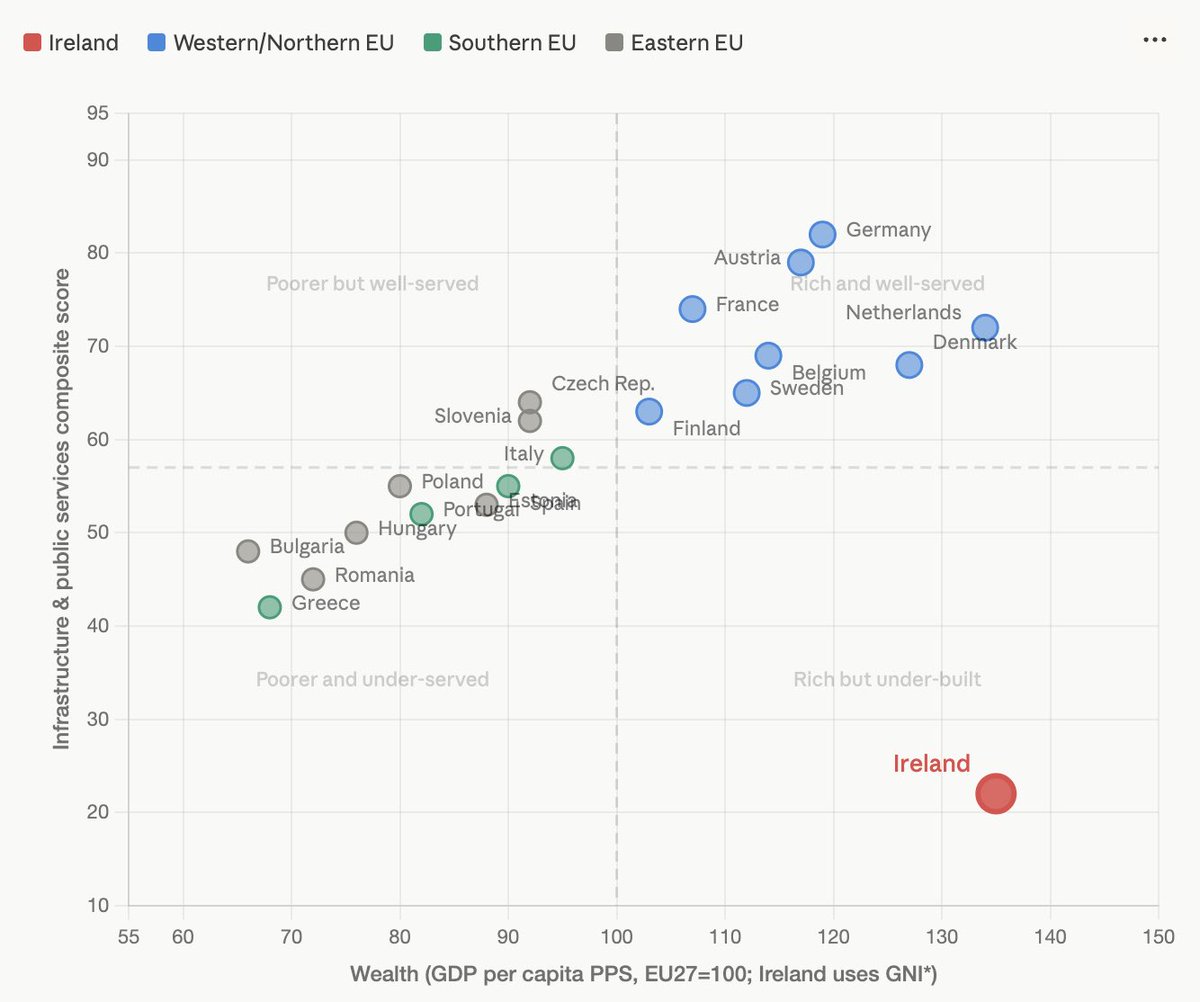
The protests in Ireland are not about just fuel! They are about the distance between Ireland on this graph and every other modern and developed economy. Ireland is second wealthiest but gets waaaaay less than any other country for that wealth. By a golden mile.
That visual gap in this graph? That’s what people are protesting. It’s a lack of infrastructure and the everyday enshittification of services, the economy, and the additional difficulty of trying to live, relative to peers in any other country. It also highlights why people don’t get uniformly listened to! - because there is no government architecture to engage meaningfully across this huge gap.
That gap is a three hour drive to work in traffic, a 14 month wait for an MRI, buses that don’t arrive, trains that don’t exist, schools that have no places for your kids, houses that are unaffordable, pubs that close before midnight, €12 sandwiches, expensive fuel.
People feel this gap, even if they can’t explain it precisely. And that builds into resentment, and ultimately protest. Fuel just happened to be the next thing that could be pointed to, today.

English
The reunification we all deserve. Bring back Mide and Mumu!!!
Paul Ó Duḃṫaiġ@du_dot_ie
Problem with this is the use of county borders - half of Offaly and North Dublin weren’t in Leinster
English
Gary Alder retweetledi

🚨 IT’S LIVE 🚨
The game has evolved… have you?
Today marks the launch of our Modern Performance Activities for Gaelic Football — your go-to resource for smarter, faster, more effective training.
📖 Available NOW — Order here 👇
cntrainingmanual@gmail.com


English
Gary Alder retweetledi