Adi Gelvan
23 posts

@gelvan_adi
CEO @Speedata1 | We built the Analytics Processing Unit (APU), purpose-built silicon for AI data prep, batch ETL & SQL analytics at scale. #ApacheSpark #AI


The limiting factor in #VLSI design isn't model strength, it's whether the agent is operating inside your workflow and your context. @IAmAdiFuchs published a field guide to making #AI coding agents actually useful in hardware design now. speedata.io/post/know-your…

Model training had scaling laws. A clear improvement trajectory. Data pipelines don't, and it's a big reason most enterprise #AI pilots quietly fail. Our CEO @gelvan_adi goes deeper on it with @DanielNenni on Semiwiki.com semiwiki.com/ceo-interviews…


Speedata is hiring: Lead SoC Architect. Own the architecture of an ASIC built from the ground up for #analytics and AI data prep, not a repurposed processor. recruit@speedata.io or apply for open #engineering roles here: speedata.io/careers/lead-s… #hiring #Israel #startup #AI


Speedata is looking for a Board Designer. This role is a great fit for someone who wants to take full ownership of board development and play a key part in building our products. Apply here: lnkd.in/dNFHpyKc #semiconductors #Boarddesign #engineering #hiring #AI #gpu


In the recent Dwarkesh interview, NVIDIA CEO Jensen made a very important point that Dwarkesh didn’t pick up on. AI is more than chips. It is a five layer stack, each of which has to be running well for AI to make an impact. At the bottom layer, we have raw energy. The US has historically been slow to expand this, but without access to massive amounts of new energy, AI will be constrained. It’s the fundamental reason why Elon wants to launch AI datacenters into space, for energy access. The next layer is chip manufacturing, which TSMC and Samsung and others do. Here too, Elon is predicting a bottleneck and it’s why he’s kicking off his Terafab project. Next is chip design. This is where NVIDIA fits in. NVIDIA has over 25 years of chip design expertise, now helped by custom in house AI chip designers. Here Tesla is just learning the ropes with AI4, Dojo and soon AI5 chips. Next is computer science AI algorithm development to expand the frontier of intelligence. While we think we have pretty smart AI models now, we are actually at the very beginning of this layer. There is easily 20 years of continuous improvement ahead of us here. Elon’s xAI is trying to catch up with the likes of Anthropic, OpenAI, Google, etc. The final layer is useful applications for consumers and business alike. ChatGPT and MidJourney were the original modern AI applications, but we will see thousands of specialized AI applications that directly tackle hard subjects in all science, engineering, creative arts, etc. Grok and Tesla FSD are Elon’s current AI applications, but Optimus will soon join them.


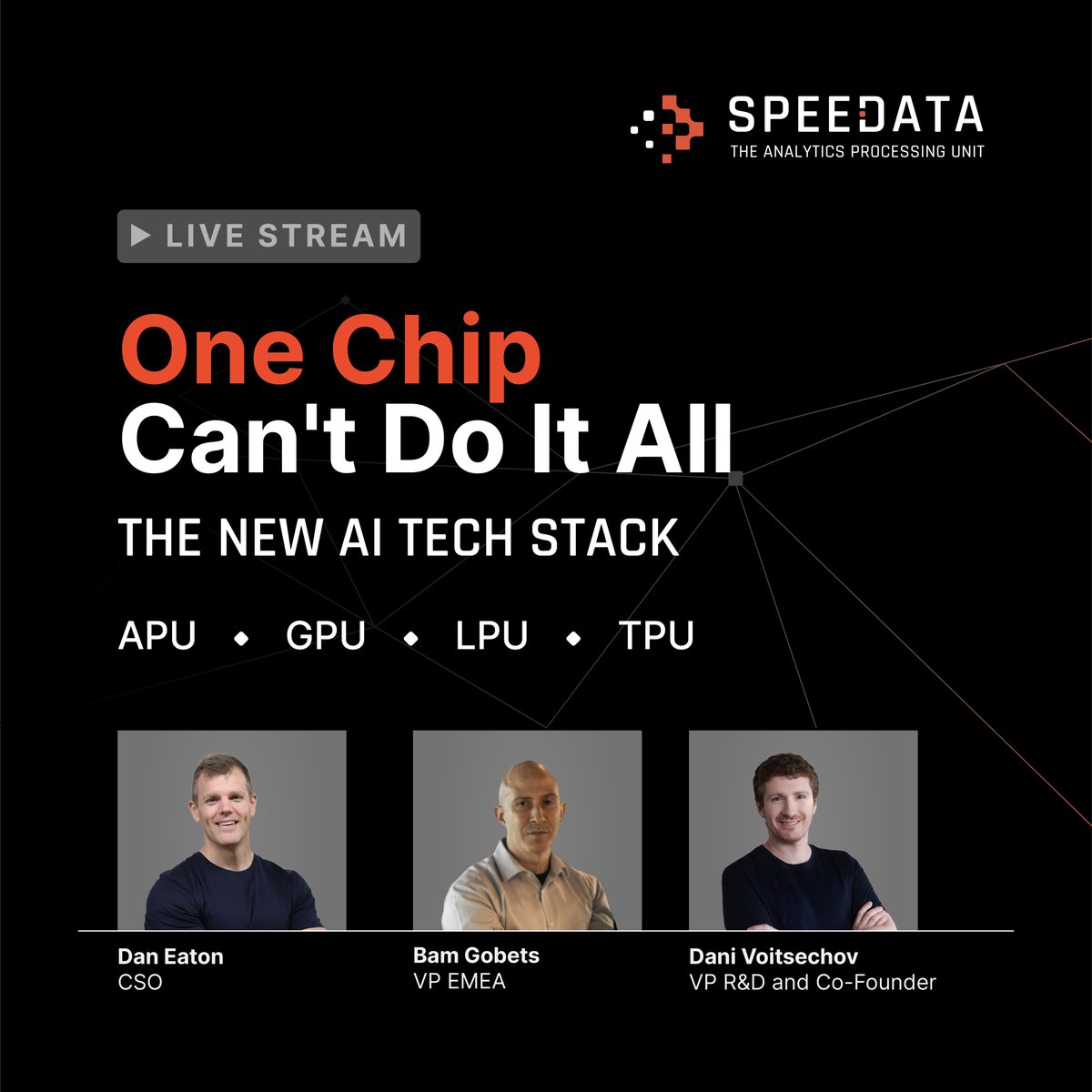
Speedata webinar, "One Chip Can't Do It All: The New #AI Tech Stack," is tomorrow 1PM EST. #GPUs, TPUs, LPUs, APUs - each one was built for a different job. We're breaking down where each processor fits in the AI compute pipeline - join us! linkedin.com/event/manage/7…

Intel is proud to join the Terafab project with @SpaceX, @xAI, and @Tesla to help refactor silicon fab technology. Our ability to design, fabricate, and package ultra-high-performance chips at scale will help accelerate Terafab’s aim to produce 1 TW/year of compute to power future advances in AI and robotics. It was fun hosting @elonmusk at Intel this past weekend!