Gerald Glickman

6.5K posts

Gerald Glickman banner
Gerald Glickman

Gerald Glickman

@GeraldGlickman

Privacy and digital identity advocate. Heatpunk. previous: Fellow @ BPI, product / risk / fraud prevention

Katılım Mayıs 2010
3.2K Takip Edilen1.4K Takipçiler
Sabitlenmiş Tweet
Gerald Glickman
Gerald Glickman@GeraldGlickman·
It's been about a full year of running my Bitcoin pool heater, so I figured I'd provide an update for those interested. Generally speaking, this has been a smashing success by all measures. The system has been running flawlessly and we've been enjoying the pool year-round.
Gerald Glickman@GeraldGlickman

Thrilled to introduce a quick overview of my Bitcoin pool heater! Unlike most pool heaters, this one is silent, can be fully enclosed, and helps to secure the world's largest peer to peer monetary network. (Reposting the original since Twitter deleted the original)

English

15
45
346
61.6K
Jon
Jon@prevhashnonce·
Rube-Goldberg Workflow The overall goal is to suck methane from an old coal mine via a Coal Bed Methane gob well (the mine operated from ~1917-1940), dry and regulate down to a pressure that is suitable to run generators for ₿itcoin mining. The compressor starts up with gas from a conventional well. Once the compressor warms up, its fuel source is switched over to the methane it extracts from the coal mine. That gas is then sent out to be dried and regulated. It first hits a filter separator, then an aftercooler, a drip, a desiccant tower, before the back pressure regulator which keeps that side at 200 psi. This enables the gas to be better dried and cooled. On the other side of the BPR there is another drip, the gas is stepped down to 65 psi where it passes a flaring unit (never use it, but it can be if needed). The gas then travels to a valve bank where a pilot motor valve sends gas out to a trunk line that feeds the generators, delivering a consistent 12 psi by opening and closing its valve based on demand. Any unused gas it pushed back to the suction side of the compressor. The gas that travels to the trunk line for the gens, passes through a meter, past a buffer tank to deliver a smooth flow of gas. And is regulated down via a reg at each generator unit. That’s basically it, that the Rube Goldberg machine I’ve created. It can be stressful as there are so many points of failure, but I love it and wouldn’t trade it for anything in the world. The last picture posted here is why I do it. ❤️ 👧🏻👧🏼👧🏼
Jon tweet mediaJon tweet media
Jon tweet media
Jon@prevhashnonce

Here's an example of why ₿itcoin mining for profit should be your number one concern. This gauge is the coalescer filter differential pressure gauge for my compressor. The compressor goes into automatic shutdown should that pressure exceed 15 PSID. A rather dumb device, if the needle hits the set threshold, the alarm panel will shut down the unit...simple. You'd think the gauge should cost $50 or so as it's a simple device, but alas it's a $300 + part. I have to watch every nickel and dime here in my operation, adhering strictly to sound economic principles. If I don't, this operation shuts down and I'm unable to contribute hashrate to the network.

English
4
3
28
1.3K
Gerald Glickman
Gerald Glickman@GeraldGlickman·
@Rlad1776 @JoeCarlasare "Risk" is subjective, as is the value of the "occasional useful point", and certainly the client and the attorney have different incentives and calibrations for both it's the marginal return for the client that drives this, along with market expectations of exhausting "useful"
English
0
0
0
15
RyanLad
RyanLad@Rlad1776·
Interesting and I’d say useful experiment would be to track matters for client 1 v client 2 over a year. You can get as granular as u want, but I’d say matter type, win rate, total cost (blended), filings. Gives you actual anecdotal data for when that conversation happens- which I’m assuming is only accelerating.
English
1
0
1
83
Joe Carlasare
Joe Carlasare@JoeCarlasare·
Two types of clients these days: Client 1 1. Lawyer carefully drafts motion to dismiss: 6.5 hrs 2. Sends the client a summary and draft motion: 0.1 hrs 3. Reviews/incorporates minor client edits: 0.5 hrs 4. Files motion Total billable time: 7.1 hrs Client 2 1. Lawyer carefully drafts motion to dismiss: 6.5 hrs 2. Sends client a summary and draft motion: 0.1 hrs 3. Lawyer reviews client’s 15 page AI-generated critique, revisions, rewrite, and “suggestions”: 2.5 hrs 4. Zoom/emails/calls explaining why most of the LLM’s output is inapplicable, wrong, or unhelpful, while conceding the occasional useful point: 2.5 hrs 5. Incorporates anything actually useful: 0.5 hrs 6. Files motion Total billable time: 11.6 hrs
English
31
4
143
18.8K
Gerald Glickman
Gerald Glickman@GeraldGlickman·
@matthew_pines The last time I was there I immediately thought of Vegas. Maybe it was the melodic noises from the games, the dead eyes of the paid characters, or just the unbridled jubilance of the uninitiated. Either way, an American classic. Hits differently as a dad.
English
0
0
1
106
Matthew Pines
Matthew Pines@matthew_pines·
I’m at a Chuck E. Cheese enjoying the ritual of American plenty in blinking technicolor: “hand-chopped salads”, cardboard pizza, “Dippin’ Dots”. The teens don their costumes in the break-room and drag on vapes. The bounce area is full and shrieking. I will drink too much pink lemonade. The empire feels no weakness. Springtime blooms.
English
14
4
143
10.3K
Daniel Ƀrrr
Daniel Ƀrrr@csuwildcat·
To elaborate: using a recursive ZKP scheme anchored on Bitcoin, it's possible to enable DNS domain owners to act as name-alias hosts for your root decentralized ID, such that they can't maliciously change the material the user hosts with them. Their only option for misbehavior is 404ing, but you can just change hosts
Daniel Ƀrrr@csuwildcat

What if I told you we could have DNS-based named identifiers, like Lightning addresses (alice@example.com), DID Web (did:web:alice.example.com), or other forms, where it is impossible for the domain owner to tamper with or replace the correct output? Would be a couple dozen txns per Bitcoin block for virtually unlimited addresses/users

English
2
0
2
1.3K
Liran Cohen (CTV + CSFS)
I think hard is very relative wrt lightning. Most people don't use lightning very privately because it makes it easier, but it also depends on who you're hiding from (receiver, LSP, state surveillance?) I think Bitcoin can be made private, and am excited for the Shielded CSV work that Ideal is working on... Much of that comes from research done at ZCash. Lightning swaps are also an extremely valuable tool for privacy that is under utilized. We have a long way to go with privacy tech but I don't think the answer is launching or promoting new coins.
English
1
0
1
44
Liran Cohen (CTV + CSFS)
Peddling nonsense once again... If you're so interested in Bitcoin privacy why did you launch a shitcoin rather than working on improving privacy in Bitcoin? Oh yeah, harder to get rich that way.
Cypherpunk ($CYPH)@cypherpunk

.@zooko: "Bitcoin is not a payment system that can empower individuals the way Zcashers and Hal Finney would have wanted."

English
8
0
13
2.1K
TFTC
TFTC@TFTC21·
OpenAI is partnering with Plaid to let ChatGPT users connect their bank accounts, credit cards, investment accounts, and other financial accounts directly to the chatbot. The feature gives ChatGPT a real-time view of your balances, transactions, stock portfolio, and liabilities including mortgages and credit card debt. Over 200 million people already use ChatGPT for finance questions monthly. Plaid connects to 12,000 financial institutions including Chase, Schwab, Fidelity, and Capital One. The feature launches first for US users on ChatGPT's $200/month Pro tier before expanding to all users. OpenAI says users can disconnect at any time, though the company retains data for up to 30 days after. Users can choose whether their financial data trains AI models under the option "Improve the model for everyone." Once data enters a training set, it's effectively irrecoverable. ChatGPT can't make changes to accounts or see full account numbers, but it can see everything else. Combined with the conversation history it already stores, including your goals, lifestyle, and priorities, this creates one of the most detailed financial profiles any private company has ever assembled on individual users. OpenAI does not specify what it will do with this data beyond AI training or what protections exist against a breach. Plaid itself paid a $58 million settlement in 2022 over allegations it collected more data than users understood they were sharing. Adding OpenAI as another party in the chain multiplies the attack surface. This follows ChatGPT Health in January, which connects to medical records. OpenAI now wants access to both your health data and your financial data. The feature is opt-in today. The pattern across tech has been consistent: start opt-in, then expand, then nudge, then default.
English
8
4
31
5.7K
Gerald Glickman
Gerald Glickman@GeraldGlickman·
@valkenburgh Perhaps the intended scope of the first is that private corporations are not at the center, and instead it's governments directly (even though in the US governments outsource these things to private firms in many contexts)?
English
0
0
0
9
Gerald Glickman
Gerald Glickman@GeraldGlickman·
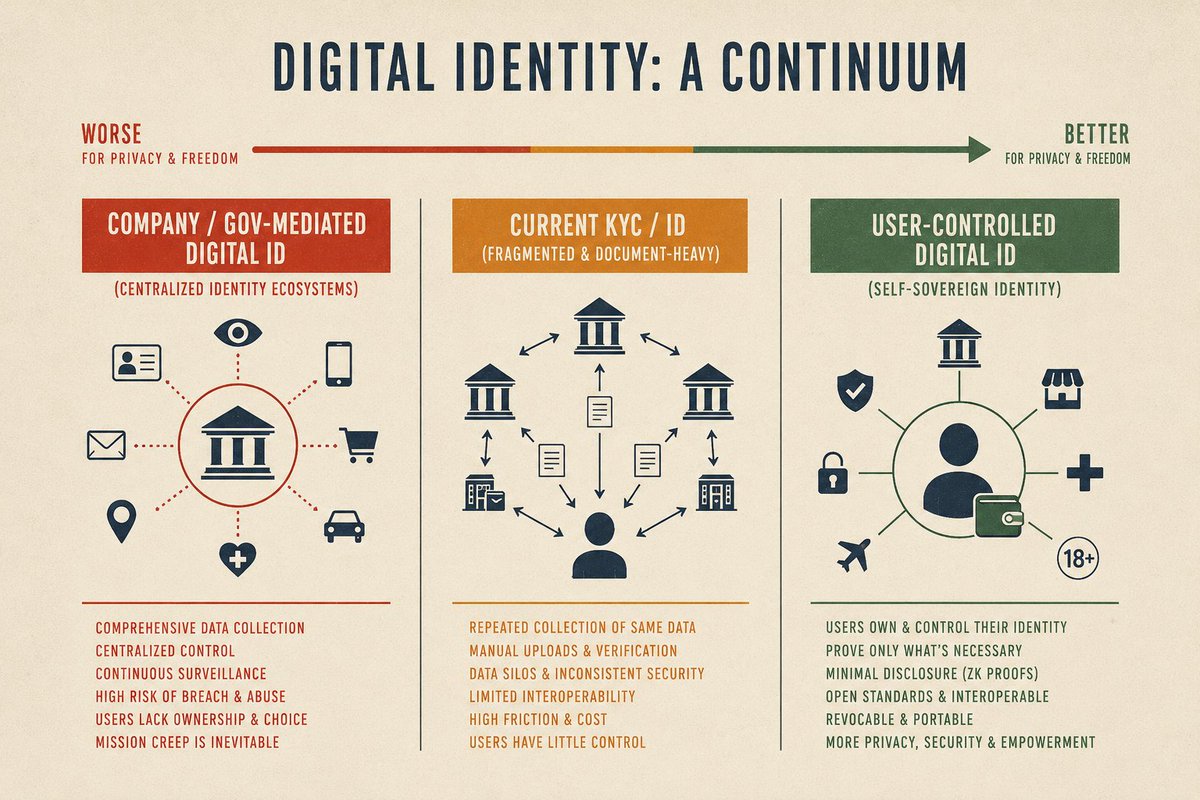
@valkenburgh IMHO, the first 2 effectively collapse into 1 - consumers repeatedly submit their documentation to for-profit entities under both models...but good frameworks have 3+ things 😅 Totally understand discrete boundaries may not exist - I'm definitely over trained on MECE frameworks
English
1
0
0
19
Peter Van Valkenburgh
Peter Van Valkenburgh@valkenburgh·
the image models are getting better. I still feel like this is too corporate power pointey despite much prompting from me.
Peter Van Valkenburgh tweet media
English
3
4
24
1.5K
Christopher Cialone 🏴‍☠️
Correct we are aligned I don’t see how this is different than what is already law today Misconduct is prosecuted and not the code itself is a funny way of giving leeway to aggressive prosecution for privacy developers who don’t play ball the way they would like in my opinion. Is it better than before, I guess in one sense but the bill is still a non starters based on the principles I follow Additionally and in parallel, the government is stepping to ‘redefine’ what privacy is, and separating anonymity and project in the digital realm Softening 1960 isn’t enough for me to think this should pass We are on the same side I just feel like we, and citizens in general, have compromised our rights too many times
English
2
0
1
36
Aaron Day
Aaron Day@AaronRDay·
The largest surveillance bill in US history is getting worse. KILL the CLARITY Act
TFTC@TFTC21

Last-minute negotiations between Banking Committee Republicans and Democrats this morning led to a compromise that removed language from the Blockchain Regulatory Certainty Act (BRCA) in Section 301 of the CLARITY Act. This is significant. The BRCA was the provision that explicitly protected noncustodial software developers from being classified as money transmitters. It was the direct response to the Tornado Cash and Samourai Wallet prosecutions, the carve-out that Senators Grassley and Lummis negotiated to shield good-faith developers while preserving prosecutors' ability to go after those who knowingly facilitate crime. That language has now been stripped to secure bipartisan votes. DeFi advocates are already raising alarms, saying the move could gut critical protections for software developers as the bill moves to the full Senate. Despite the concession, Senator Mark Warner (D-VA) still did not vote to advance the bill, even after positively referencing the changes during the markup. Senator Bernie Moreno said during the hearing that there's "still work to be done on Section 301," signaling that negotiations on developer protections will continue as the Banking Committee and Agriculture Committee merge their texts ahead of a floor vote. The bill passed committee 15-9. But the developer protection language that made this bill matter to the people actually building in Bitcoin just got traded away for votes that didn't even materialize.

English
5
97
215
10.3K
Gerald Glickman
Gerald Glickman@GeraldGlickman·
@cialoneCodes @AaronRDay To evaluate a proposal, understanding the current state is required, no? We are aligned that devs shouldn't be held liable for how people use their code - I see your advocacy there and appreciate that. BRCA explicitly changes this and provides protections that didn't exist 🤷
English
2
0
0
29
Jacob Robinson
Jacob Robinson@JacobRobinsonJD·
Monday's @LawofCodeFM podcast: the CLARITY Act. It's a multi-hour deep dive covering: 1. The history behind it 2. What gaps the 309-page bill addresses 3. How it regulates the industry 4. What projects need to know 5. Next steps to get it enacted You'll hear from experts like @NYcryptolawyer, @milesjennings, @SH_Brennan, @millercwl, @KyleBligen and Dugan Bliss, as well as snippets from prior episodes with @thatgerald and @BillHughesDC. Can't wait to share it.
Jacob Robinson tweet media
Eleanor Terrett@EleanorTerrett

🚨JUST IN: The Clarity Act ADVANCES out of the Senate Banking Committee in a 15-9 bipartisan vote, with two Democrats voting in favor: @SenRubenGallego and @Sen_Alsobrooks. Next stop: the full Senate.

English
12
10
72
11.3K
Michelle Weekley
Michelle Weekley@michelleweekley·
The government is not your friend. No amount of “Clarity” will change this.
TFTC@TFTC21

Last-minute negotiations between Banking Committee Republicans and Democrats this morning led to a compromise that removed language from the Blockchain Regulatory Certainty Act (BRCA) in Section 301 of the CLARITY Act. This is significant. The BRCA was the provision that explicitly protected noncustodial software developers from being classified as money transmitters. It was the direct response to the Tornado Cash and Samourai Wallet prosecutions, the carve-out that Senators Grassley and Lummis negotiated to shield good-faith developers while preserving prosecutors' ability to go after those who knowingly facilitate crime. That language has now been stripped to secure bipartisan votes. DeFi advocates are already raising alarms, saying the move could gut critical protections for software developers as the bill moves to the full Senate. Despite the concession, Senator Mark Warner (D-VA) still did not vote to advance the bill, even after positively referencing the changes during the markup. Senator Bernie Moreno said during the hearing that there's "still work to be done on Section 301," signaling that negotiations on developer protections will continue as the Banking Committee and Agriculture Committee merge their texts ahead of a floor vote. The bill passed committee 15-9. But the developer protection language that made this bill matter to the people actually building in Bitcoin just got traded away for votes that didn't even materialize.

English
8
4
56
1.8K