

Giacomo Benedetti
3.7K posts
Giacomo Benedetti
@giac77
Italian Indologist from Florence. For compassion and enlightenment.
Impruneta, Italy Katılım Temmuz 2010
1.5K Takip Edilen1.3K Takipçiler
Giacomo Benedetti retweetledi
West Bengal government formation updates: Suvendu Adhikari meets Bengal Governor, stakes claim to form government share.google/XUJsTu36aIgTBq…
English
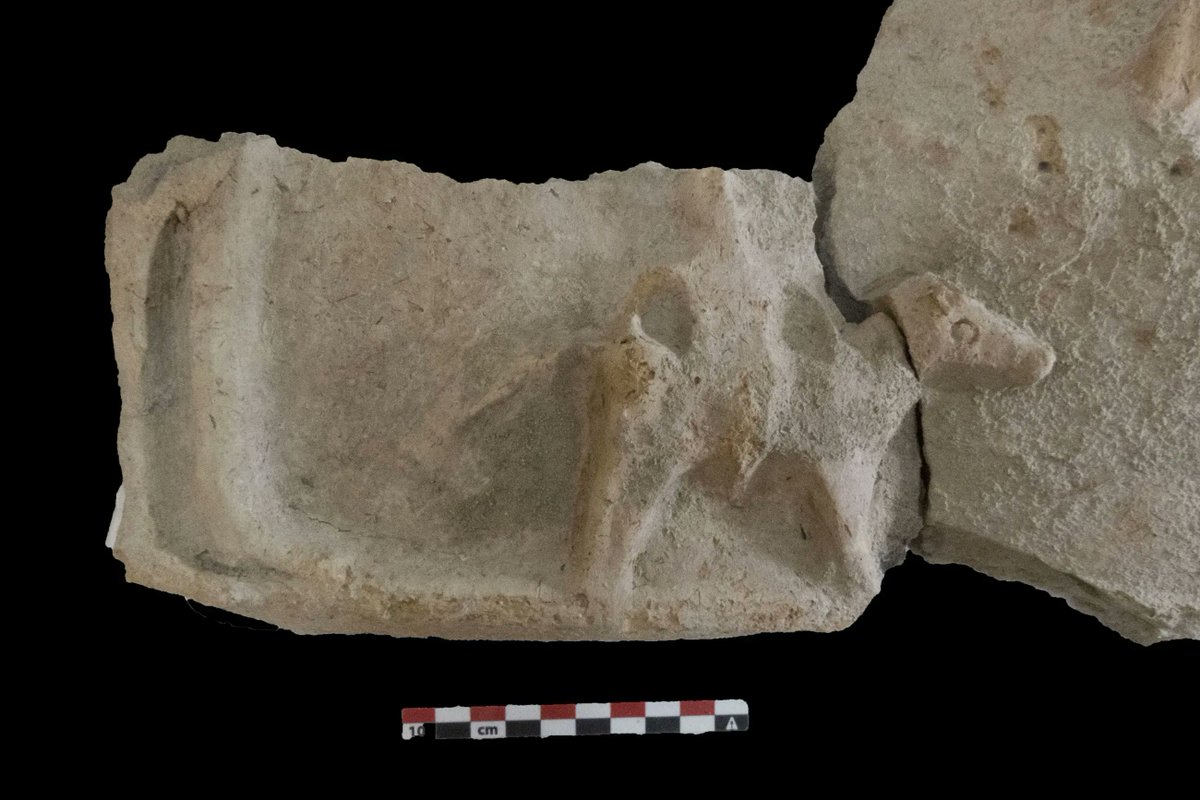
@Light3675 It seems to be one of the oldest representations of horse-riding, together with Ur III Abbakalla seal.
English
Interesting research about Kunara in Kurdistan, with (mounted?) horses at the end of 3rd millennium and unknown capacity unit, the "gur of Subartu": recherche.pantheonsorbonne.fr/actualite/le-s…
English
@DwivedulaKumar @Vritrahan2014 @gyanc7 Spoked wheels are quite evident also in Harappan terracotta wheels with painted or relief spokes. Mehrgarh amulets however have no place for an axle, they are not proper wheels, likely symbols of the circle of the seasons.
English
@Vritrahan2014 @giac77 @gyanc7 So the claim that the spoked wheel did not exist in india before the putative “aryans” brought them as chariots and that the chariots that did exist in india before 1500 BCE were ones with solid wheels and so they were less nimble and more like slower carts - all this is wrong?
English

Copper/Bronze wheel. Part of a toy cart or chariot. From Sankissa, Uttar Pradesh. Approximately 3,000 years old
Now preserved at the Shahjad Rai Research Institute, Baraut. This copper wheel is reminiscent of the 6,000-year-old copper spoked-wheel amulet from Mehrgarh. See here:
new-indology.blogspot.com/2016/12/the-wh…
Photo and Info: Dr. @AmitRaiJain1

English
@sarvamedha The coloring reminds the Tibetan style, I don't know a parallel in Indian tradition, and village brick houses of the region are not painted like that.
English

I think there should be more trees here, especially pipal which features prominently in Harappan iconography.
NiṣādaHermaphroditarchaṃśa (Mal'ta boy ka parivar)@real_mahalingam
These have to be the best reconstructions of IVC cities yet.
English
Giacomo Benedetti retweetledi

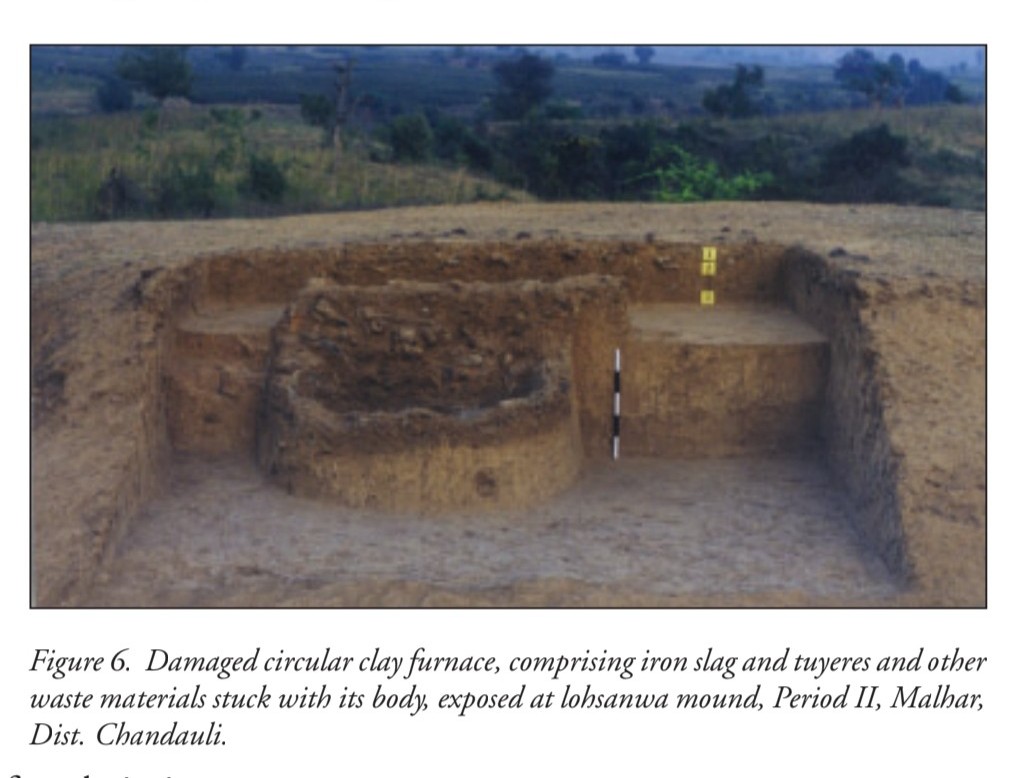
This is a furnace discovered at Malhar, dating approximately from 2000 to 1800 BCE, which is made of iron. All the iron tools recovered from this site belong to the same period or to a time close to it.
Archaeology Of Āryāvarta@SSundar55252
This is the upper part of an iron arrowhead discovered from Dadupur (Lucknow), dated to around 1600 BCE. For those who claim that iron did not exist in India during that period and question how wars (like the Mahabharata, etc.) were fought, It strongly counters their claim.
English
@Light3675 Yes, also Hakra ware should be IE. The culture that spread to Indus and Sarasvati valleys was the root of Indo-Aryan, I don't believe it was replaced later.
English
Giacomo Benedetti retweetledi
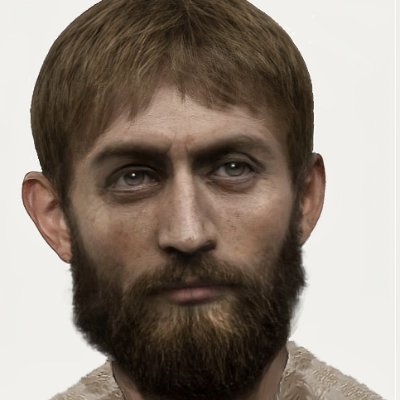
“The exact origin of bread wheat (Triticum aestivum) is still a mystery, but researchers believe they are edging closer to the source of one of the most important food staples worldwide.
Using genetic studies and ancient plant remains, an international team of scientists has narrowed the location and timeline to the Neolithic period(around 8,000 years ago) in Georgia, in the South Caucasus.”
phys.org/news/2026-04-a…
English
@nrken19 Sabines in fact belonged to the Osco-Umbrian group of languages, so they were cousins of the Umbrians rather than descendants.
English
“The autochthonous theory says that they had been in the Latium region since Prehistory. In that case, it is possible that, as Dionysius of Halicarnassus believed, their ancestors were the Umbrians, another Italic people of Indo-European language, whose presence there is attested since the second millennium B.C., and who belonged to the same family as the Volsci, Marsians, and Samnites, settled from north to south after a series of migrations along the Apennines, following the Latins.”
LBV Magazine / English Edition@lbvmag
Sabines, the Italic People Who Considered Themselves Originally from Sparta and Merged with the Romans After Several Centuries of Wars labrujulaverde.com/en/2026/04/sab…
English
@Light3675 Hakra ware is more eastern, but the earliest pottery in Mehrgarh II has western origin. Unfortunately there is no information about the affinities of Mehrgarh II population. We would need aDNA anyway.
English
@Light3675 From Mehrgarh III to Harappa there is anthropological continuity, as shown by Lukacs, what is the problem with RV? The loss of earlier oral poetry doesn't mean that they belonged to a different language.
English
@Light3675 Archaeologically, there is continuity from Neolithic Mehrgarh, and anthropologically at least from Chalcolithic Mehrgarh, so there is no support for the arrival of new people in Early Harappan.
English

@giac77 Furthermore, late introduction aligns with linguistic arguments much better, especially that of Gamkrelidze-Ivanov. You anyway date RV c. 2000 BCE beginning, so older presence in Indus is unnecessary, though material evidence shows continuity from Pre-Harappan to Early Harappan
English
@Light3675 Hi, the movements look good, but quite late, what is the reason for those dates?
English

Giacomo Benedetti retweetledi

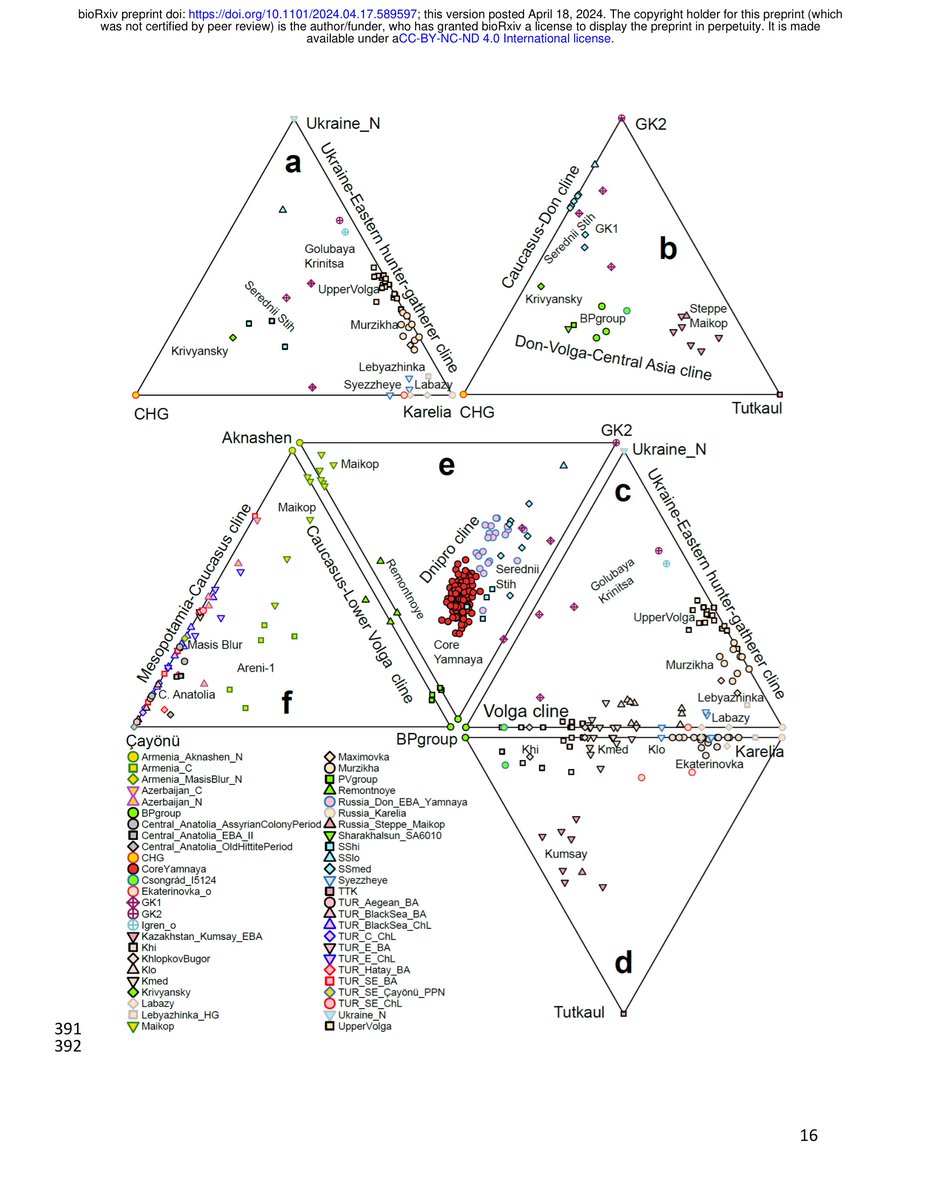
Every West Eurasian genome from 9000 BCE onward carries Iran_N ancestry, the signature of Zagros Neolithic farmers. It shows up in Anatolia Neolithic, in CHG, in the Yamnaya itself via the CHG component, in Indus Periphery individuals, in every modern Iranian, Kurd, Baloch, Gujarati, Brahmin, Tamil. The only population on earth that had Iran_N ancestry before anyone else is the Zagros Neolithic population itself. You don't get more central than being upstream of literally everyone. 4/15
pics👇
p1: Lazaridis_2024 Triangle plots of Yamnaya formation. The CHG vertex is pulling Iran_N ancestry north into the steppe, not the other way around.
p2: Formation of South Asian ancestry. Iran_N component is the deepest, oldest, and largest layer in every population.
p3: Even the Yamnaya themselves are roughly 50 percent CHG, which is itself downstream of Iran_N. The "steppe" homeland hypothesis depends on ancestry that originated in the Zagros-Caucasus zone.


English
Giacomo Benedetti retweetledi
The Swastika and Śrīvatsa symbols on this 4,500-year-old Harappan seal from Mohenjo Daro, Sindh are easily recognizable to anyone in the Dharmic world and beyond. Although neither is exclusive to Indians, both continue to hold important cultural significance for them even today.

English