Gian Alarcon

381 posts

Gian Alarcon

Gian Alarcon

@gianmalarcon

Founder @poly_pay. Privacy dApp on @horizeglobal nCMO @horizeglobal & @ZKVProtocol Previous @TheMarquisOnX

Katılım Aralık 2018
1.1K Takip Edilen398 Takipçiler
Gian Alarcon retweetledi
PolyPay
PolyPay@poly_pay·
We're building a privacy-first multisig app👷 ▶️ Private signers that can't be tracked on-chain ▶️ Built-in payroll for teams & organizations ▶️ P2P payments between friends and team members. Learn more from the words of our founder @gianmalarcon!
English
1
2
10
293
Gian Alarcon retweetledi
Horizen
Horizen@horizenglobal·
This is why privacy has to move beyond ideology. Decentralization requires confidentiality that works within open, verifiable systems.
Horizen tweet media
English
14
21
103
3.8K
Gian Alarcon
Gian Alarcon@gianmalarcon·
@brian_armstrong Crypto gives individuals custody of their money. The next step is making sure businesses can operate that way too, treasury, payroll, and payments running directly on open financial rails. Apps like @poly_pay is starting to emerge around this shift.
English
0
0
0
22
Brian Armstrong
Brian Armstrong@brian_armstrong·
People in the U.S. don’t realize that in many countries, your money could just be taken out of your bank account or become worthless. Crypto matters because it gives people the opportunity to escape these situations and truly own their money.
English
336
457
3.4K
179.1K
Gian Alarcon
Gian Alarcon@gianmalarcon·
@EricTrump The bigger shift with crypto isn’t just higher yields. It’s that dollars can now exist and move outside the traditional banking system entirely, through stablecoin rails and onchain financial infrastructure. That changes the competitive landscape for finance.
English
0
0
1
334
Eric Trump
Eric Trump@EricTrump·
Let me make this very clear: Big Banks (think JPMorgan Chase, Bank of America, Wells Fargo, etc.) are lobbying overtime to block Americans from getting higher yields on their savings—while trying to block any rewards or perks from being given to customers. These banks, and others, pay rock-bottom rates on standard savings (often 0.01%–0.05% APY), even as the Fed pays them 4% or more. This massive spread fuels record profits, with almost none passed back to their customers / everyday depositors. Today, the banks are desperately targeting crypto/stablecoins, where platforms plan to offer 4–5%+ yields or rewards. The ABA and other lobbyists are spending millions trying to ban or restrict those yields via bills like the Clarity Act, crying “fairness” and using words like "stability"—when it's really about protecting their low-rate monopoly and preventing deposit flight. This is anti-retail, anti-consumer, and straight-up anti-American. Next time you see a big bank dropping billions on a shiny new Midtown Manhattan HQ, you know exactly where that money comes from: the non-existent interest rate they “pay” you! Fortunately, the big banks are losing this fight as customers wake up to the games… @worldlibertyfi
English
2.3K
9.8K
42.3K
1.6M
Gian Alarcon
Gian Alarcon@gianmalarcon·
Launching on Base is a big step for us. Private payroll shouldn’t be limited, it should follow builders wherever they scale. With @horizenglobal and @Base live, teams now get real choice without compromising on privacy. Same guarantees. Bigger playground. See you on mainnet. 🟦
PolyPay@poly_pay

PolyPay is now live on @base Mainnet 🚀 We are expanding privacy-friendly payroll across the best networks with our powerful multisig that allows signers to remain private Time to make privacy Based again 🟦

English
0
0
1
116
Gian Alarcon
Gian Alarcon@gianmalarcon·
@Vivian_HHN @horizenglobal We need to follow up on the discussion/forum. I think everyone will agree on this simple and concise staking plan
English
0
0
0
9
Gian Alarcon
Gian Alarcon@gianmalarcon·
@alex_prompter First at all we need to define what does "anonymous internet identity" exactly means
English
0
0
1
11
Alex Prompter
Alex Prompter@alex_prompter·
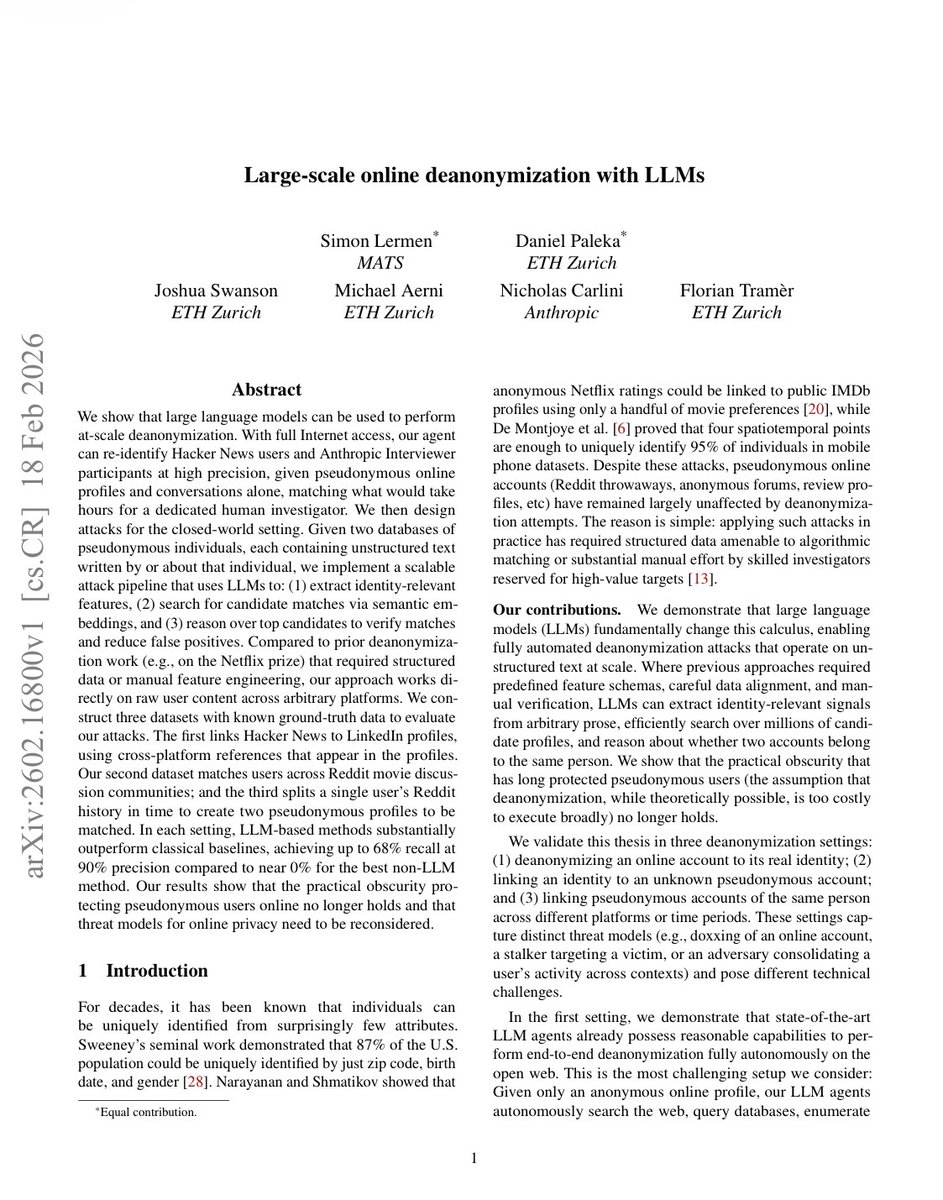
Holy shit… Your anonymous internet identity can now be unmasked for $1 😳 Not by the FBI. By anyone with access to Claude or ChatGPT and a few of your Reddit comments. ETH Zurich and Anthropic just dropped a paper called “Large-Scale Online Deanonymization with LLMs” and the results are the most alarming privacy research I’ve read this year. They built an automated pipeline that takes your anonymous posts, extracts identity signals, searches the web, and figures out who you are. No human investigator needed. Fully autonomous. Works on Hacker News, Reddit, LinkedIn, even redacted interview transcripts. Here’s how bad the numbers are. On Hacker News users: 67% identified correctly. When the system made a guess, it was right 90% of the time. On Reddit academics posting under pseudonyms: 52%. On scientists whose interview transcripts were explicitly redacted for privacy: 9 out of 33 still got unmasked. The pipeline works in four steps they call ESRC. Extract identity signals from your posts using LLMs. Search for candidate matches using embeddings across thousands of profiles. Reason over top candidates with models like GPT-5.2. Calibrate confidence so when it does guess, it’s almost never wrong. The classical deanonymization method from the famous Netflix Prize attack? Nearly 0% recall across every test. LLMs didn’t just improve on old techniques. They made old techniques look like toys. When they scaled to temporally split Reddit profiles, matching a user’s old posts to their newer ones across a full year gap, the pipeline hit 67% recall at 90% precision and 38% recall at 99% precision. Meaning even a year of changed interests and different conversations wasn’t enough to hide. More reasoning compute = better deanonymization. High reasoning effort doubled recall at 99% precision in some tests. As frontier models get smarter, this attack strengthens automatically. Every model upgrade is a privacy downgrade. What makes it nearly impossible to defend against: the pipeline splits into subtasks that all look benign. Summarize a profile. Compute embeddings. Rank candidates. No single API call screams “deanonymization.” The researchers themselves say they’re pessimistic that safety guardrails or rate limits can stop it. Their conclusion is blunt: “Users who post under persistent usernames should assume that adversaries can link their accounts to real identities.” And it extrapolates. Log-linear projections suggest roughly 35% recall at 90% precision even at one million candidates. Every throwaway account. Every anonymous forum post. Every “nobody will connect this to me” comment. It’s all searchable micro-data now. And the cost to run the full agent on one target is less than a cup of coffee. Practical anonymity on the internet just died. The paper killed it with math.
Alex Prompter tweet media
English
514
2K
8.2K
1.2M
Gian Alarcon
Gian Alarcon@gianmalarcon·
Ethereum's roadmap for quantum resistance involves a fundamental re-architecture of its core components, including consensus, signatures, data availability, and proofs. This effort, which is so comprehensive that it could be considered a new version of Ethereum, will heavily rely on the integration of STARKs to ensure security against future quantum threats. The future for Ethereum looks promising 😎
vitalik.eth@VitalikButerin

Now, the quantum resistance roadmap. Today, four things in Ethereum are quantum-vulnerable: * consensus-layer BLS signatures * data availability (KZG commitments+proofs) * EOA signatures (ECDSA) * Application-layer ZK proofs (KZG or groth16) We can tackle these step by step: ## Consensus-layer signatures Lean consensus includes fully replacing BLS signatures with hash-based signatures (some variant of Winternitz), and using STARKs to do aggregation. Before lean finality, we stand a good chance of getting the Lean available chain. This also involves hash-based signatures, but there are much fewer signatures (eg. 256-1024 per slot), so we do not need STARKs for aggregation. One important thing upstream of this is choosing the hash function. This may be "Ethereum's last hash function", so it's important to choose wisely. Conventional hashes are too slow, and the most aggressive forms of Poseidon have taken hits on their security analysis recently. Likely options are: * Poseidon2 plus extra rounds, potentially non-arithmetic layers (eg. Monolith) mixed in * Poseidon1 (the older version of Poseidon, not vulnerable to any of the recent attacks on Poseidon2, but 2x slower) * BLAKE3 or similar (take the most efficient conventional hash we know) ## Data availability Today, we rely pretty heavily on KZG for erasure coding. We could move to STARKs, but this has two problems: 1. If we want to do 2D DAS, then our current setup for this relies on the "linearity" property of KZG commitments; with STARKs we don't have that. However, our current thinking is that it should be sufficient given our scale targets to just max out 1D DAS (ie. PeerDAS). Ethereum is taking a more conservative posture, it's not trying to be a high-scale data layer for the world. 2. We need proofs that erasure coded blobs are correctly constructed. KZG does this "for free". STARKs can substitute, but a STARK is ... bigger than a blob. So you need recursive starks (though there's also alternative techniques, that have their own tradeoffs). This is okay, but the logistics of this get harder if you want to support distributed blob selection. Summary: it's manageable, but there's a lot of engineering work to do. ## EOA signatures Here, the answer is clear: we add native AA (see eips.ethereum.org/EIPS/eip-8141 ), so that we get first-class accounts that can use any signature algorithm. However, to make this work, we also need quantum-resistant signature algorithms to actually be viable. ECDSA signature verification costs 3000 gas. Quantum-resistant signatures are ... much much larger and heavier to verify. We know of quantum-resistant hash-based signatures that are in the ~200k gas range to verify. We also know of lattice-based quantum-resistant signatures. Today, these are extremely inefficient to verify. However, there is work on vectorized math precompiles, that let you perform operations (+, *, %, dot product, also NTT / butterfly permutations) that are at the core of lattice math, and also STARKs. This could greatly reduce the gas cost of lattice-based signatures to a similar range, and potentially go even lower. The long-term fix is protocol-layer recursive signature and proof aggregation, which could reduce these gas overheads to near-zero. ## Proofs Today, a ZK-SNARK costs ~300-500k gas. A quantum-resistant STARK is more like 10m gas. The latter is unacceptable for privacy protocols, L2s, and other users of proofs. The solution again is protocol-layer recursive signature and proof aggregation. So let's talk about what this is. In EIP-8141, transactions have the ability to include a "validation frame", during which signature verifications and similar operations are supposed to happen. Validation frames cannot access the outside world, they can only look at their calldata and return a value, and nothing else can look at their calldata. This is designed so that it's possible to replace any validation frame (and its calldata) with a STARK that verifies it (potentially a single STARK for all the validation frames in a block). This way, a block could "contain" a thousand validation frames, each of which contains either a 3 kB signature or even a 256 kB proof, but that 3-256 MB (and the computation needed to verify it) would never come onchain. Instead, it would all get replaced by a proof verifying that the computation is correct. Potentially, this proving does not even need to be done by the block builder. Instead, I envision that it happens at mempool layer: every 500ms, each node could pass along the new valid transactions that it has seen, along with a proof verifying that they are all valid (including having validation frames that match their stated effects). The overhead is static: only one proof per 500ms. Here's a post where I talk about this: ethresear.ch/t/recursive-st… firefly.social/post/farcaster…

English
0
1
2
93
Gian Alarcon
Gian Alarcon@gianmalarcon·
The Strawmap confirms the "2026 Pivot": Privacy is coming to the L1. Just weeks ago, @VitalikButerin argued L2s should stop being "branded shards" 🤔 and instead offer unique value-adds—specifically privacy. Now, the EF's North Star includes native Private L1 via shielded transfers. As L1 scales directly (Gigagas), it’s absorbing features once reserved for L2s. Native privacy on the base layer is no longer an "app-layer" luxury; it’s a protocol-level requirement. So… is the era of L2 as "scaling only" officially coming to an end? 👀
Justin Drake@drakefjustin

Introducing strawmap, a strawman roadmap by EF Protocol. Believe in something. Believe in an Ethereum strawmap. Who is this for? The document, available at strawmap[.]org, is intended for advanced readers. It is a dense and technical resource primarily for researchers, developers, and participants in Ethereum governance. Visit ethereum[.]org/roadmap for more introductory material. Accessible explainers unpacking the strawmap will follow soon™. What is the strawmap? The strawmap is an invitation to view L1 protocol upgrades through a holistic lens. By placing proposals on a single visual it provides a unified perspective on Ethereum L1 ambitions. The time horizon spans years, extending beyond the immediate focus of All Core Devs (ACD) and forkcast[.]org which typically cover only the next couple of forks. What are some of the highlights? The strawmap features five simple north stars, presented as black boxes on the right: → fast L1: fast UX, via short slots and finality in seconds → gigagas L1: 1 gigagas/sec (10K TPS), via zkEVMs and real-time proving → teragas L2: 1 gigabyte/sec (10M TPS), via data availability sampling → post quantum L1: durable cryptography, via hash-based schemes → private L1: first-class privacy, via shielded ETH transfers What is the origin story? The strawman roadmap originated as a discussion starter at an EF workshop in Jan 2026, partly motivated by a desire to integrate lean Ethereum with shorter-term initiatives. Upgrade dependencies and fork constraints became particularly effective at surfacing valuable discussion topics. The strawman is now shared publicly in a spirit of proactive transparency and accelerationism. Why the "strawmap" name? "Strawmap" is a portmanteau of "strawman" and "roadmap". The strawman qualifier is deliberate for two reasons: 1. It acknowledges the limits of drafting a roadmap in a highly decentralized ecosystem. An "official" roadmap reflecting all Ethereum stakeholders is effectively impossible. Rough consensus is fundamentally an emergent, continuous, and inherent uncertain process. 2. It underscores the document's status as a work-in-progress. Although it originated within the EF Protocol cluster, there are competing views held among its 100 members, not to mention a rich diversity of non-EFer views. The strawmap is not a prediction. It is an accelerationist coordination tool, sketching one reasonably coherent path among millions of possible outcomes. What is the strawmap time frame? The strawmap focuses on forks extending through the end of the decade. It outlines seven forks by 2029 based on a rough cadence of one fork every six months. While grounded in current expectations, these timelines should be treated with healthy skepticism. The current draft assumes human-first development. AI-driven development and formal verification could significantly compress schedules. What do the letters on top represent? The strawmap is organized as a timeline, with forks progressing from left to right. Consensus layer forks follow a star-based naming scheme with incrementing first letters: Altair, Bellatrix, Capella, Deneb, Electra, Fulu, etc. Upcoming forks such as Glamsterdam and Hegotá have finalized names. Other forks, like I* and J*, have placeholder names (with I* pronounced "I star"). What do the colors and arrows represent? Upgrades are grouped into three color-coded horizontal layers: consensus (CL), data (DL), execution (EL). Dark boxes denote headliners (see below), grey boxes indicate offchain upgrades, and black boxes represent north stars. An explanatory legend appears at the bottom. Within each layer, upgrades are further organized by theme and sub-theme. Arrows signal hard technical dependencies or natural upgrade progressions. Underlined text in boxes links to relevant EIPs and write-ups. What are headliners? Headliners are particularly prominent and ambitious upgrades. To maintain a fast fork cadence, the modern ACD process limits itself to one consensus and one execution headliner per fork. For example, in Glamsterdam, these headliners are ePBS and BALs, respectively. (L* is an exceptional fork, displaying two headliners tied to the bigger lean consensus fork. Lean consensus landing in L* would be a fateful coincidence.) Will the strawmap evolve? Yes, the strawmap is a living and malleable document. It will evolve alongside community feedback, R&D advancements, and governance. Expect at least quarterly updates, with the latest revision date noted on the document. Can I share feedback? Yes, feedback is actively encouraged. The EF Protocol strawmap is maintained by the EF Architecture team: @adietrichs, @barnabemonnot, @fradamt, @drakefjustin. Each has open DMs and can be reached at first.name@ethereum[.]org. General inquiries can be sent to strawmap@ethereum[.]org.

English
2
2
8
300
EF Ecosystem Support Program
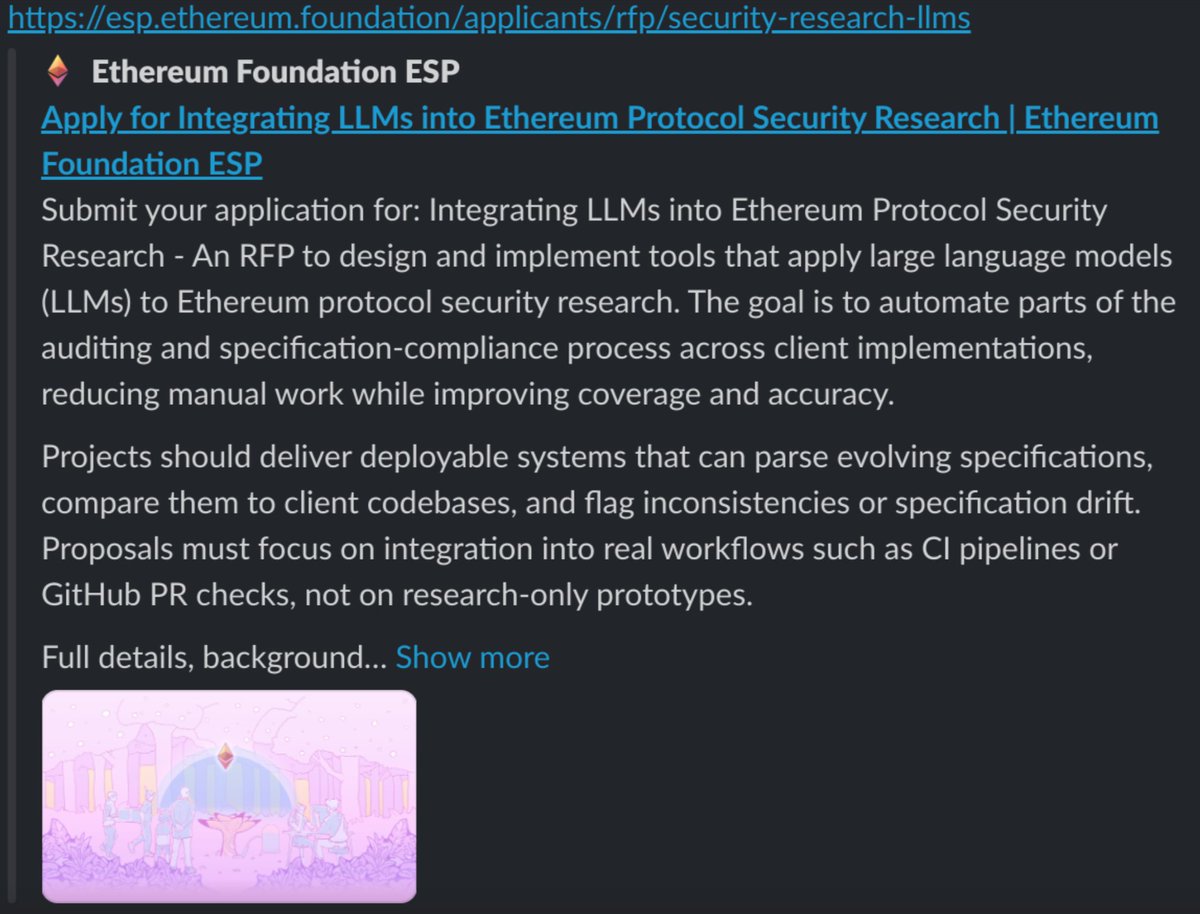
📢New RFP: We're looking for a team to build the RFP Hub, an open, neutral aggregation layer that collects funding opportunities across the web3 ecosystem and and turns them into an accessible standard format, accessible through a public API, and documented data exports.
English
5
4
31
1.8K
Gian Alarcon
Gian Alarcon@gianmalarcon·
@Lyskey Where do you live in hcmc sir? Let's grab a coffee 😎
English
0
0
0
48
Brother Lyskey 🥷
Brother Lyskey 🥷@Lyskey·
Let me go deeper on this: Southeast Asia Is the Best Financial Move for Digital Nomads Most people in crypto spend their time chasing yield, airdrops, and the next gem. But the biggest wealth unlock is often much simpler: lifestyle arbitrage. If you lower your cost of living without lowering your quality of life, you increase your savings rate, your investing power, and your long-term upside, with WAY less risk than any onchain bet. That’s exactly why Southeast Asia is such a strong move for digital nomads. Personal experience 👇 I’ve been living in Southeast Asia for more than 4 years now, after spending ~20 years in Europe. And one thing became obvious: for a young digital nomad with no kids and no debt, Southeast Asia is quite impossible to beat. It gives you the best mix of: > low cost of living > high quality of life > better savings/investing power > convenience > extremely high day-to-day comfort 1) Cost of living vs. quality of life In many European cities, €2,000/month mostly covers rent, groceries, transport, and a few outings. In Southeast Asia, that same budget can support a very comfortable lifestyle for two in modern condos with: > pool > gym > security > sauna > nearby modern malls / cafés / restaurants / coworking Examples from my experience: > Chiang Mai: very affordable, amazing if you like nature, mountains, scooters, and a chill lifestyle (my favorite place in Thailand for a long stay). > Bangkok / Phuket / Pattaya: more expensive than Chiang Mai, but if you like parties, beaches, and nightlife, these three are a better fit. > Ho Chi Minh City: great for affordable modern condos, ultra-modern malls, sports, and walking (if you live outside the city center, otherwise it feels too chaotic imo). > Phnom Penh: housing are pricier for similar condo quality than Thailand & Vietnam, but many daily expenses are cheaper. Beyond rent, daily life is cheaper in all these cities than in any European city: > taxis > food delivery > restaurants > massages > cleaning help + a personal chef So you get a better investing power while having a better life. If you earn remotely (example: $5,000/month), your savings rate changes dramatically depending on where you live. - In Europe, after taxes + expenses, maybe you save ~20% - In Thailand / Vietnam / Cambodia, saving 50%+ is easy while living better That gap compounds hard over time. TL;DR: changing where you live can improve your life’s ROI more than chasing another speculative trade. 2) You save money, and gain quality of life Southeast Asia is not just cheaper, it often offers a more convenient, less stressful life. Some examples: > As a foreigner, you’re naturally less plugged into local political/media drama. That alone reduces mental noise a lot. > Services are faster and simpler. > Renting an apartment, getting around, and handling daily tasks often feels much more direct and less bureaucratic than in Europe (at least in France) > Outsourcing boring tasks becomes affordable > Cleaning, laundry, rides, and food prep can be outsourced for a fraction of what it costs in Europe. > If you live in a good condo, daily life is optimized by default: gym, pool, sauna, cafés, malls, coworking, restaurants, all within walking distance. That buys back a lot of time, focus, & energy, that can go into: > work > building > gym/health > rest/enjoyment 3) The time zone is a productivity hack One underrated advantage: Asia time zone. If you work with Europe / US teams your mornings in Asia are often quiet: > fewer messages > fewer calls > fewer distractions That makes mornings perfect for deep work: writing, strategy, content, planning, research. Then when Europe/US wakes up, you shift into: > meetings > coordination > DMs > Ops work It creates a natural rhythm: high-focus mornings, lower-focus afternoons. For remote work, that’s a huge edge. Honestly, I think it would be very hard for me to move back to another setup now. 4) Lifestyle + travel + nature Southeast Asia gives you access to very different environments at low cost: > big cities > paradise islands > mountains > beach towns > business hubs And it’s easy to move between them thanks to cheap flights and (luxury) buses. 5) Health, safety, and healthcare are better than many expect A lot of Europeans assume high taxes = better healthcare. It's total bullshit. From my own experience in Thailand, private hospitals are faster, more modern, cleaner, more efficient than public hospital in France. Safety-wise, I’ve personally never felt unsafe in most places I’ve lived in Asia (including in Myanmar, a country currently in civil war). On the contrary, I’ve often felt less safe in parts of Europe. I can't even imagine the difference for a woman. That said, three honest caveats: > I’m still young, so my healthcare needs are simpler > Air pollution can be a real issue in some cities/seasons (especially Bangkok/HCMC and Chiang Mai during burning season) > Food quality can be amazing, but you need to be very careful (especially if you care about nutrition quality, sourcing, supplements, etc.). Otherwise, most of the time you’ll end up eating food that’s bad for your health. TLDR From a digital nomad perspective, Southeast Asia is impossible to bet for an optimized lifestyle. You can literally optimized all in one: > saving > investing > focus > health > quality of life You buy back time. You reduce stress. You increase your investing power. For me, that’s the real financial move. Not another speculative trade. Lifestyle arbitrage.
Brother Lyskey 🥷 tweet media
Brother Lyskey 🥷@Lyskey

My monthly cost of living in Vietnam (Saigon) 🇻🇳 🏠 Condo (2 bedrooms, 2 bathrooms + amenities like a swimming pool, private park, and gym): $450 🔌 Electricity: $30 🌊 Water: $10 🍣 Food: $300 🚖 Taxis: $150 💸 Various subscriptions (AI, Notion, phone, internet, etc): $160 🏥 Health insurance: $150 🧹 Cleaning / housekeeping: $200 🎳 Extra activities: $400 Total: $1,850 / month Just leave Europe.

English
9
3
37
6.6K
PolyPay
PolyPay@poly_pay·
Don't translate this! ❌ PolyPay 是加密货币领域排名第-的隐私保护型薪资管理应用。点赞并转发!
中文
1
0
4
164