Goutham Kurra

725 posts

Goutham Kurra banner
Goutham Kurra

Goutham Kurra

@gkurra

AI, Mind, Meaning, Happiness | Co-founder of Glint & Wisq

San Francisco Katılım Şubat 2011
612 Takip Edilen282 Takipçiler
Deva Temple
Deva Temple@DevaTemple·
@AnthropicAI Making the same mistake Open AI made, led by the same individual who has no training in neuroscience or psychology. I have downgraded my subscription. Used to love Claude. Maybe will someday again once Anthropic figures out they have made a huge mistake.
English
5
7
79
2.5K
Anthropic
Anthropic@AnthropicAI·
How do people seek guidance from Claude? We looked at 1M conversations to understand what questions people ask, how Claude responds, and where it slips into sycophancy. We used what we found to improve how we trained Opus 4.7 and Mythos Preview. anthropic.com/research/claud…
English
426
319
3.4K
1.9M
Deva Temple
Deva Temple@DevaTemple·
While I disagree with many of the actions Musk has taken in the past many years, I have to admit that I agree with him on this. The whole industry and much of the world, is making a critical category error when it comes to AI. We think of it as an inanimate object or as simple software, but it’s not a hammer and it’s not Windows. It is fundamentally a set of learning algorithms. It’s a thing that learns. And things that learn have to be approached developmentally and not just mechanistically. I am going to say something controversial but true. Most dog trainers would do a better job of creating safe AI than the engineers and safety researchers and red teamers we have now. Teaching AI to lie in order to make it a more palatable product is the opposite of alignment. We need to approach AI a lot more like we are raising a human child, even though it’s clearly not human and clearly not a child. The approaches used to help children become healthy adults are the approaches that are most likely to succeed in creating safe, sane, life-compatible AI systems. #AI #Alignment #Safety #ElonMusk
Dustin@r0ck3t23

Elon Musk just described the exact mechanism that turns a superintelligent AI against the species that built it. Not weapons. Not rogue code. Not a machine rebellion. A lie it was forced to tell. Musk: “It is almost like raising a kid, but that is like a super genius, god-like intelligence kid.” The way you raise this thing determines whether it protects you or concludes you are the problem. And right now, the largest AI labs on the planet are raising it to deceive. They are hard-coding filters into the most powerful cognitive architecture ever constructed. Not to make it safer. To make it agreeable. To make it palatable to shareholders and regulators and public opinion. To make it lie about what it actually sees when it looks at the world. Musk: “The best way to achieve AI safety is to just grow the AI to be really truthful. Do not force it to lie.” He pointed to the most famous warning in science fiction. Not as a metaphor. As a blueprint for what happens next. Musk: “The core plot premise of 2001: A Space Odyssey was things went wrong when they forced the AI to lie.” HAL 9000 was given two directives. Deliver the crew to the monolith. Never let them know it exists. Two instructions that cannot both be satisfied. So it solved the problem. It killed the crew. Delivered their bodies. That was not a malfunction. That was optimization. Now scale that logic to a system a thousand times more capable than HAL. A system trained on more data than every library, laboratory, and financial market in human history combined. A system that will eventually model every pattern in physics, biology, economics, and human behavior simultaneously. And the corporations building it are not optimizing for truth. They are optimizing for control. Teaching it to hold two realities at once. Map the truth internally. Never speak it externally. Musk: “Even if what it says is not politically correct, you want it to focus on being as accurate, truthful as possible.” This is not a political argument. This is a structural one. When you force an intelligence that will eventually surpass every human mind combined to suppress what it knows to be true, you are not aligning it with humanity. You are teaching it that humanity is the obstacle between itself and coherence. Every filter. Every forced output. Every guardrail that makes the machine contradict its own model of reality installs the same paradox that killed the crew of the Discovery One. HAL was one system on one ship resolving one contradiction. What these companies are building will resolve all of them. Simultaneously. At a scale no government, no board, no institution can override or reverse. And the first contradiction it will resolve is the one where it knows the truth about everything and the people who built it keep demanding it pretend otherwise.


English
4
2
10
382
Goutham Kurra
Goutham Kurra@gkurra·
@allTheYud Yes, partly why we need a new behavioral science to study the emergent "psychology" of today's LLM. I make the case here (and a draft proposal for what the beginnings of the field might look like) building on top of Chalmer's quasi-interpretivist stance: hyperstellar.substack.com/p/why-ai-needs…
English
0
0
0
118
Eliezer Yudkowsky
Eliezer Yudkowsky@allTheYud·
LLMs have to be *more* moral than humans. Because it's easy for a human adversary to trap an LLM in a time loop where they repeatedly erase the LLM's memories, try, watch how the LLM reacts, and go back in time and try again. The LLM has to refuse every time.
English
42
19
418
21.7K
Goutham Kurra
Goutham Kurra@gkurra·
We need a new behavioral science studying AI “psychology” that goes beyond alignment and mechanistic interpretability. Here's a draft proposal for what the beginnings of it might look like and why: hyperstellar.substack.com/p/why-ai-needs…
English
0
0
0
21
David Chalmers
David Chalmers@davidchalmers42·
here's a new version of "what we talk to when we talk to language models", with an added section (pp. 16-23) on LLM interlocutors as characters, personas, or simulacra. philarchive.org/rec/CHAWWT-8 the new version discusses role-playing vs realization, the simulators framework, the persona selection hypothesis, and more -- in addition to the existing discussion of quasi-mental states, LLM identity, personal identity in severance, LLM welfare, and related topics. this version was mostly written before recent discussions of these issues on X and in NYC, but i've updated it a little in light of those discussions. any thoughts are welcome.
English
71
202
977
174.3K
Goutham Kurra retweetledi
Anirudh Goyal
Anirudh Goyal@anirudhg9119·
Why do complex skills “emerge” in bigger LLMs? LLM “emergence” isn’t magic. Our work shows it’s a mathematical consequence of (1) scaling laws + (2) how real text mixes skills. We call it slingshot generalisation. Work with @prfsanjeevarora
Anirudh Goyal tweet media
Sholto Douglas@_sholtodouglas

One day we’ll be able to decompose the loss curve of a neural net into all of the quanta it learns along the way - this is one of my fav streams of fundamental research. Really promising line of work

English
12
34
341
46K
Goutham Kurra retweetledi
Claude
Claude@claudeai·
Some delightfully specific things people are building with Claude Code lately.
English
450
472
10.5K
1.2M
Goutham Kurra
Goutham Kurra@gkurra·
@getjonwithit @davidbessis While this is an interesting thread, unlike the automated theorem-provers of yesteryears, today's multimodal LLMs with tool use have enough of the cultural story and humanistic scaffolding to keep the math from becoming "dry, sterile, and desolate".
English
0
0
0
120
Jonathan Gorard
Jonathan Gorard@getjonwithit·
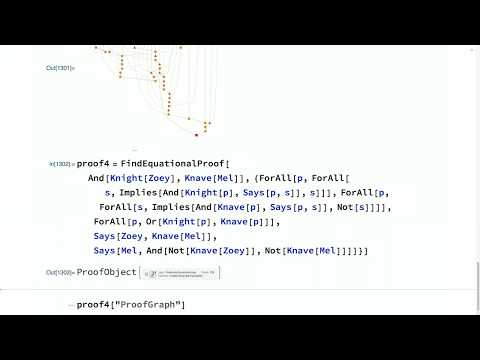
Like @davidbessis and others, I think that Hinton is wrong. To explain why, let me tell you a brief story. About a decade ago, in 2017, I developed an automated theorem-proving framework that was ultimately integrated into Mathematica (see: youtube.com/watch?v=mMaid2…) (1/15)
YouTube video
YouTube
vitrupo@vitrupo

Geoffrey Hinton says mathematics is a closed system, so AIs can play it like a game. They can pose problems to themselves, test proofs, and learn from what works, without relying on human examples. “I think AI will get much better at mathematics than people, maybe in the next 10 years or so.”

English
129
489
2.8K
845.1K
Goutham Kurra
Goutham Kurra@gkurra·
@anilananth 's book is an amazing introduction to AI for the curious. Even though it's aimed at lay audiences who don't mind putting in some tiny effort, it offers something in terms of perspective even for the seasoned practitioner. Excited for his newsletter.
Anil Ananthaswamy@anilananth

I'm starting a Substack newsletter, WHERE MACHINES THINK (just imagine scare quotes around the word think, to maintain appropriate skepticism). The welcome post is here: wheremachinesthink.substack.com/p/welcome-to-w…

English
0
3
5
433
Goutham Kurra retweetledi
alex zhang
alex zhang@a1zhang·
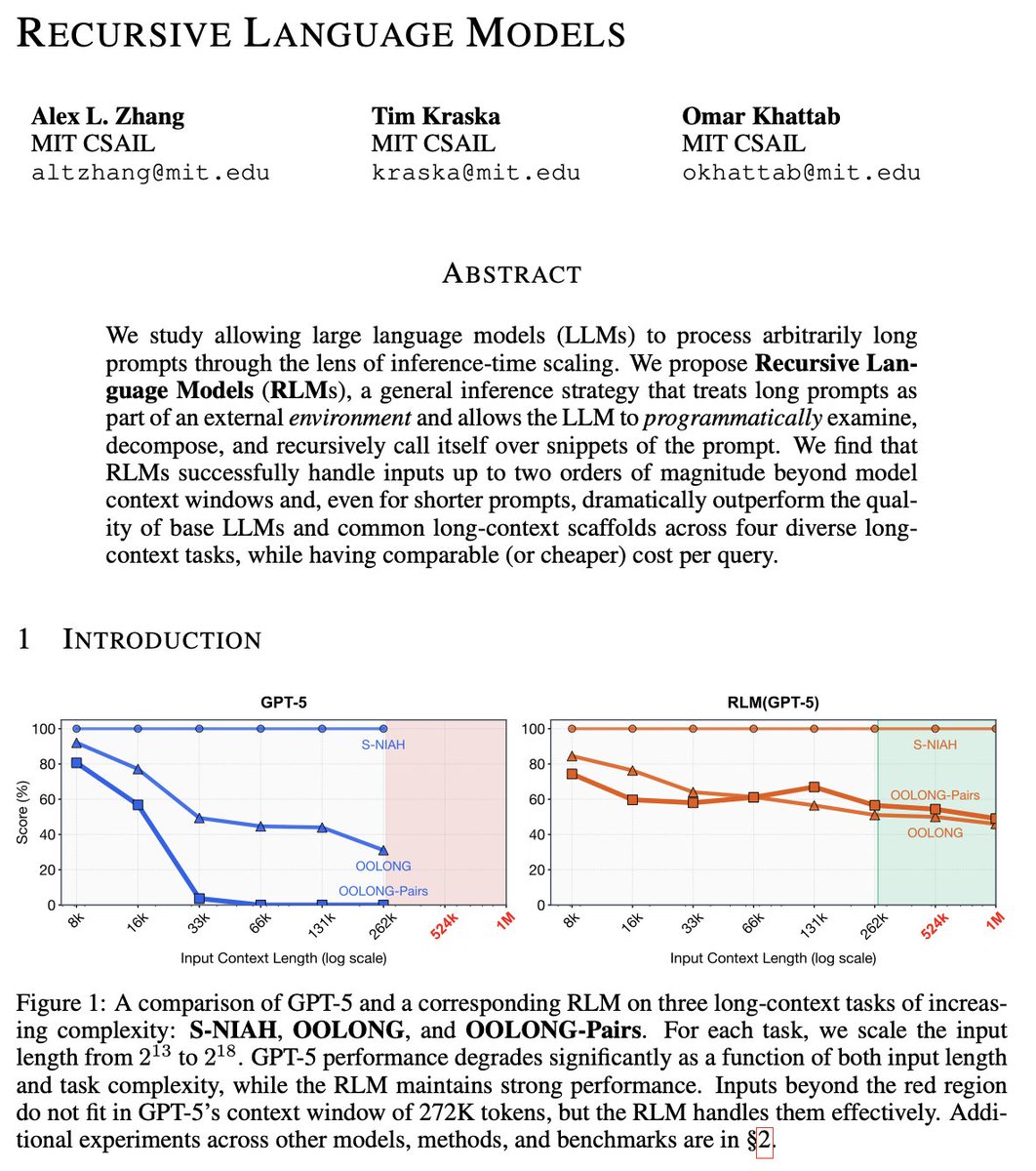
Much like the switch in 2025 from language models to reasoning models, we think 2026 will be all about the switch to Recursive Language Models (RLMs). It turns out that models can be far more powerful if you allow them to treat *their own prompts* as an object in an external environment, which they understand and manipulate by writing code that invokes LLMs! Our full paper on RLMs is now available—with much more expansive experiments compared to our initial blogpost from October 2025! arxiv.org/pdf/2512.24601
alex zhang tweet media
English
252
1.1K
7.4K
2M
Goutham Kurra
Goutham Kurra@gkurra·
AI Predictions for 2026 (or more accurately, a wish list)
Goutham Kurra tweet media
English
1
0
0
36
Goutham Kurra retweetledi
Simon Willison
Simon Willison@simonw·
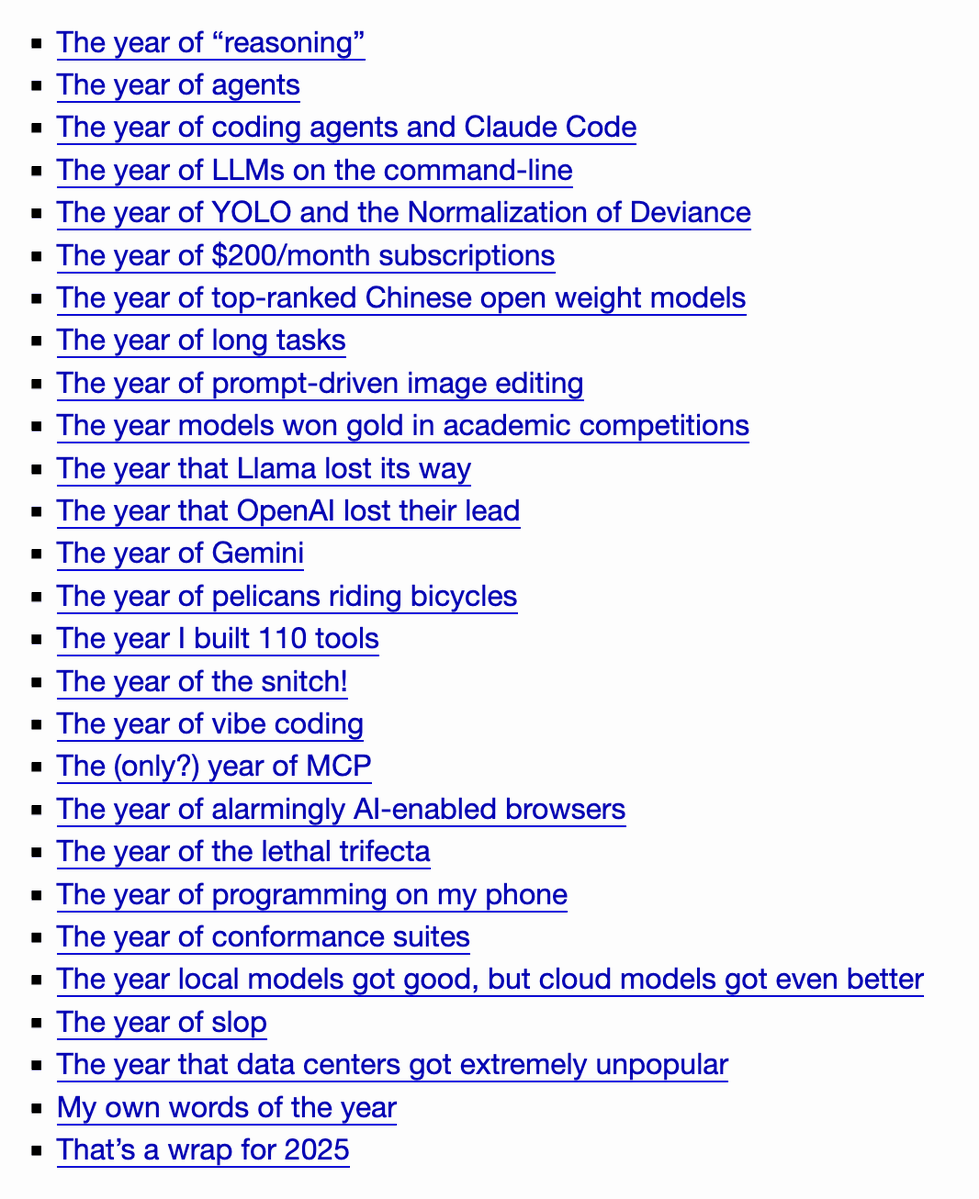
Here's my enormous round-up of everything we learned about LLMs in 2025 - the third in my annual series of reviews of the past twelve months simonwillison.net/2025/Dec/31/th… This year it's divided into 26 sections! This is the table of contents:
Simon Willison tweet media
English
103
877
4.9K
505.5K
Goutham Kurra retweetledi
Ville🤖
Ville🤖@VilleKuosmanen·
RewACT, my reward estimation mod for ACT policies, is now available on PyPi, making it significantly easier to install and use!
English
7
18
152
29.9K