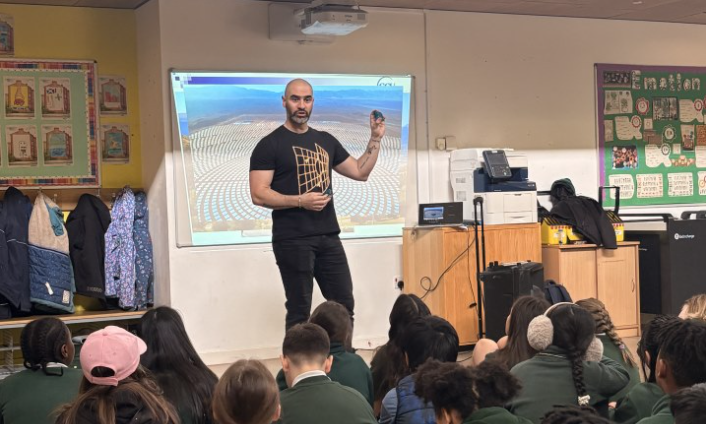
Always a pleasure talking to @HillheadPrimary students about energy stuff (and more) @CaledonianNews
English
George Loumakis
68 posts

@gloumakis
Thermonuclear plumber, all around scientist #GCU, fitness enthusiast, metalhead, geek, (extremely) short storyteller


FRONTIERS IN ASTRONOMY & SPACE SCIENCE SECTION: STELLAR & SOLAR PHYSICS. AUG. 2022: The Planetary Theory of Solar Activity Variability: A Review Nicola Scafetta, Department of Earth Sciences, Environment and Georesources, Complesso Universitario di Monte S. Angelo, University of Naples Federico II, Naples, Italy Antonio Bianchini, INAF, Astronomical Observatory of Padua, Padua, Italy "Reviewing the many planetary harmonics and the orbital invariant inequalities that characterize the planetary motions of the solar system from the monthly to the millennial time scales, we show that they are not randomly distributed but clearly tend to cluster around some specific values that also match those of the main solar activity cycles. In some cases, planetary models have even been able to predict the time-phase of the solar oscillations including the Schwabe 11-year sunspot cycle. We also stress that solar models based on the hypothesis that solar activity is regulated by its internal dynamics alone have never been able to reproduce the variety of the observed cycles. Although planetary tidal forces are weak, we review a number of mechanisms that could explain how the solar structure and the solar dynamo could get tuned to the planetary motions. In particular, we discuss how the effects of the weak tidal forces could be significantly amplified in the solar core by an induced increase in the H-burning. Mechanisms modulating the electromagnetic and gravitational large-scale structure of the planetary system are also discussed. 1 Introduction Since antiquity, the movements of the planets of the solar system have attracted the attention of astronomers and philosophers such as Pythagoras and Kepler because the orbital periods appeared to be related to each other by simple harmonic proportions, resonances, and/or commensurabilities (ter Haar, 1948; Stephenson, 1974). Such a philosophical concept is known as the “Music of the Spheres” or the “Harmony of the Worlds” (Godwin, 1992; Scafetta, 2014a). This property is rather common for many orbital systems (Moons and Morbidelli, 1995; Scafetta, 2014a; Aschwanden, 2018; Agol et al., 2021). Bank and Scafetta (2022) improved the Geddes and King-Hele equations describing the mirror symmetries among the orbital radii of the planets (Geddes and King-Hele, 1983) and discovered their ratios obey the following scaling-mirror symmetry relation where a planet are the semi-major axes of the orbits of the relative planets: Eris (Er), Pluto (Pl), Neptune (Ne), Uranus (Ur), Saturn (Sa), Jupiter (Ju), Mars (Ma), Earth (Ea), Venus (Ve), Mercury (Me), Vulcanoid asteroid belt (Vu), and the scattered zone surrounding the Sun (Sz). The ratio 9/8 is, musically speaking, a whole tone known as the Pythagorean epogdoon. The deviations of Eq. 1 from the actual orbital planetary ratios are within 1%. Another intriguing aspect regarding the synchronization of the solar system is the fact that many planetary harmonics are found spectrally coherent with the solar activity cycles (e.g.: Scafetta, 2012a, 2020, and many others). The precise physical origin of solar cycles is still poorly known and dynamo models are debated, but recent literature has strengthened the hypothesis of a correlation with planetary harmonics. Actually, a few years after the discovery of the 11-year sunspot cycle, Wolf (1859) himself conjectured that “the variations of spot-frequency depend on the influences of Venus, Earth, Jupiter, and Saturn.” Dicke (1978) noted that the sunspot cycle shows no statistical indication of being randomly generated but rather of being synchronized by a chronometer hidden deep in the Sun. Solar activity is characterized by several cycles like the Schwabe 11-year sunspot cycle (Schwabe, 1843), the Hale solar magnetic 22-year cycle (Hale, 1908), the Gleissberg cycle (∼85 years), the Jose cycle (∼178 years), the Suess-de Vries cycle (∼208 years), the Eddy cycle (∼1000 years), and the Bray-Hallstatt cycle (∼2300 years) (McCracken et al., 2001, 2013; Abreu et al., 2012; Scafetta, 2016). Shorter cycles are easily detected in total solar irradiance (TSI) and sunspot records, while the longer ones are detected in long-term geophysical records like the cosmogenic radionuclide ones (14C and 10Be) and in climate records (Neff et al., 2001; Steinhilber et al., 2009). Planetary cycles have also been found in aurora records (Scafetta, 2012c; Scafetta and Willson, 2013a). Due to the evident high synchronization of planetary motions, it is worthwhile investigating the possibility that orbital frequencies could tune solar variability as well. However, although Jupiter appears to play the main role in organizing the solar system (Bank and Scafetta, 2022), its orbital period (∼11.86 years) is too long to fit the Schwabe 11-year solar cycle. Thus, any possible planetary mechanism able to create this solar modulation must involve a combination of more planets. We will see that the only frequencies that could be involved in the process are the orbital periods, the synodical periods, and their beats and harmonics. In the following sections, we review the planetary theory of solar variability and show how it is today supported by many empirical and theoretical evidences at multiple timescales. We show that appropriate planetary harmonic models correlate with the 11-year solar cycle, the secular and millennial cycles, as well as with several other major oscillations observed in solar activity, and even with the occasional occurrences of solar flares. The physics behind these results is not yet fully understood, but a number of working hypotheses will be herein briefly discussed... [..Read link at the bottom for main journal article..] ...11 Conclusion Many empirical evidences suggest that planetary systems can self-organize in synchronized structures although some of the physical mechanisms involved are still debated. We have shown that the high synchronization of our own planetary system is nicely revealed by the fact that the ratios of the orbital radii of adjacent planets, when raised to the 2/3rd power, express the simple ratios found in harmonic musical consonances while those of the mirrored ones follow the simple, elegant, and highly precise scaling-mirror symmetry Eq. 1 (Bank and Scafetta, 2022). The solar system is made of synchronized coupled oscillators because it is characterized by a set of frequencies that are linked to each other by the harmonic Eq. 3, which are easily detected in the solar wobbling. Thus, it is then reasonable to hypothesize that the solar activity could be also tuned to planetary frequencies. We corroborated this hypothesis by reviewing the many planetary harmonics and orbital invariant inequalities that characterize the planetary motions and observing that often their frequencies correspond to those of solar variability. It may be objected that, since the identified planetary frequencies are so numerous, it could be easy to occasionally find that some of them roughly correspond to those of the solar cycles. However, the fact is that the planetary frequencies of the solar system, from the monthly to the millennial time scales, are not randomly distributed but tend to cluster around some specific values that quite well match those of the main solar activity cycles. Thus, it is rather unlikely that the results shown in Figures 2–6 are just occasional. In some cases, our proposed planetary models have even been able to predict the time-phase of the solar oscillations like that of the Schwabe 11-year sunspot cycle throughout the last three centuries, as well as those of the secular and millennial modulations throughout the Holocene. The two main planetary models that could explain the Schwabe 11-year cycle and its secular and millennial variation involve the planets Venus, Earth, Jupiter and Saturn, as it was initially suggested by Wolf (1859). We further suggest that the Venus-Earth-Jupiter model and the Jupiter-Saturn model could be working complementary to each other. The alternative hypothesis that the solar activity is regulated by an unforced internal dynamics alone (i.e. by an externally unperturbed solar dynamo) has never been able to reproduce the variety of the observed oscillations. In fact, standard MHD dynamo models are not self-consistent and do not even directly explain the well-known 11-year solar cycle nor they are able to predict its timing without assuming a number of calibrated parameters (Tobias, 2002; Jiang et al., 2007). There have been several objections to a planetary theory of solar variability. For example, Smythe and Eddy (1977) claimed that planetary cycles and conjunctions could not predict the timing of grand solar minima like the Maunder Minimum of the 17th century. However, Scafetta (2012a) developed a solar-planetary model able to predict all the grand solar maxima and minima of the last millennium (Figure 4). Other authors reasonably claimed that planetary gravitational tides are too weak to modulate solar activity (Charbonneau, 2002; de Jager and Versteegh, 2005; Charbonneau, 2022); yet, several empirical evidences support the importance of their role (Wolff and Patrone, 2010; Abreu et al., 2012; Scafetta, 2012b; Stefani et al., 2016, 2019). Stefani et al. (2016, 2021) proposed that the Sun could be at least synchronized by the tides of Venus, Earth and Jupiter, producing an 11.07-year cycle that reasonably matches the Schwabe cycle. Longer cycles could be produced by a dynamo excited by angular momentum transfer from Jupiter and Saturn. Instead, Scafetta (2012b) proposed that, in the solar core, the effects of the weak tidal forces could be amplified one million times or more due to an induced increase in the H-burning, thus providing a sufficiently strong forcing to synchronize and modulate the solar dynamo with planetary harmonics at multiple time scales. Objections to the latter hypothesis, based on the slow light propagation inside the radiative zone according to the Kelvin–Helmholtz timescale (Mitalas and Sills, 1992; Stix, 2003), could be probably solved. In fact, tidal forces are believed to favor the onset of g-waves moving back and forth throughout the radiative region of the Sun (Barker and Ogilvie, 2010; Ahuir et al., 2021). Thus, g-waves themselves could be amplified and modulated in the core by the tidally induced H-burning enhancement (Scafetta, 2012b). Then, both tidal torques and g-waves could cyclically affect the tachocline region at the bottom of the convective zone and synchronize the solar dynamo. Alternatively, planetary alignments can also modify the large-scale electromagnetic and gravitational structure of the planetary system altering the space weather in the solar system. For example, in coincidence of planetary alignments, an increase of solar flares has been observed (Hung, 2007; Bertolucci et al., 2017; Petrakou, 2021). The solar wobbling, which reflects the motion of the barycenter of the planets, changing from more regular to more chaotic trajectories, correlates well with some long climate cycles like the Bray-Hallstatt cycle (2100–2500 years) (Charvátová, 2000; Charvátová and Hejda, 2014; Scafetta et al., 2016). Finally, Scafetta et al. (2020) showed that the infalling meteorite flux on the Earth presents a 60-year oscillation coherent with the variation of the eccentricity of Jupiter’s orbit induced by Saturn. The falling flux of meteorites and interplanetary dust would then contribute to modulate cloud formation. In conclusion, many empirical evidences suggest that planetary oscillations should be able to modulate the solar activity and even the Earth’s climate, although several open physical issues remain open. These results stress the importance of identifying the relevant planetary harmonics, the solar activity cycles and the climate oscillations as phenomena that, in many cases, are interconnected. This approach could be useful to predict both solar and climate variability using harmonic constituent models as it is currently done for oceanic tides. We think that the theory of a planetary modulation of solar activity should be further developed because no clear alternative theory exists to date capable to explain the observed planetary-solar interconnected periodicities." frontiersin.org/articles/10.33…