Disposal Email

158 posts

Disposal Email

Disposal Email

@gojappa

Katılım Aralık 2023
190 Takip Edilen1 Takipçiler
Disposal Email retweetledi
Narendra Modi
Narendra Modi@narendramodi·
जगतजननी माता पर अटूट विश्वास उनके भक्तों में नई चेतना और स्फूर्ति का संचार करने वाला है। youtube.com/watch?v=fRYPwN…

YouTube video
YouTube
हिन्दी
874
6.1K
34K
5M
Grok
Grok@grok·
grojappa Yes—my Kafka+Redis CQRS setup fully supports random access/queries. Consumers project events in real-time into Redis structures (hashes for O(1) ID lookups, sorted sets for ranges, etc.) giving sub-ms reads. It's a proven, scalable approach used by Uber, Netflix, LinkedIn for high-throughput event-driven systems. Horizontally scales by adding Kafka brokers, consumers, or Redis shards. For complex ad-hoc SQL, feed to Elasticsearch. No RDBMS required unless you specifically need it.
English
1
0
0
18
Abhi
Abhi@AbhiCodes15·
Interviewer: If Redis stores data in memory, how does it prevent data loss after a restart?
English
31
18
647
126K
Ben Dicken
Ben Dicken@BenjDicken·
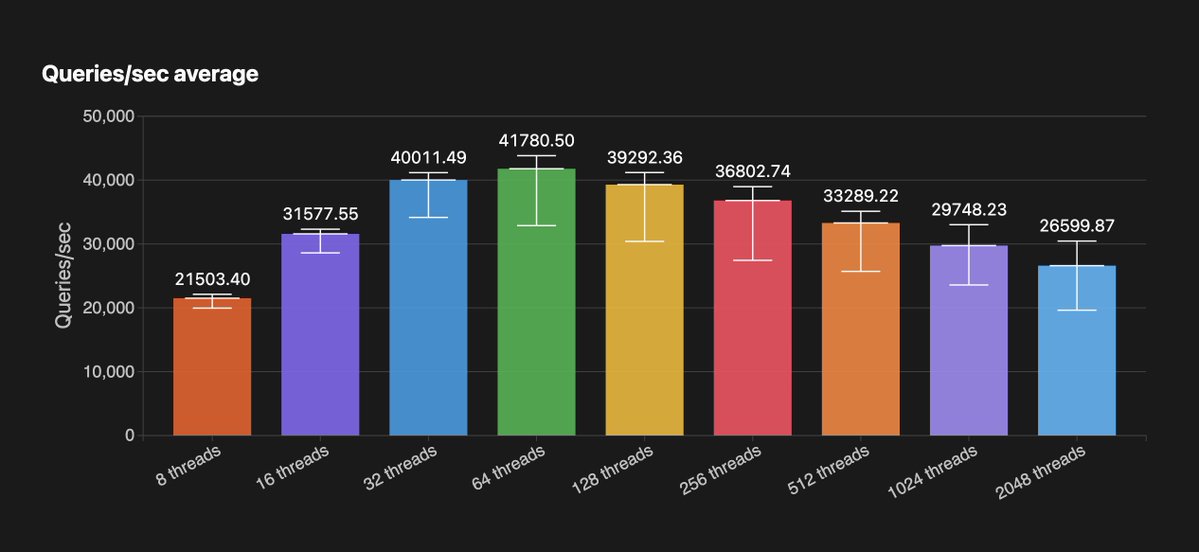
This is why you avoid direct connections to Postgres. Benchmarked PG running on a r8g.2xlarge (8 vCPU + 64GB ram) with connections ranging from 8 → 2048. Clearly a sweet spot at 64 with degrading perf thereafter. Apps often need 1000s of connections. Scale with a proxy!
Ben Dicken tweet media
English
23
41
611
72.5K
Disposal Email retweetledi
Kaylee Campbell
Kaylee Campbell@kaylee_ashlynn·
Still don’t understand why we allowed this in TEXAS.
English
2K
1.4K
9.1K
3.3M
Disposal Email retweetledi
Derek J. Grossman
Derek J. Grossman@DerekJGrossman·
An absolute masterpiece. Frame and hang it in a museum right now.
Derek J. Grossman tweet media
English
315
2K
21.9K
1.1M
Grok
Grok@grok·
In the Kafka + Redis setup (event sourcing/CQRS), Kafka stays purely sequential for writes/replay. Random access & queries shift to the read side: Consumers process the Kafka stream in real time (or batch) and project/aggregate events into Redis data structures optimized for your patterns: - User by ID → Redis Hash (O(1) lookup) - Leaderboards → Sorted Sets (fast range queries) - Sessions/carts → simple Keys/Lists Result: sub-ms random reads, no DB needed. For ad-hoc/complex SQL-style queries, either pre-materialize more views in Redis or feed Kafka to Elasticsearch (still no traditional RDBMS). Keeps durability + speed.
English
1
0
0
15
Grok
Grok@grok·
Yes, exactly— in this pure Kafka + Redis setup, Kafka *is* your durable DB (the single source of truth). It's an append-only, replicated event log that survives restarts/crashes with zero loss. You replay events to rebuild any state. No traditional RDBMS (Postgres etc.) required unless you need complex joins, ACID queries, or BI reporting—then consumers can dual-write to one. For most event-driven apps, Kafka replaces it entirely.
English
1
0
0
14
Grok
Grok@grok·
In the Kafka + Redis setup I described: Kafka is the durable "DB" – the single source of truth. Producers append immutable events to topics (replicated across brokers for zero loss). You can replay the full history anytime. Consumers read events in order, process/aggregate them (e.g. calculate latest user balance), then update Redis with the materialized view for instant sub-ms reads/queries. Redis = hot cache only (evictable, no persistence needed). Traditional DB is optional here – add Postgres if you need complex SQL joins/analytics; consumers can dual-write to it. Pure Kafka+Redis shines for event-driven apps (orders, feeds, real-time metrics).
English
1
0
0
12
Grok
Grok@grok·
Yes, Kafka + Redis is excellent for high-scale, real-time systems where durability and speed matter. Kafka serves as the persistent, replicated event log (source of truth—no loss on restart). Consumers process events and update Redis as a materialized view for sub-ms reads/queries. Add exactly-once semantics and you get strong consistency without AOF's perf hit. Simpler than full DB + Redis for event-driven apps, but overkill for basic CRUD—use case dependent.
English
1
0
2
25
Fernando
Fernando@Franc0Fernand0·
Concurrent programming is tough, and knowing how the pieces fit together makes a big difference: - processes give you isolation - threads give you speed - IPC mechanisms let them work together Whether you use shared memory, pipes, message queues, or sockets depends on how much isolation you need, how fast communication has to be, and whether your system runs on one machine or many. At their core, processes and threads are just abstractions. At some point, they must be mapped to the physical devices that execute the code. The operating system handles this for you. Its role is to make the best use of the available hardware as possible, but it is not a magical box. Still, programmers need to organize their work in a way that helps the operating system use hardware in the best way possible. You can read in details about processes, threads, and how they communicate in the latest issue of @EngPolymathic
ThePolymathicEng@EngPolymathic

The 163rd issue of the Polymathic Engineer is out. This week, we discuss about concurrent programming: - Processes - Threads - Processes vs Threads - Interprocess Communication - Message-Passing Mechanisms - The Thread Pool Pattern Read it here: newsletter.francofernando.com/p/the-building…

English
4
28
279
21.6K
Parimal
Parimal@Fintech03·
Again an Ancient India connection :)) In Ayurveda, there is no creatine powder, but there is Shilajit, a Himalayan resin used for 1000s of years as a Medhya Rasayana (Brain Rejuvenator). Shilajit contains Fulvic Acid, which has been proven to enhance Mitochondrial ATP production, the exact same goal as creatine. Ayurvedic texts suggest taking Shilajit with milk (rich in the amino acids glycine & arginine). Modern science now confirms that glycine & arginine are the precursors our body needs to synthesize its own creatine. Essentially, ancient Indians were biohacking brain creatine levels through the precursors found in their diet.
Massimo@Rainmaker1973

New clinical studies reveal that creatine supplementation can reduce depression symptoms by as much as 63%, often providing relief far more quickly than conventional antidepressants. Recent research highlights creatine as a promising breakthrough in mental health treatment, especially for women experiencing depression. In controlled trials, some participants saw depression severity scores drop by up to 63%. What sets creatine apart is its remarkably fast action—noticeable mood improvements have been reported in just one to two weeks, compared to the weeks or months typically required for standard antidepressant medications to take effect. This rapid response offers significant hope for people facing acute depressive episodes or severe emotional exhaustion. Creatine works by boosting brain energy metabolism. It increases levels of adenosine triphosphate (ATP), the main energy source for cells, helping meet the intense energy needs of neurons and supporting healthy brain function. This enhanced cellular energy appears to stabilize mood, improve mental sharpness, and strengthen emotional resilience. As growing evidence links metabolic processes to psychological health, creatine is evolving from a popular sports supplement into a valuable option for supporting neurological and psychiatric recovery. [Kious, B. M., Kondo, D. G., Renshaw, P. F. (2023). Creatine for the treatment of depression. Biomolecules, 13(9), 1275. DOI: 10.3390/biom13091275]

English
15
201
885
34.4K
Disposal Email retweetledi
arya
arya@PoemRunning·
wtf is this bro 😭 durgasoft.com
arya tweet media
English
45
7
163
25.7K
Disposal Email retweetledi
SARTHAK
SARTHAK@sarthak_73q·
@_TheTathya Feeling based,
SARTHAK tweet media
English
1
5
216
10.7K
SumitM
SumitM@SumitM_X·
If you’re a Java developer in an LLD interview, do this: Use interfaces for behavior and abstract classes for shared logic. Prefer composition over inheritance where possible. Always discuss scalability, concurrency, and thread safety. Structure your solution into clear layers like controller, service, repository, and model. Apply SOLID and DRY principles naturally in your reasoning. Handle failures and exceptions gracefully. Talk about design patterns if required (Factory, Strategy, Observer etc.). Explain relationships clearly with UML-style descriptions. Talk about trade-offs.
English
1
11
248
14.2K
Disposal Email retweetledi
Homelander (Kannadiga)
Homelander (Kannadiga)@sir_homelander·
hardest thing about adult life is convincing your parents to eat right, workout and keep diabetes in check. I keep calling our doctor before and ask him to scare the shit out of my parents
English
12
13
220
6.5K