

Gokey
1.6K posts

Gokey
@gokeyforever
Never give up, never surrender. Road to $10M in progress.
Alpharetta, GA Katılım Şubat 2011
662 Takip Edilen333 Takipçiler

$ASTS friendly reminder, I pointed out $66 as a major zone to monitor last month in the mid $70s. Then called for a major low when we undercut $65 in real-time and followed up saying there was a path back to a breakout opening the door for higher. Many replied saying it wouldn't rally till we had successful launches.
We're now 60%+ off the lows
Moral of the story is don't underestimate TA and statistical analysis
GIF
English

Sometimes I genuinely sit back and wonder how in the world I ended up with this platform.
I’m just a young man who's spent 1000s of hours obsessively flipping through charts, journaling my thoughts, and trying my best to survive the psychological warfare known as the "stock market."
Half the time I still feel like I have no idea what I’m doing.
But 1 thing I can promise is that I’ll continue sharing my process openly...the wins, the losses, the emotional mistakes, the realizations, the lessons, the embarrassing moments, and all the weird little nuances I notice along the way.
Because if even 1 person learns something useful from my journey, avoids a major mistake, or starts thinking independently because of something I shared…then all those quadrillion hours were worth it!
If I’ve ever helped you learn more about yourself, make money in the markets, improve your process, or stop revenge trading $SPY 0DTEs at 9:32am…
like this post.
I’m trying to see something...
Thanks in advance, love y'all!
- iain 🩵
English

At the beginning of my journey, I was obsessed with entry tactics.
I thought if I could just master the perfect ORH breakout, the VWAP reclaim, the ideal pullback into the 9 EMA, then everything would finally click.
I remember watching traders on X buy a name at the exact right second, trail it perfectly, and post the winner after the fact. Naturally, I thought the secret had to be in the precision.
So I spent months doing what most newer traders do:
Overstudying entries and underthinking context.
What I wish I understood sooner is that entry tactics are just a form of risk management… and that took me a while to learn.
Over more screen time, I started realizing that some of the best traders I know all enter differently. I have friends who buy end of day and outperform year after year (@FelipeGuirao).
I also know traders who only trade the first 30 minutes of the open. I know others who wait until midday, when the volatility calms down and the real character of the session starts to show.
> Same market.
> Same opportunities.
> Different execution styles.
Just that alone taught me that the entry itself is rarely the deciding factor. The real work happens before the entry!
Now my process is almost the complete opposite of how I started.
Before I even think about how I want to enter, I’m asking bigger questions.
- "What groups are leading?"
- "Where is the big money flowing to?"
- "Which names are showing relative strength versus the market and their sector?"
- "Are institutions clearly accumulating and/or distributing?"
- "Is the environment rewarding breakouts, undercuts, ORH moves, or pullbacks into moving averages?"
Those questions matter far more than whether I buy at 9:47, 11:12, or 3:38.
If I’m in the right name, in the right group, in the right environment, the entry becomes a detail.
That doesn’t mean entry tactics don’t matter. They do. I care a lot about them. But only after I’ve done the harder work first.
My focus always starts with the leading groups and leadership inside those groups. If semis are acting well, I’m looking at the best semis. If data centers are leading, I’m watching the strongest names in that space. If the market is choppy but certain leaders keep holding support and making higher highs, that gets my attention.
My end goal is simple: get positioned in leading relative strength names with the least risk possible.
That’s where entry tactics come in for me.
Once I know I’m looking in the right place, then I start thinking about execution. Maybe the market is rewarding undercut-and-reclaims off support. Maybe the first 30min pivot has been the best entry per risk. Maybe waiting for midday confirmation is giving better odds.
I try to adapt to what the market is currently rewarding. That flexibility has helped me way more than trying to become a robot about one exact entry model.
A lot of people get this backwards...
They want the perfect entry on a stock nobody cares about, in a weak sector, in a bad market.
I would much rather have an average entry in a name that institutions are clearly buying.
That’s just a much easier game for me.
From my own experience, the biggest improvement in my trading didn’t come from learning another entry pattern... It came from understanding my own tendencies, building trust in my system, and learning when conditions actually favor my style.
Once I did that, managing risk became more natural. I stopped forcing trades where it didn’t matter and started putting my energy into:
- stock selection
- sector strength
- market conditions
- and overall risk exposure.
That’s what has helped me most, and that’s what I’m still working on every single day. So if I could tell my younger self one thing, it would be this:
Focus on where the money is going first.
Focus on how to enter second.
Because if you’re trading with the wind at your back, the entry tactic matters less than you think.
And if you’re fighting the tape, no entry tactic in the world is going to save you.
Just my 2 cents!
- iain 🩵
Alex Desjardins@PrimeTrading_
Over the years, my trading has shifted a lot. I used to obsess over perfect entries; if it wasn’t the best, it felt like a bad trade. Now, the focus is much higher level, understanding the market cycle, positioning in leading names, and finding good R:R areas, both stock and market-wise, while managing overall exposure. This game isn’t about precision entries. It’s about getting exposure when conditions are in your favor, and managing it well. Don’t overthink the entry, overthink when to press, be patient, and when not to.
English

Posting my thesis’ that I highlighted not long ago, coming to fruition now.
$AAOI then: $31
Now: $150
$AEHR then: $28
Now: $71
I try to find these before the masses do, this is where the biggest returns come from.
In order to make outsized gains in the market you need to be early. If it was as easy as just buying what everyone else was buying at the same exact time, everyone would be rich.
But that’s not the case.


English

On May 8, 2025 I underwent spinal fusion surgery, a 6 hour procedure in which I was filleted from front to back.
First, my abdomen was opened up so that the surgeon could scrape out the disc between L5 and S1, replacing it with a perforated cage containing bone grafting material that was screwed into my vertebra.
Then I was flipped over and opened up on my back so that my surgeon could screw vertical rods into L5 and S1 to secure my spine position to ensure the fusion sets properly.
The procedure was successful, correcting 15 years of lower back debilitation due to severe Spondylolisthesis. However, the recovery process demanded I endure far more than I bargained for, debilitating me in ways I thought might handicap me permanently.
For the first 3 months I could barely move. For the first six months my activity was limited to walking only. Pain was constant.
At nine months I was still in so much discomfort, still so limited in my range of motion, still too unstable to do anything to elevate my heart rate.
My weight ballooned. My muscles atrophied. My mood plummeted. And I was becoming resigned to the idea that my athletic identity (let alone performing extreme feats of ultra-endurance) was a thing of the past, a memory well behind me.
But very slowly after that I began to turn a corner. At ten months, I finally felt stable enough to resume a very modest non-spine compressing return to fitness exercise regimen. Zone 1 indoor cycling, gentle core work, extremely low weight / high rep resistance training.
Proceeding on a ‘less is more’ mandate in late November (which demands discipline for someone like myself prone to taking everything to the extreme, I just showed up every single morning to do what I could, and stop well before doing more than I should.
Today I am down 35 pounds from November (207 to 171) including a body fat reduction from 20% to 11%. More importantly, I am beginning to feel like myself again. Grateful and hopeful.
I still have a long way to go—it takes 12-18 months for the fusion to fully set. My surgeon was not optimistic that I will be able to run again. Time will tell of course, but I’m confident that provided I continue to proceed patiently that I have a future in which running can become part of my new reality.
Towards that end I have a goal—which is to celebrate my 60th birthday this Fall by participating in the NYC Marathon.
But here’s the thing. I’m not trying to return to who I once was. I’ve leaned into the stillness this experience has demanded of me to become someone new and better.
I am posting this story not for external validation but rather to say that change is always possible. And the way to do it is the same way I have navigated every one of my many life transformations, from alcoholism to sobriety, from sedentary to middle aged ultra endurance athlete, and from a corporate lawyer career to becoming an author and podcaster: getting sober and staying sober: by taking contrary action consistently and religiously—one day at a time.
As Chris Paul said on my podcast, “keep stacking days.”
And remember, every obstacle life presents you is simply an opportunity custom-designed for your growth and evolution.


English
@ZeeContrarian1 Absolute gold.
Better trusting a degenerate gambler that understands one ounce of game theory over a financial analyst that builds forecasts.
English

Take a moment to reflect on all the forecasts that ruled the start of this year.
Oil is going to 50.
The dollar is dead.
Interest rates are going lower.
The S&P will be up 10%.
There’s a reason forecasts are made by idiots for idiots.
Not only do they not help, they actively hurt. As a small human, you crave forecasts because they give the illusion of certainty. But as reality unfolds, you stay anchored to predictions made by people you were told were intelligent.
What matters far more is noticing what is actually happening.
Do not make forecasts.
The only forecast in the stock market with any credibility is that, over the long term, stocks tend to go up.
Everything else is just noise.
English
1) Identify the leaders
2) Patience
3) Wait for weakness into support
4) Define the invalidation level
5) Patience
6) Execute
7) Patience
8) Patience
9) Go touch grass!
10) Pick up the kids from school (I don't have kids).
iain@ohiain
In this market, I’ve had to remind myself of the same thing almost every day: Buy weakness in Relative Strength names. When the indexes are choppy and directionless, chasing strength rarely works. Breakouts tend to stall, momentum fades quickly, and you often end up buying right as the move exhausts. I fear we've all learned that lesson the hard way more times than we'd like to admit. From what I've seen has been working, is letting strong names come back. When a stock is showing relative strength while the broader market chops around, that tells me institutions are quietly supporting it. It doesn’t mean the stock will go straight up, but it does mean there’s underlying demand. So instead of chasing the move, I’ve been focusing on buying constructive pullbacks into areas where risk is clearly defined. That might be a pullback into the 9/21 EMAs, a tight consolidation after a strong move, or a dip into a key pivot that previously acted as resistance. In this environment, those moments of weakness often turn into the best entries because they allow you to participate in the next leg without paying the emotional premium of chasing. Another thing I constantly remind myself of is that money in the market never sits still. It rotates. When one group cools off, capital quietly shifts into another. The strongest stocks tend to keep showing their hand through relative strength even when the indexes aren’t doing much. That’s why selectivity matters so much right now. You don’t need the entire market moving. You just need to be in the names where money is flowing. So my focus lately has been to: - identify the leaders - wait for weakness into support - define the invalidation level and be ready to execute when momentum comes back. I'm talking to myself here.
English
As dreamed for many years, when I’m 50 (14 away) I’ll sit at an outside dinner table in an Italian villa. Love / laughs. I’ll be surrounded by my wife, two children, and their closest friends. Everything will be covered, no praise or admiration needed. Thats a reason to have kids.
English

if you ask most peeps why they want kids they’ll give you some npc answer.
the reason why i think having children would be amazing is that you get a front row seat to consciousness booting up. like watching an os that god wrote light up for the first time.
& as they grow up you get to examine the world through an innocence lens you basically shedded a long long time ago.
English
@Tim_Denning Exactly what you said give or take a few nuances during the 30’s. Fortunate position to want what truly matters 👊🏼
English

I’m about to turn 40.
At 30, all I wanted was:
• Supermodel girlfriend
• Big house
• General Manager job title
• $20M+ net worth
At 40, all I want is:
• Time with my two daughters
• Personal freedom
• Never get told what to do
• Hang out with my elderly parents
A 50, all I’ll want will be:
• Leaving a legacy
• Educating my daughters about money
• Run a marathon
• Freedom
Family. Freedom. Wealth.
That’s my version of the good life. What’s yours?
English

If someone paid you $300,000 to not have a single drop of alcohol for a year, would you do it?
English

When I punched out of the corporate world in 2018 at the peak of my career, my friends thought I was crazy. But my rationale was very simple and logical:
I was 47 and didn’t want to spend the next 10 years behind a desk.
Since then I’ve literally spent 1000 days outside instead of in an office.
Who’s the crazy one?
Ultimately, the single most important question in life is:
How do you want to spend your time?
Having control of your time is a privilege that is earned, but one thing’s for sure…
You’ll never get there if you don’t:
DEFINE the end state you’re building toward—most people haven’t.
ALIGN your actions with it. Most people do things that take them further from their ideal end state, not closer—now THAT’S crazy! 🤪
English
Please pray for my young son. He’s been in the hospital since last night for a bad stomach bug and he is not improving at this time.
English
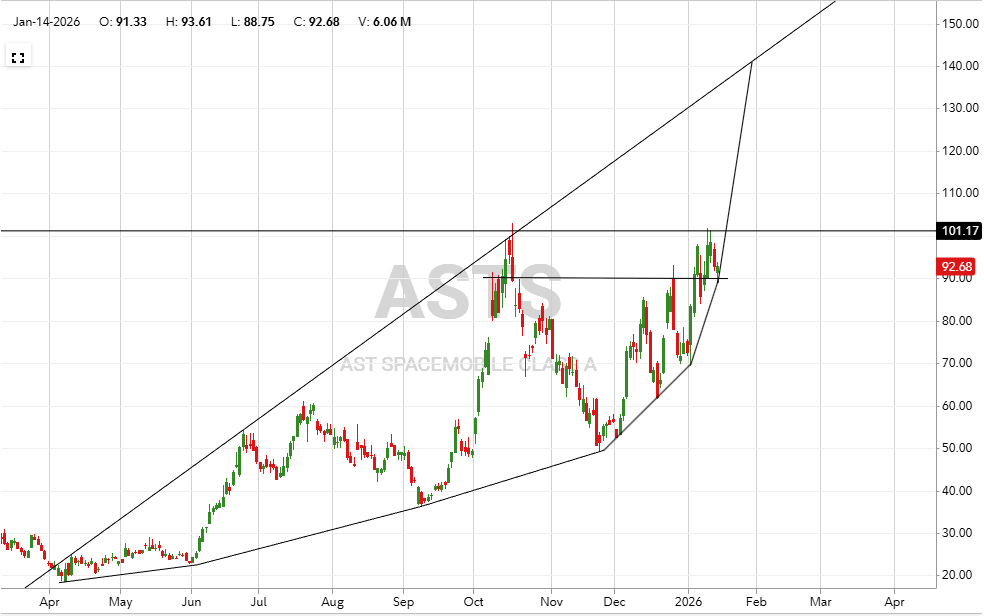
$ASTS is coiling under the breakout level. Assuming it doesn't dip to form a handle it could be poised for a move towards $130-$150 area I have been eyeing for several weeks now.
Linear chart
Log chart
*NFA

English
All it takes is studying how sectors performed leading up to a major company going public. Don’t over complicate it and don’t presume fundamentals will give you an edge in shorting in the middle of momentum. 👇
Reformed Tr🅰️der@Reformed_Trader
Most recently, bears shorting quantum and nuclear stocks the whole way up last year. Shorting AI leading up to CRWV IPO. In 2020 shorting EV/alt energy before RIVN IPO or LCID DA with Churchill SPAC. Shorting crypto or crypto related stocks before COIN IPO. Shorting MJ stocks leading up to TLRY IPO. Lots of examples of sectors outperforming leading up to a major company going public.
English


Everyone's sharing that "Long Degeneracy" article and nominating it for article of the year with 20m views. I just got around to reading it…overall, I get it. It's well written, emotionally resonant, and captures something real about generational anxiety. I like the author, I subscribe to their stuff… talented Quant.
But nobody's pushing back, so let me while I watch my kids at the pool.
My main pushback is this: the article is a suicide note dressed up as investment advice. I REFUSE to hand my agency to "the house." The moment you accept "the game is rigged so I might as well gamble," you've surrendered. You've quit on the process that actually works because someone convinced you it doesn't. There are no easy buttons. No shortcuts. No magic money options. There is only learning, sacrifice, and continual grit.
It tells a generation they're prisoners. Then it sells them a lottery ticket and calls it freedom. Then it tells YOU to invest in the prison.
That's not analysis. That's despair with a ticker symbol.
The author spends 2000 words empathizing with young people as "prisoners" trapped by a broken economy… then tells you to invest in the platforms extracting fees from their desperation. "Long Coinbase, long DraftKings, long the casinos."
Read that again. The thesis is: a generation is so economically desperate they're turning to gambling, most will lose, and YOU should profit by owning the house.
You can't weep for the prisoners and then sell shares in the prison. Pick one.
4 points I want to make....
Pushback 1: "Closed" is doing a lot of work
The claim that traditional wealth building is "closed, not difficult" is asserted, not proven. The boomer vs millennial wealth stat is misleading… it compares 65 year olds to 35 year olds. Of course boomers hold more wealth. They've been alive longer.
Housing is brutal in coastal cities. But median home prices in most US metros are still accessible to dual income households. "Wages up 8% while housing doubled" has no timeframe and cherry picks the comparison. Real wages post 2020 have actually grown.
Is it harder than it was? Yes. Is the game "fundamentally broken"? That's a much bigger claim requiring a much longer discussion.
Pushback 2: Negative EV doesn't become rational just because you feel stuck
The core logical move is: "if you're trapped anyway, a 5% chance of escape beats 100% certainty of stagnation."
But gambling doesn't leave you "still stuck." It makes most participants actively worse off. That 5% moonshot comes paired with a 95% chance of losing your savings, your rent money, your runway.
The author admits "most people lose" then hand waves it because gamblers "understand the odds." But understanding bad odds while taking them isn't rationality. It's emotional capitulation wearing economic language as a costume.
This isn't a generation finding a path out. It's a wealth transfer mechanism moving money FROM desperate young people TO platform operators.
Pushback 3: The article accidentally reveals the real problem
The author admits social media has "repositioned the zeroth line" so people earning $150k feel poor. Admits the algorithm ensures "you never feel like you've arrived." Admits basic needs are met and there's "cognitive bandwidth" for existential questions.
But wait. If the problem is FEELING trapped due to infinite upward comparison rather than BEING trapped… gambling doesn't fix that. You could 10x your net worth and the algorithm will still show you someone richer.
The "Maslow trap" section accidentally confesses: this generation isn't imprisoned. They're dissatisfied. These are different problems.
Pushback 4: I don’t have enough FAITH to live in a world without God
This is the part nobody wants to hear.
The entire thesis rests on a materialist assumption: your life's meaning is determined by your net worth, your house, your access to experiences. If you can't get those things, you're "imprisoned." If you can, you're "free."
That's spiritual poverty masquerading as economic analysis.
Jesus said it plain: "What does it profit a man to gain the whole world and forfeit his soul?" The author's answer is apparently "at least you beat the algorithm."
My BIGGEST problem with the article isn't economic. It's theological. It assumes the highest human need is "self actualization" through financial success. That Maslow's hierarchy is the truth about human nature. That if you can't afford the vacation and the house, you're missing what makes life worth living.
That's not wisdom. That's the prosperity gospel without the gospel. No thanks.
The reason this generation feels trapped isn't because housing costs went up. It's because they've been handed a worldview where meaning comes from consumption, identity comes from status, and hope is a betting slip. When you build your life on that foundation, of course you feel imprisoned. The cell is interior.
Real freedom isn't financial. It never was. The peace that passes understanding doesn't require a Polymarket account. Eternity is a LONG time.
So what's the alternative?
First: Exit the comparison machine. The author correctly identifies social media as manufacturing infinite dissatisfaction. The answer isn't to gamble your way to a moving target. It's to stop letting an algorithm define your "zeroth line." Your reference class should be your actual life, not curated highlights from 8 billion people. Delete the apps. Touch grass. Go to church. Give yourself to something BIGGER than your net worth.
Second: Skill acquisition still compounds. The article mocks "getting better at your job" as boomer advice. But the same young people pouring hours into memecoin research could pour those hours into skills that compound. The difference is skills don't have a house edge. Coding, sales, writing, trades… these translate into income whether the market is up or down. AI is changing which skills matter but it's not eliminating the returns to expertise. It's concentrating them.
Third: Asymmetric bets exist outside casinos. If you want convexity, build something. Start a business. Create content. Ship a product. The difference between entrepreneurship and gambling is you're building equity in something that can compound, not burning capital on negative EV.
Fourth: Anchor your identity somewhere the market can't touch. If your sense of self rises and falls with your portfolio, you're a slave. If your hope depends on a moonshot, you have no hope. The man who knows who he is in Christ doesn't need a 100x to feel like his life matters. He's already free. That's not copium. That's the only foundation that doesn't move.
The real trap
The article's framing is seductive because it offers absolution. You're not making bad decisions. You're rationally responding to a broken system. The house always wins but at least you're playing.
The framing IS the trap.
The economy is harder than it was. Housing costs are real. AI anxiety is real. But "harder" isn't "impossible," and the author's solution… becoming a customer of fee extracting platforms or an investor in them… doesn't help the people he claims to sympathize with.
It helps the house.
Here's what actually works.
-Wake up early. Get after it. Be Relentless.
-Spend less than you earn. No excuses.
-Acquire skills that compound. Every single day. Stack them.
-Build things you own. Equity, not lottery tickets.
-Get your body right. Discipline starts physical.
-Get your soul right with the Lord. My closeness with the Lord has grown MORE in trials and tribulations than any fancy car.
-Exit the comparison machine. The algorithm is not your friend. It's your enemy.
-Find your people. Real ones. In person. Build a family. Build a group you trust.
-Serve something bigger than yourself.
-Pray. Not as a last resort. As a first principle. Daily.
-The path is painful. The path is boring. The path requires years of work that nobody will clap for.
But it's the path that works.
The casinos will keep taking their vig. The gurus will keep selling hope. The algorithms will keep showing you what you don't have.
Let them.
You are not a prisoner. You are not a degenerate. You are not a customer.
You are a free human being with a soul that matters and a life to build.
So build it through active faith, aggressive patience, and a mindset geared towards eternity and not your bank account.
sysls@systematicls
English
I think about this a lot.
We owe it to our kids to live boldly.
Because if we don’t… they probably won’t either.

English