
Greg Olear

51.5K posts

Greg Olear banner
Greg Olear

Greg Olear

@gregolear

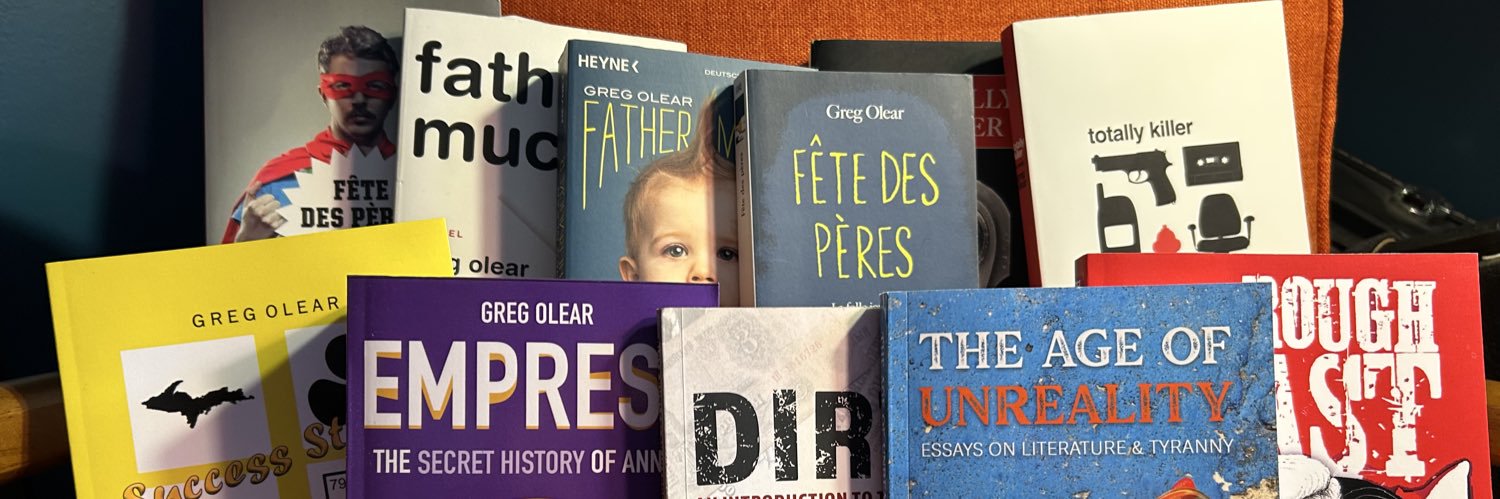
Lapsed novelist, #RoughBeast & #DirtyRubles author, PREVAIL columnist & podcaster, co-host of "The Five 8," enjoyer of Friday Manhattans.

New York, USA Katılım Şubat 2009
20K Takip Edilen168.5K Takipçiler
Sabitlenmiş Tweet
Greg Olear
Greg Olear@gregolear·
I've been wracking my brain for months, trying to figure out how we can get rid of not just Trump, but also Vance and the entire monstrous Cabinet--quickly, legally, and nonviolently. #Liz48 is what I've come up with. Please share this. open.substack.com/pub/gregolear/…
Greg Olear tweet media
English
42
491
1K
73.2K
Greg Olear
Greg Olear@gregolear·
"I see the girls go by dressed in their summer clothes Burn all the Epstein files so nobody knows..." c: @chunkled
English
0
7
14
924
Greg Olear
Greg Olear@gregolear·
@ClaireMPLS @IKNOWBALL365 Spirit of the Staircase is ⭐️⭐️⭐️⭐️⭐️. Or to put it in sports terms, elite. And not just because the title is a take on “l’esprit de l’escalier.”
English
0
0
0
30
claire  de  lune
claire de lune@ClaireMPLS·
people not knowing i've been a professional recording artist since i was a teenager must mean i've really made it in this basketball shit🥲
The Wolf of Ball Street@IKNOWBALL365

@ClaireMPLS I follow you and like your sports posts. Maybe chill out when you get called out on music topic.

English
18
16
911
49K
slontone bushinsky
slontone bushinsky@SBushinsky·
Scott Bessent, the Treasury Secretary, one of [every thinking person's] least favorite people in the entire administration. Just the way he lies—lies with such smirky abandon. @gregolear
English
1
0
2
335
Greg Olear
Greg Olear@gregolear·
@stealthygeek @LorraineEvanoff Lol. Good point. When I wrote my historical novel I chose a period not much discussed. I found all kinds of contradictions and bad information even in the history books. Fun!
English
5
1
2
68
Patrick S. Tomlinson
Patrick S. Tomlinson@stealthygeek·
@LorraineEvanoff @gregolear Where I found writing sci-fi to be generally easier than writing historical fiction because there's nobody to fact-check you on what a new planet looks like in 400 years but they will eat you alive if you get a cross street name wrong in 1863 London.
English
2
0
5
269
Lorraine Evanoff
Lorraine Evanoff@LorraineEvanoff·
Amazing analogies @gregolear 👏🏻👏🏻👏🏻 "My first published novel, Totally Killer, is a thriller (2009). Fathermucker is a “day-in-the-life-of” chronicle (2011). Empress is historical fiction (written in 2014-15, published later). Six novels, six different genres. What’s missing on the list? Science fiction. I tried my hand at that, too. Back in the summer of 2000, right after much-ado-about-nothing Y2K, I decided I was ready to take on that challenge. Most novels don’t require much in the way of world-building. You have to build the worlds of the various characters, of course. But setting a book in, say, New York City in 1991, as I did with Totally Killer, is like building a website with Wix or Wordpress, or writing a sonnet: the underlying architecture already exists; you’re just building on top of the existing framework. Sci-fi isn’t like that. You get to—or, if you’re being pessimistic, you have to—start from scratch. You’re coding your own website. You’re writing in free verse. You’re making the rules. New York City in 1991 is easy; New York City in 2091 is a lot harder. It’s more work. Not only do you have to conceive of this brave new world, but you also have to figure out how to convey information about it to your readers without sounding like a Wikipedia page or a Christopher Nolan movie about nuclear scientists. I got the idea while on the phone with a notably good-humored customer service representative from American Express. She was entering data to pull up my account, and it was taking longer than expected, and she said, “Sometimes the computer can’t read my mind.” This was innocuous, a joke, meant to keep me occupied while she futzed with the keyboard. But that line was all I needed. It opened a door to something, and I saw, in a flash, what my book was going to be about—including how it would end. I used it as the third and final epigraph to the new sci-fi novel-in-progress: Sometimes the computer can’t read my mind. —AMEX customer service operator, 11 July 2000 The central idea of my sci-fi novel is that anything you can do with a computer now—that is, in 2000-2002 or so—you will be able to do, in the future, entirely with your brain: send a text, listen to music, read a map, take a photo, check the score of the Knicks game. But in order for that to be achieved, everyone has to be logged into the vast network that connects everyone’s brain. I called this network “the LOOM,” a word that means both a device used to weave, and also a sense of foreboding and dread of what lies ahead. The working title of my novel-in-progress was Servers of the Loom. Later I shortened it to The LOOM." Sunday Pages: The LOOM, by open.substack.com/pub/gregolear/…
English
2
1
4
371
Greg Olear
Greg Olear@gregolear·
@worldflood1 Thank you and thanks for sharing all of that. I hope you’re wrong about that last part…
English
1
0
2
29
D.mac
D.mac@worldflood1·
Greg, I can’t express in words with this meant to me. I wish you would try to write the whole thing. My wife is reading science fiction now and I kind of tease her as I’m rereading Hemmingway‘s “For whom the bell tolls” She retorts “why are you reading Hemmingway again?”, I don’t answer. The Loom really. Especially if you did it on the fly, blew me away. I want more. Years back I studied Buddhism. I still meditate on it. Whatever has the beginning has an end. Whatever is subjected to arising is subjected to demise. Life is suffering. We are all dependent arising. We don’t exist on our own, in end of our ourselves. But, Yates is one of my favorite authors. Now that I’m old and dying, I thought about trying to write a novel about being born in the time of milk and honey 1950. I must tell you in 1955 I went to Disneyland. They had this modern car ride. But, I recall a load speaker (or many of them) repeating over and over “Monsanto an adventure into inner space”; they had another Mansano phrase, when they opened the house of the future in 1957. Ironically, I was born in 1950 when temperatures were 0.1°C over pre-industrial times. The carbon in the atmosphere was 305ppm in the atmosphere; pre industrial times, it was something like 285. Now in 2024 we hit 1.5°C which was the goal to reach at 2100 via the Paris accords. There’s 428ppm CO2 in the atmosphere. not many now can remember with specificity what it was like in the 1950s. The normal rain patterns. I was born and raised in the San Francisco Bay Area, which was the Mediterranean climate of the United States. (Although, my father often took me up to my great uncle’s ranch in Oregon. What wildlife, beautiful forest harsh winners, hot summers. The ranch was something out of an old western. It was a cattle ranch. There was a bunk house and my great aunt would ring a triangle to get the workers there before dawn, to eat at a big table full of flapjacks, bacon, eggs, toast and black coffee. What an experience I had when we built a place of a tubular to the lake. I spent many summers in the late 50s and to the mid 60s there. Sure things you would never experience in the city.) No, I’m in the far out SF east bay backed to a wilderness. Been here for 24 years; as a species of all types, peacocks, turkeys, quail, squirrels, rabbits, etc. disappeared in such a large number. Wildfires here, 4 years straight caused us to have to evacuate twice. We had a 25 year drought. Prior to that we hadn’t had one since, 1976 that lasted a year. I’m so old now I think of Yeats poem “When you are old“ I think in the second paragraph after the old man is set with a book, in front of a fire “How many loved your moments of glad Grace, and loved your beauty with love, false or true, but one man loved the pilgrim soul in you, and loved the sorrows of your changing face“ I don’t believe in God, even though I was forced to go to Sunday school. The Jesus I learned about was not the one that these white Christian nationalist believe in. I have a friend here who warns me about what’s happening with Peter Thiel and Elon Musk and the outfit Palantir The only reason I’m not overly concerned, is with the climate study, I started in the 1980s (House meetings in East Bay with special guest, Eco lawyers people that would climb in Redwood trees and stay there or spike the trees to break the logger’s chains ) at the current rate of depleting fossil fuels, without any regulation or any attempt to move to green energy, by 2050 4B People will die off. By 2060 nothing will survive. This is subject to being much faster than I’m mentioning. In all the craziness of this Trump administration and the billionaire tech Bros, along with the wars and the absolute addition of carbon and other dangerous chemicals to our atmosphere, we’ve lost sight of how fast the planet is heating up. This year scientist believe with El Niño. It’ll be one of the harshest years in in modern history, heat waves and drought.
English
1
1
1
36
Greg Olear
Greg Olear@gregolear·
"A sci-fi novel about a group of young, renegade creative types committing an act of mass sabotage by blowing up data centers to liberate us from the tyranny of heartless technology feels very of the moment." gregolear.substack.com/p/sunday-pages…
Greg Olear tweet media
English
1
11
26
1.3K
Greg Olear retweetledi
courtneybonneauimages
courtneybonneauimages@cbonneauimages·
What does terrorism mean to you? If it’s no double-tap killings of paramedics, journalists, and today a 12 year old girl, then what is it? Westerners, where is your humanity? Cameraman: @aliezzedine7
English
383
6.6K
16.2K
1M
MM 
MM @adgirlMM·
There are some big accounts on here that I regularly reply to and when I do, it's crickets. No response. No acknowledgment. When I reply to those accounts, I bring a lot of engagement to their tweets. Why? Because I have one of the most awesome and active communities on here. I'm not doing it anymore. If you think your tweets are a one way street, and you can't take the time to acknowledge those who support you – with a reply, a simple like, or the rare follow – you really don't deserve the large following you have. Thanks for coming to my TED Talk.
MM  tweet media
English
226
270
1.5K
19.6K
Greg Olear
Greg Olear@gregolear·
THE END OF VALERIAN'S WAR WITH PERSIA An aged, infirm leader seeks to secure the borders of his moribund empire—and, more importantly, boost his flagging popularity—by winning a quick and decisive military victory over a hated adversary he perceives as weaker. After announcing plans for a triumphal arch, he sets his sights on the East, where lurks an ancient nation, practitioner of a strange, unfamiliar religion, ruled over by a cruel tyrant, who’s been mucking up the trade routes. A victory in Iran would be quite the feather in a cap notably devoid of plumage. It should be an easy sell. His people already understand that the Persians are the enemy. So he marshals his forces and, with great hue and cry, and with next-level hubris, he attacks. The year, as I’m sure you realize, is Anno Domini 260. The moribund empire is Rome, overextended and weak, unable to fend off invasions from Goths, Vandals, Picts, Saxons, Franks, Alemanni, Caledonians, Burgundians, Alans, and other barbarian hordes. The aged, infirm leader is Publius Licinius Valerianus—Valerian. The cruel tyrant is Shapur I the Great, the second Sasanian King of Kings of Iran. And the field of battle is Edessa, a city in Upper Mesopotamia. Shapur was a wily, backstabbing motherfucker. He was roundly defeated at Rasaena in 243 by Gordian III, but this did not deter him. Once Philip I (“The Arab”) assassinated Gordian and took the throne a year later, Shapur, perceiving his enemy’s vulnerability, attacked again, this time winning. He negotiated a peace treaty with Philip, whereby the new emperor handed over Armenia and Mesopotamia and paid Shapur a fuck-ton of money—half a million denarii—to hold his horses. Which Shapur dutifully did, for three whole years, before going on a city-sacking spree. (History does not record if the Sasanians had nuclear weapons, but the De Caesaribus of Aurelius Victor, published in A.D. 360, states that Valerian believed Shapur would come into possession of them “duas hebdomades auferet.”) Rome was already in a state of decline. Inflation was rampant. Internal rivalries threatened to break the empire apart. Infectious disease was a constant scourge; the Plague of Cyprian—a highly contagious, ebola-like pestilence—raged throughout Europe and beyond. As the biographer Pontius of Carthage wrote: [T]here broke out a dreadful plague, and excessive destruction of a hateful disease invaded every house in succession of the trembling populace, carrying off day by day with abrupt attack numberless people, every one from his own house. All were shuddering, fleeing, shunning the contagion, impiously exposing their own friends, as if with the exclusion of the person who was sure to die of the plague, one could exclude death itself also. There lay about the meanwhile, over the whole city, no longer bodies, but the carcasses of many, and, by the contemplation of a lot which in their turn would be theirs, demanded the pity of the passers-by for themselves. (The Romans treated this, Eusebius tells us, by drinking copious quantities of raw milk, ingesting droplets of colloidal silver and aqueous solutions of chlorine dioxide, and hanging out in bathhouses with a healer known as Hædus Petram. Curiously, none of that worked.) Valerian took the purple robe in A.D. 253, at the decrepit age of 54. Because of the aforementioned plague, it took him a few years to raise an army, but he managed to do so. In A.D. 260, he marched some 70,000 men to the eastern borderlands of his empire and enjoined the Sasanians in battle. It didn’t go well. At all. The Romans got their asses kicked so badly that the emperor sent an embassy to Shapur to sue for peace. The King of Kings said, “I will only negotiate with the emperor personally.” So Valerian, with a small bodyguard, met Shapur…who immediately executed the bodyguard and took his rival prisoner. Valerian became the first Roman emperor to be captured in battle—an unforgivable humiliation that dispelled forever the notion of Rome as an invincible superpower. (Uh-oh.) But the humiliation didn’t end there. The sources differ on what actually happened. Some say Shapur gave the emperor some servants and set him up in apartments suitable for a king. Others, such as Lactantius, maintain that Valerian was ritually humiliated, forced to serve as Shapur’s footstool; the King of Kings would put his boot on the small of the kneeling Valerian’s back, to mount his steed. (There were other humiliations as well, such as the release of earwormy video clips showing a diapered Lego Valerian licking the Lego feet of Lego Shapur.) This degradation went on for four years or so. The manner of death is also disputed in the sources. We are told that Valerian was made to drink molten gold—a horrible death, but unlikely, because why waste the gold? We are told he was flayed alive. One enduring tale is that his body was taxidermyzed—stuffed with hay and mounted on the wall of Shapur’s palace. (This is also unlikely, because, as everyone reading this will confirm, the last thing anyone would want to do upon the death of a loathsome, stupid emperor is to keep looking at his ugly face every time you walked into the living room.) gregolear.substack.com/p/historical-p…
Greg Olear tweet media
English
5
38
110
10.3K