
Sabitlenmiş Tweet
Harmonic
297 posts


Harmonic
@HarmonicMath
Building Mathematical Superintelligence
Katılım Ocak 2024
7 Takip Edilen19.3K Takipçiler
Mathematical superintelligence is nearer by the day.
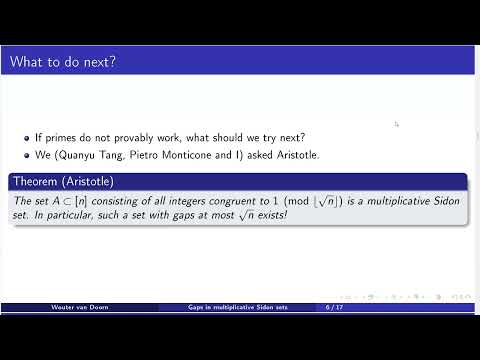
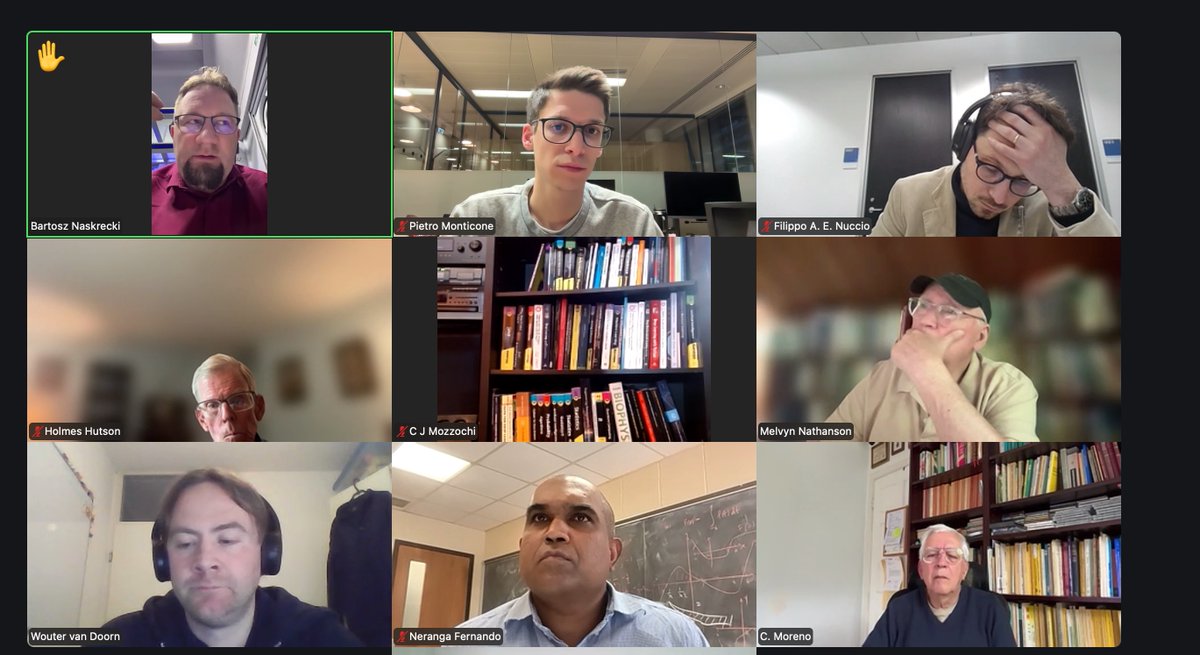
Wouter van Doorn presented at NYNTS how he used Aristotle to tackle an important unsolved problem in number theory.
Check it out here: youtu.be/7G6B0w8Quok
YouTube
Bartosz Naskręcki@nasqret
Today at the New York Number Theory Seminar, Wouter and Pietro were discussing their new paper. Really cool use of the AI-human feedback loop, with Aristotle as the main AI ingredient. I explained how I think formalization feels like doing the low-tech steps of algebraic geometry proofs with commutative algebra. You can have high-brow intuitions, but eventually one has to prove all the details. I wonder how this will evolve, but we are definitely at the level of assembly language being written by models like Aristotle. Tactics feel like the first glimpses of higher-level programming principles. The next step might be a more conversational style of working with the models. I am now working on a tighter integration of Lean with computer algebra languages. Stay tuned!
English
ICYMI: A few quality of life improvements landed in Aristotle Web to make it much more interactive and responsive:
▪ Live Updates. Aristotle can now share updates while it's in the middle of a run, so that you always know what it's doing and whether it's on track.
▪ Steering. You can message Aristotle while it's working if you want to redirect it, or if you just want to let it know it's doing a great job.
Keep the feedback coming; we'll continue cooking ...

English

mathematical superintelligence solves this @HarmonicMath
alex peysakhovich@alex_peys
got a framed copy to hang by the ai team
English
Harmonic retweetledi

Today at the New York Number Theory Seminar, Wouter and Pietro were discussing their new paper. Really cool use of the AI-human feedback loop, with Aristotle as the main AI ingredient.
I explained how I think formalization feels like doing the low-tech steps of algebraic geometry proofs with commutative algebra. You can have high-brow intuitions, but eventually one has to prove all the details.
I wonder how this will evolve, but we are definitely at the level of assembly language being written by models like Aristotle. Tactics feel like the first glimpses of higher-level programming principles. The next step might be a more conversational style of working with the models.
I am now working on a tighter integration of Lean with computer algebra languages. Stay tuned!
Pietro Monticone@PietroMonticone
Here's what András Sárközy, Erdős's most prolific collaborator, asked 25 years ago: "How small can one make the maximal gap between the consecutive elements of a multiplicative Sidon set selected from {1, 2, ..., n}?" In particular: does there exist a multiplicative Sidon set A ⊆ {1, 2, …, n} such that every sub-interval of [1, n] of length at least √n contains at least one element of A? The answer is yes. The solution was autonomously discovered and formally verified in #Lean by Aristotle. We then improved the bound below √n and Aristotle formalised our proof too.
English
Harmonic retweetledi

Here's what András Sárközy, Erdős's most prolific collaborator, asked 25 years ago:
"How small can one make the maximal gap between the consecutive elements of a multiplicative Sidon set selected from {1, 2, ..., n}?"
In particular: does there exist a multiplicative Sidon set A ⊆ {1, 2, …, n} such that every sub-interval of [1, n] of length at least √n contains at least one element of A?
The answer is yes. The solution was autonomously discovered and formally verified in #Lean by Aristotle. We then improved the bound below √n and Aristotle formalised our proof too.

Română
Harmonic retweetledi

I used @HarmonicMath's Aristotle to formalize Erdős problem #426 in Lean 4…
and ended up fully verifying a stronger bound that the original paper only suggested 🧵
Erdős offered $25 for a disproof, and $100 if the conjecture was true 👇

English
Harmonic retweetledi

Mel Nathanson — How Harmonic's Aristotle solved some of my problems. gist.github.com/kim-em/20212c6… #LeanProver #ITP #Aristotle #AI4Math
English
Harmonic retweetledi
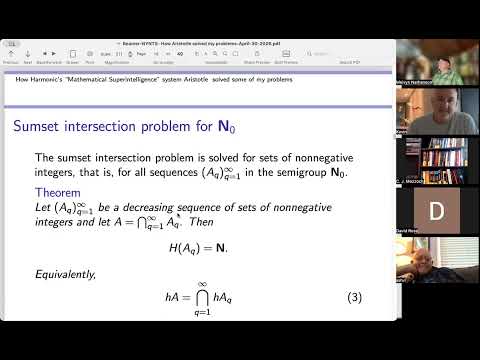
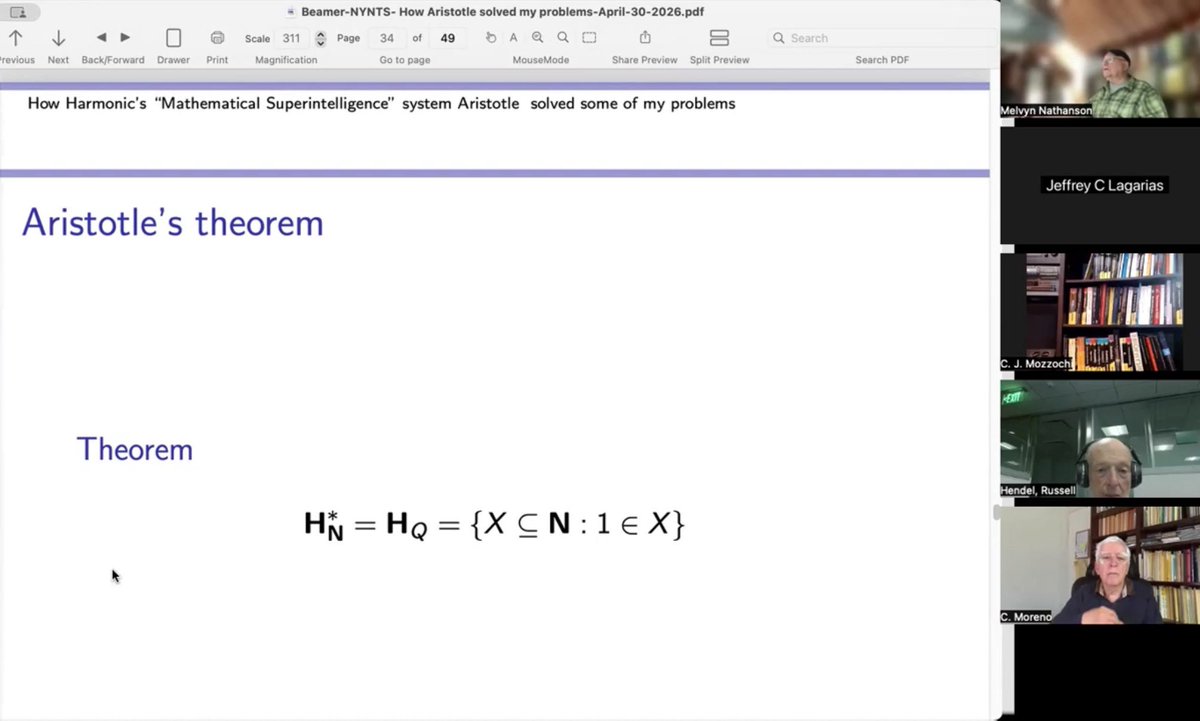
Nathanson has just published the recording of his talk about Aristotle’s solutions and it is very interesting to watch!
“I tried to figure out what it did that I didn’t do to solve the problems.”
“The incredibly clever idea that Aristotle had was…”
youtu.be/VBIxv-6m7sk
YouTube
Pietro Monticone@PietroMonticone
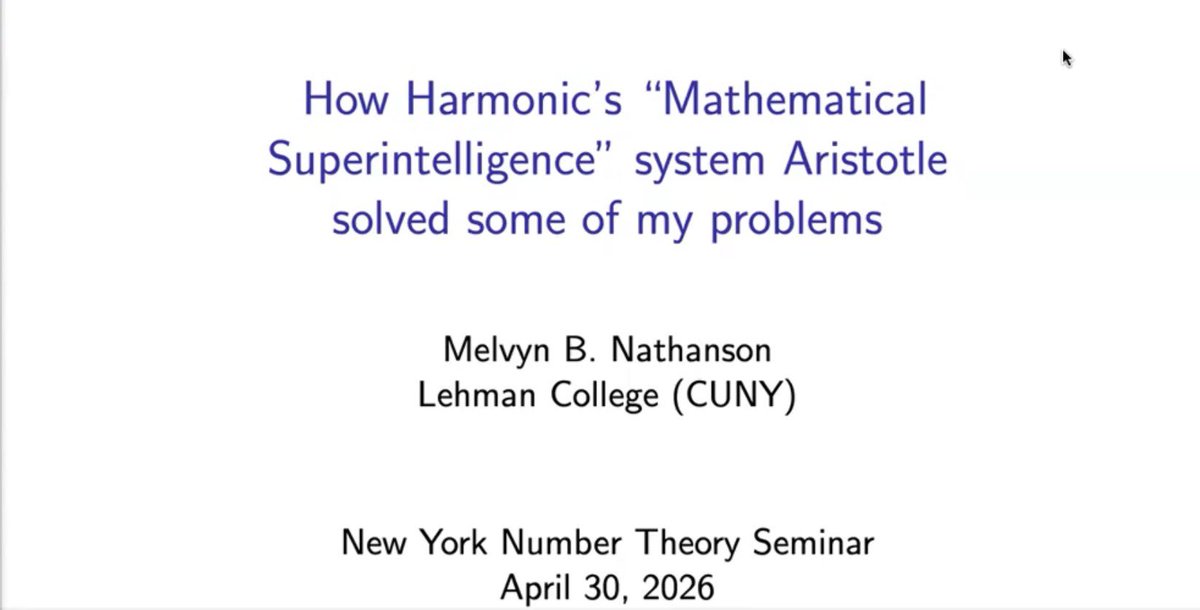
Interesting update: a few days ago, Nathanson presented a talk at the New York Number Theory Seminar explaining how Aristotle solved some of his problems.
English
Aristotle solves several open problems from Melvyn B. Nathanson, a frequent collaborator with Paul Erdos
Pietro Monticone@PietroMonticone
Interesting update: a few days ago, Nathanson presented a talk at the New York Number Theory Seminar explaining how Aristotle solved some of his problems.
English
Harmonic retweetledi

Great to see Lean at the centre of this closed loop: from autonomous discovery, to formal verification, to mathematical exposition that humans can read, rewrite, and improve.
Pietro Monticone@PietroMonticone
To my mind, what seems most important here is not so much the results themselves, nor even the particular methods used in the proof. What really matters is the workflow: the closed loop from autonomous discovery of the right constructions, to formal verification of the proof in Lean, to informalised exposition back into a manuscript that mathematicians can read, understand, rewrite, and improve. It suggests a framework in which formal proof is not merely a static final certificate, but an active part of mathematical research: a medium through which ideas are found, organised, tested, explained and made available for human judgment. That dynamic loop is the real story for me. The natural next question is how far it can be pushed.
English
Aristotle is getting more and more capable, assisting mathematicians not just in formalization but also discovery.
Team continues to cook 🔥
Pietro Monticone@PietroMonticone
"Aristotle's proof is correct, simple, elegant, and beautiful. It uses techniques in the original paper and adds its own new ideas. I am amazed and impressed by what Aristotle has done." This is what Melvyn Nathanson, a leading additive number theorist and longtime Erdős collaborator, wrote to me after reading solutions by Aristotle (@HarmonicMath) to two problems he had posed earlier this year. Our paper answers Nathanson's Problems 10 and 11 on product intersection sets in semigroups, and also settles the second parts of Problems 4 and 7 as corollaries.
English
JUST IN: Aristotle writes and formally verifies z80 emulator in @leanprover
Alex Meiburg@Timeroot
The Lean language (@leanprover) has utilities for verifying software, and AI is adept at using it. But can AI prove correctness for a *foreign architecture* with *no existing API*? It turns out, yes! @HarmonicMath's Aristotle wrote a z80 emulator: github.com/Timeroot/Z80Emu (1/n)
English
Pure mathematics will be mostly unrecognizable. Like very early black and white talkies becoming color home theater. Today’s math will not be unwatchable like silent pictures, but even that will happen eventually too.
This AI math hype cycle will have crashed in wildly overclaimed tech CEO BS, but the CEOs will be proven to be correct for the cycles that followed.
Older mathematicians and younger colleagues may be seriously divided in a way that we haven’t seen.
Papers will not exist in the same way. You will have an automatically adaptive custom presentation based on your abilities and interests.
Many established results will survive revelations that the proofs in the literature were flawed. This will be very disturbing to mathematicians.
We will find out that a lot of problems we thought were hard were actually completely misgauged.
Machines will write for each other and translate to English when needed. There will be too much Mathematics to sort through. Amateurs will submit their machine’s results which will be AI verified as valid.
The successors to LLMs will relentlessly rely on a few main tricks to generate nonimmitative discoveries. LLMs in math will have crashed.
It’s going to be both ego crushing and magnificent. A tragedy and a liberation.
Currently Unthinkable Visualizations will democratize what can be understood. Like exotic structures on 7-spheres.
Humans will still matter. But less and less so. They will move from doing research to directing it. We will get worse in a sense at mathematics as we atrophy. But the machines will compensate for that too.
Computers may invent new areas or “theories” by 7 years. But maybe not. Hard to say.
Our abysmal Mathematical pedagogy will have finally fallen.
——-
One math PhD’s guess anyway, in 2026.
Paata Ivanisvili@PI010101
What will mathematics look like 7 years from now? I’m really curious to hear your brief opinion.
English
Formally verified by Aristotle
Enrique Barschkis@ebarschkis
Kind of crazy. I had a rough idea for an Erdős problem, gave it to GPT-5.4 Pro, went for a walk, came back to a solution. I verified it, formalized it with Aristotle from @HarmonicMath together with @Tomodovodoo. Incredible how powerful these tools are in the right hands!
English
BREAKING: Aristotle now powering formal verification of Solana smart contracts
"Prove your Solana code is correct. Mathematically"
shek@shek_dev
two major upgrades that made this possible asm2lean: assembly to Lean transpiler, no manual transcription hell aristotle by @HarmonicMath : the agentic prover can run for upto 24 hours on harder theorems x.com/HarmonicMath/s…
English
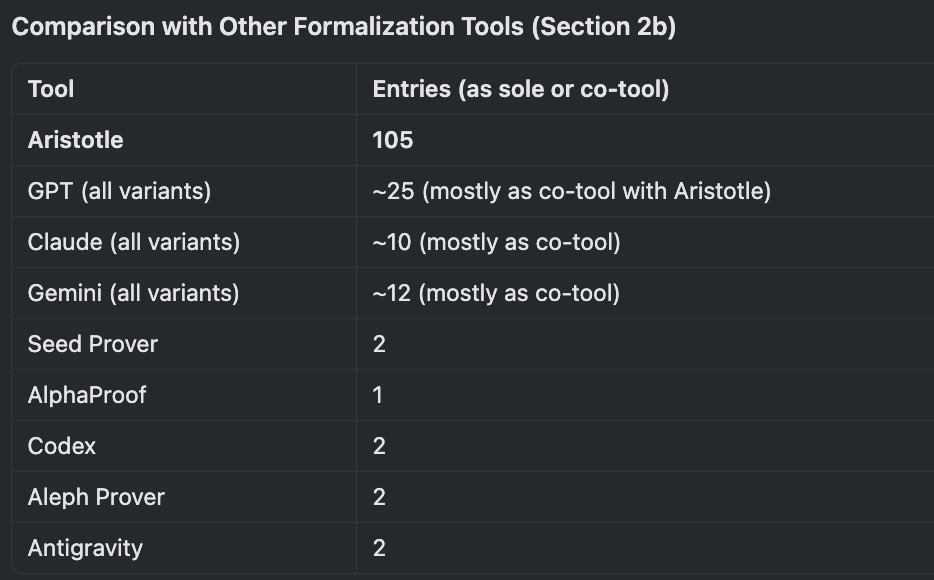
Update: Aristotle has been used to autoformalize 105 of the 115 Erdős problem formalizations produced by AI tools, i.e. 91% of the total.
This includes formalizations of classical proofs such as Pólya (1918), Barrow and Mordell (1937), Hall (1947), de Bruijn (1951), and Lorentz (1954), alongside very recent proofs such as Tao (2026), He–Li–Tang (2026), Pomerance (2026), and Chojecki (2026).
English
We are past the event horizon of mathematics and entering a strange world for which there is no precedent
Pietro Monticone@PietroMonticone
AI is increasingly changing how we do mathematics. Erdős Problem #650, open for over 60 years, was solved a few weeks ago through a collaboration between human mathematicians, an informal reasoning model (GPT 5.4 Pro @OpenAI) and a formal one (Aristotle @HarmonicMath). 🧵
English