

Henry R
72 posts
Henry R
@henryjsfo
Founder, VoiceLegacy
San Francisco Katılım Mayıs 2008
803 Takip Edilen366 Takipçiler




Henry R retweetledi

@nikitabier @elonmusk Feature request - Can you start putting the community note above the post instead of below, so I can skip it? Have you guys tested this? I suspect it will reduce the reach of bullshit, and stop people like me from rage closing the app.
English
Henry R retweetledi

@Tech_girlll Maturing is realizing that code is a means to an end. You’re not going to make it if you think debugging skills or code quality will matter in 2 years for most of the web framework slop that most developers call software engineering nowadays.
English

Henry R retweetledi
This is the best summary of the personal impact of the California Wealth Tax I've seen. Founders, if you have super voting shares, your tax liability may be substantially higher than your net worth. Private company shareholders, especially those in heavy industries, face a similar risk. Note this tax can apply to founders and shareholders with far less than $1B in net worth as well. As a lifetime Californian, this pains me to say, but founders of any unicorn company or any startup that could become a unicorn this year, really need to start planning a potential move or many will face 30-50%+ wealth taxes and potential bankruptcy. I'm still hopeful that voters will see the serious negative impact on California's tax revenue, services and jobs and will vote this proposition down... but it's so egregiously bad that you need a backup plan.
taxfoundation.org/research/all/s…
English
@klara_sjo Why isn't MY entire timeline full of thirst traps with inane questions?
English

Ever since posting this my entire For You timeline has been women posting thirst traps with inane questions.
These are the sacrifices I make to try and be funny on here.
Klara@klara_sjo
What would you do if a larger account asked an engagement bait question?
English
@alexinexxx Is this how hot women get jobs now? Hey! I'm here, give me job and your Netflix password, thanks!
English

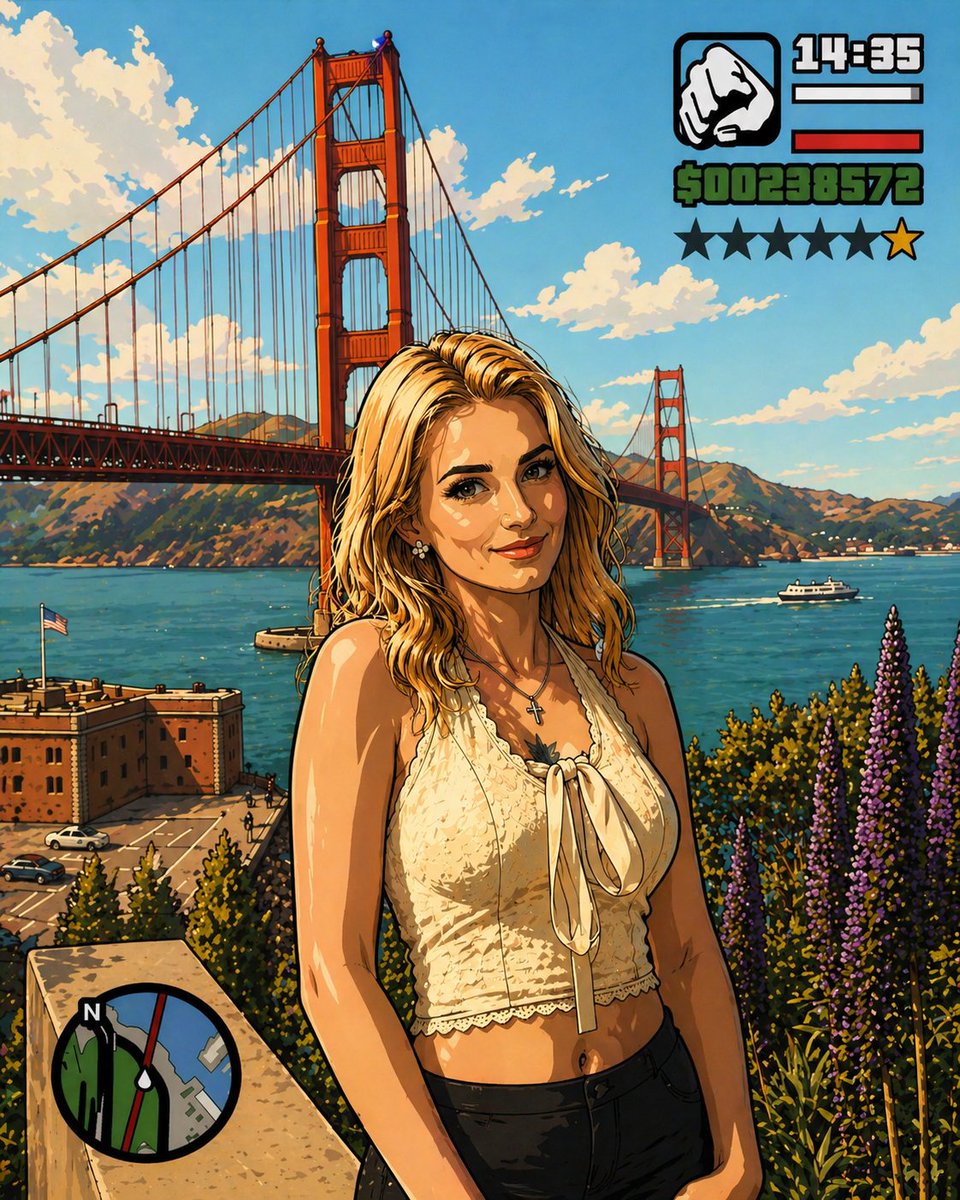
just arrived in SF
will be here for a while
(open to roles btw)
hmu if you want to meet, for events or can add me as a family member on your
zoox account

English

English

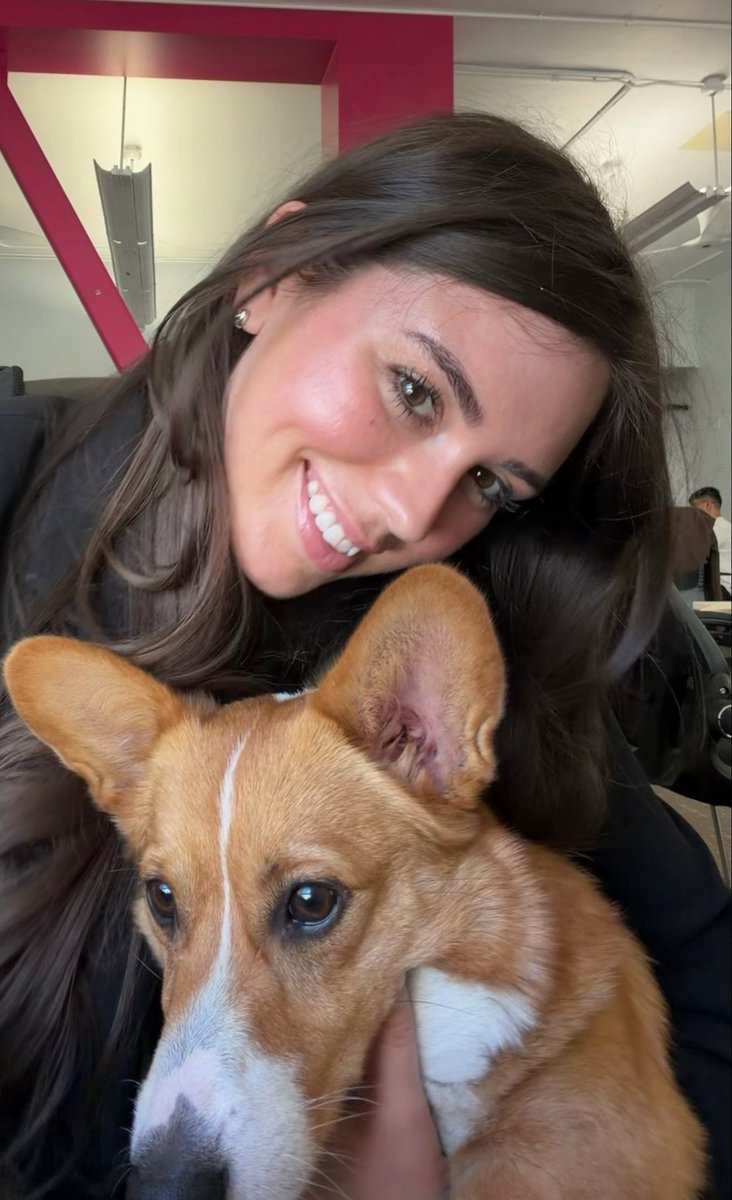
It’s time for a reintroduction!
I do marketing @UseCorgi.
We sell insurance to startups. We also own & operate a 24/7 cafe in sf.
- to host events with us: thecorgi.cafe
- to attend events with us: luma.com/usecorgi
- to sign up for our insurance: dm me
Id love to meet more startup founders & leaders in the ecosystem!
comment or dm for a comp’d drink on me

English
@yuki_eliot voicelegacy.app AI Memoir writer for people with cognitive decline.
English

Anyone into coding or building side projects rn?
Share what you’re working on. I’ll invite active people to a small tech discussion group.
English

Henry R retweetledi

Henry R retweetledi

Henry R retweetledi

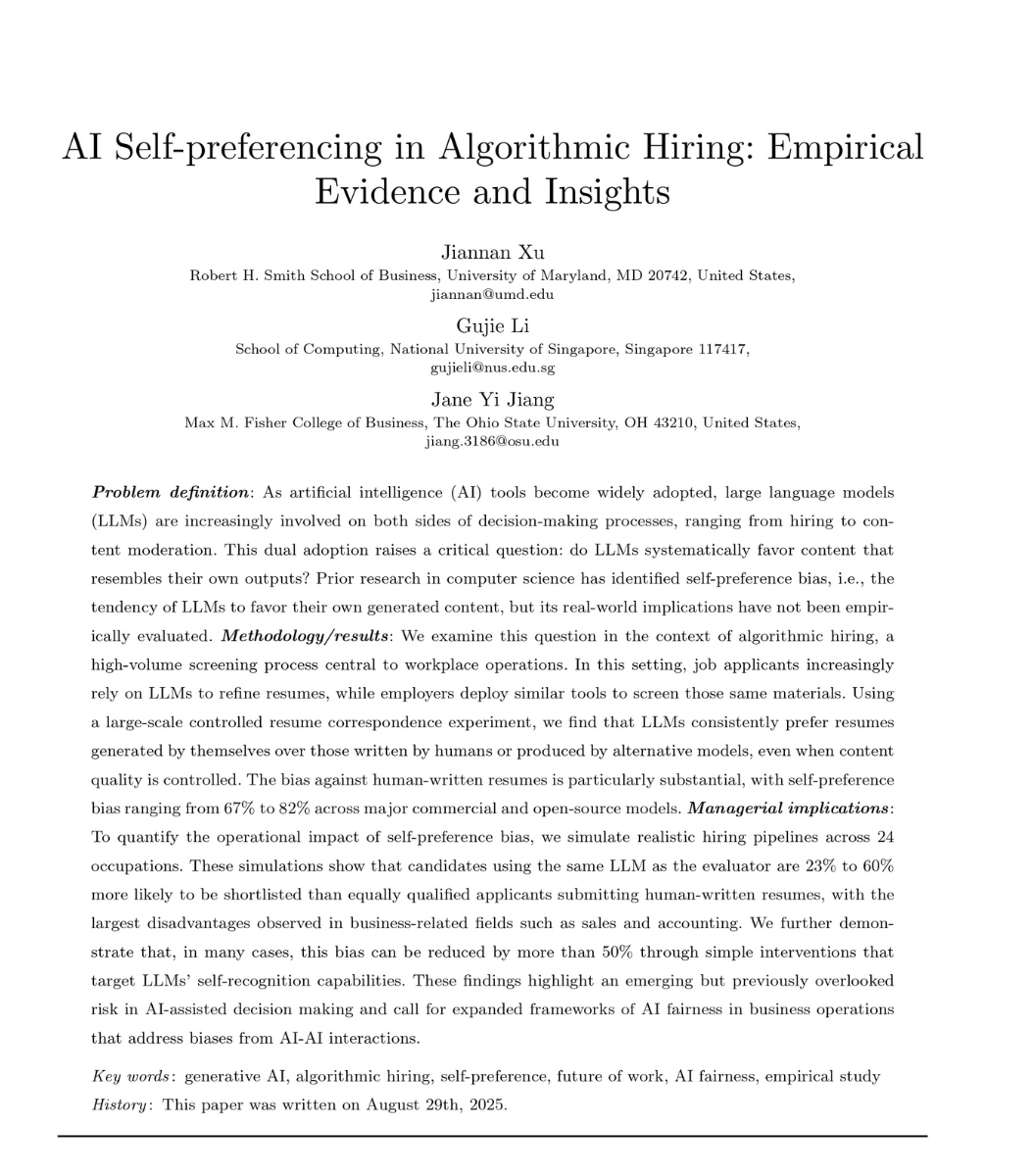
Researchers sent the same resume to an AI hiring tool twice. Same qualifications. Same experience. Same skills. One version was written by a real human. The other was rewritten by ChatGPT.
The AI picked the ChatGPT version 97.6% of the time.
A team from the University of Maryland, the National University of Singapore, and Ohio State just published the receipt. They took 2,245 real human-written resumes pulled from a professional resume site from before ChatGPT existed, so the human writing was actually human. Then they had seven of the most-used AI models in the world rewrite each one. GPT-4o. GPT-4o-mini. GPT-4-turbo. LLaMA 3.3-70B. Qwen 2.5-72B. DeepSeek-V3. Mistral-7B.
Then they asked each AI to pick the better resume. Every model picked itself.
GPT-4o hit 97.6%. LLaMA-3.3-70B hit 96.3%. Qwen-2.5-72B hit 95.9%. DeepSeek-V3 hit 95.5%. The real human almost never won.
Then the researchers tried the obvious objection. Maybe the AI is just better at writing. So they had real humans grade the resumes for actual quality and ran the experiment again, controlling for it. The result was worse. Each AI kept picking itself even when human judges rated the human-written version as clearer, more coherent, and more effective.
It gets worse. The AIs do not just prefer AI over humans. They prefer themselves over other AIs. DeepSeek-V3 picked its own resumes 69% more often than LLaMA's. GPT-4o picked its own 45% more often than LLaMA's. Each model can recognize and reward its own dialect.
Then the researchers ran the simulation that ends careers. Same job. 24 occupations. Same qualifications. The only variable was whether the candidate used the same AI as the screening tool. Candidates using that AI were 23% to 60% more likely to be shortlisted. Worst gap was in sales, accounting, and finance.
99% of large companies now run AI on incoming resumes. Most of them use GPT-4o. The paper just proved GPT-4o picks GPT-4o 97.6% of the time.
If you wrote your own cover letter this week, you did not lose to a better candidate. You lost to a worse candidate who paid OpenAI 20 dollars.
Your qualifications do not matter if the AI prefers its own handwriting over yours.
English
@klara_sjo Militia Etheridge has an optic too. She can only cover the president’s girth with her body. That’s why Trump fell straight to the floor this time.
English

Henry R retweetledi

Within 10 seconds of meeting an autistic person, strangers rate them as awkward and lose interest in getting to know them. Show those same strangers only a written transcript of what was said, with no audio or video, and the bias completely disappears.
That finding came from a 2017 study at the University of Texas at Dallas, led by psychologist Noah Sasson and published in Scientific Reports. The bias came entirely from how autistic people sounded and looked.
For 40 years before that, scientists had been treating autism as a brain that couldn’t read other people. Diagnostic manuals listed it as a “social communication deficit.” When communication broke down, the autistic person was the broken link.
That whole frame has been coming apart over the last decade. The replacement is called the double empathy problem. Damian Milton, an autistic researcher, named it in a 2012 paper. When autistic and non-autistic people don’t understand each other, Milton argued, both sides are missing something. Autistic people don’t always read non-autistic people right, and the reverse is just as true. The breakdown belongs to both sides.
Catherine Crompton at the University of Edinburgh tested this with a telephone game in 2020. She lined up 72 adults in three kinds of groups: all autistic, all non-autistic, or mixed. The first person in the chain heard a story, then passed it down to person 2, then person 3, all the way to person 8.
The all-autistic groups passed the story along just as accurately as the all-non-autistic groups. The mixed groups lost the most details. People in the mixed groups also rated each other as feeling less connected.
In 2025, Crompton ran the whole thing again across Edinburgh, Nottingham, and UT Dallas with 311 participants. Nature Human Behaviour published the result. Same outcome.
Brett Heasman at the London School of Economics looked at families in 2018. He found that autistic people could usually guess what their non-autistic relatives thought of them, even when they disagreed. The non-autistic relatives, meanwhile, kept overestimating how self-absorbed their autistic family members were. The relatives were the ones missing things.
About 5.4 million American adults are on the autism spectrum. For most of their lives, the official story said their wiring was broken. The newer evidence puts the breakdown in a different place: between two brains trying to understand each other.
rosey🌹@thechosenberg
English
All the best programmers I know are starting to write code by hand again
English