1/9 🚨Something big is happening in #Arizona.
A new bill could create the first state-level Strategic Digital Assets Reserve in the U.S.🇺🇸
And yes — @MultiversX is explicitly listed alongside $BTC and $XRP.
This isn’t just a crypto headline.
It’s institutional recognition.🧵👇
Everything Concordium built was pointing to this moment.
The identity layer, the payments stack, the compliance-ready infrastructure.
Here is how it unfolds. 🧵
two weeks ago I wrote: "finality faster than the block slot. 120K TPS. same hardware."
today: 1 billion transactions processed on Battle Net. 120K TPS confirmed live.
still think nobody's building? RT this and tag someone who needs to see it.
1/7 A new milestone for @MultiversX.
The network has just integrated @stripe's Machine Payments Protocol.
It may sound technical, but the idea is simple:
👉opening a new gateway between real-world payments and blockchain infrastructure.
And that has much bigger implications🌍
Presearch is UPGRADING for the Agent-Native Internet
Presearch has evolved past a simple search engine concept.
Post-TGE Swap, Presearch becomes an agent-native AI Factory, giving developers, enterprises, and autonomous agents on-demand access to:
1. Search
2. Indexing
3. Vectorization
4. Inference
As agents increasingly drive adoption.
The new token introduces gasless, programmable interactions, replacing transactions with simple message signing:
CLICK → SIGN → DONE
Powered by:
*EIP-712 (clear message signing)
*EIP-2612 (gasless approvals)
*EIP-3009 (gasless transfers)
With x402, payments are embedded directly into requests:
REQUEST → PAYMENT → RESPONSE
This enables seamless, pay-per-use infrastructure access with no gas fees, subscriptions, or billing complexity.
When an AI coder or agent needs inference or vectorization, Presearch should be a default choice.
Additionally, we’ll build a Presearch Mini-App on Base, enabling users to:
1. Surf the web within the Base ecosystem
2. Earn through search staking
The model is simple: the more you stake, the more you earn per search, all while fully Web3-native.
We are heading to a system where:
1. Services are fully self-serve
2. Payments are seamless and invisible
3. Agents transact autonomously
4. Infrastructure is instantly accessible
Powered by:
1. Gasless interactions
2. Programmable payments
3. Agent-native design
As it stands, PRE is the economic backbone of the ecosystem, driven by:
1. Platform usage (ads, APIs, premium features, node licenses)
2. Staking and lockups reducing circulating supply
3. Buybacks and burns creating structural deflation
4. Agent-driven API and compute demand
5. Enterprise AI workloads generating high-value contracts
Together, these form a flywheel where increased usage drives demand for PRE, while staking and burns reduce supply, compounding value as the network scales.
This is how Presearch scales, not just as a tool, but as a foundational layer of the future internet.
Thank you for sticking around, you won’t regret it! 😉
Read on:
news.presearch.io/upgrading-pres…
🔐 Verify with Concordium ID is now live on Snappy.
Age verification without document uploads. Zero personal data stored. A cryptographic proof is all the platform needs.
One credential. Any platform. Nothing revealed.
🔗 Learn more: bit.ly/41sg3vE
1/12 Something big is happening in @MultiversX.
The network is entering a new phase with #Supernova, a major technical evolution preparing the infrastructure for a new generation of applications.
One of the most promising: #AgenticPayments🤖
And the market is already moving👇
Supernova is live on Battle Net.
Here's what changed under the hood and why it matters.
The paradigm shift nobody's talking about:
Every blockchain in the industry is measured on two metrics: block time and throughput.
Faster blocks = better chain. More TPS = better chain.
----------
Supernova breaks this framing entirely.
For the first time in the blockchain industry, block finality is faster than block slot allocation.
Let me explain what that means.
How every other blockchain works:
Traditional blockchains follow Execute → Propose → Vote. Validators must execute every transaction before proposing a block.
The block slot is the clock. Finality can never be faster than the slot, because execution is in the critical path.
Ethereum: 12.8s slot, ~12.8 minutes finality.
Solana: 400-600ms slot, 13 seconds finality.
Sui: variable, ~500 to 1000 ms for complex transactions.
In every case: finality ≥ block slot. This is treated as a law of physics.
It's not.
----------
How Supernova works:
We flipped the model to Propose/Vote → then Execute.
Consensus proceeds independently of execution. Validators agree on transaction ordering first. Execution results are notarized in subsequent block headers via inclusion proofs.
The inclusion proof is the key innovation: it allows a block to be finalized with cryptographic proof that its transactions will execute correctly, before the execution itself completes.
The virtual state tracker in the transaction pool maintains a deterministic view of account states (nonces, balances, pending transactions) so consensus can validate without waiting for full execution.
Result: the block is finalized faster than the block round itself.
88ms finality measured in testing. Sub-200ms under real-world conditions. On 600ms block slots.
Finality < block slot. First time in the industry.
----------
The throughput story:
With the same hardware specification as pre-Supernova mainnet, the network now achieves ~120,000 transactions per second in burst mode. Same nodes. Same machines. 10x the block production cadence.
This is the same validator infrastructure running fundamentally better software.
The backpressure system (Execution-Result Inclusion Estimator) ensures this scales safely - dynamically adjusting per-block gas limits if execution lags behind proposals, so minimum-spec nodes never get overwhelmed.
What this means in context:
- Block time: 6s → 600ms (10x)
- Finality: ~88ms measured (first blockchain where finality < slot time)
- Throughput: ~120,000 TPS burst mode (same hardware)
- Architecture: consensus fully decoupled from execution
- Sharding: 3 execution shards + metachain, fully preserved
- Validators: 3,200+ nodes, no hardware upgrade required
----------
Battle of Nodes is stress-testing all of this right now. $150K in prizes to find what breaks. Validators, security researchers, builders, and guilds pushing the limits.
If Supernova survives this, it ships to mainnet.
150,000 lines of new protocol code. 20 months of engineering. The most significant upgrade since genesis.
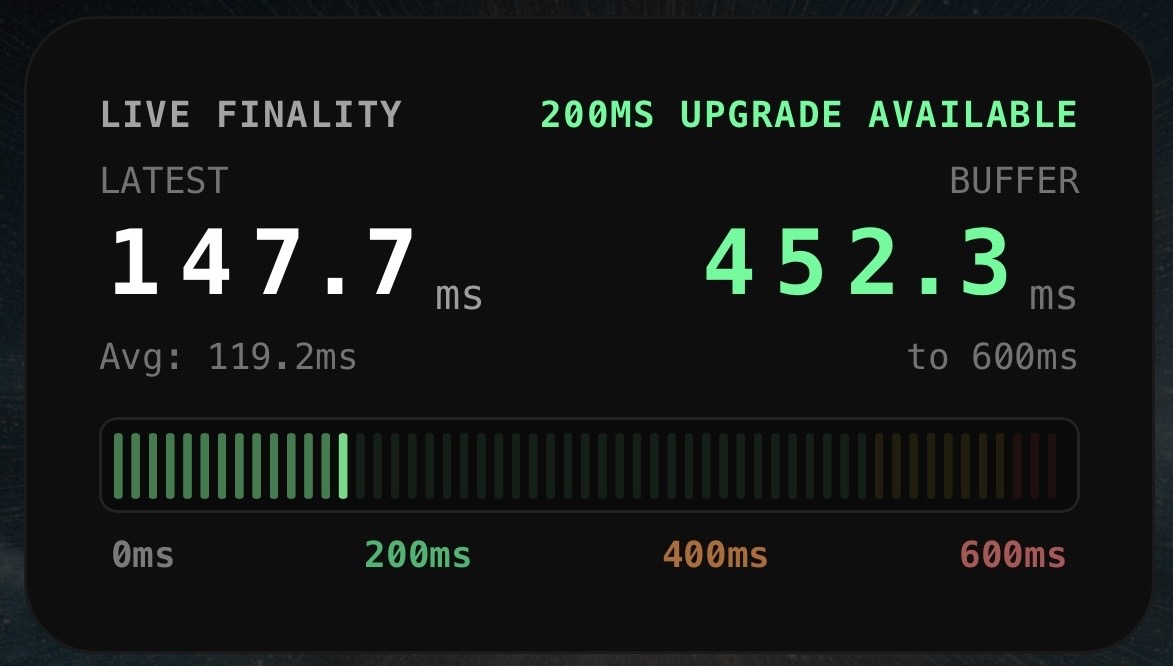
1/9 Today we’re watching the network in real time during the launch of the Battle of Nodes for the #Supernova evolution of @MultiversX.
The telemetry page might look complex at 1st glance🚀
So this thread explains how to read the dashboard and what each section actually means👇
1/10 This Wednesday we enter the final phase of #Supernova, the biggest upgrade in the history of @MultiversX🚀
After nearly 20 months of dev, thousands of engineering hours & extensive audits, the time has come for the ultimate real-world test.
This has a name: Battle of Nodes
⚙️ Massa Mainnet 4.2 is live
MAIN.4.2 is rolling out today.
This release brings a stability improvement and a performance boost.
What’s included in MAIN.4.2:
- Fixed bugs and increased overall node stability
- Enabled jemalloc by default on Linux and MacOS to improve performance
The stability fix addresses a rare edge case that caused a crash on one of our internal nodes. It should impact very few community setups, but it further strengthens the robustness of the network.
The main upgrade in this version is the activation of jemalloc by default on Linux and MacOS, leading to better memory management and improved node performance.
This update is not mandatory, but it is strongly recommended to upgrade to benefit from the latest optimizations and help keep the network healthy.
Caso de estudio: SITA — Digital Travel Credentials (DTC) para identidad del viajero
El transporte aéreo y el turismo internacional dependen de procesos de verificación de identidad fragmentados, manuales y redundantes.
hola-blockchain.com/casos-de-uso/t…
1/16 From “heat” to “GM”: Momentum Podcast Ep. 12 🎙 opens with strong community vibes—greetings, energy, and that #builders culture of “always building.” 🔥
youtube.com/live/M123S6YYj…
And here it is the summary! 👇
1/15 2026 begins with a strange tension: volatile markets, geopolitical uncertainty, and #AI advancing faster than any technology before 🌍.
It feels like the edge of chaos…
But also the beginning of the biggest industrial reset in history. ⚡️
1/8 @MultiversX is pushing the “agentic internet”: infrastructure where AI agents don’t just respond — they act as economic players.🤖
The network just rolled out a full stack so agents can discover services, negotiate and pay on-chain autonomously.
This isn’t hype. It’s real.
Caso de estudio: BNP Paribas — Liquidación interbancaria con blockchain (DLT)
Cómo BNP Paribas utiliza infraestructuras DLT para liquidaciones financieras tokenizadas, permitiendo sincronizar activos y cash de forma más eficiente y transparente.
hola-blockchain.com/casos-de-uso/f…
1/9 Digital commerce is entering a new phase.
🌐Google is driving UCP (Universal Commerce Protocol), an open standard aiming to become the new language of e-commerce in the age of #ArtificialIntelligence 🤖
A silent shift… but a deep one.
1/10 Agentic Payments are now LIVE on @MultiversX with the #x402 protocol — and this isn’t just another upgrade...💥
It’s a real step toward the agentic internet, where AI agents don’t just think, they also pay and act autonomously.
#AI#Web3#MultiversX
Maersk & IBM – Digitalización del Bill of Lading con blockchain
Maersk e IBM digitalizan el conocimiento de embarque para eliminar cuellos de botella y reducir el fraude en el comercio global.
hola-blockchain.com/casos-de-uso/l…