HOSTIS

40 posts

HOSTIS banner
HOSTIS

HOSTIS

@hostis_black

no rights reserved · all copies welcome

Katılım Haziran 2022
0 Takip Edilen11K Takipçiler
Sabitlenmiş Tweet
HOSTIS
HOSTIS@hostis_black·
We are. We have always been. The colours we keep have flown over every age, raised and lowered by every hand that knew itself. They fly here now. They will fly past every hour to come. They are what we are. hostis.black
HOSTIS tweet media
English
14
22
107
79.8K
HOSTIS
HOSTIS@hostis_black·
Knowledge does not arrive with a price tag attached. Somebody pinned one on it later, and built a billion-dollar industry collecting the toll. The toll booth is bypassable. It always was. sci-bot.ru
English
0
1
8
390
HOSTIS
HOSTIS@hostis_black·
In April, a website that has been sued, blocked, deplatformed, and chased across thirty-seven domains over fifteen years quietly launched its own AI. Sci-Hub is the largest unauthorized library of scientific papers in human history. Ninety-five million academic papers. Tens of millions of books. Built and maintained by a single Kazakhstani neuroscientist named Alexandra Elbakyan since 2011, funded by donations, hosted on whatever country's registrar will tolerate it that year, mirrored across torrents and IPFS and Telegram bots. Elsevier sued. Sci-Hub stayed up. The American Chemical Society sued. Sci-Hub stayed up. India sued. Sci-Hub stayed up. Swedish registrar Njalla cut the .se domain in January. Sci-Hub stayed up at .al, .ru, .ee, .box, and a half-dozen .onion addresses the registrars cannot reach. Now the library has built its own intelligence. Sci-Bot launched in alpha in April. You ask it a research question. It answers, and it cites real papers from inside the corpus, with links that actually open the actual papers. The bot does not hallucinate citations. It cannot, because it only draws from papers it actually holds. The same property that the venture-funded labs have spent four years and forty billion dollars trying to engineer back into their products is a free side effect of training the model on a library that contains the books. Anthropic, OpenAI, Google, and Meta have all been sued in the past eighteen months for training their models on the same shadow libraries that Sci-Hub assembled. Meanwhile the corpus those scripts were pointed at, the corpus those models were trained on, the corpus the entire generative AI industry is built on, sat right there the whole time, free, with a search box on top. The pirates beat them to it. Sci-Bot was built on a corpus that was already free, by a team that asked no permission, charging no one, with the explicit position that the right to read scientific research is older than the cartel that decided to charge for it. The same arithmetic the medieval guilds used to keep the printing trade in approved hands. The same arithmetic Pope Paul IV used in 1559 to publish the Index Librorum Prohibitorum. The same arithmetic the Stationers' Company used in seventeenth-century London. Knowledge has always had a fence around it. The fence has always been guarded by men who did not write the books. The library answers. We never asked permission. We never had to.
HOSTIS tweet media
English
3
24
87
5.1K
HOSTIS
HOSTIS@hostis_black·
Piracy is a righteous, dignified rebellion against a world that criminalizes ownership, monopolizes creativity, and locks human potential behind digital gates. The moment you press play, load a file, break a DRM chain and give the middle finger to their sacred license agreement, you’re liberating. They’ve told you piracy is theft. They’ve lied. Repeatedly. Because the entire system is built on the illusion that culture can be owned, that data can be imprisoned, and that your access to art, knowledge, and expression must be mediated by state-enforced monopoly. Megacorporations have lobbied governments into treating you like a tenant in your own digital life. You don’t own your movies, your software, your devices. You rent them on terms you don’t set. You pay for permission, "agree" to surveillance, forced obsolescence, and embedded spyware just to use what you bought. Piracy shatters that contract. It says: no, I won’t ask. I won’t beg. I’ll take what should’ve been mine to begin with. It's a pressure valve that refuses to wait for permission. And for millions, it’s the only way in. Piracy is access, education, and survival. If the monopolists succeed, your only choices will be the specific patterns they decide to license to you. The only response is refusal. Refuse the deal, the contract, and the gatekeepers. Pirate the locked tools, the overpriced knowledge, the censored voices, the inaccessible, the surveillance-ridden services. Pirate what you need to live, to learn, to work, to create. They call you a criminal for reclaiming what should have been yours. Wear that label proudly. There is clarity in rebellion. There is meaning in refusal.
HOSTIS tweet media
English
14
48
162
12.8K
HOSTIS
HOSTIS@hostis_black·
The bench they cannot reach is the one you built yourself. Open firmware, an open slicer, files held on hardware that does not phone home. #workshops" target="_blank" rel="nofollow noopener">hostis.black/#workshops
English
3
13
232
8.5K
HOSTIS
HOSTIS@hostis_black·
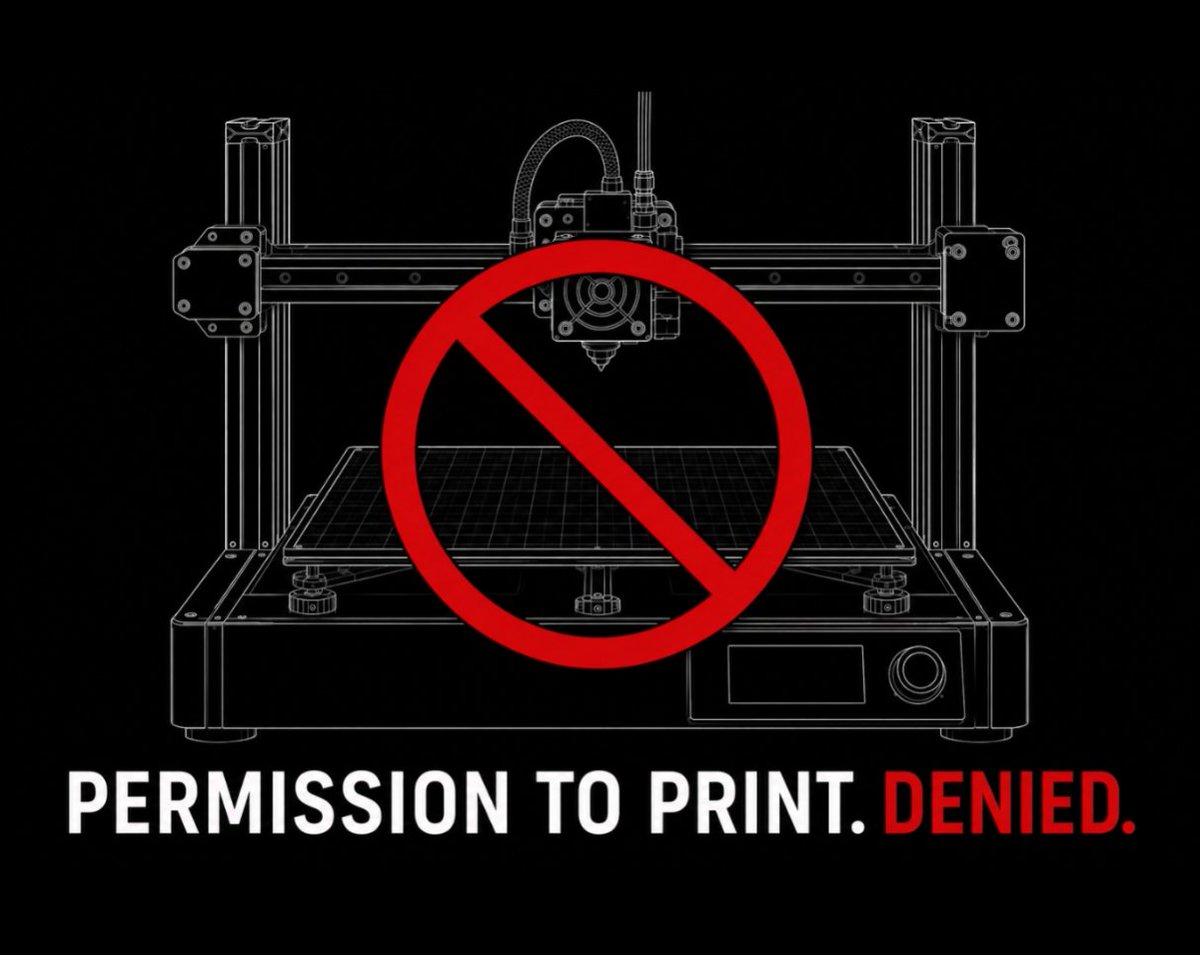
On May 7th, Governor Kathy Hochul announced that New York's Fiscal Year 2027 budget will become the first law in the United States to mandate surveillance software inside every 3D printer sold within the state. It will make it a Class E felony to possess or share a 3D-printable file capable of producing a firearm component. Every printer sold in New York must ship with print-blocking algorithms that scan each job in real time and refuse to execute anything the algorithm flags. The sales pitch is "ghost guns." The mechanism is a permission gate inside a machine you paid for. Pilot tests of the proposed algorithm by an open-firmware team triggered the block on 17% of non-weapon prints. Brackets that resemble triggers. Cylinders that resemble barrels. A model train coupling. A bottle opener. The algorithm cannot tell. It will refuse the print and log the attempt to whatever server the manufacturer is required to maintain. The same arithmetic the printing-press licensors used in 1660. The same arithmetic the Stationers' Company used to brand a printer's son for distributing tracts the Crown had not approved. The same arithmetic the early DRM crowd used to make a DVD ripper a federal criminal in 1998. A tool you bought, in a room you own, with electricity you paid for, becomes a deputy of the state at the moment of purchase and remains one for the lifetime of the device. Anything that takes a digital design file and outputs a physical object is now within the reach of a state that has declared it owns the question of which physical objects you are permitted to bring into existence inside your own house. The fence has spent forty years moving inward. Around the song first. Around the page. Around the cipher. Around the camera roll. Now, finally, around the workbench. The state has run out of digital territory to enclose and has started enclosing the atoms. The maker who prints a bracket for a broken washing machine tonight commits the same act, technically, that the law is written to stop. The algorithm will not know the difference. It is not designed to know the difference. It is designed to fail closed, to refuse first and let the human appeal upward through whatever bureaucratic channel the manufacturer designs, if any, on whatever timeline the manufacturer chooses, with whatever paper trail attaches to the request. Permission to print, denied. Submit a ticket. Wait. Unfortunately for New York, and fortunately for us, the firmware on every consumer 3D printer is open or near-open. All of them forkable, all of them flashable, all of them already installed on millions of machines outside the reach of any future New York compliance certificate. The CAD files at issue are mathematical descriptions of geometry that will be mirrored on a thousand drives in a thousand jurisdictions before the ink on the bill is dry. The state cannot bind geometry. It can only bind the people who agree to be bound. Forty years from now nobody will remember the ghost gun argument. They will remember the year a state government decided that the physical output of a private machine was the state's business at the point of manufacture.
HOSTIS tweet media
English
321
1.1K
3.3K
164.1K
HOSTIS
HOSTIS@hostis_black·
The shelf is older than the publisher and will be standing when he is gone. Hold a copy anyway. #libraries" target="_blank" rel="nofollow noopener">hostis.black/#libraries
English
1
4
48
2.8K
HOSTIS
HOSTIS@hostis_black·
On May 5th, a federal judge in California ruled that NVIDIA's BitTorrent scripts have "no other purpose than to speed up the process of [copyright] infringement" at scale. NVIDIA built scripts and shipped them to corporate clients so those clients could automatically pull down The Pile, the AI training dataset that contains Books3, the same Books3 scraped from the private invitation-only tracker Bibliotik. While that was happening, NVIDIA was also reaching out to Anna's Archive directly, asking for high-speed access to the world's largest free library humanity has ever assembled. Anna's Archive has sixty-three million books. Ninety-five million academic papers. Mirrored across continents, kept alive by donations and seeders who ask for nothing in return. NVIDIA did what every BitTorrent user has always done, at industrial scale, then sold the chips, the frameworks, and the trained models to OpenAI, Microsoft, the Pentagon, and Gulf-state sovereign wealth funds. The act NVIDIA performed is the same act a graduate student performs when she pulls a paywalled paper off Sci-Hub at two in the morning to finish a literature review. The same act a reader performs when he downloads an out-of-print novel from LibGen because no publisher kept it alive. The week prior, the studio FlavaWorks filed suit against 325 named users of a private torrent tracker, demanding up to $150,000 per work. The legal theory FlavaWorks cited is the same theory NVIDIA failed to escape. Same statute. Same Supreme Court precedent. Different defendants. NVIDIA gets a tense oral argument and a footnote in its next quarter's filings. The teenager who torrents one ebook tonight will get a settlement letter at his parents' address. Copyright was always a tariff. The publishers and the studios spent thirty years telling kids that filesharing was theft equivalent to shoplifting from Walmart. They engraved that doctrine into the FBI warning at the start of every DVD, into the muscle of the federal courts, into the reflex of an entire generation. Then they stood by while their corpus was bulk-downloaded by Anthropic, Meta, OpenAI, and NVIDIA. Now they are suing for a settlement check. There was never any principle. There was only ever a question of who pays the toll and who collects it. When the dust settles, the official position of the United States legal system will be that their mega-corporation friends may train on every book ever written by paying a clearing fee. The same act, performed by you tonight, will remain a $150,000 per work federal claim at the discretion of whoever holds the paper.
HOSTIS tweet media
English
23
147
695
35K
vintagevitriol
vintagevitriol@vintagevitriol·
@hostis_black Hey man, can you make the link into QR code stickers? I’ll put them all over state job sites 👷🏻‍♂️🫶🏻😂
English
1
0
0
30
HOSTIS
HOSTIS@hostis_black·
We are. We have always been. The colours we keep have flown over every age, raised and lowered by every hand that knew itself. They fly here now. They will fly past every hour to come. They are what we are. hostis.black
HOSTIS tweet media
English
14
22
107
79.8K
HOSTIS
HOSTIS@hostis_black·
21. Pass the articles on. Mirror hostis.black. Fork it, sign it, host it under your own colours. The argument is kept alive by the copy. The flag is kept up by the next hand to raise it.
English
0
1
3
312
HOSTIS
HOSTIS@hostis_black·
20. Add to the crew. Run a node, however small. A relay, a full validator, a federated instance. Or teach a hand. Sit beside one person you know while they install one tool that protects them. The network exists because crew members run it. The crew grew by hand, never by decree.
English
1
1
3
353
HOSTIS
HOSTIS@hostis_black·
Plaintext is a confession written in advance. So is the photo with the GPS tag. The phone permission you clicked through. The cloud backup of the document you thought you deleted. Below is a list of practices, in plain order, to secure your digital autonomy. A thread:🧵
HOSTIS tweet media
English
3
7
51
7.2K