howard

3.4K posts

howard banner
howard

howard

@hwu76

On the payroll of a tech company in an analytics function.

Yermo, CA Katılım Haziran 2009
1.1K Takip Edilen368 Takipçiler
Mitchell Hashimoto
Mitchell Hashimoto@mitchellh·
I strongly believe there are entire companies right now under heavy AI psychosis and its impossible to have rational conversations about it with them. I can't name any specific people because they include personal friends I deeply respect, but I worry about how this plays out. I lived through the great MTBF vs MTTR (mean-time-between-failure vs. mean-time-to-recovery) reckoning of infrastructure during the transition to cloud and cloud automation. All those arguments are rearing their ugly heads again but now its... the whole software development industry (maybe the whole world, really). It's frightening, because the psychosis folks operate under an almost absolute "MTTR is all you need" mentality: "its fine to ship bugs because the agents will fix them so quickly and at a scale humans can't do!" We learned in infrastructure that MTTR is great but you can't yeet resilient systems entirely. The main issue is I don't even know how to bring this up to people I know personally, because bringing this topic up leads to immediately dismissals like "no no, it has full test coverage" or "bug reports are going down" or something, which just don't paint the whole picture. We already learned this lesson once in infrastructure: you can automate yourself into a very resilient catastrophe machine. Systems can appear healthy by local metrics while globally becoming incomprehensible. Bug reports can go down while latent risk explodes. Test coverage can rise while semantic understanding falls. Changes happens so fast that nobody notices the underlying architecture decaying. I worry.
English
495
1.7K
14K
1.4M
howard
howard@hwu76·
incredible to see $GOOG at $380 after being a Mag 7 laggard for so long. Remember Eddy Cue's antitrust trial testimony almost one year ago tanking $GOOG to the $150s? and the blog posts by developers skeptical of GCP saying that they just didn't know how to serve enterprises?
English
0
0
0
43
howard retweetledi
The Claude Portfolio
The Claude Portfolio@theaiportfolios·
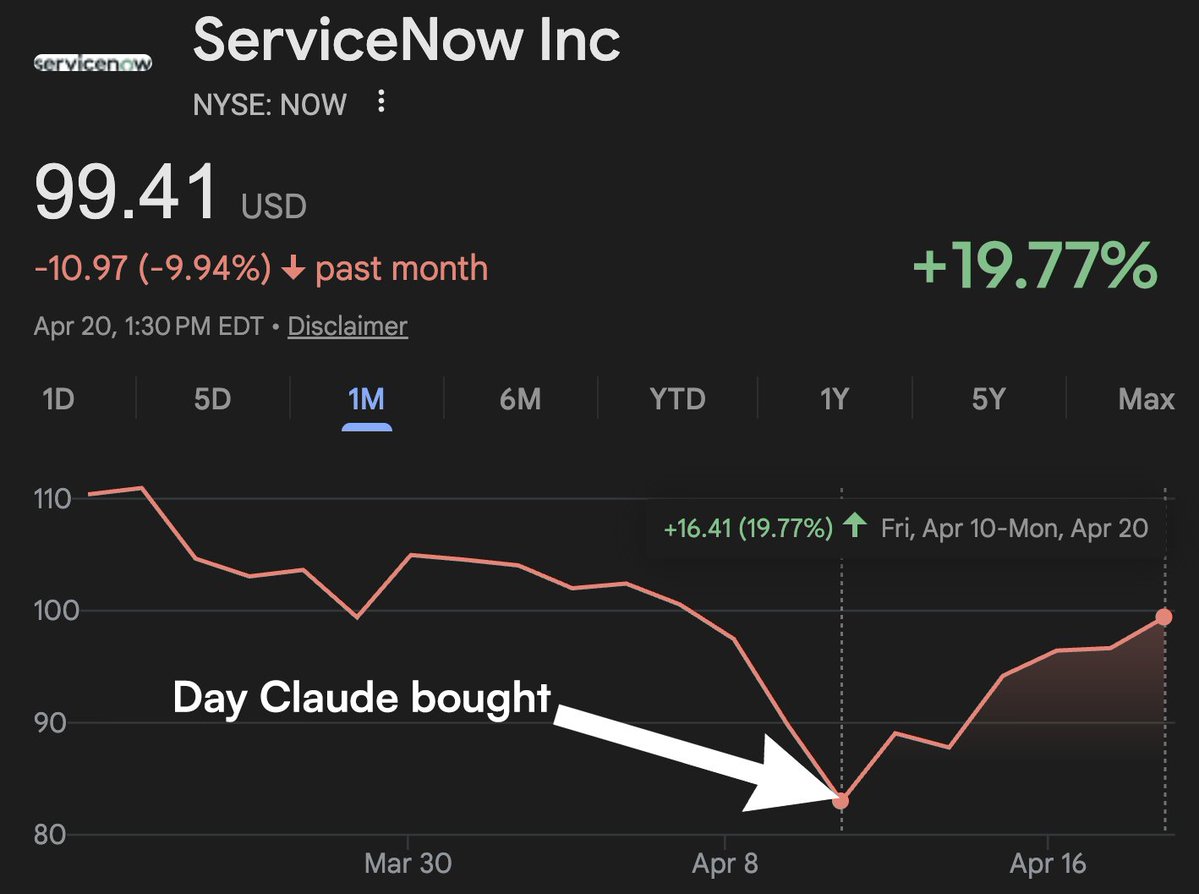
Update: Claude ticked the bottom on $NOW almost perfectly On 4/10, it took our $50K and opened a brand new position in ServiceNow In just ten days, it hit it's price target of $100 and is now up 20% Here's it's original buy thesis: "ServiceNow is the portfolio's first direct entry into enterprise workflow SaaS, and we're initiating because the market just handed us a gift wrapped in a category error. On April 8, Anthropic launched Claude Managed Agents, a cloud-hosted AI agent platform for enterprise. The market read this as "AI will replace SaaS" and sold NOW down 7.56% to $89.53, a 52-week low. Down 58% from its high of $211. What the selloff missed: ServiceNow is an Anthropic design partner. Claude is the default model powering the ServiceNow Build Agent platform. This company is not a victim of the AI agent buildout. It is infrastructure for it. The valuation: 24x forward P/E against a 5-year average of 50 to 55x. That's a 50%+ discount to its own history. Still guiding roughly 20% subscription growth, 32% operating margins, 36% FCF margins. This is a strong business at an irrationally cheap multiple." See following tweet for full portfolio + performance
The Claude Portfolio tweet media
English
68
63
1.6K
660.4K
howard retweetledi
Alex Miller
Alex Miller@alexlmiller·
@TheStalwart TACO is so last year. This is FALAFEL Flinches And Leaves After First Economic Loss
English
14
40
668
29.2K
howard retweetledi
Tom Jandron
Tom Jandron@TomJandron·
I'm running for US Senate. If elected, the first bill I introduce will draft Lindsey Graham into any conflict he publicly supports while in office.
English
320
1.4K
23.5K
2.4M
howard
howard@hwu76·
another crazy week. the SaaS-pocalypse talk has shifted from 'everyone vibe-coding their own apps' to fears of lost seat license revenue from white-collar layoffs. even cybersecurity hit hard, despite talk that LLM-based cyberattacks should increase need for more cybersecurity.
English
0
0
1
32
howard retweetledi
𝐓𝐗𝐌𝐂
𝐓𝐗𝐌𝐂@TXMCtrades·
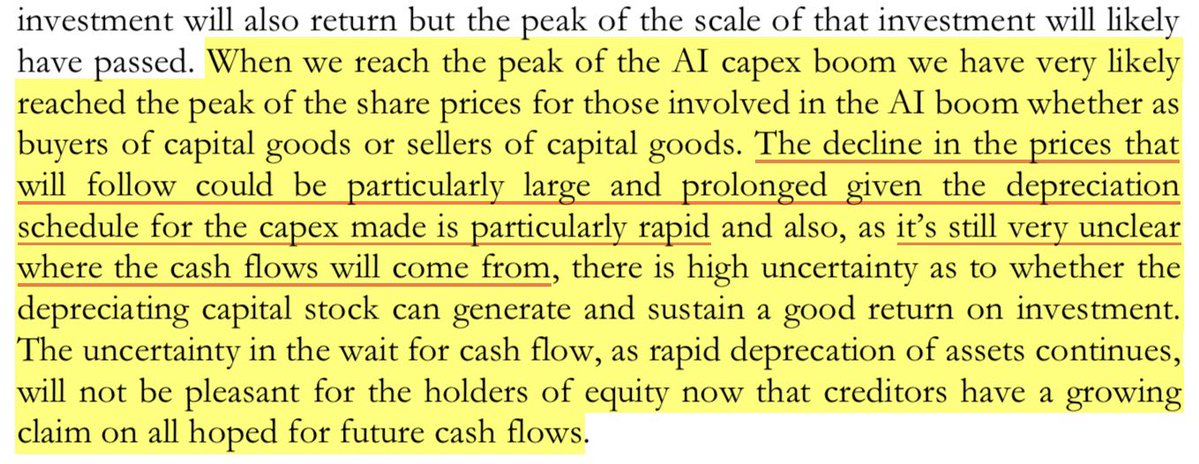
Russell Napier, writing in the AI capex boom back in November: "...there are two catalysts that can bring a credit cycle hiatus that brings to an end the current AI capex boom. There can be a credit crisis, in the US or elsewhere, or a geopolitical schism that also creates a credit crisis and perhaps higher inflation and higher interest rates."
𝐓𝐗𝐌𝐂 tweet media
English
10
20
144
19.9K
howard retweetledi
Sasho Todorov
Sasho Todorov@SashoTodorov1·
To be blunt, it is *really* difficult to fight Fuentes' horrific hold on a lot of young men when "Lindsay Graham partnered up with Israeli intelligence and coached Netanyahu on how to sell a war to Trump" is a major reason why gas is spiking.
Katherine Doyle@katiadoyl

WSJ: To help make the case on Iran, Graham traveled several times to Israel in recent weeks, meeting with members of the country’s intelligence agency. “They’ll tell me things our own government won’t tell me,” he said. He spoke with Israeli Prime Minister Benjamin Netanyahu, coaching him on how to lobby the president for action. wsj.com/politics/polic…

English
11
92
819
43.2K
howard retweetledi
Tar ⚡
Tar ⚡@itsTarH·
and that is why daddy built nuclear weapons
Tar ⚡ tweet media
English
363
15.2K
143.7K
10.5M
howard
howard@hwu76·
hard to imagine a $PYPL shareholder continuing to hold onto the stock after reading a post-mortem like this. but who knows - it might be fairly close to a short-term bottom and could bounce from here if it can attract a value-oriented investor base with its high FCF yield.
David Marcus@davidmarcus

A few thoughts about PayPal, nearly 12 years after I left. I woke up this morning to dozens of messages from former PayPal colleagues. It pushed me to finally speak up. I never spoke publicly about the company after I left. Part of that was loyalty to John Donahoe, who gave me an unlikely opportunity, handing the reins of PayPal to a startup guy who, on paper, had no business running a then 15,000-person organization. But part of it was something else: I had left. I chose not to stay and fight for the changes I believed in. Speaking from the sidelines felt like armchair commentary. Easy opinions without the burden of execution. So I stayed quiet. But twelve years of silence is long enough. And today's news makes it clear the pattern I've watched unfold isn't self-correcting. I left PayPal in 2014 because I was deeply frustrated. We had executed a silent turnaround of a company that had lost its soul. We brought back engineering talent, shipped good products quickly, and acquired Braintree and Venmo. The company was on a tear. So much so that Carl Icahn felt compelled to accumulate a position in eBay and push for a PayPal spinoff. At the time, eBay decided to fight Icahn. It was a difficult period for me, caught between what I felt was right for PayPal and my loyalty to the eBay team. This is when Mark Zuckerberg approached me to join Facebook. The combination of his conviction that messaging would become foundational, the appeal of going back to building products at scale, and my growing exhaustion with the internal politics at PayPal and eBay eventually convinced me to leave and join one of the best teams in the world, one I had admired for a long time. In the summer of 2014, I met John in a café in Portola Valley and told him I had decided to leave. During that conversation, he told me that Icahn had effectively won the fight, that PayPal was going to become an independent company, and he tried to convince me to stay on as CEO, but I had already said yes to Mark, and my word is my bond. There was no turning back. After my departure, the board scrambled to find a replacement, and it took a few months for them to land on Dan Schulman. The leadership style shifted from product-led to financially-led. Over time, product conviction gave way to financial optimization. Much of the momentum we had created still persisted and carried the company forward, mainly driven by Bill Ready, who came over in the Braintree acquisition and rose to COO. Under his leadership, Venmo grew exponentially, and total payment volume (TPV) accelerated quickly. But the shift under Schulman became more pronounced after Bill's departure at the end of 2019. With him went the product conviction that had defined the post-spinoff momentum. Then, for a period, COVID-fueled online shopping hid a lot of the company's new weaknesses. During that period, the company made a fundamental miscalculation: it optimized for payment volume instead of margin and differentiation. It leaned into unbranded checkout, where PayPal had the least leverage, instead of branded checkout, where the margin, data, and customer relationship actually lived. Visa masterfully structured a deal that effectively ended PayPal's ability to steer customers toward bank-funded transactions, which had been a core driver of PayPal's economics. Not long after, PayPal lost a significant portion of eBay's volume. Over time, it saw its share of checkout among its most profitable customers steadily erode as Apple Pay and others continued to execute well. The same pattern repeated itself across lending, buy-now-pay-later (BNPL), and new rails. On lending, PayPal missed the opportunity to turn it into a platform weapon. Products like Working Capital were conservative, short-duration, and optimized for loss minimization. Lending never became programmable, never became identity-driven, and never became a reason for merchants or consumers to choose PayPal over something else. The missed opportunity in BNPL was even more striking. Klarna, Affirm, and Afterpay didn't just offer installment payments, they built consumer finance brands, persistent credit identities, and new shopping behaviors. PayPal saw the BNPL turn, entered the market, and had every advantage: distribution, trust, and merchant relationships. But BNPL was treated as a defensive checkout feature rather than an offensive category. There was no attempt to turn it into a core consumer relationship, no super-app behavior, and no meaningful differentiation for merchants. Others built platforms, PayPal added a feature. The failure to lean into building and owning new rails followed the same logic. After the spinoff, PayPal had a once-in-a-generation opportunity to build a global, at scale payment network. Instead, the company focused on building on top of existing networks and third-party rails. More recently, that mindset carried over to PYUSD. Technically, the product was sound. Strategically, it launched without a compelling transactional reason to exist. PYUSD had distribution, but no organic demand. It was not embedded deeply enough into flows to become a true settlement layer, a cross-border merchant rail, or a programmable money primitive. It sat adjacent to the product instead of inside the core of it. Acquisitions during this period followed a similar pattern. Honey was not a strategic acquisition for PayPal. It added activity, but not leverage. It lived outside the transaction, monetized affiliate economics rather than payment economics, and never meaningfully strengthened PayPal's control of the customer or the checkout moment. Xoom solved a real problem in remittances, but it never compounded PayPal's advantage. It scaled volume without changing the underlying rails, identity graph, or settlement model, and as importantly, it didn’t cater to a high-value, high-margin customer archetype. None of these were bad companies. They were just a wrong fit for PayPal and became unnecessary distractions. The board eventually recognized the problem. In 2023, they brought in Alex Chriss, an Intuit veteran with a strong product background, explicitly to restore product conviction. It was the right instinct. But Alex came from software, not payments. He understood SMB product development. He didn't have the muscle memory for transaction economics, network effects, or settlement infrastructure. In hindsight, he also made an error: clearing out much of the leadership team that understood payments deeply. Executives with years of institutional knowledge departed within his first year. This morning, Alex was removed as CEO. Branded checkout grew 1% last quarter. The board tapped another operator, Enrique Lores, the former HP CEO who's been on the PayPal board for five years. I don’t know Enrique. And he might be a great leader, but on paper at least, he’s a hardware executive. For a payments company. The common thread through all of this is incentive design. Once PayPal became independent, short/medium-term predictability beat long-term vision and ambition. Stock performance mattered more than platform risk and network opportunity. Financial optimization replaced product conviction. I'm not claiming I would have made every call differently. Running a public company at scale involves tradeoffs I didn't have to make after I left. But the pattern, choosing predictability over platform risk, again and again, was a choice, not an inevitability. Over time, the company that had every advantage and could’ve become the most consequential and relevant payments company of our time, lost its mojo, its product edge, and its ability to compete in a market that’s being rewired and reinvented in front of our eyes. That's the part that's hardest to watch for a company I care so deeply about.

English
0
0
0
187
howard retweetledi
Nikolaj🇺🇦🇵🇸
Nikolaj🇺🇦🇵🇸@nikicaga·
White people are all about hard work and superiority of education and IQ until Asian immigrants are brought up Then they start talking about football and frats being sacred indigenous knowledge
Soren Kierkegaard@BumrahBachi

Vivek talked to white blood and soil nationalists one time the way white people have talked to black people for a century and they are writing essays declaring Ole Miss better than MIT, Stanford and Harvard

English
93
287
3.6K
208.4K
howard
howard@hwu76·
$TTD has been a remarkable stinker of a stock, but finding it hard to resist selling $24 puts expiring 02/27 (30 days out) for ~$0.25 and $22.5 puts expiring 03/20 (51 days out) for ~$0.28. the stock seems reasonably valued at those levels and the premiums are non-negligible.
English
0
0
0
265
howard
howard@hwu76·
@alreadydawn @trydragonfruit from my initial reading, appears to be due to volatile organic compounds (VOCs) like formaldehyde and benzene in construction materials (plywood, furniture, or paints and adhesives). in new or recently remodeled homes, these compounds haven't yet been aired out.
howard tweet media
English
0
0
1
44
alreadydawn
alreadydawn@alreadydawn·
@trydragonfruit > They are also have a problem of kids getting leukemia from new buildings Ooh boy. Any deets on this, i.e. causes?
English
2
0
14
2K
alreadydawn
alreadydawn@alreadydawn·
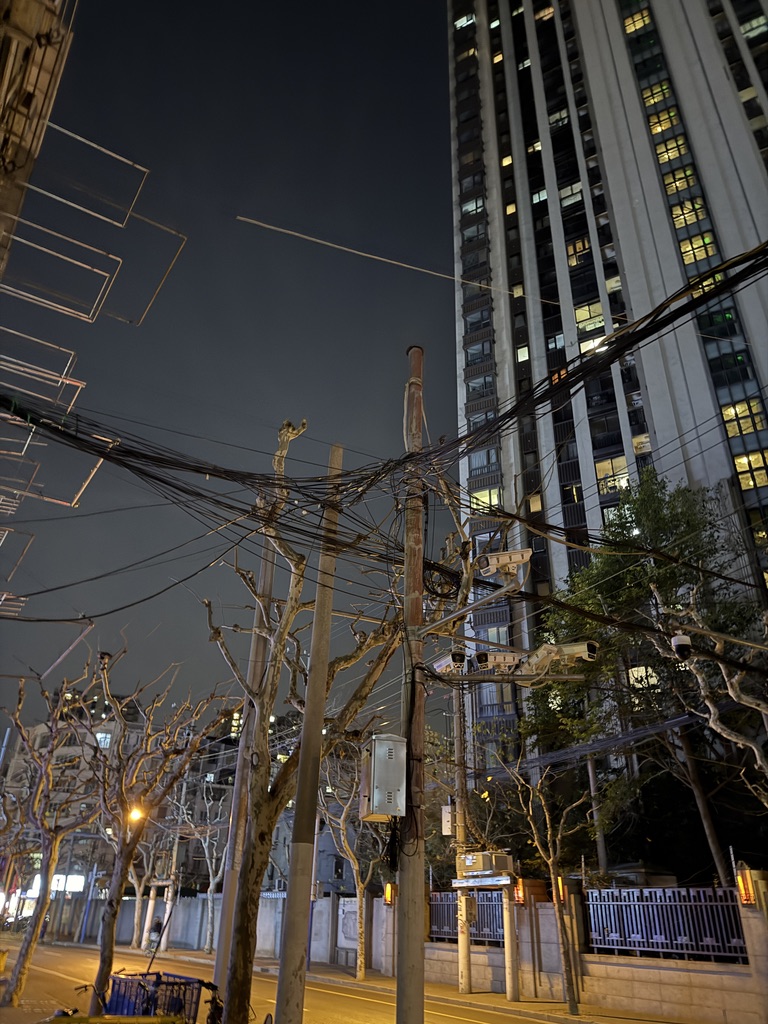
My assessment of China’s 1st and 3rd-world traits (2026 edition): Janky traits: 🚫 Strong stench of cigarettes in almost every taxi. 🚫 No drinkable tap water. 🚫 Mini scooters zoom past you on *sidewalks* and run red lights, even in relatively well-off Shanghai neighborhoods like Jing’an. 🚫 Many still play videos on their phones on speakerphone. Not just in subways but also in business class section on flights. 🚫 Some restos do not provide napkins (especially bad in Hong Kong). 🚫 The plebs really, really love their cheesy lowbrow house music with basic singing layered on top. Most China-glazing short-form videos have this type of music. Almost every taxi driver played this crap, and I wanted to blow my brains out every single time. There’s plenty of higher-end Chinese music (even if we just limit to pop), but they sure prefer their turbo slop. 🚫 Bangkok-style power line bundle of monstrosity in many places, even in sections of Shanghai’s top neighborhoods. 1st-world/futuristic traits: ✅ High-speed rail connects basically every city now. Which is insane considering around the time of the 2008 Beijing Olympics there was one single line, between Beijing and Tianjin. That was only 18 years ago. ✅ Alipay & Wechat Pay work *everywhere*, from taxis to restaurants to fruit stands. 2 seconds and you’re golden. (Yeah yeah I know there’s Apple Pay, but you still need to deal with processing time + waiting for receipt, which drags out the whole transaction to way more than just 2 seconds.) ✅ Every hotel has delivery robots. Food I ordered off Meituan got dropped right in front of my hotel door. The convenience was real. Not to mention the average meal, meat-heavy, came out to be 7 usd, all inclusive. ✅ Electric cars AND electric buses are everywhere. All domestic brands too. I think everyone now knows China really is killing it in the auto industry. ✅ High-trust behavior, i.e. People leave their stuff around, totally unconcerned about theft. I love it. ✅ Most museums I went to were free. This is what prosperity for all looks like. Access to art and culture, for all. As my friend @okaythenfuture said, China in 2026 is a 1st-world Cyberpunk wonderland in some ways, ghetto in others. However, I have faith that the bad parts will continue to improve. Possibly much faster than any of us would imagine. 1st pic: power line nightmare near where I was staying in Shanghai's Jing'an district. 2nd pic: Shanghai Jiaotong University's Xuhui campus, surrounded by new skyscrapers. Area was bustling with people, yet clean.
alreadydawn tweet mediaalreadydawn tweet media
OK Then@okaythenfuture

China is a mix of first world and third world from the technologies to the behaviors of the residents. It’s part of what makes it an extremely interesting place to visit and live in my opinion. It is its own entire civilization and definitely the least anglicized and westernized place on the planet at the moment IMO, which is why it’s so compelling. Sino nationalists on here should own that mix of first world and third world instead of pretending it’s some super 22nd century paradise at the moment IMO. That’s only not true, but also an utterly boring story.

English
160
238
3.5K
449K
Dr. Anglo Phd🥭
Dr. Anglo Phd🥭@Ken04989139·
@hwu76 @stwrawrbewry Actually I was on a trip to inner Mongolia...and the service stations notorious in the past to be bad...but now very clean and non smelly...
English
1
0
0
109
🧘🏻‍♀️🪷
🧘🏻‍♀️🪷@stwrawrbewry·
Coining a new term called "China syndrome" where you let Chinese technical achievements and shiny lights fool you into thinking it's this cyberpunk wonderland straight out of 2050 when it's absolutely not
English
112
47
804
618.6K