Ian Buck

5 posts

Ian Buck

Ian Buck

@ia_buck

VP/GM Accelerated Computing, NVIDIA

Katılım Mayıs 2012
54 Takip Edilen551 Takipçiler
Ian Buck
Ian Buck@ia_buck·
@cmarschner @karpathy Patrice is great. Worked with him back at MSR back in the day. Published a neural network implementation on a GPU which is afaik the first published work ever of a GPU running a neural network and, yup, it was faster than CPUs even back in 2025. ieeexplore.ieee.org/abstract/docum…
English

0
0
4
104
Andrej Karpathy
Andrej Karpathy@karpathy·
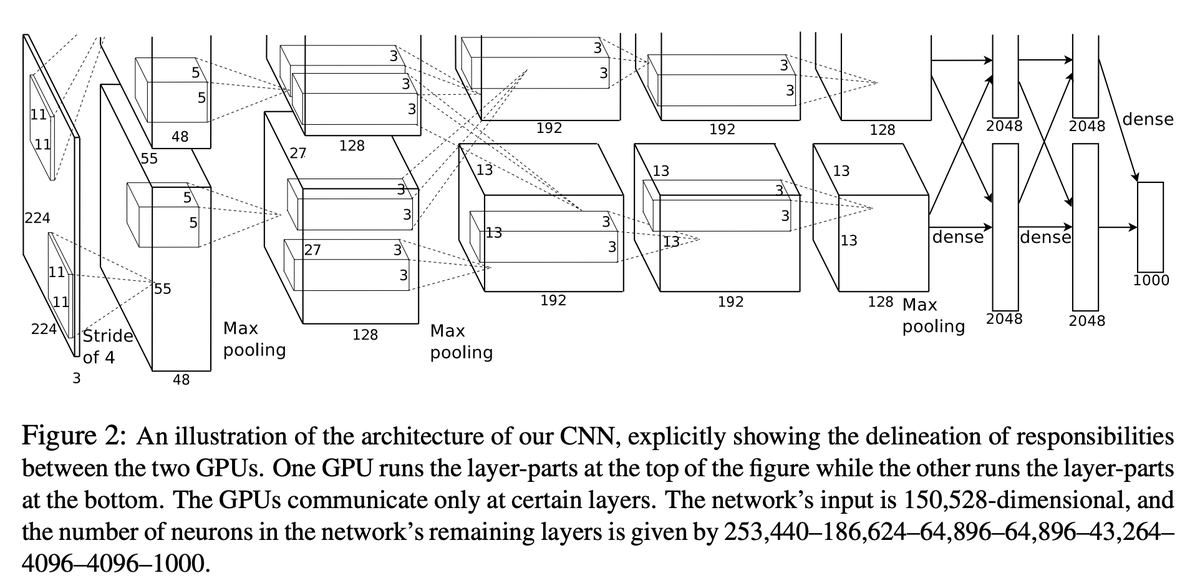
# CUDA/C++ origins of Deep Learning Fun fact many people might have heard about the ImageNet / AlexNet moment of 2012, and the deep learning revolution it started. en.wikipedia.org/wiki/AlexNet What's maybe a bit less known is that the code backing this winning submission to the contest was written from scratch, manually in CUDA/C++ by Alex Krizhevsky. The repo was called cuda-convnet and it was here on Google Code: code.google.com/archive/p/cuda… I think Google Code was shut down (?), but I found some forks of it on GitHub now, e.g.: github.com/ulrichstern/cu… This was among the first high-profile applications of CUDA for Deep Learning, and it is the scale that doing so afforded that allowed this network to get such a strong performance in the ImageNet benchmark. Actually this was a fairly sophisticated multi-GPU application too, and e.g. included model-parallelism, where the two parallel convolution streams were split across two GPUs. You have to also appreciate that at this time in 2012 (~12 years ago), the majority of deep learning was done in Matlab, on CPU, in toy settings, iterating on all kinds of learning algorithms, architectures and optimization ideas. So it was quite novel and unexpected to see Alex, Ilya and Geoff say: forget all the algorithms work, just take a fairly standard ConvNet, make it very big, train it on a big dataset (ImageNet), and just implement the whole thing in CUDA/C++. And it's in this way that deep learning as a field got a big spark. I recall reading through cuda-convnet around that time like... what is this :S Now of course, there were already hints of a shift in direction towards scaling, e.g. Matlab had its initial support for GPUs, and much of the work in Andrew Ng's lab at Stanford around this time (where I rotated as a 1st year PhD student) was moving in the direction of GPUs for deep learning at scale, among a number of parallel efforts. But I just thought it was amusing, while writing all this C/C++ code and CUDA kernels, that it feels a bit like coming back around to that moment, to something that looks a bit like cuda-convnet.
Andrej Karpathy tweet media
English
160
857
6.9K
1M
Andrej Karpathy
Andrej Karpathy@karpathy·
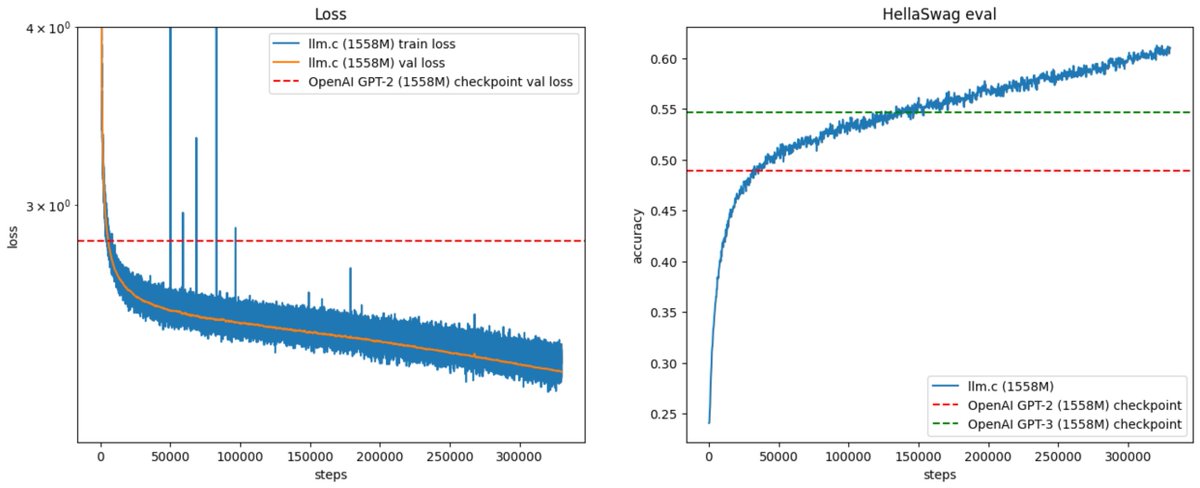
In 2019, OpenAI announced GPT-2 with this post: openai.com/index/better-l… Today (~5 years later) you can train your own for ~$672, running on one 8XH100 GPU node for 24 hours. Our latest llm.c post gives the walkthrough in some detail: github.com/karpathy/llm.c… Incredibly, the costs have come down dramatically over the last 5 years due to improvements in compute hardware (H100 GPUs), software (CUDA, cuBLAS, cuDNN, FlashAttention) and data quality (e.g. the FineWeb-Edu dataset). For this exercise, the algorithm was kept fixed and follows the GPT-2/3 papers. Because llm.c is a direct implementation of GPT training in C/CUDA, the requirements are minimal - there is no need for conda environments, Python interpreters, pip installs, etc. You spin up a cloud GPU node (e.g. on Lambda), optionally install NVIDIA cuDNN, NCCL/MPI, download the .bin data shards, compile and run, and you're stepping in minutes. You then wait 24 hours and enjoy samples about English-speaking Unicorns in the Andes. For me, this is a very nice checkpoint to get to because the entire llm.c project started with me thinking about reproducing GPT-2 for an educational video, getting stuck with some PyTorch things, then rage quitting to just write the whole thing from scratch in C/CUDA. That set me on a longer journey than I anticipated, but it was quite fun, I learned more CUDA, I made friends along the way, and llm.c is really nice now. It's ~5,000 lines of code, it compiles and steps very fast so there is very little waiting around, it has constant memory footprint, it trains in mixed precision, distributed across multi-node with NNCL, it is bitwise deterministic, and hovers around ~50% MFU. So it's quite cute. llm.c couldn't have gotten here without a great group of devs who assembled from the internet, and helped get things to this point, especially ademeure, ngc92, @gordic_aleksa, and rosslwheeler. And thank you to @LambdaAPI for the GPU cycles support. There's still a lot of work left to do. I'm still not 100% happy with the current runs - the evals should be better, the training should be more stable especially at larger model sizes for longer runs. There's a lot of interesting new directions too: fp8 (imminent!), inference, finetuning, multimodal (VQVAE etc.), more modern architectures (Llama/Gemma). The goal of llm.c remains to have a simple, minimal, clean training stack for a full-featured LLM agent, in direct C/CUDA, and companion educational materials to bring many people up to speed in this awesome field. Eye candy: my much longer 400B token GPT-2 run (up from 33B tokens), which went great until 330B (reaching 61% HellaSwag, way above GPT-2 and GPT-3 of this size) and then exploded shortly after this plot, which I am looking into now :)
Andrej Karpathy tweet media
English
124
754
6.3K
723.9K
Ian Buck retweetledi
NVIDIA
NVIDIA@nvidia·
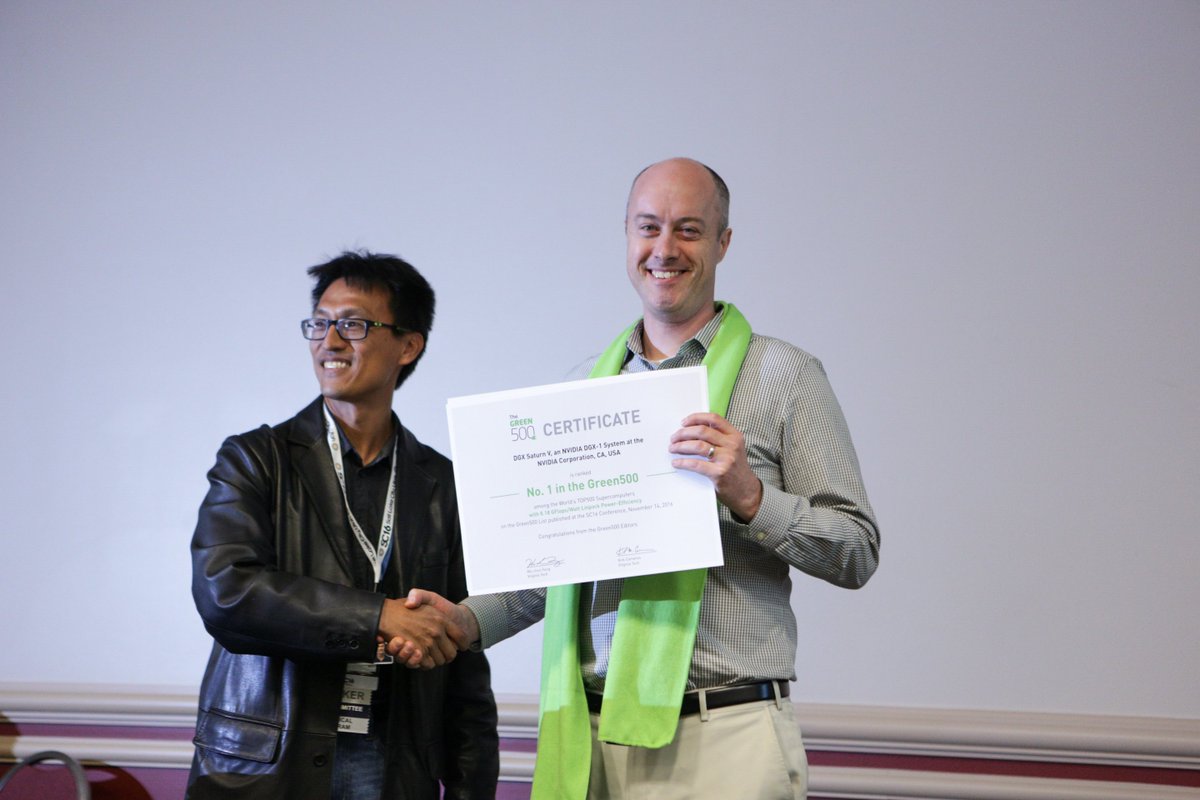
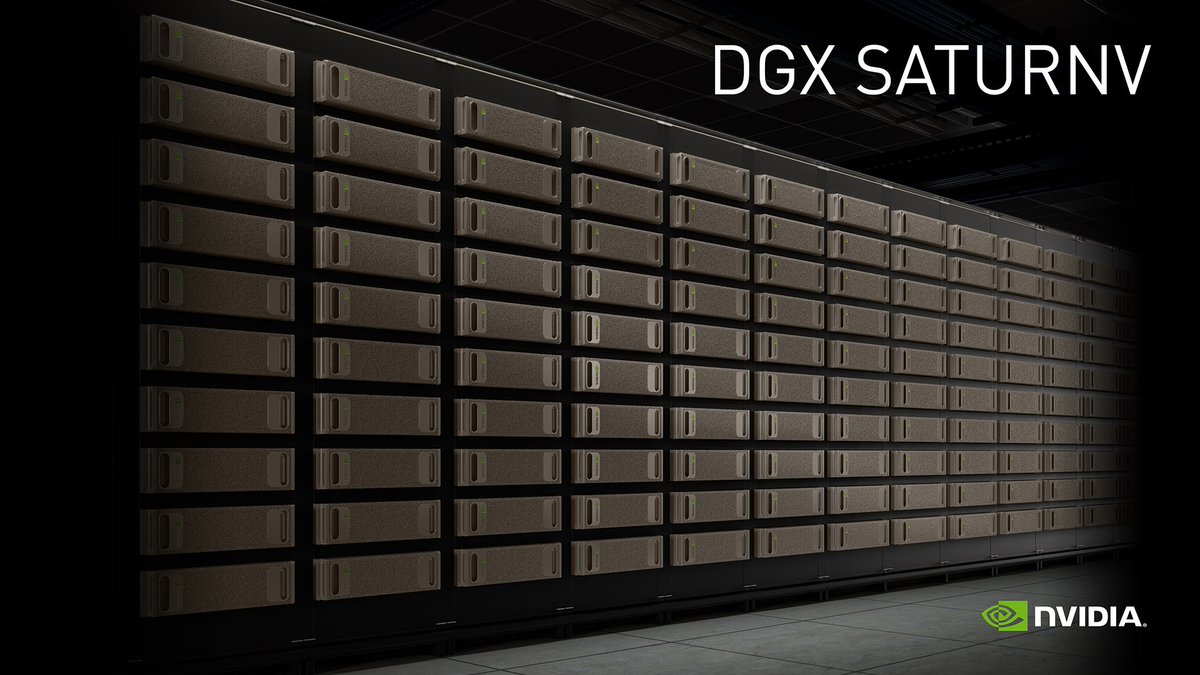
Our NVIDIA DGX SATURNV was just honored as #1 on the Green 500 list for most energy efficient architecture at #SC16. nvda.ws/2eT6xrJ
NVIDIA tweet mediaNVIDIA tweet media
English
1
24
71
0