Omojo

2.6K posts

Omojo banner
Omojo

Omojo

@iamTonyCletus

I build builders. Applied AI. Perpetually curious. Running @programmify. Research @aani_ai

Africa 🌍 Katılım Ekim 2016
419 Takip Edilen860 Takipçiler
Omojo
Omojo@iamTonyCletus·
@asemota I'd be surprised if this wasn't their default. What do you do when you're sitting on what's currently the most advanced coding model.
English
0
0
0
72
Omojo
Omojo@iamTonyCletus·
The comments and quotes under this post just prove how backwards many developers are in this AI era. Last year at @programmify, we had some interns building MVPs in a day, not weeks. I wonder why so many people are surprised by a developer building an OSS in a week in 2026 😆.
FO@FOjebiyi

Hi guys, I built an open-source alternative to @pewbeam_ai in one week. github.com/openbezal/rhema Started coding during a Sunday church service. By the following Sunday, we were using it live during our church service. Wild. Here's what Rhema does: it listens to your pastor's sermon in real-time, detects Bible verse references as they're mentioned, and displays them on screen instantly. No manual clicking, no dedicated slide operator needed. The tech stack: - Tauri 2.0 with a Rust backend handling all the heavy lifting: audio capture, transcription pipeline, verse detection logic, and system tray integration - Local AI embeddings using Qwen3-0.6B so everything runs on-device with zero cloud dependency. Your sermons never leave your machine - Real-time audio transcription paired with semantic search against a full Bible verse database The Rust backend was a deliberate choice. We needed low latency audio processing and efficient memory usage for running an embedding model locally, and Rust delivers on both. Is it perfect? Probably not. But the core functionality works and we're already using it in a real church environment This is where you come in. Rhema is fully open source and we need contributors to help take it to the next level. Whether it's improving the verse detection accuracy, adding multi-language support, building a better overlay UI, adding support for more Bible translations, or optimizing the transcription pipeline, there's real work to be done and real impact to be made. If you're a Rust developer, a frontend engineer, an ML enthusiast, or just someone who loves building tools for the church, come build with us. Star the repo. Fork it. Open a PR. Let's make this the go-to open-source solution for live Bible verse display in churches worldwide. github.com/openbezal/rhema

English
0
0
1
63
Omojo
Omojo@iamTonyCletus·
@prospercode Lol. Building alternatives has nothing to do with being a rich guy.
English
0
0
1
114
Chukwunonso Prosper
Chukwunonso Prosper@prospercode·
For every product you intend to build, just know there’s a rich guy somewhere planning to create an alternative and make it open source 😤 And honestly, this isn’t a great way to compete. It feels more like a long term strategic move than a genuine push for open source.
FO@FOjebiyi

Hi guys, I built an open-source alternative to @pewbeam_ai in one week. github.com/openbezal/rhema Started coding during a Sunday church service. By the following Sunday, we were using it live during our church service. Wild. Here's what Rhema does: it listens to your pastor's sermon in real-time, detects Bible verse references as they're mentioned, and displays them on screen instantly. No manual clicking, no dedicated slide operator needed. The tech stack: - Tauri 2.0 with a Rust backend handling all the heavy lifting: audio capture, transcription pipeline, verse detection logic, and system tray integration - Local AI embeddings using Qwen3-0.6B so everything runs on-device with zero cloud dependency. Your sermons never leave your machine - Real-time audio transcription paired with semantic search against a full Bible verse database The Rust backend was a deliberate choice. We needed low latency audio processing and efficient memory usage for running an embedding model locally, and Rust delivers on both. Is it perfect? Probably not. But the core functionality works and we're already using it in a real church environment This is where you come in. Rhema is fully open source and we need contributors to help take it to the next level. Whether it's improving the verse detection accuracy, adding multi-language support, building a better overlay UI, adding support for more Bible translations, or optimizing the transcription pipeline, there's real work to be done and real impact to be made. If you're a Rust developer, a frontend engineer, an ML enthusiast, or just someone who loves building tools for the church, come build with us. Star the repo. Fork it. Open a PR. Let's make this the go-to open-source solution for live Bible verse display in churches worldwide. github.com/openbezal/rhema

English
5
2
20
9.3K
Omojo
Omojo@iamTonyCletus·
The road favours the traveller.
Aakash Gupta@aakashgupta

There's a physicist at Stanford named Safi Bahcall who modeled this exact principle and the math is wild. He calls it "phase transitions in human networks." When you're stationary, your probability of a lucky event is limited to your existing surface area: the people you already know, the places you already go, the ideas you've already been exposed to. Your opportunity window is fixed. When you move, your collision rate with new nodes in a network increases nonlinearly. Double your movement (new conversations, new cities, new projects) and your probability of a serendipitous encounter doesn't double. It roughly quadruples. Because each new node connects you to their entire network, not just to them. Richard Wiseman ran a 10-year study at the University of Hertfordshire tracking self-described "lucky" and "unlucky" people. The single biggest differentiator wasn't IQ, education, or family money. Lucky people scored significantly higher on one trait: openness to experience. They talked to strangers more, varied their routines more, and said yes to invitations at nearly twice the rate. The "unlucky" group followed the same routes, ate at the same restaurants, and talked to the same 5 people. Their networks were closed loops. No new inputs, no new collisions. Luck isn't random. Luck is surface area. And surface area is a function of movement. The lobster emoji is doing more work than most people realize. Lobsters grow by shedding their shell when it gets too tight. The growth requires a period of total vulnerability. No protection, no armor, soft body exposed to the ocean. That's the cost of movement nobody posts about. You have to be uncomfortable first. The new shell only hardens after you've already moved.

English
0
0
0
25
Omojo retweetledi
Omojo retweetledi
Andrej Karpathy
Andrej Karpathy@karpathy·
LLM Knowledge Bases Something I'm finding very useful recently: using LLMs to build personal knowledge bases for various topics of research interest. In this way, a large fraction of my recent token throughput is going less into manipulating code, and more into manipulating knowledge (stored as markdown and images). The latest LLMs are quite good at it. So: Data ingest: I index source documents (articles, papers, repos, datasets, images, etc.) into a raw/ directory, then I use an LLM to incrementally "compile" a wiki, which is just a collection of .md files in a directory structure. The wiki includes summaries of all the data in raw/, backlinks, and then it categorizes data into concepts, writes articles for them, and links them all. To convert web articles into .md files I like to use the Obsidian Web Clipper extension, and then I also use a hotkey to download all the related images to local so that my LLM can easily reference them. IDE: I use Obsidian as the IDE "frontend" where I can view the raw data, the the compiled wiki, and the derived visualizations. Important to note that the LLM writes and maintains all of the data of the wiki, I rarely touch it directly. I've played with a few Obsidian plugins to render and view data in other ways (e.g. Marp for slides). Q&A: Where things get interesting is that once your wiki is big enough (e.g. mine on some recent research is ~100 articles and ~400K words), you can ask your LLM agent all kinds of complex questions against the wiki, and it will go off, research the answers, etc. I thought I had to reach for fancy RAG, but the LLM has been pretty good about auto-maintaining index files and brief summaries of all the documents and it reads all the important related data fairly easily at this ~small scale. Output: Instead of getting answers in text/terminal, I like to have it render markdown files for me, or slide shows (Marp format), or matplotlib images, all of which I then view again in Obsidian. You can imagine many other visual output formats depending on the query. Often, I end up "filing" the outputs back into the wiki to enhance it for further queries. So my own explorations and queries always "add up" in the knowledge base. Linting: I've run some LLM "health checks" over the wiki to e.g. find inconsistent data, impute missing data (with web searchers), find interesting connections for new article candidates, etc., to incrementally clean up the wiki and enhance its overall data integrity. The LLMs are quite good at suggesting further questions to ask and look into. Extra tools: I find myself developing additional tools to process the data, e.g. I vibe coded a small and naive search engine over the wiki, which I both use directly (in a web ui), but more often I want to hand it off to an LLM via CLI as a tool for larger queries. Further explorations: As the repo grows, the natural desire is to also think about synthetic data generation + finetuning to have your LLM "know" the data in its weights instead of just context windows. TLDR: raw data from a given number of sources is collected, then compiled by an LLM into a .md wiki, then operated on by various CLIs by the LLM to do Q&A and to incrementally enhance the wiki, and all of it viewable in Obsidian. You rarely ever write or edit the wiki manually, it's the domain of the LLM. I think there is room here for an incredible new product instead of a hacky collection of scripts.
English
2.7K
6.6K
55.4K
19.6M
Omojo
Omojo@iamTonyCletus·
Cybersecurity is not dead. Security is fundamental.
Feross@feross

🚨 CRITICAL: Active supply chain attack on axios -- one of npm's most depended-on packages. The latest axios@1.14.1 now pulls in plain-crypto-js@4.2.1, a package that did not exist before today. This is a live compromise. This is textbook supply chain installer malware. axios has 100M+ weekly downloads. Every npm install pulling the latest version is potentially compromised right now. Socket AI analysis confirms this is malware. plain-crypto-js is an obfuscated dropper/loader that: • Deobfuscates embedded payloads and operational strings at runtime • Dynamically loads fs, os, and execSync to evade static analysis • Executes decoded shell commands • Stages and copies payload files into OS temp and Windows ProgramData directories • Deletes and renames artifacts post-execution to destroy forensic evidence If you use axios, pin your version immediately and audit your lockfiles. Do not upgrade.

English
0
0
1
49
Omojo
Omojo@iamTonyCletus·
If you never fail, how will your story be worth telling? Never let anyone make you feel small for starting again. The world rewards the brave.
English
0
0
1
30
Omojo retweetledi
Programmify
Programmify@programmify·
Got an idea? Let’s build it! We’re launching the Programmify AI Weekend Build! 🎉🚀 A 2-day virtual build experience to collaborate, learn and create real AI projects Beginner or pro, you belong here. (1/3)

Programmify tweet media
English
2
2
7
150
Omojo retweetledi
Akintola Steve
Akintola Steve@Akintola_steve·
Please let’s take note and understand this once and for all ! Microservices is just a design pattern. Netflix, Amazon, Uber didn’t adopt it because it’s the “right” way to build software. They did it because they had hundreds of engineers and needed a way to stop them from stepping on each other. The architecture served the org, not the other way around. If you’re building lean as a startup, never start with microservices. You’re solving a problem you don’t have yet. So I’ll advise, start with a monolith. Ship. Get users. Then let’s say within the company you then seeing reasons to migrate into a microservice based architecture then you can proceed. Don’t just copy the architecture diagram of a company with 2,000 engineers when you have a team of 4. You then jump on it too because they are doing it then you too want to do it. T for thanks.
Mari@Tech_girlll

Migrating to microservices when your app barely has users is basically building a Ferrari for your bicycle.

English
19
20
136
14.9K
Omojo retweetledi
Alex Hormozi
Alex Hormozi@AlexHormozi·
There are two groups of people: People who see failures as setbacks. People who see failures as mile markers. The second group goes farther.
English
91
49
666
18.3K
Omojo
Omojo@iamTonyCletus·
Open models quietly winning.
Kimi.ai@Kimi_Moonshot

Congrats to the @cursor_ai team on the launch of Composer 2! We are proud to see Kimi-k2.5 provide the foundation. Seeing our model integrated effectively through Cursor's continued pretraining & high-compute RL training is the open model ecosystem we love to support. Note: Cursor accesses Kimi-k2.5 via @FireworksAI_HQ ' hosted RL and inference platform as part of an authorized commercial partnership.

English
0
0
1
47
Omojo
Omojo@iamTonyCletus·
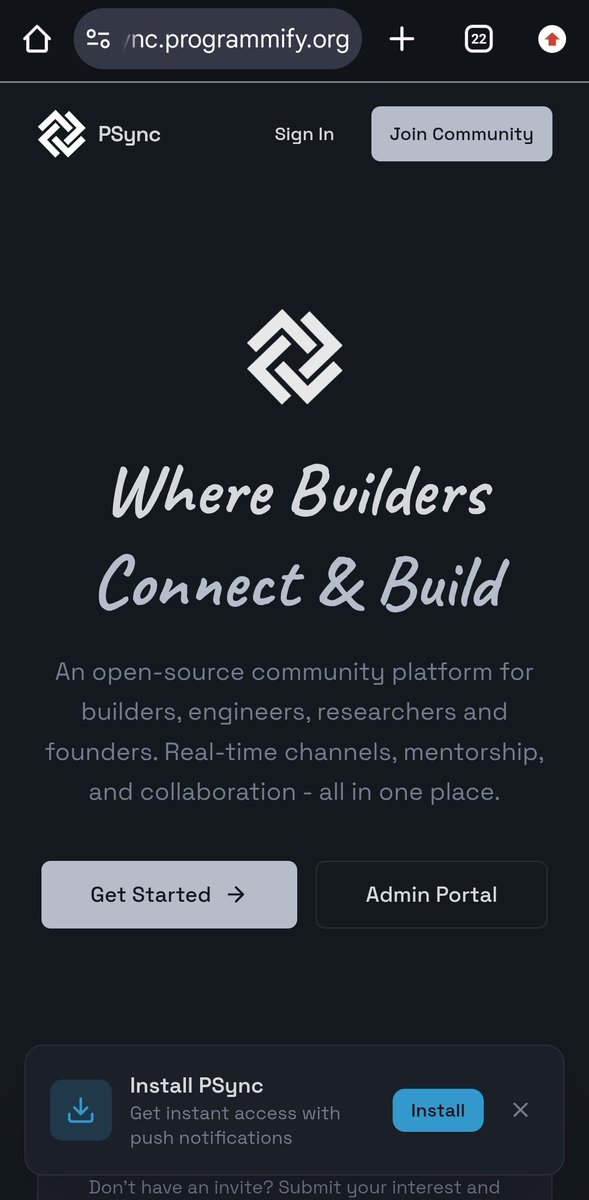
@IamJoshJackson We tried to focus on the core loop first: channels, messaging, mentions + notifications, threads, DMs, roles + access, then added high-impact extras: search, push notifications, link previews, read receipts, typing indicators. Everything else is coming later.
English
0
0
0
24
Omojo
Omojo@iamTonyCletus·
Last week, we did something we've always wanted to do at Programmify. We built our own Slack alternative, PSync. It took a few hours to get the core features working. Channels, messaging, auth, notifications. Everything. Now, it's just continuous improvement.
Omojo tweet mediaOmojo tweet mediaOmojo tweet mediaOmojo tweet media
English
1
1
3
75