
Imani Carter

1.3K posts

Imani Carter banner
Imani Carter

Imani Carter

@ic_explorer

A problem is a chance for you to do your best.

Liverpool Katılım Mart 2023
59 Takip Edilen15 Takipçiler
Imani Carter retweetledi
Night Sky Today
Night Sky Today@NightSkyToday·
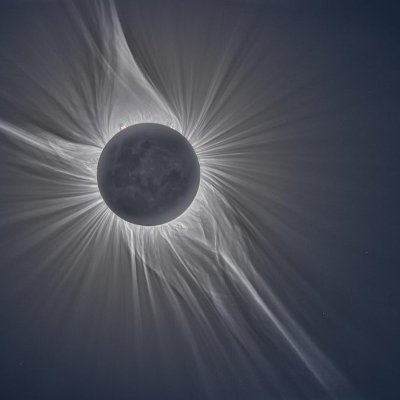
A true once-in-a-lifetime Shot. An Extremely Bright Perseid meteor streaked across the sky over the Great Pyramid of Giza at dawn this morning, with Jupiter and Venus glowing in this picture-perfect cosmic moment. ☄️
English
6
47
177
4.5K
Imani Carter retweetledi
Black Hole
Black Hole@konstructivizm·
Mind-blowing cosmic scale: There are 2 trillion galaxies in the observable universe... Imagine this: the universe is so unimaginably vast that light itself hasn’t had enough time to reach us from its farthest edges. What we can see is just a tiny bubble we call the observable universe — and even inside that cosmic neighborhood, astronomers estimate there are roughly 2,000,000,000,000 (two trillion) separate galaxies.That’s not just a big number. That’s two million million galaxies, each potentially home to hundreds of billions of stars, planets, and who-knows-what-else. And remember — that’s only the part we can see. The full universe? Probably far, far bigger. Your brain might need a moment to recover. Mine still hasn’t.
Black Hole tweet media
English
7
21
74
3.9K
Imani Carter retweetledi
Cosmos Archive
Cosmos Archive@cosmosarcive·
Did you know the James Webb Space Telescope isn’t orbiting Earth at all? The James Webb Space Telescope operates near the Sun–Earth L2 point, about 1.5 million km from Earth. From there, the Sun, Earth, and Moon stay on the same side of the telescope, allowing its giant sunshield to block their heat and light at the same time. That keeps Webb cold and stable enough to detect extremely faint infrared signals from deep space. Because of this, Webb can peer through clouds of cosmic dust and observe galaxies whose light has traveled for more than 13 billion years. Every image it captures is not just a view across space, but a look back into the early history of the universe.
English
11
59
250
12K
Imani Carter retweetledi
World History Encyclopedia
World History Encyclopedia@whencyclopedia·
#CylinderSeals were impression stamps used by the people of ancient #Mesopotamia. Known as kishib in #Sumerian and kunukku in #Akkadian, the seals were used by everyone, from royals to slaves, as a means of authenticating identity in correspondence. Regardless of what purpose it was put to, the seal was a prized possession, and its loss was taken as seriously as people today regard the loss of their personal ID or credit cards. 📝Full article here: worldhistory.org/Cylinder_Seal/ #AncientHistory
World History Encyclopedia tweet media
English
0
3
19
1.9K
Imani Carter retweetledi
Kirsten Petersen
Kirsten Petersen@_kirstenelise·
Two confirmed on the same evening 🎟️ Don Fanucci Zet will make his sixth (!) appearance in the Elitloppet, qualifying through the E-Loppen system. Charron has been magnificent, and after what he’s shown in France he deserves this spot.
Kirsten Petersen tweet mediaKirsten Petersen tweet media
English
0
3
21
1K
Imani Carter retweetledi
Universal-Sci
Universal-Sci@universal_sci·
NGC 5037 - a stunning spiral galaxy shining beautifully in the constellation Virgo! (Credit: ESA/Hubble & NASA, D. Rosario / L. Shatz)
Universal-Sci tweet media
English
4
44
213
7.8K
Imani Carter retweetledi
Latest in space
Latest in space@latestinspace·
🚨 NASA's Nancy Grace Roman Space Telescope is ahead of schedule and now launching as early as Sept. 2026 The new flagship observatory is designed to investigate dark energy, dark matter, and exoplanets It also has a field of view 200x greater than Hubble!
Latest in space tweet media
English
18
118
895
50.1K
Imani Carter retweetledi
James Lucas
James Lucas@JamesLucasIT·
Oxford University is older than the Aztec Empire, the Ming dynasty of China, the Inca Empire, the Māori settlement of New Zealand, and the Ottoman Empire.
English
110
691
5.1K
167.6K
Imani Carter retweetledi
NASA Universe
NASA Universe@NASAUniverse·
Our Fermi telescope helped reveal the power source of a rare and unusually luminous supernova. A supermagnetized neutron star amplified the blast, causing the stellar explosion to shine brightly in visible light and gamma rays much longer than anticipated! go.nasa.gov/43gC1Tg
English
3
63
321
15.9K
Imani Carter retweetledi
Space Explained
Space Explained@SpacedExplained·
🚨#BREAKING | NASA is officially planning a permanent Moon Base. The base will allow astronauts to live on the Moon for long periods as humanity prepares for missions deeper into space — including Mars. NASA will reveal new details on May 26 as part of the Artemis program.
Space Explained tweet media
English
3
2
62
731
Imani Carter retweetledi
Black Hole
Black Hole@konstructivizm·
This is what the night sky might look like in the distant future as the Andromeda galaxy approaches.
English
7
37
198
11.8K
Imani Carter retweetledi
Black Hole
Black Hole@konstructivizm·
Just had an absolute blast testing Axiom Space’s next-generation lunar surface suit — and it’s seriously impressive. Climbing in is a breeze thanks to the rear-entry design, the mobility is outstanding, and the gloves finally deliver the dexterity we’ve been waiting for. We put it through its paces while evaluating seamless interfaces with the Astrolab rover, which is launching to the Moon later this year.Getting to experience the new legacy of Axiom’s suits firsthand in their Houston test rig was genuinely thrilling. The future of lunar exploration just got a lot more wearable.
English
3
5
23
3.1K
Imani Carter retweetledi
Everyday Astronaut
Everyday Astronaut@Erdayastronaut·
SpaceX is about to launch their first V3 Starship and it’s by far the biggest and most radical change to the program to date. Here's a super quick overview of what all is new and different including the incredible new Raptor 3 engines, the new launch pad, and everything else that’s debuting on Flight 12. 00:00 - Intro 01:07 - Pad 2 03:15 - Raptor 3 04:59 - SuperHeavy V3 07:56 - Starship V3 10:52 - Flight 12 Profile
English
84
817
7.3K
222.8K
Imani Carter retweetledi
NASA
NASA@NASA·
We're building a Moon Base! @NASAMoonBase will serve as a habitat where astronauts live and work during long-term science missions. Join us at 2pm ET on Tuesday, May 26, for a live news event where we’ll share updates on our lunar exploration plans: go.nasa.gov/4uinkLi
NASA tweet media
English
4.7K
10.8K
77.3K
23.4M
Imani Carter retweetledi
All day Astronomy
All day Astronomy@forallcurious·
🚨: A photographer captured the Sun for three years straight from the exact same spot at the same time, then combined every position into one incredible image
English
146
1.4K
10.5K
1.1M
Imani Carter retweetledi
Black Hole
Black Hole@konstructivizm·
Mars never truly sleeps.Beneath its rust-red skies, the Red Planet pulses with a dramatic, ancient heartbeat. Towering volcanoes that dwarf Mount Everest rise above vast, scarred plains. Deep, winding valleys carved by long-vanished rivers slice through the landscape like fingerprints of a wetter past. Massive polar ice caps gleam under the Sun, while planet-wide dust storms rage with enough fury to darken the entire world for months.Every new image beamed back from orbiters and rovers tells a richer story. Billions of years of cosmic violence and subtle change are written into its rocks: dried-up lakebeds, mineral deposits that only form in liquid water, and mysterious underground reservoirs of ice that could one day sustain human explorers.With each passing mission — Perseverance drilling into ancient river deltas, Curiosity climbing through layered mountains of time, and orbiters mapping hidden lava tubes and glacial remnants — scientists edge closer to answering the ultimate question: Did Mars once harbor life?From sun-baked deserts where temperatures plunge to -80°F (-62°C) to tantalizing hints of briny water still flowing beneath the surface, Mars refuses to be ordinary. It is a world that whispers of lost oceans, exploding volcanoes, and perhaps even microbial neighbors that thrived when Earth was still young.And it continues to pull us forward.Every discovery sharpens our gaze toward crewed missions, permanent bases, and the dream of making humanity a multi-planet species. The Red Planet isn’t just a neighbor — it’s a mirror, a challenge, and one of the greatest adventures still waiting in our Solar System. Mars is calling. And humanity is listening.
English
4
15
66
5.3K