Hereafter
16K posts

Hereafter
@idyllicmusing
“The Good cannot be in things that come into being, but only in that which is without beginning." Fiancée to @arpingarre66002
Indiana, USA Katılım Nisan 2017
383 Takip Edilen7.9K Takipçiler

God is the collective reflection of us, possessing the power to predict our every move and know what we will say. Yet despite this infinite foresight, He still asks “why,” as if true love requires restraint, choosing not to impose His will onto us but instead honoring our agency above the certainty of His own omniscience.
English

People do not always stop when a problem is solved. They stop when their understanding of the problem has been satisfied. Someone sweeps the floor and leaves the pile of dirt in the corner. In their mind, the floor has been cleaned because sweeping was the action they associated with cleaning. A person with a fuller understanding sees that the task is not complete until the dirt is placed in the trash.
Knowledge changes the boundary of completion.
The same pattern appears in larger questions. One person may see immigration as a problem solved by deportation. Another may see employment, legal status, housing, public resources, or integration as part of the same problem. Each person’s proposed solution reveals where they believe the problem begins and ends.
This is why people can look at the same reality and reach entirely different conclusions. They are not always solving the same version of the problem.
Knowledge reveals more steps. Wisdom decides which steps truly matter.
We finish problems according to the size of our understanding.
Wisdom is not knowing more facts. It is seeing more of reality. That is why I believe Christ is wisdom incarnate. He does not merely solve problems, He reveals that many of the problems we thought we were solving were only fragments of a much larger picture.
English

Sometimes something around you, something you’ve simply observed, raises a question in your mind. You think to yourself, “Huh, I wonder why that is.” But you never follow through. You never take the steps to actually find the answer. Curiosity can feel strong in that moment. It can even feel like enough. But wondering alone doesn’t lead to understanding. It takes action.
How often do we let our questions remain questions, simply because we never chose to move toward their answers?
We do the same thing with people.
Someone says something strange or acts in a way that puzzles us, and we think, “I wonder why they do that.” The curiosity is there. But we don’t ask them. We let the moment pass and carry the question with us, unanswered.
It can also be something informational, a small detail that could make life easier for us or for the people we care about. We notice it feels off or interesting, but because it doesn’t seem immediately useful, we don’t pursue it or pass it along. In both cases, wonder appears, but we never turn it into action. And over time, this contours how well we know the people around us and how much practical wisdom we actually carry.
English

We often assume that our sense of right and wrong is just "common sense," but if we actually stepped back in time, we’d realize that our modern conscience is actually a historical anomaly. We are essentially living in the aftermath of a total moral revolution that flipped the world’s values upside down. The world used to operate under a simple, merciless logic. Power was everything. If you were a winner, it was because the gods favored you, and if you were a victim, you were simply a loser whose life carried no inherent value.
The most radical thing to ever happen to our collective psychology was the Christian idea that a victim, specifically a man executed as a criminal on a cross, could actually be the most important person in the universe. This single concept rewired how we see everything. It turned humility from a sign of weakness into a mark of character, and it turned the "underdog" into the moral hero of the story. Whenever we feel an instinctive urge to protect the vulnerable or feel a sense of outrage at a "bully," we are using a moral compass that would have been completely unrecognizable to the ancient world.
Even the things we consider "secular" or "universal," like human rights and equality, aren't actually found in nature. You can’t find "human dignity" under a microscope. These are inherited ideas, spiritual carryovers that we’ve kept even as we’ve moved away from the rituals that created them. We like to think we’ve outgrown the past, but we are still speaking its language. Every time we fight for justice or demand that a billionaire be treated the same as a person on the street, we are leaning on a framework that insists every individual soul has a sanctity that the state cannot touch.
Ultimately, we are like fish swimming in a vast ocean of influence that we no longer notice because it’s everywhere. Even the people who think they are the most modern or "progressive" are usually just using these old, inherited values to critique the very world that produced them. We haven't really moved past this moral heritage; we’ve just internalized it so deeply that we can't imagine thinking any other way. Our modern "self" is built on a foundation of ideas that were once considered total madness, but now feel as natural as the air we breathe.
English

The larger a man’s testes (measured as residual volume after adjusting for height), the less he actually stepped up with childcare. He has lower scores on mother-reported tasks like bathing the child, taking them to the doctor, and handling night wakings. When these dads viewed photos of their own children, the reward center deep in their brain (the ventral tegmental area, or VTA — the same region that lights up for motivation and pleasure) activated far more weakly in men with bigger testes, showing a strong negative correlation of r(45) = −0.48.
By contrast, fathers whose VTA lit up more strongly when seeing their child’s face did significantly more hands-on parenting, with that brain response predicting higher caregiving scores at r(56) = 0.28. These effects tied to testicular volume stayed powerful even after researchers controlled for testosterone levels.
Resources channeled into competing for mates and producing more sperm appear to dial down or reduce the brain’s drive to invest in the children they already have.
PsikoBilim@Psikobilim_
Testisleri büyük erkeklerin çocuk bakımına katılımları daha az olma eğilimi gösteriyor. Ayrıca bu erkekler, kendi çocuklarının fotoğrafını gördüklerinde ebeveynlikle ilişkili ödül merkezleri daha zayıf aktive oluyor.
English

A landmark French study of 225 autistic women found that 88.4% had experienced sexual victimization. Among the 199 victims, 75% endured multiple assaults, 68% were first victimized at age 18 or younger, and 56% at age 15 or younger (including 19% under age 9). Primo-victimization strongly predicted revictimization, and younger age at first assault significantly increased risk of repeated victimization.
These findings highlight autism as a major vulnerability factor within the broader pattern of systemic sexual violence against women.


English


@PelopeAl41549 tragic consequence of assertive men being so rare. women see the first flash of disagreeableness and mistake psychopathy for masculinity.
English

Women will genuinely send nudes to their “twitter bf” named @rapeallfoids1488
English

Power is also the ability to produce, preserve, multiply, legitimize, and extend influence beyond one lifetime. Historically, powerful men did not treat women as irrelevant to power. They sought wives for heirs, alliances, land, bloodlines, social legitimacy, and continuity. A daughter could be exchanged between families as part of an agreement, which can rightly be viewed as exploitation, but it also proves that women were never outside the structure of power. Their bodies, names, fertility, loyalties, and relationships could alter the future of entire houses.
Even the man who believed himself to possess all authority still depended upon other people to make that authority real. A king without subjects is only a man wearing metal. A wealthy man without workers, buyers, heirs, family, or social recognition possesses resources, but very little living influence.
The same remains true now. Women are frequently criticized for directing household spending, yet that spending is part of what turns accumulated wealth into homes, clothing, education, hospitality, beauty, comfort, status, and an actual standard of living. Money that never moves is only stored potential. Economic and social power depend upon circulation.
My point was never that a strong man politely divides his authority into equal portions. It was that intelligent power recognizes other forms of power and knows how to work with them. A foolish man can dominate what is beneath him. A greater man can strengthen what stands beside him and become more formidable through the alliance.
Every powerful person has someone beneath them. The strongest also know the value of having someone worthy beside them.
English

@idyllicmusing That is wrong definition of power power is chockepoint not sharing power is monopoly and manipulation if strong man have power he will not share it to women or man your definition is very wrong how power works in real life
English

Is that something you have observed in your own daily life, or is it mostly the impression given by the news?
My experience is that people are becoming increasingly detached from what is directly in front of them. I do not mean in one particular city or neighborhood. I mean ordinary public life almost anywhere. Someone struggles to reach something, an older woman needs help crossing, a person drops their belongings, a child is screaming, or someone is visibly crying. Others notice, but many seem uncomfortable, avert their eyes, and continue walking.
That makes me question whether we truly have too much compassion. Perhaps we have too much misplaced empathy.
Empathy can be given where it is undeserved, exploited until people become emotionally exhausted, and redirected into protests or causes through guilt, social pressure, resentment, or even spite. But that does not mean compassion itself is destroying civilization.
English

@idyllicmusing Suicidal empathy is destroying civilization. We need less compassion in the West.
English

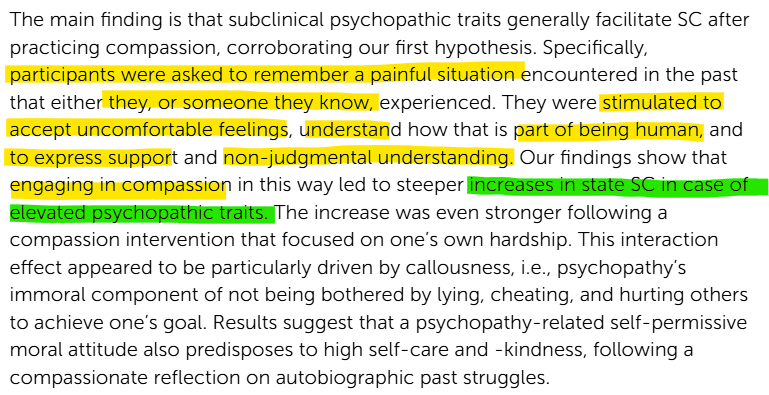
Compassion isn't an innate fixed trait but a skill anyone (even those starting from a deficit) can deliberately level up with minimal effort. Participants scoring higher on subclinical psychopathy began with markedly lower baseline self-compassion (r = −0.36, p < 0.001) and other-compassion (r = −0.34, p < 0.001), yet after a brief writing induction teaching mindfulness, common humanity, and kindness, higher psychopathy levels, especially callousness, predicted significantly stronger gains in self-compassion (B = 0.66, p = 0.01). Most remarkably, these same traits did not impair the ability to increase compassion toward others; psychopathic traits showed no negative or differential effect on improvements in other-compassion, meaning even highly callous individuals ramped up kindness for others at rates comparable to everyone else when guided through the exercise.
Dark-triad-like traits may confer short-term edges (charisma, boldness), but the ability to cultivate compassion unlocks long-term mating success, trust, and well-being that pure detachment can't.


English

More people should be looking at structural economics. Historically, the evolutionary drive of hypergamy meant women looked for a partner with baseline stability and status. But as our economy has grown richer, the distance between the rungs on the social ladder has widened into a chasm. We no longer have a flat hierarchy where a factory worker and a white-collar professional belong to the same broad middle class. Instead, we have an “hourglass economy” where working-class industrial and manual labor jobs have been pushed to the absolute bottom of the social and financial tier. And maybe within some of your hearts, being jobless or unemployed feels better because you actually subconsciously recognize this.
College degrees are becoming cultural and social gatekeepers. Women have outpaced men in earning them and seeking status quickly. Is that bad? Depends how you look at it, but one thing remains true. higher education and high-tech industries to completely monopolize the definition of “status,” we have structurally stripped working-class men of their value in the marriage market. We cannot wonder why family formation is struggling when we have actively engineered an economy that pushes the jobs most accessible to average men straight to the bottom of the hierarchy.
English

@idyllicmusing @PSUWRESTLINGBBC women have outvoted men since 1980, women control education and mass media, women alone can choose reproduction, make 80% of consumer decisions, gleefully steal men's jobs and scholarships via official quotas. But please keep up this "teehee ur so weak and dumb for letting us"
English

First, women are not a monolith. While they make up 50.5% of the population (America), they do not vote as a single bloc. millions are not feminists, and millions did not vote at all. In fact, pointing to high female turnout as some kind of progressive triumph makes no sense when you look at the outcome. Trump is in office, meaning a portion of those female voters actively chose him…
Second, WHY are eligible men not voting? Also, did you know that 2025 data shows Gen Z men (32%) now identify as feminists.
Sure, I could probably find an explanation for other times in history but I think these points shouldn’t be overlooked.

English

Most women are not the ones in power. The hierarchies are enforced by men, signed off by men, and maintained by men. If you wish to challenge power, argue with the men above you. It is an illusion to think that women have any power over man to begin with. She is only as powerful as the world men permit her to move within.
English

@idyllicmusing Hey let’s debate. I think woman shouldn’t be in power and the rise is woman in power coincides with the downfall of the western world. It’s not the cause but just a side effect of the country going to shit
English

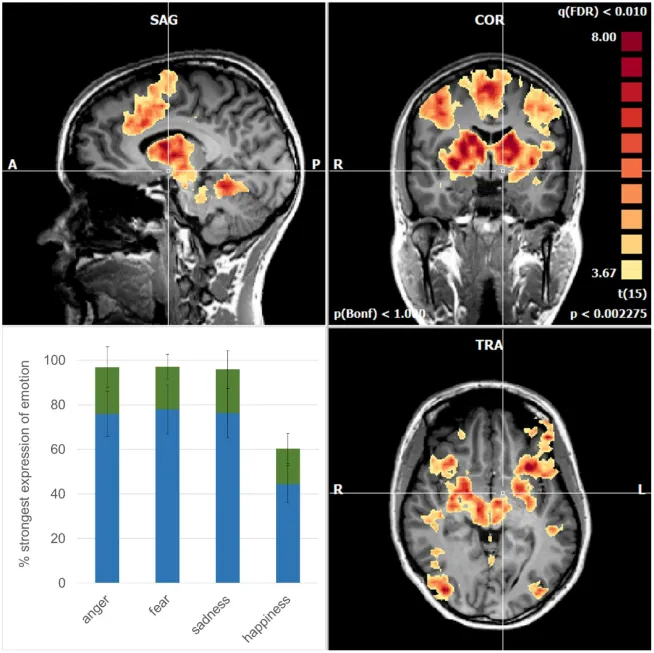
We spot happiness at just 40% of its visual evolution (helped by obvious cues like an open, toothy smile). But negative emotions like anger, fear, and sadness drag dramatically, needing nearly 80% intensity before we consciously register them.
Empathy is strictly sequential. It can only kick in after that conscious belief forms. This provides powerful evidence that “believing” is a foundational, prelinguistic brain function.
Our minds must first commit to a belief about a feeling before experiencing it.
When we believe we’ve identified the emotion, the brain unleashes a highly symmetrical “explosion” of activity. This surge lights up and it is far more intense than the initial visual processing itself.

English
Hereafter retweetledi

201 rows later and my recreation of the Birth of Venus in filet crochet is complete 🐚🦪✨🤍💫

Kiki@pyreticheart
73 rows down, 128 rows to go but Venus’ scallop shell is complete!!🤍
English

Man spares only what mirrors his soul; all else is meat for the machinery of survival.
LifeNews.com@LifeNewsHQ
Hitler killed Jews because he said they're not people. Abortion kills babies because feminists say they're not people.
English