iii

66 posts

iii banner
iii

iii

@iiidevs

unreasonably simple software engineering. GitHub: https://t.co/gYgSu54UPV Discord: https://t.co/RmFaK77BCY

Austin, TX Katılım Şubat 2026
1 Takip Edilen310 Takipçiler
dax
dax@thdxr·
please i'm begging you show me something you built not another "this is my custom agent setup" post where you pretend you're doing something smarter than vanilla claude code please
English
1.9K
198
7.1K
430.2K
iii
iii@iiidevs·
iii means one engine, one contract for every capability, and one answer when the system needs to grow: just add a worker.
English
0
1
9
1.2K
iii
iii@iiidevs·
Databricks recently shared research comparing AI harnesses and models for coding tasks within their environment. One thing currently overlooked in their study (and most similar research) is that upwards of 80% of tokens used with these harnesses are spent on integration, rather than on logic that provides direct business value. In any complex system, every service requires integration code to connect to databases, queues, or other services, or to fetch data via HTTP. This integration overhead only compounds with scale. This means that regardless of the harness choice, your total cost per task is inflated by at least 5x, and realistically more, once you account for the additional context required to manage such a massive amount of integration code. It is excellent that Databricks is exploring how to make developers and agents more effective with LLM programming and workflows. However, the question they should be asking is: What does the new paradigm of software engineering actually look like? Our answer: this new paradigm is iii. iii consists of just three core primitives: Workers, Functions, and Triggers. By adopting iii and its three primitives, both humans and agents become significantly more effective, gain just-in-time system understanding, and write more concise and consistent code. With iii, you can focus on creating compact, reusable components instead of boilerplate, effectively reducing integration to zero.
English
0
0
1
209
iii
iii@iiidevs·
While most products announce with fanfare that they now let you schedule a prompt… with iii, you can schedule anything, from a function to an entire agentic workflow, using standard cron syntax. But most importantly, cron in iii is just another worker that fires a standard trigger that any other worker can listen to. No additional code is required, and there are no additional patterns to memorize. This is the exact same kind of trigger as what a queue or a reactive database would also fire. Create schedules exactly the same way that you would use any other trigger type. What's being advertised as a fancy new feature with a trademark by other solutions, in iii is just a pattern that comes out of proper architecture. The iii harness, of course, already knows how to implement schedules in this way with just a single prompt. See iii scheduling in action in this demo.
English
0
1
6
1.7K
iii
iii@iiidevs·
When the system is properly architected, all the patterns come out for free.
English
0
0
0
65
iii
iii@iiidevs·
…in a single prompt with no additional input or guidance. You don't have to create custom new features for map-reduce with agents - just use all the software engineering patterns that have been around for years.
English
1
0
0
78
iii
iii@iiidevs·
On Jun 1st Devin announced Agentic MapReduce, their take on a map-reduce pattern for agents. It's reinventing the wheel. Essentially, their solution is spinning up a set of sub-agents, and then collecting their work into one final work result.
English
2
0
5
914
iii
iii@iiidevs·
Full changelog: #sdk-a-major-breaking-reorganization-of-the-public-surface" target="_blank" rel="nofollow noopener">iii.dev/docs/changelog… As the next step: update your imports to the new paths and follow the upgrade guide. Let us know here if you have any questions about the upgrade, or - to get even faster assistance - ask for help in our Discord: discord.gg/iiidev
English
0
0
2
61
iii
iii@iiidevs·
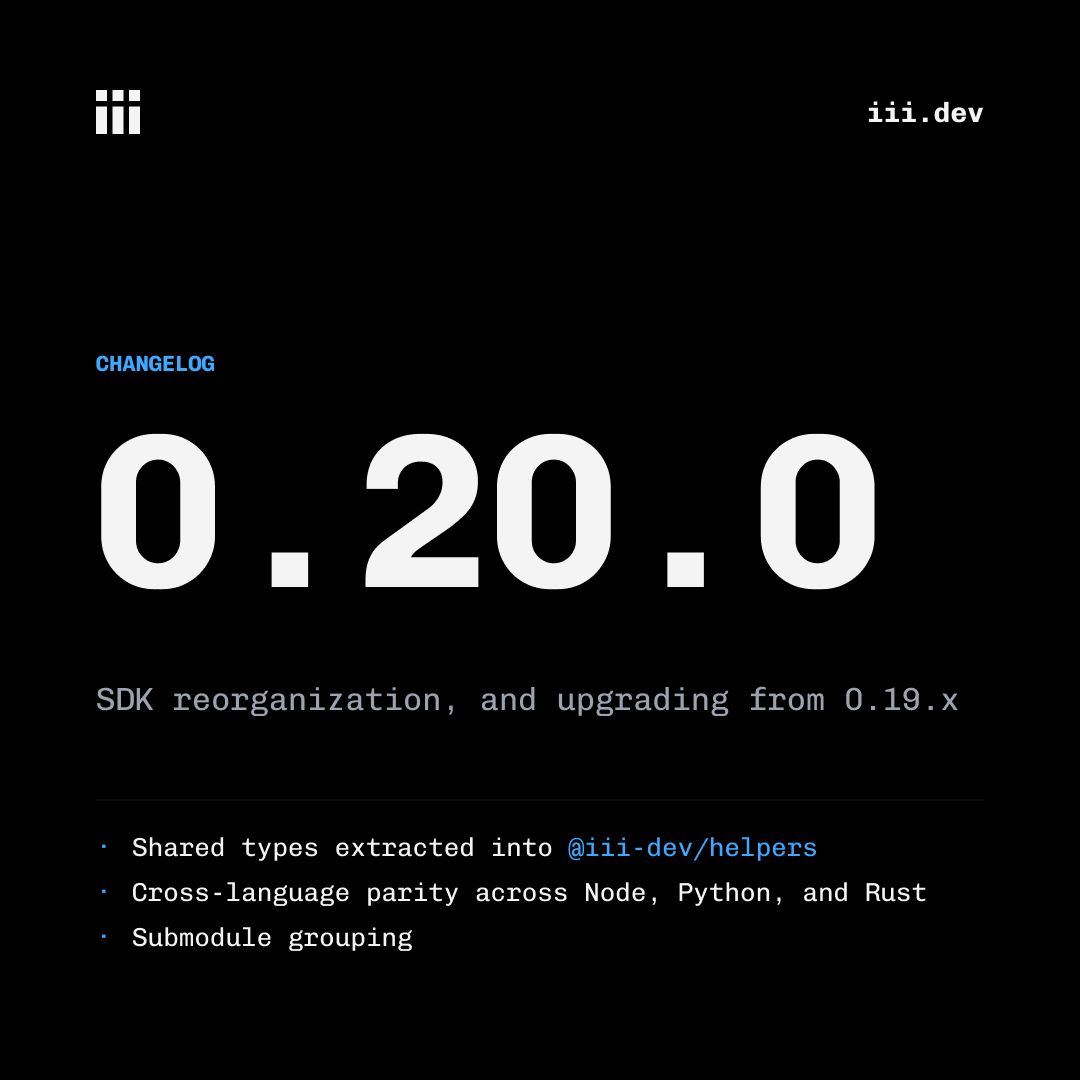
Getting there is a breaking step in the SDK; the iii runtime itself remains unchanged. Some symbols move out of the core SDK and into a helpers library, so existing apps need import updates before upgrading. Learn more in our upgrade guide: iii.dev/docs/upgrading…
English
1
0
2
64
iii
iii@iiidevs·
New release: iii 0.20.0 is now out. iii 0.20.0 introduces one concise and consistent public surface across our core Node, Python, and Rust SDKs. A small, predictable API means less to hold in your head and less context and fewer tokens to load.
iii tweet media
English
1
1
7
944
iii retweetledi
Rohit Ghumare
Rohit Ghumare@ghumare64·
I changed the way you're using Claude code today. Claude Code as worker changes the unit of composition. It is no longer only a coding agent you run in your terminal. It becomes a backend capability. You can call `claude::run` like any other iii function. Start a long coding turn. Stream its progress. Stop it. Resume it. Inspect usage and cost. Route permissions through policy. Let other workers observe what happened. Local file edits still use Claude Code’s native tools. Backend actions go through registered iii functions. That is the important part. Claude Code can now sit beside your queue worker, state worker, HTTP worker, sandbox worker, database worker, Telegram worker, or any custom worker you add. For users, this means your coding agent is no longer isolated from the system. It can participate in the same live, composable, observable backend fabric as everything else. Agents should not be special sidecars. They should be workers. workers.iii.dev
Rohit Ghumare tweet media
English
1
2
12
1.9K
iii retweetledi
Mike Piccolo
Mike Piccolo@mfpiccolo·
The old paradigm of adding a new service and integrating it to all others is dead. Find out how iii killed it in 563 seconds.
English
1
7
34
6.3K
iii
iii@iiidevs·
Read @MarqKwesi blog here: #what-i-would-want-from-iii-next" target="_blank" rel="nofollow noopener">umai-tech.com/blog/i-built-a…
English
0
0
4
70
iii
iii@iiidevs·
Marcus Elwin hand-rolled his own multi-agent harness, then he built the production version with iii and loved it. A very detailed writeup, definitely worth your time. He says: “The harness is the set of jobs that make an agent safe, durable, observable, and operable. iii’s bet is that those jobs should be workers on a shared bus, not hidden inside one framework object. [...] The powerful idea isn’t “use this one agent framework.” It’s seeing queues, streams, state, model providers, policy gates, approval surfaces, browser tabs, and business services as the same kind of thing: workers. If a capability is missing, add or replace a worker. Don’t keep changing the core engine.” He put these ideas to the test by moving his hand-rolled harness onto iii while keeping the frontend app stable. This is exactly the experiment we hoped someone would run. His read: “the primitives are strong, the defaults can get sharper.” That's the most useful feedback we can get, and it's already shaping what we build next. His writeup is one of the clearest takes we’ve seen on iii thus far. Well worth your time if you're running agents in production. Check out his multi-agent harness here: github.com/MarcusElwin/mu… And follow us to keep updated with what’s coming next.
iii tweet media
English
1
2
8
618