Aditya Arora

2.1K posts

Aditya Arora banner
Aditya Arora

Aditya Arora

@imAArora

ELLIS PhD TUDarmstadt | Prev MSc YorkU, Research Engineer at IIAI

Germany Katılım Ekim 2012
1K Takip Edilen206 Takipçiler
Aditya Arora retweetledi
Bhumika Mittal
Bhumika Mittal@mittalbhumika7·
Great initiative by @AalokDThakkar A regularly updated repository of grants, fellowships, and awards in the sciences for students, postdocs, and faculty. aalok-thakkar.github.io/grants Do check it out. Worth bookmarking!!
English
2
36
200
58K
Aditya Arora retweetledi
Voice Arena
Voice Arena@voicearena_ai·
Announcing the Voice Arena STT Leaderboard, our human-verified benchmark testing how accurately speech-to-text models transcribe real, spontaneous conversation across 7 languages The leaderboard covers 🇺🇸 US English, 🇮🇳 Hindi, 🇧🇩 Bangla, 🇧🇷 Brazilian Portuguese, 🇻🇳 Vietnamese, 🇷🇴 Romanian and 🇸🇦 Arabic. Every model is evaluated on the same held-out corpus per language: real, unscripted phone calls between native speakers, recorded in-country on their own phones, with the noise, fillers and interruptions of natural conversation. Unlike public STT benchmarks, results are measured on fully proprietary audio - no model has seen a second of it in training. @Reson8Offical's resonant-1 leads the US English board at 4.34% WER, ahead of models from @Microsoft , @Google , @OpenAI and @Meta . @SarvamAI leads in Hindi and Bangla, while Microsoft takes #1 in Romanian and Brazilian Portuguese. Key elements of the Voice Arena STT Leaderboard: ➤ Real speech, real conditions: audio is drawn from unscripted phone calls between native speakers, recorded in-country on the speakers' own devices, preserving the background noise, fillers and interruptions of production traffic. ➤ 100% proprietary, held-out audio: the corpus is collected and owned by Voice Arena. No model has seen a second of it in training, so results cannot be inflated by dataset contamination. ➤ Human-verified ground truth: transcripts are produced by native transcribers through a six-stage pipeline, and only segments verified 3-of-3 survive into the final test set. ➤ Corpus-level WER with symmetric, language-aware normalization: the same normalization is applied to both references and hypotheses, so models are penalized for recognition errors, never for spelling choices. Key results for the Voice Arena STT Leaderboard: ➤ The most accurate US English model is not from a big lab: Reson8's resonant-1 leads at 4.34% WER, ahead of Microsoft, Google, OpenAI and Meta. ➤ Model choice alone is worth ~44%: on the US English board, #1 sits at 4.34% WER and #20 at 7.74%. Same audio, same test set. Picking the right model cuts nearly half of your transcription errors before you touch anything else in the pipeline. ➤ There is no global winner: the #1 model changes with the language, with Reson8 leading US English, Sarvam leading Hindi and Bangla, and Microsoft leading Romanian and Brazilian Portuguese. Teams building for more than one market will not be covered by a single vendor at the top of every board.
Voice Arena tweet media
English
5
57
79
2K
Aditya Arora retweetledi
Berrak Sisman
Berrak Sisman@berraksismann·
I am looking for PhD students to join my lab at Johns Hopkins University in Fall 2027. If you’re attending #ACL2026 in San Diego, feel free to contact me through the Whova app. I’ll be around today and tomorrow. @aclmeeting @jhuclsp @JohnsHopkins @HopkinsEngineer
English
2
24
133
14.4K
Aditya Arora retweetledi
Andrei A. Rusu
Andrei A. Rusu@andreialexrusu·
I'm hiring for my team at GDM! If you’re passionate about engineering scalable agentic learning systems and doing impactful research, please apply here: goo.gle/4wsFoTU
English
9
25
394
43.5K
Aditya Arora retweetledi
Lorenzo Xiao
Lorenzo Xiao@lrzneedresearch·
Disappointed by the review received from the tutorial track in @emnlpmeeting and @aaclmeeting literal gatekeeping…
Lorenzo Xiao tweet media
English
13
8
179
56.6K
Aditya Arora retweetledi
Feryal
Feryal@FeryalMP·
I’m hiring! Come join our team at Google DeepMind in London or Mountain View to work on Gemini agent post-training. We are looking for Research Scientists and Research Engineers interested in advancing the capabilities of AI agents. Please apply here: google.com/about/careers/…
English
31
82
1.1K
180.5K
Aditya Arora retweetledi
Yong Zheng-Xin
Yong Zheng-Xin@yong_zhengxin·
Joining @openai next month! after seeing people's reaction to Alisa's post about her experience, I also wrote down some of the surprising things I wish I know before my research scientist job search: yongzx.github.io/blog/2026/06/2…
English
79
139
2.2K
148.9K
Aditya Arora retweetledi
Alexander Goslin
Alexander Goslin@xandurglar·
I owe it all to this Reddit post
Alexander Goslin tweet media
Alexander Goslin@xandurglar

Introducing InfiniteDiffusion, my independent paper accepted to #SIGGRAPH2026! I have one RTX 3090 Ti. No funding, advisors, or team. By day I'm a new grad SWE at Walmart. The paper has two main contributions: - InfiniteDiffusion: a new approach to infinite generation with diffusion models. - Terrain Diffusion: the world’s first learned procedural terrain generator. Here’s why this matters, and how they are connected. 🧵
English
24
291
5.6K
314.9K
Aditya Arora retweetledi
Francesco Orabona
Francesco Orabona@bremen79·
Final version of my book (with a new title) Online Learning: A Modern Introduction Using Convex Optimization Especially proud of the Foreword by @NicoloCB! It'll be printed by Cambridge University Press. The end of 7 years of updates :) arxiv.org/pdf/1912.13213
Francesco Orabona tweet mediaFrancesco Orabona tweet mediaFrancesco Orabona tweet mediaFrancesco Orabona tweet media
English
12
114
597
58.9K
Aditya Arora retweetledi
אגי-e/acc
אגי-e/acc@murage_kibicho·
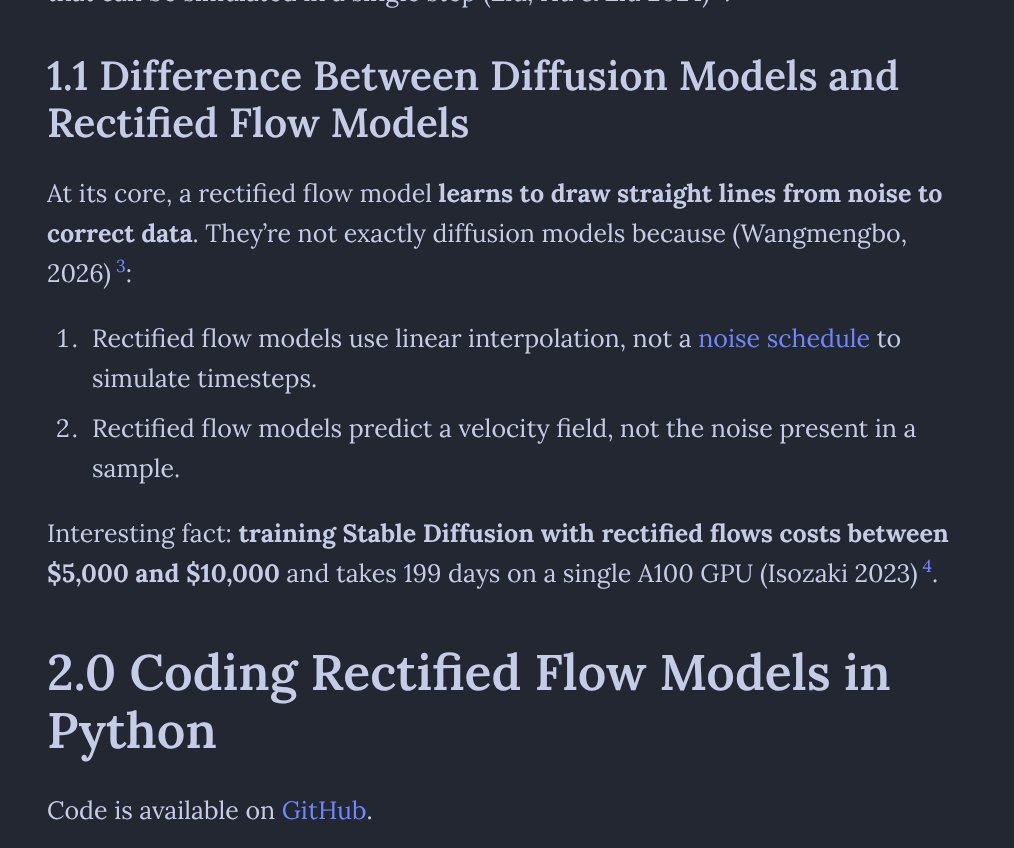
No one benefits from pages of dense math. Ultimately, only the loss function (and the corresponding code) matter. The paper could have been a blog post: leetarxiv.substack.com/p/rectified-fl…
אגי-e/acc tweet media
Antonio Lupetti@antoniolupetti

"An Introduction to Flow Matching and Diffusion Models" is a set of MIT lecture notes for the course "Generative AI With Stochastic Differential Equations" (2026) that provides a clear introduction to the mathematics behind modern generative AI. The notes discuss flow matching and denoising diffusion models as core techniques behind many advanced generative systems, with references to models such as Stable Diffusion 3, FLUX, VEO-3, and AlphaFold3. They develop the mathematical foundations of generative modelling, covering topics such as sampling from probability distributions, ordinary and stochastic differential equations, Brownian motion, diffusion processes, flow matching, score matching, classifier-free guidance, architectures for image and video generation, latent spaces, autoencoders, and discrete diffusion models for language generation. What I particularly appreciated is the teaching style. The notes first build geometric and probabilistic intuition and only then derive the complete mathematical formulations. The result is a treatment that is rigorous, visual, and remarkably approachable. This is probably one of the best freely available resources for understanding what is actually happening under the hood of diffusion models from a mathematical perspective. diffusion.csail.mit.edu/2026/docs/lect…

English
2
19
230
21.8K
Aditya Arora retweetledi
Grigory Sapunov
Grigory Sapunov@che_shr_cat·
1/ We think deep reasoning models need complex hierarchical loops, slow/fast memory tracks, or explicit scratchpads. They don't. A flat, single-loop Transformer can outperform them all. It just needs the right signal propagation. 🧵
Grigory Sapunov tweet media
English
3
52
339
21.9K
Aditya Arora retweetledi
Stanford NLP Group
Stanford NLP Group@stanfordnlp·
“I started my process by watching all the lectures from Stanford’s Language Modeling from Scratch course, which is helpful for illustrating the breadth of topics I needed to learn and helped me organize many scattered concepts in my brain into one coherent picture of the field.”
Alisa Liu@alisawuffles

I'm joining OpenAI next week!🥹 The job search turned out to be really challenging but also super rewarding, so I wrote a small blog to share what I learned along the way and hopefully make the process a little less mysterious for the next person. alisawuffles.github.io/blog/job-search

English
9
102
2.6K
215.7K
Aditya Arora retweetledi
ℏεsam
ℏεsam@Hesamation·
this PhD student had 47 interviews and 4 offers before she was hired at OpenAI. she practiced with her “notes on LLMs” and math and they’re a goldmine. super concise and organic and shared to everyone for free. you can use her notes or her topic list to study on your own.
ℏεsam tweet mediaℏεsam tweet media
Alisa Liu@alisawuffles

I'm joining OpenAI next week!🥹 The job search turned out to be really challenging but also super rewarding, so I wrote a small blog to share what I learned along the way and hopefully make the process a little less mysterious for the next person. alisawuffles.github.io/blog/job-search

English
25
578
7.8K
817.8K
Aditya Arora retweetledi
Lucas Beyer (bl16)
Lucas Beyer (bl16)@giffmana·
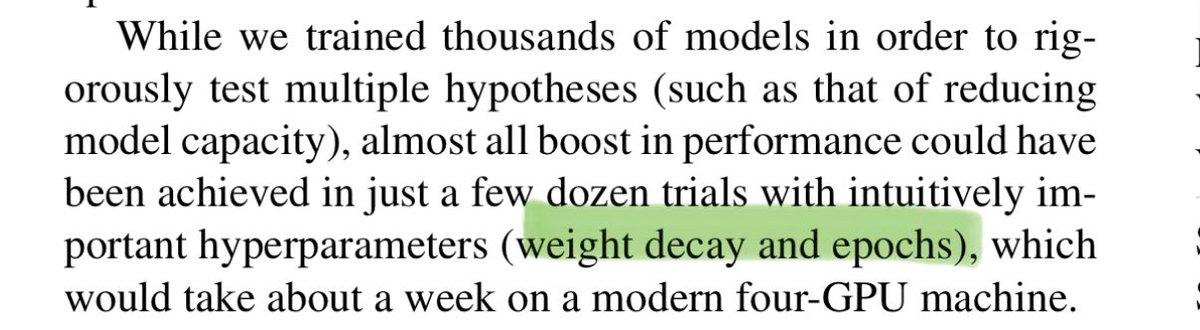
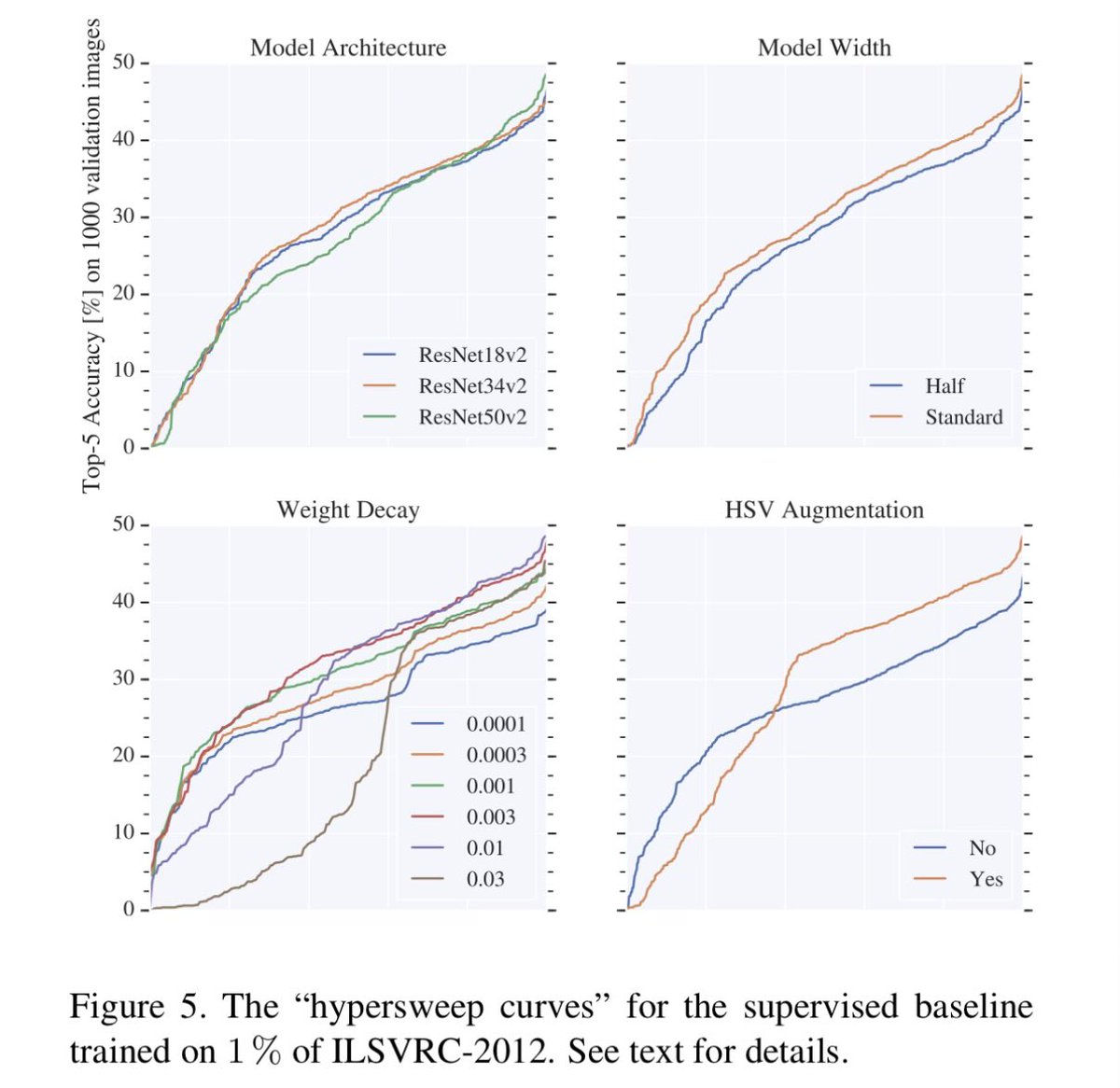
LLM community slowly rediscovering what we in vision found out over half a decade ago. MY SCHMIDHUBER MOMENT IS COMING! Source: S4L paper where i tuned the most sota 10% and 1% ImageNet baselines ever, by far. arxiv.org/abs/1905.03670
Lucas Beyer (bl16) tweet mediaLucas Beyer (bl16) tweet mediaLucas Beyer (bl16) tweet mediaLucas Beyer (bl16) tweet media
Teortaxes▶️ (DeepSeek 推特🐋铁粉 2023 – ∞)@teortaxesTex

for people wondering how frontier labs can scale to hundreds of trillions of tokens: just crank weight decay ALL THE WAY UP and keep grinding on the same dataset, silly! Lots of other details on distillation, ensembling, synthetic data too No, tokens won't be a wall

English
27
48
817
186.8K
Aditya Arora retweetledi
Yossi Gandelsman
Yossi Gandelsman@YGandelsman·
This may be a controversial take, but I think it needs to be said: the gap between computer vision research in academia and industry is widening with every conference. A huge fraction of @CVPR papers—especially those that boil down to "we tweaked/fine-tuned/RL'ed large-scale model X to improve on task Y"—will become obsolete with the next model release. That's not where academia creates lasting value. PIs should adapt much faster to this changing reality. Academia should focus on fundamentally new ideas, new problem formulations, explaining emergent phenomenology, or uncovering blind spots that industry can later solve with scale, compute, and data.
English
37
114
1.1K
96.4K
Aditya Arora retweetledi
Gabriele Berton
Gabriele Berton@gabriberton·
Great quote that every AI researcher should aspire to: "I do things, which work, rather than being novel, but not working." - @ducha_aiki
English
15
15
163
14.3K