Predmet
132 posts

Recent BTC eco farms:
Opensea - larping about launching and listing ordinals
Arch Network - entire manifesto campaign just to not launch
OpNet - burn2earn for pill, wont launch for months
Spark - locked users funds & hasn’t been back for a month
Having fun?
English
Predmet retweetledi
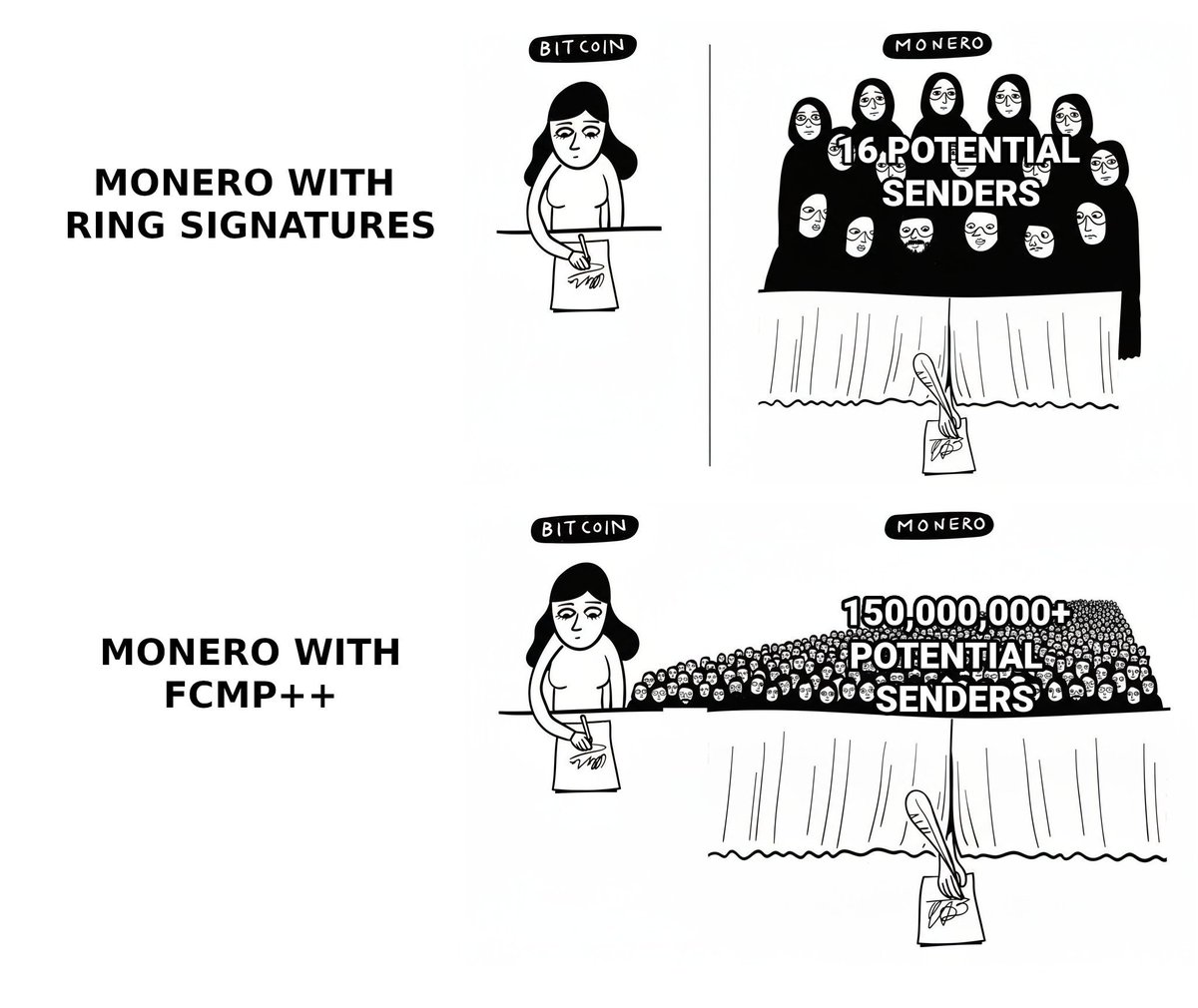
@CR1337 @fluffypony They're trying sooo hard to make Zcash look like the big privacy answer, it's kinda funny tbh..
English


Predmet retweetledi

Your claims about the UAE are simply false.
First of all The UAE did not ban Bitcoin, self-custody, or wallets.
Users aren’t affected.
The UAE is one of the world’s most pro-crypto hubs.
@binance & @cz_binance , @Bybit_Official & @benbybit , @okx , @cryptocom & @kris , and major market makers all operate legally under SCA, VARA, and ADGM.
If crypto was “banned,” none of them would be here.
Article 62 targets unlicensed entities, not regular people.
Holding Bitcoin, using a wallet, or running an explorer is not prohibited.
Your “repressive government” comments are outdated stereotypes.
The UAE built SCA regulations, VARA, ADGM’s DLT regime, and a global digital-asset ecosystem long before most countries even had clarity.
Respectfully: stop spreading misinformation about a country you clearly don’t understand.
The UAE is building the future of digital assets not banning them.
English
Just use @mullvadnet and pay with Monero.
Done.

Pirat_Nation 🔴@Pirat_Nation
Google Issues Security Alert: Your VPN App Could Be Spyware in Disguise According to Google’s advisory, these fake VPNs can exfiltrate a treasure trove of sensitive information, including your browsing history, private messages, financial credentials, and even cryptocurrency wallet details.
English
The Zcash vs Monero debate isn't complicated.
Zcash made privacy optional. Only 30% of transactions use shielded pools - so if you're using privacy, you're standing out in a tiny crowd. Small anonymity sets = weak privacy, no matter how good the tech is.
Monero made privacy mandatory. 100% of transactions are private. Everyone's forced into the same pool, so you actually blend in. That's real anonymity.
And here's the proof: exchanges happily list ZEC because regulators tolerate it. But XMR? Mass delistings everywhere because it's actually threatening.
If you want real privacy that can't be compromised, the choice is obvious. Don't fall for "optional privacy" - it defeats the whole purpose.
English
Predmet retweetledi

Predmet retweetledi

Predmet retweetledi

"Show me fucking smart contracts on Bitcoin?" - they said.
Time has come to answer this question once and for all.
Bitcoin doesn't have a virtual machine. It doesn't have state storage. Its scripting language is intentionally limited. So how can you possibly have real smart contracts, actual DeFi, genuine programmable money on Bitcoin itself? Not on a sidechain, not through a bridge, but directly on Bitcoin?
We spent two years building OPNet, a consensus layer that adds smart contracts to Bitcoin without modifying Bitcoin's protocol, without requiring anyone's permission, without creating any fork.
What's remarkable is that this could have been built since P2SH activated in 2012, but nobody figured it out. When Vitalik Buterin tried to solve this problem and couldn't, he created Ethereum instead. Every other attempt resulted in separate blockchains. We solved it directly on Bitcoin.
What follows is the complete technical breakdown of how OPNet works: deterministic execution, cryptographic consensus, epoch-based finalization, and mathematical proof that makes disagreement impossible. This isn't theoretical; the testnet is live, smart contracts are running, and Motoswap is processing real swaps. This is precisely how we made smart contracts work on Bitcoin.
The first thing to understand is why every other Bitcoin protocol faces fundamental limitations. BRC-20, Runes, and other protocols all operate as meta-protocols that rely on indexers interpreting data. When you "own" BRC-20 tokens, those tokens don't exist on Bitcoin; they exist in database entries maintained by indexers. Different indexers can show different balances because there's no mechanism forcing them to agree. They're hoping everyone calculates the same results, but hope isn't consensus. Alkanes took an interesting approach by introducing WASM smart contracts, which represents significant technical progress for Bitcoin protocols. However, like other meta-protocols, contract execution happens within indexers without a consensus mechanism to ensure all participants reach identical states. Each indexer independently processes contracts, potentially arriving at different results.
OPNet is fundamentally different because it's a consensus layer, not a metaprotocol. A consensus layer provides cryptographic proof of correct execution where every participant must arrive at exactly the same result, or their proofs won't validate. Think about what this means: when a smart contract executes on OPNet, it's not just describing what should happen; it's proving what did happen, with mathematical certainty that makes any other outcome impossible.
To understand how this works, you need to grasp the distinction between consensus and indexing. Consensus means that given the same inputs, every participant reaches the same conclusion through deterministic processes, and any disagreement can be proven wrong through cryptography. Indexing means each participant maintains their own database and hopes others maintain theirs the same way. With consensus, if two nodes disagree about a balance, one is provably wrong. With indexing, you just have two different opinions and no way to determine which is correct.
Bitcoin itself achieves consensus on transactions through proof-of-work. Miners compete to add blocks, nodes validate according to identical rules, and the chain with the most accumulated work becomes truth. Ethereum extends this to smart contracts where every node executes the same code and must reach identical results. Meta-protocols don't have this; they have voluntary agreement, which breaks down the moment participants disagree.
OPNet implements consensus by embedding everything directly in Bitcoin's blockchain. Every OPNet transaction, whether deploying a contract, calling a function, or making a swap, gets written to Bitcoin using tapscript witness data. This isn't metadata sitting alongside transactions; it's the actual contract bytecode, the function parameters, the execution data, all embedded in Bitcoin transactions that get confirmed by Bitcoin miners and become part of Bitcoin's permanent record.
Now let me walk you through exactly how OPNet's epoch system works, using epoch 113 as a concrete example to explain each step of the process.
The system divides time into epochs, where each epoch consists of five consecutive Bitcoin blocks, roughly fifty minutes. Epoch 113 specifically covers Bitcoin blocks 565 through 569. During these five blocks, every OPNet transaction that gets confirmed becomes part of epoch 113's state. When someone deploys a smart contract in block 566, that deployment is part of epoch 113. When someone swaps tokens on Motoswap in block 568, that swap is part of epoch 113. Every interaction, every state change, every event that occurs during these five blocks belongs to this epoch.
Here's where OPNet differs from simply reading transactions in order: OPNet has its own deterministic ordering rules within each block. Transactions don't execute in the random order they appear; they get sorted first by gas price, then by priority fees, then by transaction ID. This creates a canonical ordering that every node must follow. This matters because in smart contracts, the order of operations can change outcomes, especially in DeFi where prices and liquidity constantly shift.
Every OPNet node processes these transactions through WebAssembly smart contracts. The execution is completely deterministic, meaning the same input always produces the same output. If a contract calculates a swap price, every node calculates the exact same price. If a function updates balances, every node updates them identically. By the end of block 569, every node has processed every transaction and arrived at exactly the same state.
When epoch 113 concludes at block 569, the network must finalize everything that occurred during those five blocks. Every node has already reached the same state through deterministic execution, but now we need to create an immutable checkpoint that becomes part of Bitcoin's permanent record. This checkpoint, called the checksum root, is a cryptographic fingerprint of the entire epoch's final state: every balance, every contract's storage, every single bit of data. If anything differs, even by a single bit, the checksum root completely changes.
The finalization process begins with mining. Miners compete to find the best SHA1 near-collision with the checksum root from block 564, which was the last block of epoch 112. They take this previous epoch's final checksum, combine it with their public key and a random 32-byte salt, and hash it using SHA1. They're searching for a hash that matches a target pattern as closely as possible, counting the number of matching bits.
Finding competitive solutions requires significant computational work. A miner might generate millions of attempts, adjusting their salt each time, looking for better and better matches. The more bits that match between their hash and the target, the better their solution. This is similar to Bitcoin mining, but instead of counting leading zeros, we're counting total matching bits, and instead of SHA256, we're using SHA1.
During epoch 114, which covers blocks 570 through 574, miners submit their solutions as actual Bitcoin transactions. These submissions contain their SHA1 collision proof, their public key, the salt they used, and critically, an attestation to the state from epoch 109. Why epoch 109? Because it ended at block 549, which is now over twenty blocks deep in Bitcoin's history. At that depth, every honest node must agree on what that state was because Bitcoin doesn't reorganize that deep. The deepest reorganization in Bitcoin's history was actually 53 blocks in March 2013 due to a database bug that split the network between different versions. However, this required extraordinary circumstances including incompatible software versions running simultaneously, something that modern Bitcoin's consensus rules and network monitoring make effectively impossible today. Under normal operations, reorganizations beyond 6 blocks are extraordinarily rare, and 20 blocks provides an enormous safety margin.
Since multiple miners typically submit solutions, the protocol needs a deterministic way to select exactly one winner. The selection process uses pure mathematics with multiple tiebreakers. First, whoever achieved the most matching bits in their SHA1 collision wins. If multiple miners achieved the same number of bits, the miner whose public key has the smallest numerical value wins. If somehow that's still tied, the system checks how many bits the last twenty bytes of each public key match with the target hash. Then it compares salts numerically, and finally transaction IDs. This cascading system ensures that given the same set of submissions, every single node will identify the same winner without any communication between them.
The winning miner's solution becomes the official checkpoint for epoch 113, embedded forever in Bitcoin's blockchain. But here's the fascinating part: the winner doesn't receive fees from epoch 113. They receive all gas fees from epoch 116, which hasn't even happened yet. Those transactions literally don't exist when the miner is competing. They're mining for the right to collect fees from future network activity. This prevents miners from manipulating their own epochs for profit since they don't know which epoch's fees they'll receive, and it incentivizes keeping the network healthy since dead networks generate no future fees.
This architecture makes forking OPNet impossible without forking Bitcoin itself. To create an alternative version of epoch 113, you would need to rewrite Bitcoin blocks 565 through 569 to change the transactions, then rewrite blocks 570 through 574 to change the submissions, then continue rewriting every subsequent block to maintain the alternative history. After just one day, an epoch is buried under 144 Bitcoin blocks. After a week, it's under 1,008 blocks. The cost isn't just millions of dollars; it would require controlling the majority of Bitcoin's global hashrate for days or weeks, something that would be immediately visible to the entire world.
This is why OPNet provides stronger finality than Bitcoin transactions themselves. A Bitcoin transaction is considered secure after six confirmations. An OPNet epoch becomes practically irreversible after a few hours and mathematically impossible to change after a day. The security compounds over time until changing old epochs would literally require rewriting months of Bitcoin's history.
What makes this truly remarkable is that OPNet adds programmability to Bitcoin without changing Bitcoin at all. It's not a soft fork or hard fork. It's an optional consensus layer that exists on top of Bitcoin, available to anyone who wants it, invisible to anyone who doesn't. If you don't run OPNet, you just see normal Bitcoin transactions with some extra witness data. If you do run OPNet, you see a complete smart contract platform with deterministic execution and cryptographic consensus. Every DeFi application that exists on Ethereum can now be built on Bitcoin. Decentralized exchanges with guaranteed price execution and atomic swaps. Lending protocols with deterministic liquidations and automated interest rates. Options, futures, prediction markets, all with mathematical certainty about outcomes. No bridges needed, no wrapped tokens required, no committees to trust. The smart contracts execute directly on Bitcoin, their state is proven through cryptography, and their security comes from Bitcoin's own immutability.
OPNet miners aren't validators making decisions about validity. They're witnesses competing to checkpoint deterministic execution that has already occurred. They don't choose which transactions are valid; the consensus rules determine that. They don't decide transaction ordering; the deterministic algorithm handles that. They compute SHA1 collisions to earn future rewards while creating cryptographic proofs that everyone must accept.
The entire system runs as a single piece of software that connects to Bitcoin, processes transactions according to deterministic rules, and maintains synchronized state. No separate indexers that might disagree, no auxiliary networks that might fail, no additional trust assumptions beyond Bitcoin itself. If Bitcoin is running, OPNet is running. If Bitcoin is secure, OPNet is secure.
We started building this in January 2024 because we saw what everyone else missed: Bitcoin doesn't need modification to support smart contracts; it needs a consensus layer that leverages Bitcoin's existing security. Not a separate chain, not a federation, but actual consensus achieved through mathematical proofs embedded in Bitcoin itself.
The testnet has been running for months. You can deploy actual smart contracts, trade on Motoswap with real atomic swaps, build applications with deterministic execution. Every transaction creates proofs embedded in Bitcoin. Every epoch becomes progressively more immutable. Every state change carries cryptographic certainty that cannot be disputed.
And this brings us to what's actually possible with real consensus on Bitcoin. Take NativeSwap, for example, the first truly decentralized AMM on Bitcoin that trades native BTC for tokens without any custody. This isn't an order book on a centralized server or a protocol hoping indexers agree on trades. It's an actual automated market maker with virtual reserves, two-phase commits, CSV timelocks, and queue impact formulas, all running on OPNet's consensus layer. NativeSwap can coordinate atomic swaps across 200 different providers in a single transaction, handle partial fills automatically, and guarantee price execution, something that's literally impossible without consensus. The protocol doesn't hold BTC; it tracks the economic effect of trades through virtual reserves while the actual Bitcoin flows directly between traders. This kind of sophisticated DeFi application simply cannot exist on meta-protocols that lack consensus. It requires the mathematical certainty that OPNet provides, where every node must reach the same state or their proofs fail validation. NativeSwap is just the beginning of what becomes possible when you have real smart contracts on Bitcoin.
OPNet represents what happens when you stop trying to work around Bitcoin's constraints and start working with them; when you recognize that patience creates certainty and time strengthens security; when you build consensus through mathematics rather than politics; it's the consensus layer Bitcoin always could have had if anyone had understood Bitcoin deeply enough to build it; after two years of development, that's exactly what we're delivering; not another metaprotocol hoping indexers agree, not another chain claiming to complement Bitcoin, but a true consensus layer that makes smart contracts on Bitcoin not just possible but inevitable; the future isn't Bitcoin plus other chains but Bitcoin plus consensus layers that inherit its security while extending its capability; OPNet is the first, it won't be the last, but it will always be the one that proved it was possible.
English
Predmet retweetledi
I tried @theprivacycash on Solana and really liked it.
Feels like Tornado Cash but on Solana: fast, cheap, private SOL transfers built on Solana's confidential infra.
Interesting project to check out! Learn how to stay anonymous here: tornado-cash.medium.com/how-to-stay-an…
Privacy Cash@theprivacycash
Transfer SOL. Privately. Privacy Cash lets you transfer funds to a clean wallet without linking past addresses or transaction history. Why Privacy Cash?
English
Predmet retweetledi

The RAILGUN privacy set is now over $100 million total value shielded & $3.5 billion in private volume.
Around $2.5 billion of that volume occurred in the last 18 months.
The more value is privatized through RAILGUN, the stronger the privacy set is for all users.
English
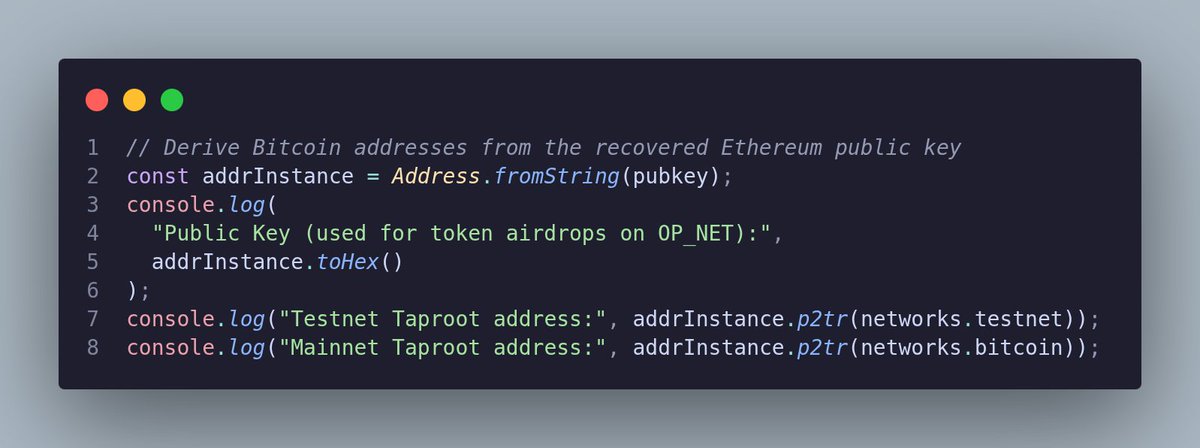
@AAyanlere65420 @opnetbtc It's possible right now.
You can import an ETH private key into Unisat, OP_WALLET, etc., and it'll give you the BTC addresses for that same key.
English

@impredmet @opnetbtc does this mean we can do that on the extension wallet ? or it still needs to go through some rigorous steps since its unlike the native BTC<> BTC txns /ETH<>ETH txns
English
@Kosmozilla_eth @opnetbtc Nah, it doesn't let you spend anything, it's just that if someone has sent from an ETH address before, you can figure out the matching BTC public address from the same key.
Private key stays private, so you can't touch the BTC without it.
English