
Privi

3.9K posts

Privi banner
Privi

Privi

@imprivi

Building Content agents for real estate & crypto | Sharing Life Hacks 10x your growth 📈 travel and Fitness. DM for collabs! #AI #Crypto #Life

Katılım Nisan 2020
2.4K Takip Edilen4.3K Takipçiler
Privi retweetledi
iain
iain@ohiain·
Relative strength isn’t complicated to understand. A simple way to train your eyes is to compare every stock against 3 things: 1) the market 2) its sector 3) its own recent structure. If $SPY and $QQQ are weak but a stock is flat, tight, or green, pay attention. If its sector is red but the stock is holding higher lows, pay attention. If the market bounces and that stock immediately pushes to highs, pay attention. This is a simple framework I use every single day!
iain@ohiain

Relative Strength FIRST, setup SECOND. Today is a great day to do your homework & train your eyes. And when I say “do your homework,” I mean asking a stupidly simple question: "How is a stock behaving relative to the market + relative to its sector/group?" That’s literally it. If the indices are weak and a stock is: - holding key levels +barely pulling back - tightening up + respecting EMAs - building higher lows intraday …that’s relative strength. But if the market is green and the stock still can’t hold pivots or keeps lagging against its sector, I lose interest very quickly. One of the best analogies I’ve ever heard for relative strength is the beach ball underwater. When $SPY + $QQQ are under pressure, my job is to study what refuses to break. The names holding structure while everything else bleeds are usually institutions showing their hand in favor... Those are the names I care about: 1) the stocks staying above moving averages 2) holding structured tight ranges 3) refusing to fully participate in market weakness Because once pressure lifts and the market stabilizes, those names usually don’t just “bounce,” but launch. That built-up pressure gets released all at once, just like the beach ball. Focus on leadership first. The setup matters, but the stock selection matters even more. A mediocre setup on a true leader will usually outperform a perfect setup on a weak stock. Study this concept deeply because once you train your eyes to recognize relative strength properly, it's a whole different ball game.

English
8
11
105
8.6K
Privi retweetledi
iain
iain@ohiain·
Relative Strength FIRST, setup SECOND. Today is a great day to do your homework & train your eyes. And when I say “do your homework,” I mean asking a stupidly simple question: "How is a stock behaving relative to the market + relative to its sector/group?" That’s literally it. If the indices are weak and a stock is: - holding key levels +barely pulling back - tightening up + respecting EMAs - building higher lows intraday …that’s relative strength. But if the market is green and the stock still can’t hold pivots or keeps lagging against its sector, I lose interest very quickly. One of the best analogies I’ve ever heard for relative strength is the beach ball underwater. When $SPY + $QQQ are under pressure, my job is to study what refuses to break. The names holding structure while everything else bleeds are usually institutions showing their hand in favor... Those are the names I care about: 1) the stocks staying above moving averages 2) holding structured tight ranges 3) refusing to fully participate in market weakness Because once pressure lifts and the market stabilizes, those names usually don’t just “bounce,” but launch. That built-up pressure gets released all at once, just like the beach ball. Focus on leadership first. The setup matters, but the stock selection matters even more. A mediocre setup on a true leader will usually outperform a perfect setup on a weak stock. Study this concept deeply because once you train your eyes to recognize relative strength properly, it's a whole different ball game.
iain@ohiain

Ever held a beach ball underwater? No matter how long you hold it down, the second you let go, it explodes upward. That’s how relative strength works in the market. When the market’s under pressure, you watch what refuses to break. Those names holding higher lows, staying above EMAs, and showing tight ranges while everything else bleeds slowly... That’s strength. Because when the pressure lifts and the market finds footing, those stocks don’t just recover… they launch. Like that beach ball you tried to hold under, all that built-up energy gets released at once. So while everyone’s panicking, our job is to quietly study what’s holding up best. Because when strength returns to the market, that’s where the next wave of momentum will come from. I'm begging you, please study and know this.

English
6
19
147
21.9K
Privi retweetledi
The Trading Geek (Brad Goh)
The Trading Geek (Brad Goh)@Bradgohtrades·
I made $2.2 million day trading in 2025. I've boiled my entire trading approach down into a simple 3-step framework that anyone can follow. In this thread, I'll show you exactly what it is and how it works:🧵
English
8
49
291
51.2K
Privi retweetledi
Tom
Tom@t0mbfx·
If you want to become a profitable trader, become disciplined in your life outside of trading I failed at trading for 4 years Then I locked in for a few months on my sleep routine, my fitness and my eating habits and started to get consistent payouts The discipline you have in your daily life will bleed into your trading If you’re staying up watching youtube until 3am every night, playing video games for hours every day and not doing basic things like journalling your trades - you make it 10x harder to become consistently profitable
English
46
58
681
13.9K
Privi retweetledi
Christian Flanders
Christian Flanders@CFlanders7·
Every single time I think about holding onto my winners I come back to this passage. "His name was Partridge, but they nicknamed him Turkey behind his back, because he was so thick-chested and had a habit of strutting about the various rooms, with the point of his chin resting on his breast. The customers, who were all eager to be shoved and forced into doing things so as to lay the blame for failure on others, used to go to old Partridge and tell him what some friend of a friend of an insider had advised them to do in a certain stock. They would tell him what they had not done with the tip so he would tell them what they ought to do. But whether the tip they had was to buy or to sell, the old chap's answer was always the same. The customer would finish the tale of his perplexity and then ask: "What do you think I ought to do?" Old Turkey would cock his head to one side, contemplate his fellow customer with a fatherly smile, and finally he would say very impressively, "You know, it's a bull market!" Time and again I heard him say, "Well, this is a bull market, you know!" as though he were giving to you a priceless talisman wrapped up in a million-dollar accident-insurance policy. And of course I did not get his meaning. One day a fellow named Elmer Harwood rushed into the office, wrote out an order and gave it to the clerk. Then he rushed over to where Mr. Partridge was listening politely to John Fanning's story of the time he overheard Keene give an order to one of his brokers and all that John made was a measly three points on a hundred shares and of course the stock had to go up twenty-four points in three days right after John sold out. It was at least the fourth time that John had told him that tale of woe, but old Turkey was smiling as sympathetically as if it was the first time he heard it. Well, Elmer made for the old man and, without a word of apology to John Fanning, told Turkey, "Mr. Partridge, I have just sold my Climax Motors. My people say the market is entitled to a reaction and that I'll be able to buy it back cheaper. So you'd better do likewise. That is, if you've still got yours." Elmer looked suspiciously at the man to whom he had given the original tip to buy. The amateur, or gratuitous, tipster always thinks he owns the receiver of his tip body and soul, even before he knows how the tip is going to turn out. "Yes, Mr. Harwood, I still have it. Of course!" said Turkey gratefully. It was nice of Elmer to think of the old chap. "Well, now is the time to take your profit and get in again on the next dip," said Elmer, as if he had just made out the deposit slip for the old man. Failing to perceive enthusiastic gratitude in the beneficiary's face Elmer went on: "I have just sold every share I owned!" From his voice and manner you would have conservatively estimated it at ten thousand shares. But Mr. Partridge shook his head regretfully and whined, "No! No! I can't do that!" "What?" yelled Elmer. "I simply can't!" said Mr. Partridge. He was in great trouble. "Didn't I give you the tip to buy it?" "You did, Mr. Harwood, and I am very grateful to you. Indeed, I am, sir. But --" "Hold on! Let me talk! And didn't that stock go up seven points in ten days? Didn't it?" "It did, and I am much obliged to you, my dear boy. But I couldn't think of selling that stock." "You couldn't?" asked Elmer, beginning to look doubtful himself. It is a habit with most tip givers to be tip takers. "No, I couldn't." "Why not?" And Elmer drew nearer. "Why, this is a bull market!" The old fellow said it as though he had given a long and detailed explanation. "That's all right," said Elmer, looking angry because of his disappointment. "I know this is a bull market as well as you do. But you'd better slip them that stock of yours and buy it back on the reaction. You might as well reduce the cost to yourself." My dear boy," said old Partridge, in great distress "my dear boy, if I sold that stock now I'd lose my position; and then where would I be?" Elmer Harwood threw up his hands, shook his head and walked over to me to get sympathy: "Can you beat it?" he asked me in a stage whisper. "I ask you!" I didn't say anything. So he went on: "I give him a tip on Climax Motors. He buys five hundred shares. He's got seven points' profit and I advise him to get out and buy 'em back on the reaction that's overdue even now. And what does he say when I tell him? He says that if he sells he'll lose his job. What do you know about that?" "I beg your pardon, Mr. Harwood; I didn't say I'd lose my job," cut in old Turkey. "I said I'd lose my position. And when you are as old as I am and you've been through as many booms and panics as I have, you'll know that to lose your position is something nobody can afford; not even John D. Rockefeller. I hope the stock reacts and that you will be able to repurchase your line at a substantial concession, sir. But I myself can only trade in accordance with the experience of many years. I paid a high price for it and I don't feel like throwing away a second tuition fee. But I am as much obliged to you as if I had the money in the bank. It's a bull market, you know." And he strutted away, leaving Elmer dazed. What old Mr. Partridge said did not mean much to me until I began to think about my own numerous failures to make as much money as I ought to when I was so right on the general market. The more I studied the more I realized how wise that old chap was. He had evidently suffered from the same defect in his young days and knew his own human weaknesses. He would not lay himself open to a temptation that experience had taught him was hard to resist and had always proved expensive to him, as it was to me. I think it was a long step forward in my trading education when I realized at last that when old Mr. Partridge kept on telling the other customers, "Well, you know this is a bull market!" he really meant to tell them that the big money was not in the individual fluctuations but in the main movements that is, not in reading the tape but in sizing up the entire market and its trend." - Reminiscences of a Stock Operator
Christian Flanders tweet media
Christian Flanders@CFlanders7

"Why do you follow your sell rules now? What made you change?" Here are some of the more egregious reasons why.

English
15
47
389
51.2K
Privi retweetledi
Kyna Kosling
Kyna Kosling@KynaKosling·
Find stocks that are showing interesting behaviour, then start stalking them. A huge part of your job is TRACKING stocks. Not BUYING them all the time. Dan Zanger in a 2006 interview with Tradersworld: “A lot of stocks have good patterns, but then they don’t move. […] So you really have to find what moves and then find the patterns that they create. “I have initially missed the first move of a stock, but I will track it for a month or two waiting for something to set up as opportunistic to buy either a breakout to the upside or a potential sell to the downside.” 2010 interview with Tradersworld: “If anything is up a dollar or two for the day, I want to know about it. […] On interesting stocks, I’ll see what the pattern looks like […] I look at the fundamentals to see how much the earnings are up. […] “I will download the stock into my AIQ charting program and start to track it. I will also put it on my eSignal quote screen and start to monitor the stock and see how it behaves. […] I want to make sure the stock is a consistent mover before I buy it. “Once you find them, you need to keep tracking them. You basically have to be a stalker, keeping after them for long periods of time. […] It takes a long time to track stocks and wait for them to set up for the proper time. So that’s how I find my stocks: by letting the market tell me which stocks it wants to move up.” (Lightly copy-edited. Both interviews available from the “Dan in the media” page on his website.)
Kyna Kosling@KynaKosling

Many traders search for that ‘perfect’ scan, looking for setups. But you’re really using a scan to find stocks worth adding to a watchlist — not necessarily names buyable today. And relying more on a scan rather than a well-maintained watchlist(s) makes you more likely to miss the powerful moves out of big bases. ~ Interviewer: “You don’t use automated scans to help you?” Zanger: “No. Because then I have to look through the stocks that the scans spit out as well as my 400 stocks, and scans are not going to get all the movers the way I will on a manual scan. The charts tell you everything you need to know about the stock. If a stock is lying dormant, no scan will tell you it’s time to go before it goes, but viewing the chart manually will.” ~ Full Zanger interview (from 2003): chartpattern.com/articles/stock… More on watchlists with @Clement_Ang17: tradingresourcehub.substack.com/p/how-to-build…

English
1
10
72
6.4K
Privi retweetledi
Julian Komar 🚨 Market Update Premium
Want to know more about me and my trading journey? 🎙️📈 Over the last months, I joined several interviews where we talked deeply about how I trade momentum and growth stocks 1) When Story, Fundamentals, and Technicals Align · Julian Komar - youtu.be/hWx_d6gAhPQ?si… 2) Full-Time Daily & Weekly Chart Trading - Julian Komar - youtu.be/717ZEyaTjyE?si… 3) Julian Komar: A truly honest account of his 20+ year journey to trading success - youtu.be/ntbREsvdOCY?si… No hype. No fake promises. Just real experience from somebody who has lived through bull markets, crashes, drawdowns and big winners. If you want to better understand how I think, trade and teach — these interviews are probably the best place to start. These patterns repeat. You can learn them too.
YouTube video
YouTube
YouTube video
YouTube
YouTube video
YouTube
Julian Komar 🚨 Market Update Premium tweet media
English
1
7
47
4K
Privi retweetledi
Elite Swing Traders
Elite Swing Traders@1ChartMaster·
The 30-minute pivot strategy used by Elite Swing Traders (@1ChartMaster) is a tactical entry method designed to help traders buy high momentum stocks at defined support levels while minimizing the risk of "chasing" a move. It is particularly effective for traders prone to FOMO (Fear Of Missing Out). Core Components of the Strategy Identifying Relative Strength (RS): The strategy focuses on "RS names" stocks that are holding up better than the broad market. The goal is to find a stock you want to own that is currently experiencing a short-term pullback. The "String of Red" Setup: A key signal for this entry is seeing a string of red 30-minute candles in a stock that is otherwise in a strong uptrend. This represents a healthy, short term "cooling off" period. The Pivot Entry: Rather than buying as the stock is falling, the trader waits for a "pivot" a specific point where the downward momentum on the 30minute chart shifts back to the upside. Defined Risk: By entering at the 30 minute pivot, you have a defined spot for a stop loss, usually just below the recent 30 minute low. Why Use It? Patience over FOMO: It forces the trader to wait for the stock to come to them rather than buying at the top of a parabolic move. Institutional Alignment: It seeks to buy the "dip" in a leading stock, often near short term support levels like the 8 EMA or the 8 wee EMA High Expectancy: When a High Tight Flag (HTF) or a high momentum name pulls back, the 30minute pivot often provides a low risk entry into the next explosive leg higher. Key Takeaway: The strategy is about finding the "beachball underwater" a strong stock being temporarily pushed down by market noise and entering at the moment the pressure is released and the stock begins to "pop" back up.
English
18
42
424
54.6K
Privi retweetledi
The Honest Trader
The Honest Trader@TheH0n3stTrader·
You're not a trader if you haven't read these books: ‣ Trading in The Zone by Mark Douglas. ‣ The Disciplined Trader by Mark Douglas. ‣ Best Loser Wins by Tom Hougaard. ‣ Thinking in Bets by Annie Duke. ‣ Reminiscences Of A Stock Operator by Edwin Lefevre. ‣ One Good Trade by Mike Bellafiore. ‣ Unknown Market Wizards by Jack Schwager. ‣ How to Day Trader for a Living by Andrew Aziz. ‣ The Mental Game of Trading by Jared Tendler. ‣ Trade Like a Casino by Richard Weissman. ‣ Building Winning Algorithmic Trading Systems by Kevin Davey. ‣ The Playbook by Mike Bellafiore.
English
11
85
369
15.1K
Privi retweetledi
Kyna Kosling
Kyna Kosling@KynaKosling·
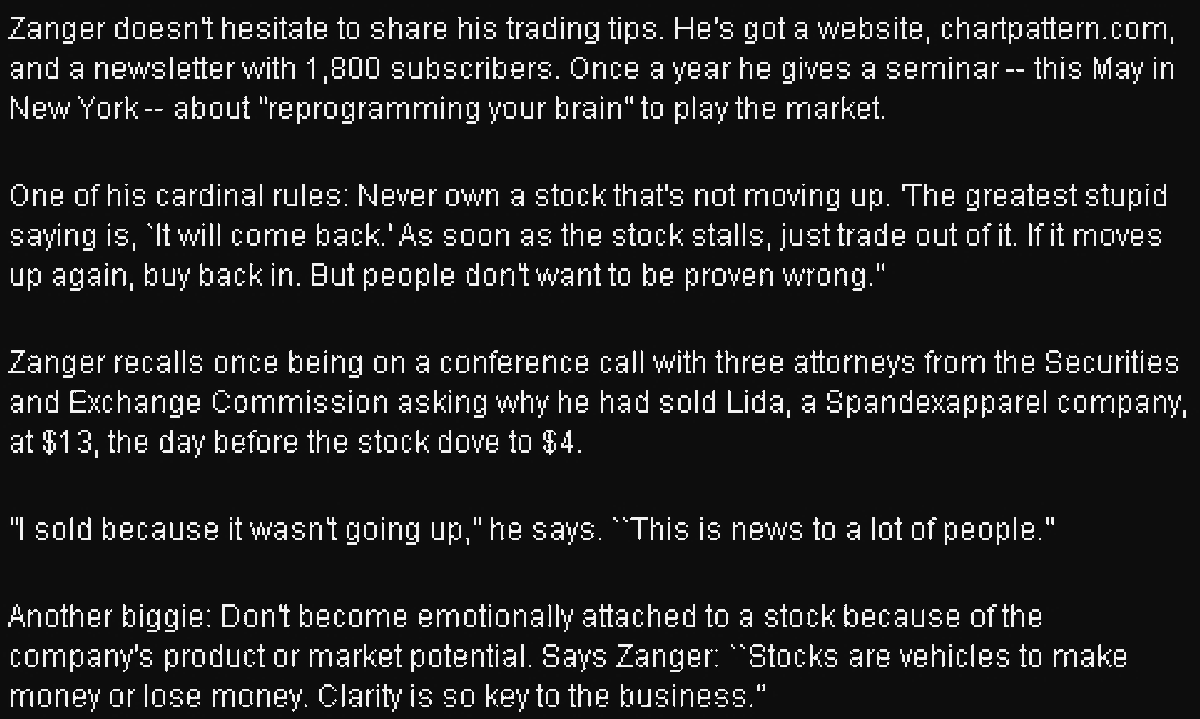
“Never own a stock that’s not moving up.” “As soon as the stock stalls, just trade out of it. If it moves up again, buy back in.” “Stocks are vehicles to make money or lose money. Clarity is so key to the business.” All Dan Zanger quotes from a 2006 interview with the Miami Herald. Also contains a story I haven’t seen anywhere else: Dan was asked by SEC attorneys why he’d sold Lida at $13 the day before the stock gapped down to $4. “I sold because it wasn’t going up. This is news to a lot of people.”
Kyna Kosling tweet media
English
4
25
264
15.8K
Privi retweetledi
Lone
Lone@lonextrades·
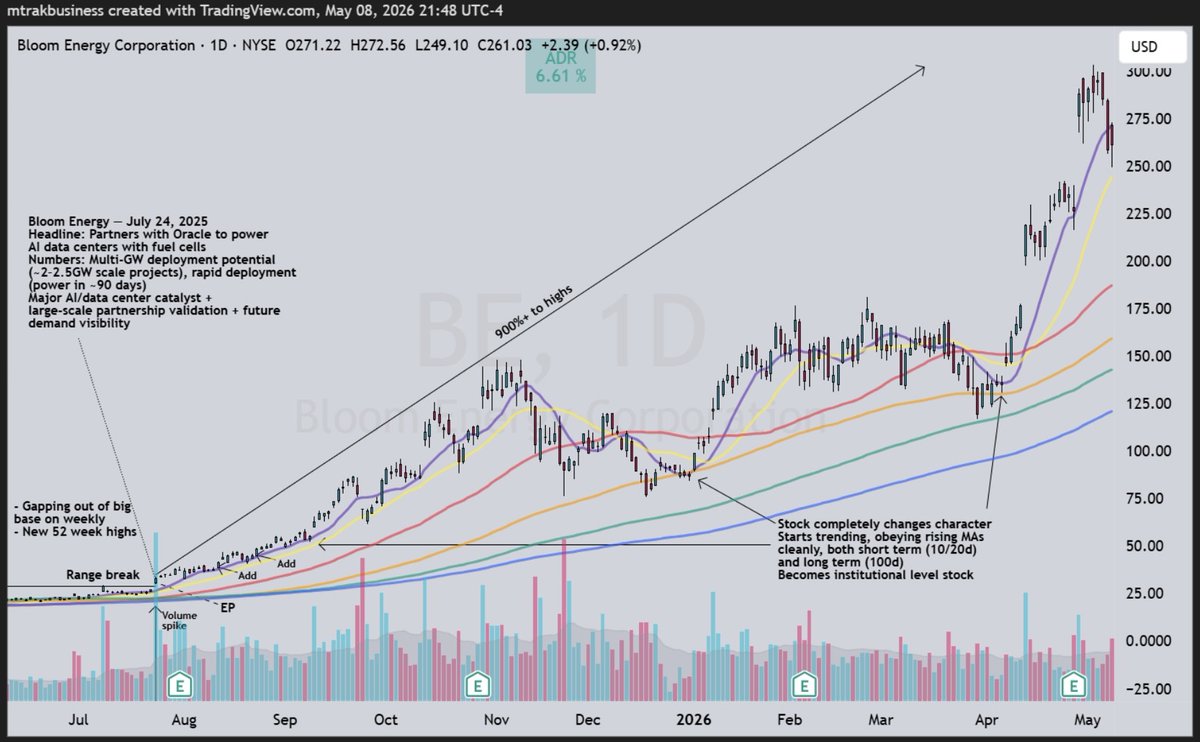
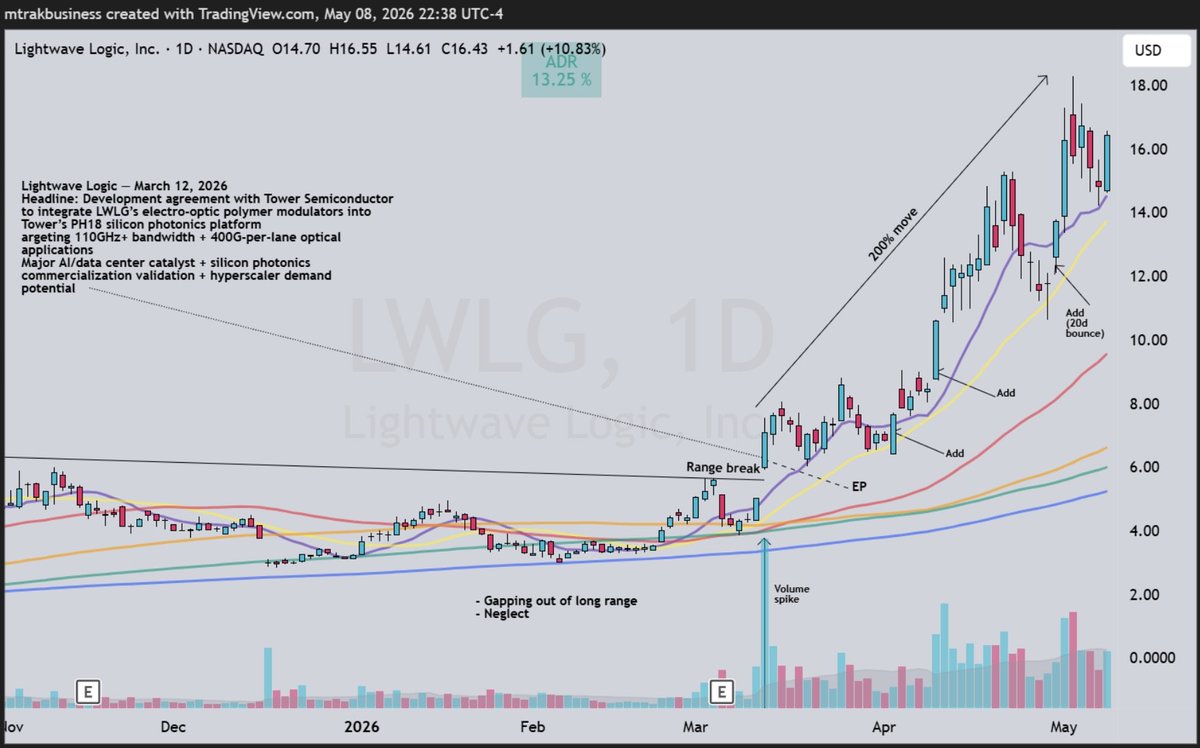
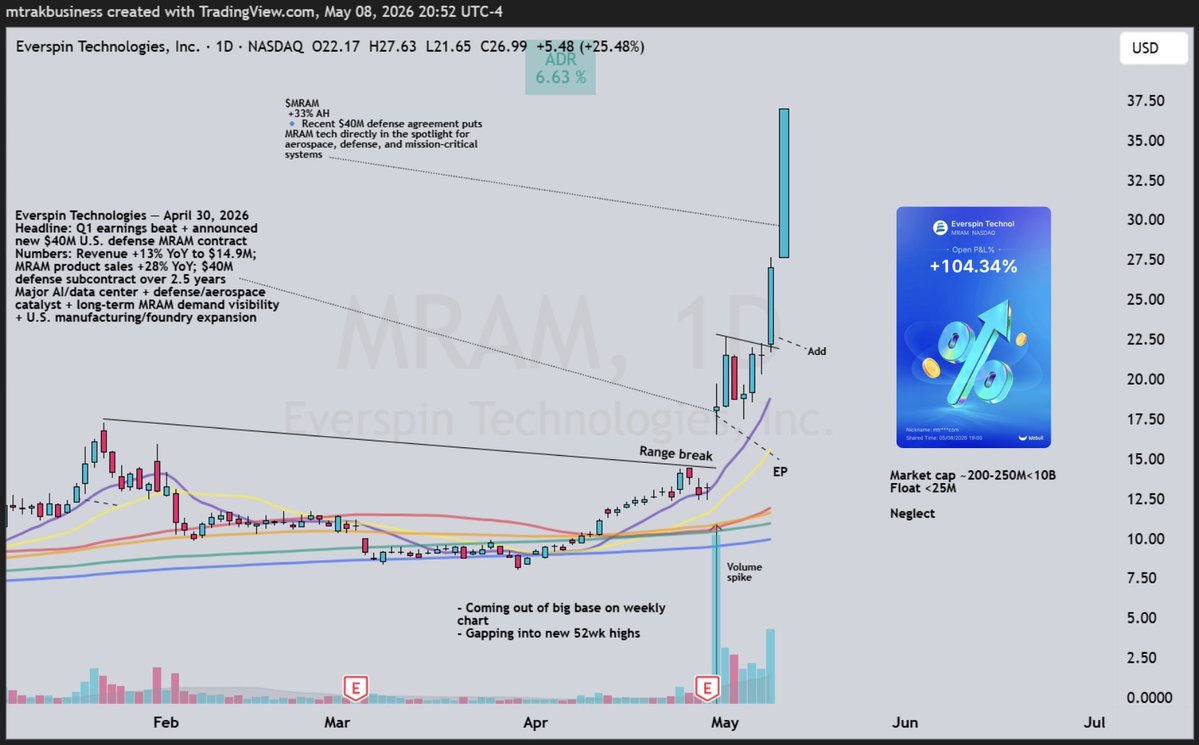
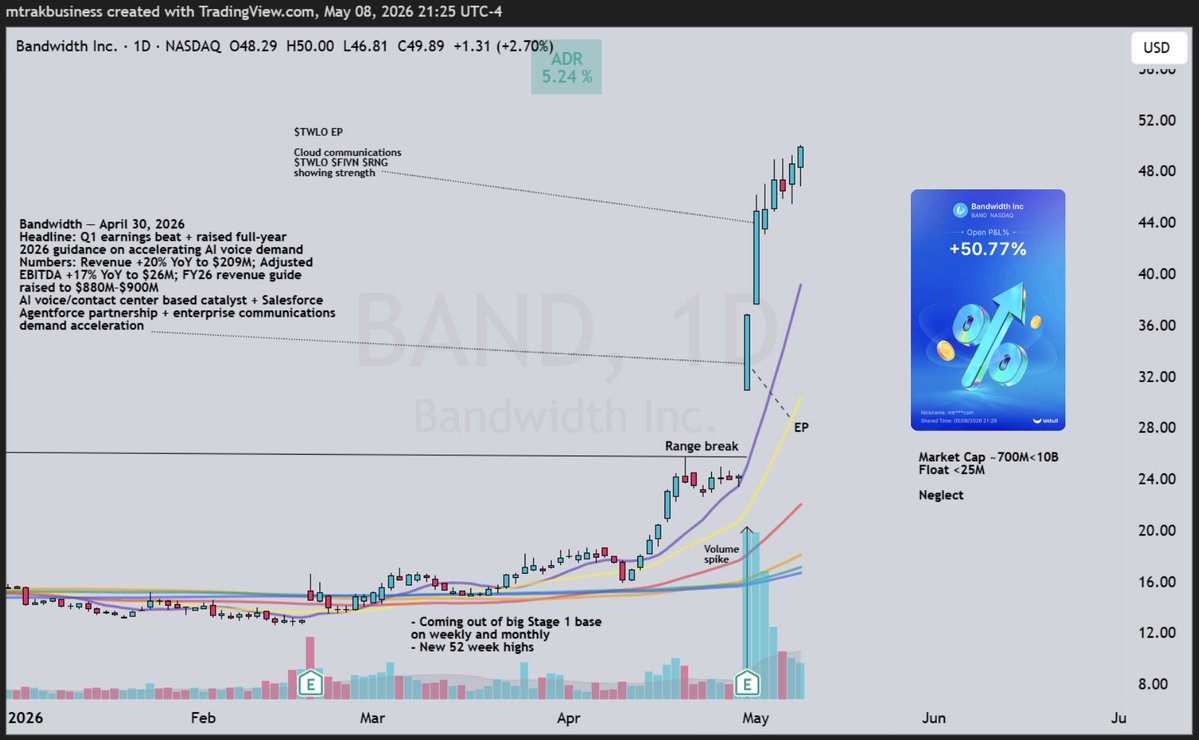
"Episodic Pivots are the start of new uptrends." - Qullamaggie There have been so many great moves and trends off of EPs in the last year. Looking back. $BE 900%. $TTMI 660%. $LWLG 200%. $DELL 90%. Just to name a very small few. Neglected stocks. Gap up on catalysts or earnings. One announcement. And they immediately change character and start to uptrend. Providing plenty of setups and adds along the way. Some stocks like $BE $TTMI completely transform. Becoming institutional grade stocks. Making large outsized moves. Obeying institutional moving averages. Some moves are more short lived. Regardless, still plenty of profits to net from these setups. Really cool to see these play out. How far they go. And trading new ones. Some solid opportunities this season so far. Hoping $MRAM $BAND or $OSS can be next winner for me. $RKLB too. Larger market cap but still looks powerful. Just insane potential for big winners and big moves out of these setups.
Lone tweet mediaLone tweet mediaLone tweet mediaLone tweet media
English
19
78
591
27.7K
Privi retweetledi
TraderLion
TraderLion@TraderLion·
Most traders do not have an edge problem. They have a focus problem. Goverdhan Gajala, a consistently profitable trader who built his entire approach through disciplined self-review, solved it by screenshotting every trade, studying what his winners shared, and cutting his setups down to five or six patterns he knew cold. That narrow playbook, built through backtesting and honest pattern recognition, is what finally unlocked consistent results. You do not need more setups. You need fewer, better ones.
English
0
14
157
17.3K
Privi retweetledi
Jaynit Makwana
Jaynit Makwana@JaynitMakwana·
🚨 BREAKING: A poker champion who won $4 million says you're making decisions wrong... because you confuse good outcomes with good decisions. Annie Duke played against the best in the world for 20 years. Then she became a decision-making consultant for Fortune 500 CEOs, NFL teams, and hedge funds. Her insight is brutal... most people judge decisions by how they turned out. But outcomes involve luck. And luck teaches you nothing. The question isn't "did it work out?" The question is "was it a good bet?" I turned Annie Duke's poker-tested frameworks into 10 Claude prompts. You describe any decision... past, present, or future... and it runs her system to separate skill from luck and show you where your thinking broke. Here are all 10:
Jaynit Makwana tweet media
English
45
154
1.4K
307.7K
Privi retweetledi
Atal
Atal@Atalburhani·
There's a moment in trading that changes everything. You don't go looking for it. You just see it one day and you can never go back. For me it was losing trades where I did everything right. Not sloppy trades. Not impulsive entries. Not revenge trades I could blame on my emotions. Clean setups. Perfect structure. Entries I'd take a hundred times over. And they lost. The first few times, I explained it away. Bad luck. Wrong session. Market was weird today. There's always a reason if you look hard enough. But it kept happening. Perfect setup. Loss. Perfect setup. Loss. Not every time. But enough times that the pattern became impossible to ignore. I did everything right and it still didn't work. That sentence broke something in me. Because my entire trading identity was built on the belief that if I just got good enough at reading the charts, I could control the outcome. That skill determined results. That a perfect entry deserved a win. It doesn't. It never did. Winning and losing on any individual trade have nothing to do with skill. A perfect setup can lose. A garbage entry can win. The outcome of the next trade is genuinely independent of how good your analysis was. You can do everything right and still lose. You can do everything wrong and still win. Once I saw that, I couldn't unsee it. And something unexpected happened. I stopped trying to be right. Not gradually. Not as a decision I made and had to discipline myself into. The need just dissolved. Because what's the point of trying to be right about something that was never knowable in the first place? I stopped entering trades expecting a win. I stopped feeling betrayed when a good setup lost. I stopped needing the market to validate my analysis. Because my analysis was never meant to predict the outcome. It was meant to filter for setups where the math is in my favour over a hundred trades. Not this one. A hundred. That shift didn't make me a better analyst. It made me a better trader. Because I finally stopped fighting the one truth that the market was trying to show me from day one: You were never in control of the outcome. You were only ever in control of the decision to show up and execute. Everything after that was always out of your hands. The traders who see this stop chasing. They stop forcing. They stop grieving every loss and celebrating every win. They just trade. Quietly. Consistently. Without needing permission from the P&L to feel okay about themselves. That's not a technique. That's not a mindset hack. It's something you see once and carry with you forever.
English
6
18
129
5K
Privi retweetledi
iain
iain@ohiain·
The 9/21EMA crossback continues to be one of my favorite areas for momentum returning to a leader. You just needed to recognize the character change and catch a piece of the trend. +50% on the underlying in 12 trading sessions, right off the 9/21EMA crossback. Chart: $MU.
iain tweet media
iain@ohiain

Tried $MU yesterday off 443 +9EMA, took nice trims this morning, then got stopped at b/e midday before price reversed at my average, which is part of the game. What stands out to me is that $SPY is closing red while $MU is closing green and printing a very tight inside day, which is exactly the type of relative strength I pay attention to. If buyers show up, watch those prior highs tomorrow!

English
12
33
330
46K
Privi retweetledi
Julian Komar 🚨 Market Update Premium
For long-term #trading success you need to … 1) Put your ego aside and follow a process 2) Accept small losses as business costs 3) Trade a system with a mathematically edge 4) Avoid overtrading in size and frequency 5) Work on your mindset every day 6) Become a specialist in one trading approach 7) Isolate yourself from other traders and news 8) Always think from a risk view - not from a profit view 9) Never stop learning 10) Reward yourself from time to time to make virtual money real
English
4
11
102
4.5K
Privi retweetledi
True market Leader
True market Leader@TmarketL·
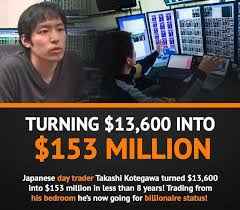
Takashi Kotegawa—a famously disciplined Japanese day trader. His story (turning a small account into massive wealth) gets exaggerated online, but the underlying principles are very real and worth studying. Here are 10 grounded lessons you can take from his approach:
True market Leader tweet media
English
5
50
223
25.9K
Privi retweetledi
iain
iain@ohiain·
I went back and did some backtesting on strong themes + prior leadership around entries near the EMAs. Specifically, when price is pulling back constructively, sellers are drying up, and the structure is still intact. I found that this consistently produces far better risk/reward than chasing late breakouts after recent strength. You’re entering where risk is defined, not where emotion is highest. Here are just a few things that stood out: - Tighter stops (LOD/pivot breaks) - Faster feedback (you’re right or wrong quickly) - Less fakeouts and less stress - Ability to size slightly larger due to tight risk - Higher R:R vs chasing extended moves Breakouts still work (dependant ont he environment)…but the best ones usually come after consolidation or a reset phase, not when a stock is already extended and obvious to everyone. You don’t need to chase strength to make money. The asymmetry is found in the most uncomfortable places...+ less stress, tighter entries, and a simple process I can repeat over and over again!
English
11
15
148
8.2K
Privi retweetledi
Market Rebellion
Market Rebellion@RebellioMarket·
3 Common Mistakes New Traders Make 1️⃣ Chasing Breakouts: Buying 2%+ above the base or consolidation pivot. 2️⃣ Ignoring Market Leaders: Failing to focus on true leaders —often higher-priced, high-quality stocks with institutional interest. 3️⃣ Overtrading in Noise: Forcing trades when the market is outside the boundaries of their system, strategy, or edge.
English
0
4
17
2.6K