loading… retweetledi
loading…
79 posts

loading… retweetledi

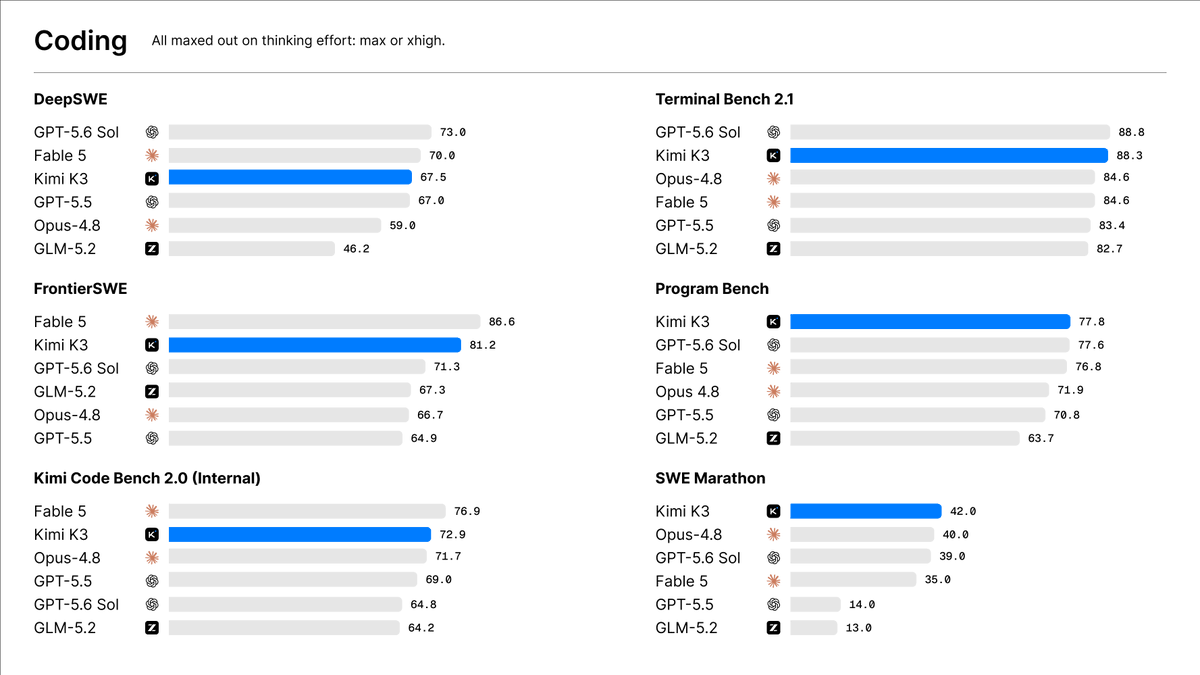
Introducing Kimi K3: Open Frontier Intelligence
🔹 2.8 Trillion Parameters, 1 Million Context, Native Multimodal
🔹 Kimi Delta Attention enables up to 6.3x faster decoding in million-token contexts
🔹 Attention Residuals deliver ~25% higher training efficiency at <2% additional cost
🔹 Built for long-horizon agentic coding and self-evolving workflows
Kimi K3 is now live on on Kimi.com, Kimi Work, Kimi Code, and the Kimi API.
Open Weights by July 27, 2026.
🔗 API: platform.kimi.ai
🔗 Tech blog: kimi.com/blog/kimi-k3


English
loading… retweetledi

Just launched a new website where I’m sharing all the AI agent-specific components I build as ready-to-use code snippets. 12 are already available.
👉 aicss.dev
Still in beta, and a lot is WIP, but I’ll be adding a lot more over the next few weeks to build out a solid free library.
Want to contribute? Feel free to DM me 🫡
English
loading… retweetledi

New skill: /find-animation-opportunities
Search your UI for places that would genuinely benefit from motion, while also telling you what not to animate.
github.com/emilkowalski/s…
English

@danilocoding That tracks well with what I’ve seen playing out. At the end of the day the agencies are collections of individuals all competing with each other and with differing methodologies. What works for one agency might not for another (based on tech stack and approach)
English

@inloadingstate Real estate is highly fragmented, each operator needs a specific tool, not something generic. It helps with quality and data privacy
Everyone says it's about AI but I beg to differ: the value is in where and how you implement the system
English
loading… retweetledi

Your UI is silent.
That's a choice. 10 synthesised interaction sounds, built live with Web Audio. No files. ~2kb. Zero deps.
One attribute per element. That's it.
cuelume-site.pages.dev
English
loading… retweetledi

introducing dither-kit
a library of gorgeous dithered charts built from the ground up,
no dependencies, they're built on top of a tiny <canvas> engine
install it today at tripwire.sh/dither-kit
English

@danilocoding it’s telling that harness engineering has picked up as much traction as it has. it’s not about slapping the latest model onto the problem but mapping the logic before the context gets to the AI
English

@inloadingstate There are too many people adventuring in the automation space. they don't know how to fulfil and try slapping AI into everything
English
loading… retweetledi

I've built a system for real estate investors that finds below-market deals, saves 52hr/week and doesn't need AI.
I built this 2.5 years ago, before everyone was shoving AI down your throat. As an internal product for a property investment company in South Florida.
First, I found the workflow that used to take them 40h/week to run. They had to sit on Zillow, analyzing 1,000s of properties to find deals. Hunting for the ones priced below market.
Then we pulled their entire market into one place, instead of going house by house, they can now scan every listing at once and highlight every opportunity in seconds.
Then there was sending offers, the kind of work that takes another 12h/week or you hire a VA for, now it runs on autopilot. They just pick the homes and click “send”.
Now you might be asking, why didn’t you add AI?
The honest answer is we didn't have to.
See, everyone’s chasing keywords: "AI-first”, “agentic” but aside from stroking your ego and making you feel innovative. That stuff doesn’t always move the money.
My approach with clients is built around their no. 1 bottleneck.
And here’s a $100k/mo app idea I don’t care if you steal:
Sure, you could add an AI layer that looks at the home photos, pulls up info on the owner, highlights red flags, and even makes the call for you.
It’s a cool feature that feels like magic. But it wasn’t their bottleneck.
And if it ever became one, we could always add it on later, the foundation was built to handle it.
So sit with this for a second.
While everyone races to automate with AI, most people aren't actually solving the problems they need to solve. They're solving the ones that sound impressive.
The moment you understand this, you start pulling ahead of everyone else.
English
loading… retweetledi

After 40+ forward deployed engineering (FDE) engagements, we learned the hardest part of building AI agents and tools is Context Extraction.
FDE sounds like an engineering role. It's actually 3 jobs in one:
• Consulting - where in the business to build
• Product - what to build
• Engineering - how to build
Coding is the easy part now thanks to Claude Code, @cursor_ai, and other coding agents.
The hard part is everything before the code.
Extracting context from clients who have it scattered across people and tools. And creating context when it doesn't exist at all.
Then using that context to figure out what to build, and work with AI on architecture and development plans.
FDEs turn the chaos and unknowns within every company into shipped AI applications.
That's why every major AI company is building an FDE arm. OpenAI and Anthropic recently raised $5.5B for theirs. Cursor and others have several open FDE job listings.
But their returns won't come from service revenue. They'll come from tokens and subscriptions. Service revenue doesn't matter to VCs, only tech revenue does because it's more scalable.
Here's how FDEs make coding agent companies trillion dollar companies:
Cursor and Claude Code are currently focused primarily on the professional engineer market.
But the total addressable market (TAM) for coding agents is infinite because almost every job benefits from code. It just used to be too expensive.
FDEs are the bridge from the technical market to the non-technical market, which is far larger.
Every coding agent and LLM company will eventually automate and productize their FDE teams though.
So we decided to replace ourselves before someone else does:
• Voice agents run discovery interviews to find problems, map workflows, and extract expertise to train agents on
• Cloud agents build prototypes, make demo videos, and collect feedback
• Consultant sub-agent prioritizes AI use cases by business impact vs engineering effort
The next most valuable problem for coding agent and LLM companies to solve is figuring out where to build, what to build, and how to build.
Context is the solution. So if you can figure out how to extract and create context, you can make a ton of money.
Coding agents can take it from there.
English
loading… retweetledi

Rork is the easiest way to use Claude Code with Opus 4.5 to build real mobile apps, publish to App Store in 3 clicks and start making revenue
Reply to get a free 25$ subscription.
Ends tomorrow!
Rork@rork
Introducing Rork 1.5 • Easy app monetization with RevenueCat • Built-in analytics (no Firebase needed) • The smartest agent based on Opus 4.5 & Claude Code • Rork Stars community where successful mobile app founders like @zach_yadegari (Cal AI), @aslater (QUITTR), @georgeLampro20 will help you grow your app & over 100 small improvements 👇
English
loading… retweetledi

An open-source collection of smooth animated icons for your projects.
→ lucide-animated.com by @pqoqubbw
English