

Inside Computing
2.4K posts

Inside Computing
@insidecomput
Inside Computing. Understanding the technology behind modern computing. Linux, C, CPUs, systems, memory, kernels, RISC-V, AI, and FPGA
La Canada Flintridge, CA Katılım Haziran 2018
13.6K Takip Edilen12.4K Takipçiler


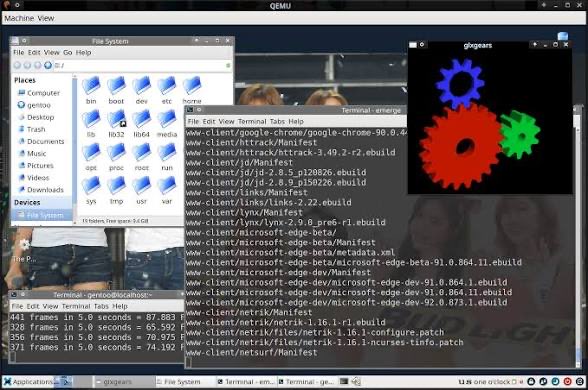
What is QEMU?
Developed originally by Fabrice Bellard in 2003, QEMU is a generic, open-source machine emulator and virtualizer.
While common virtualization software like VirtualBox or VMware only lets you run virtual machines that match your computer’s hardware (e.g., running x86 Windows on an x86 Linux PC), QEMU can cross the ISA boundary.
It allows your x86_64 Intel/AMD processor (or ARM-based Apple Silicon Mac) to mimic a 64-bit RISC-V CPU so perfectly that the Linux kernel cannot tell the difference.
English
Looking to dive into RISC-V without spending a dime on hardware?
QEMU is your ultimate playground. You can emulate a full 64-bit RISC-V Linux system right on your current machine in just minutes.
Why this combo is a game-changer for devs:
🔹 Zero-cost development: Test architectures before buying silicon.
🔹 Perfect for kernel hacking: Debug and trace everything with ease.
🔹 CI/CD friendly: Spin up RISC-V environments in your build pipelines seamlessly.
Stop waiting for hardware delivery. The open-source instruction set architecture (ISA) future is already running on your machine.
#RISCV #QEMU #OpenSource #EmbeddedSystems #Linux #TechCommunity

English
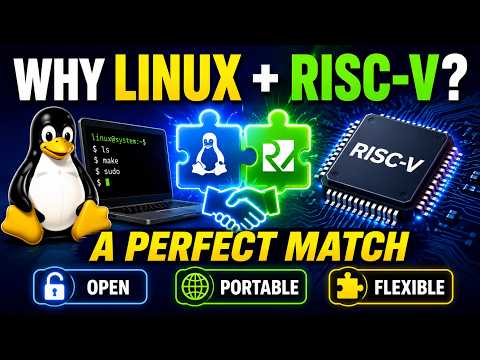
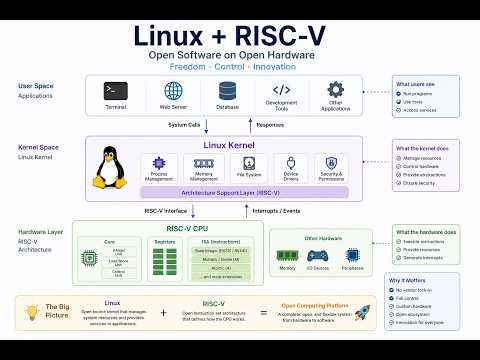
Linux opened the software world. RISC-V is opening the interface between software and the processor.
youtu.be/PL0DCzKFGJ8
So why are Linux and RISC-V considered a perfect match?
How tools such as GCC, LLVM, QEMU, OpenSBI, and U-Boot help build a complete RISC-V Linux ecosystem.
#Linux #RISCV #OpenSource #ComputerArchitecture
YouTube


English

Try Grok Build
x.ai/cli
X Freeze@XFreeze
Just press Ctrl + Space in Grok Build and start talking Grok's Speech-to-Text is incredibly accurate, transcribing your prompts in real time as you speak It makes interacting with your coding agents feel completely natural Instead of pausing to type every instruction, you can simply think out loud while Grok keeps up with your ideas Once you start using voice in Grok Build, it's surprisingly hard to go back to typing everything
English
Grok Build improves almost every day
Tech Dev Notes@techdevnotes
Grok Build now has /timeline command to Toggle the timeline sidebar
English
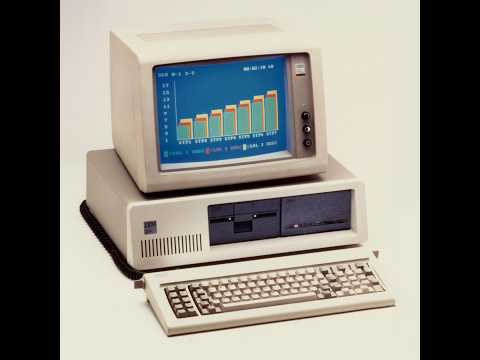
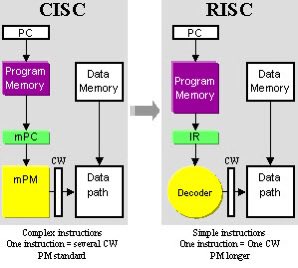
The biggest misconception in computer architecture:
youtu.be/HN1yRMSFEv0?si…
x86 CPUs don’t actually execute x86 instructions directly.
They decode them into internal micro-operations first.
Today’s Intel and AMD processors look far more RISC-like internally than most people realize.
The CISC vs RISC debate changed forever.
YouTube

English
if you want us to sell your embedded products and hardware, please contact us

English
The momentum is unstoppable.
With the RISE Project (RISC-V Software Ecosystem) pumping commercial backing into the software layer, the gap is closing fast. We’re moving from "hobbyist toys" to edge, IoT, and eventually server-grade deployments.
We are watching the birth of a third major computing ecosystem in real-time.
English
The Reality Check: What’s still holding us back?
1. Extension "Fragmentation": Because RISC-V is modular, different vendors pick different extensions. Writing software that runs optimally across all chips is a moving target.
2. The GPU Bottleneck: The CPUs are open, but many budget boards still bundle closed-source, proprietary GPU IPs. Fully open graphics is still a struggle.
3. Software JIT Optimization: Runtimes like V8 (JS), JVM, Rust, and Go are compiled, but still lack the deep micro-architectural optimizations of ARM/x86.
English
Linux + RISC-V is a match made in heaven: A completely open-source OS running on an open-standard ISA.
youtu.be/IqLOPZWOOvw?si…
But for years, "Linux on RISC-V" felt like an academic toy or a painful hobby.
Well, things have changed. We are officially in the era of real, usable systems.
A quick thread on how we got here & what’s still holding us back. 👇
YouTube
English
How it’s going: Real silicon is here & cheap.
Today, the barrier to entry has plummeted:
Affordable SBCs: StarFive VisionFive 2, Milk-V, and Lichee Pi have brought 64-bit Linux boards down to the $50–$100 range.
Vector Extensions (RVV 1.0): Mass-produced chips now feature vector extensions, boosting crypto, media, and local AI.
Distros: Debian, Fedora, Ubuntu, and Arch now have active, native ports.
English
How it started: "Just get it to boot."
In 2018, running Linux on RISC-V meant:
Relying heavily on QEMU software emulation.
Buying a $999 SiFive HiFive Unleashed dev board (if you had the cash).
Painfully slow upstreaming to the main Linux kernel.
It was a triumph of patience, not performance.
English
Step 3: Getting Processor Time ⏱️
The OS scheduler sees the new ls process waiting in the queue.
It allocates a tiny sliver of CPU time (a timeslice) and assigns a CPU core to begin executing the machine instructions of the ls program.
English
Step 2: The Cloning Process (fork & execve) 🧬
The shell can't run ls inside itself, or a crash would kill your terminal.
Instead, it calls fork() to clone itself into a child process, which then calls execve() to load the ls binary into memory.
English
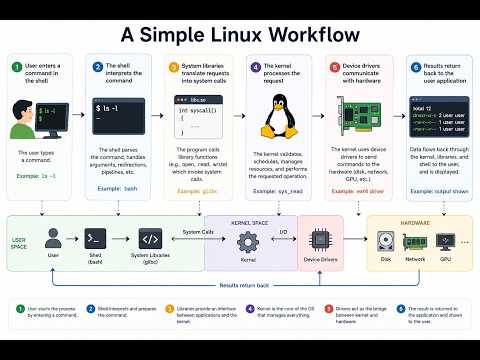
We type ls dozens of times a day. It feels instant.
youtu.be/9PkIYK9tdAI?si…
But under the hood, your OS is conducting a massive, highly coordinated symphony.
In just a few milliseconds, a simple command travels through the entire Linux stack.
Here is the epic journey of ls 🧵👇
YouTube
English