Alex Cutbill

1.3K posts

Alex Cutbill

Alex Cutbill

@intersectarian

Maths Education and Assessment Specialist interested in Edtech, History of Maths, and Linguistics. He/him

Slough, England Katılım Ağustos 2015
202 Takip Edilen297 Takipçiler
Alex Cutbill retweetledi
MEI
MEI@MEIMaths·
From September 2026, The MAT will no longer take place. The University of Oxford will use the TMUA. More info: buff.ly/K4bVGPx
English
0
1
2
321
Alex Cutbill
Alex Cutbill@intersectarian·
@robert_lyman Pre-covid, the choir would go for a pint or two after evensong. I haven't been very often since it started closing at 6pm on a Sunday. But I've had a good time on the odd occasion I've been able to visit and sample the excellent selection of ales on draught!
English
0
0
0
80
Robert Lyman 🇺🇦
Robert Lyman 🇺🇦@robert_lyman·
In my spare time I run a village pub. It’s the centre of a small Berkshire village, and has been in use as a pub since 1723 (we’ve owned the building - built c. 1400 - since 1608). We’ve just run the numbers. It’s not looking good. Net profit is down a third of pre-covid levels. We had seen some small improvement, but starting from a pretty desperate position. Everything now seems to be against us. We were recovering after COVID, but the latest government taxes are like a torpedo under the water line. We’re facing impossible rises in staff costs and other taxes. The latest survey by the British Institute of Innkeeping suggests only 1 in 3 Hospitality business are currently profitable. This will drop to 1 in 10 after the budget rises in April. The result is inevitable. Thank you @RachelReevesMP and @10DowningStreet. Don’t ever start pretending you know anything about businesses like ours, or even care.
Robert Lyman 🇺🇦 tweet media
English
716
2.9K
12.6K
578.8K
Alex Cutbill
Alex Cutbill@intersectarian·
@MathsNot Thanks! Yeah the jeopardy aspect is definitely an issue, but I think less than in PISA where you're also trying to compare between countries (cultures) and not just between years.
English
0
0
0
19
Graham Cumming
Graham Cumming@MathsNot·
@intersectarian It’s a small sample and I’m never convinced by tests where there’s no jeopardy for the students (do they even find out their results?). Mind you, I feel the same about PISA tests; not much transparency around them, either nfer.ac.uk/for-schools/pa…
English
1
0
1
34
Graham Cumming
Graham Cumming@MathsNot·
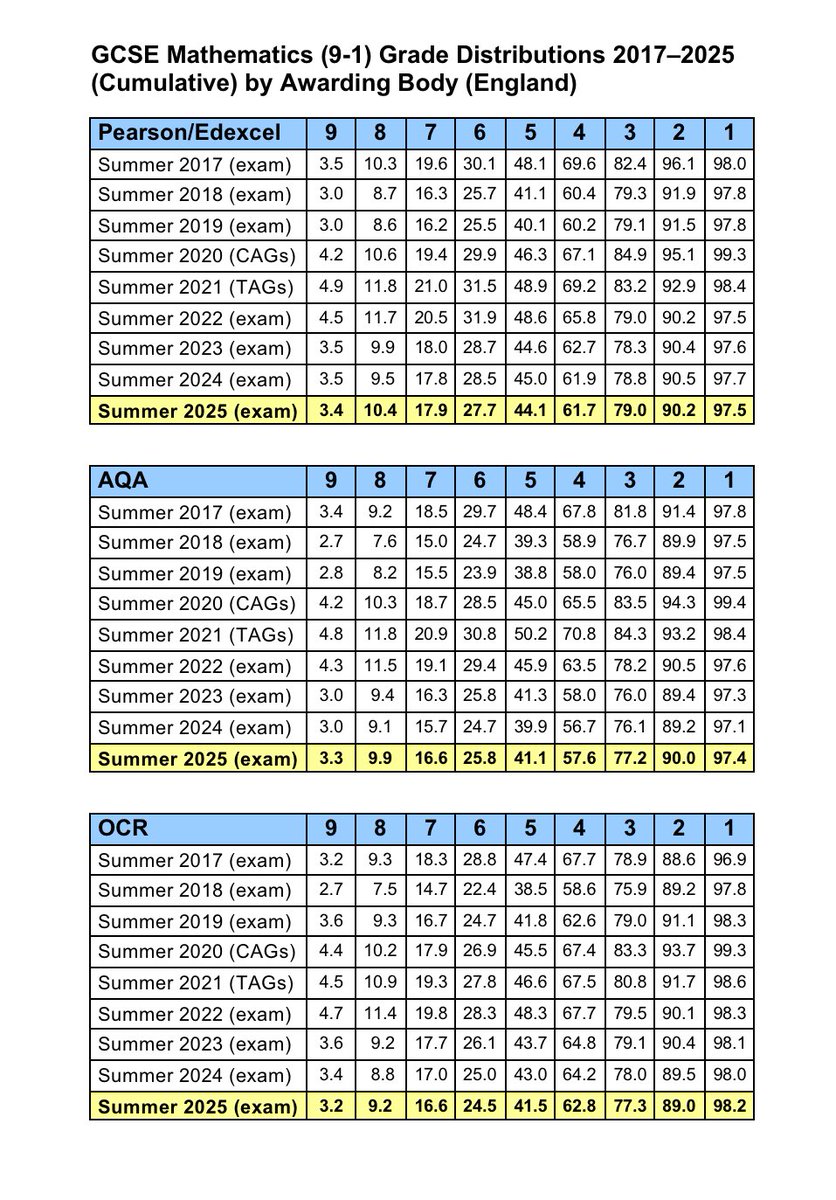
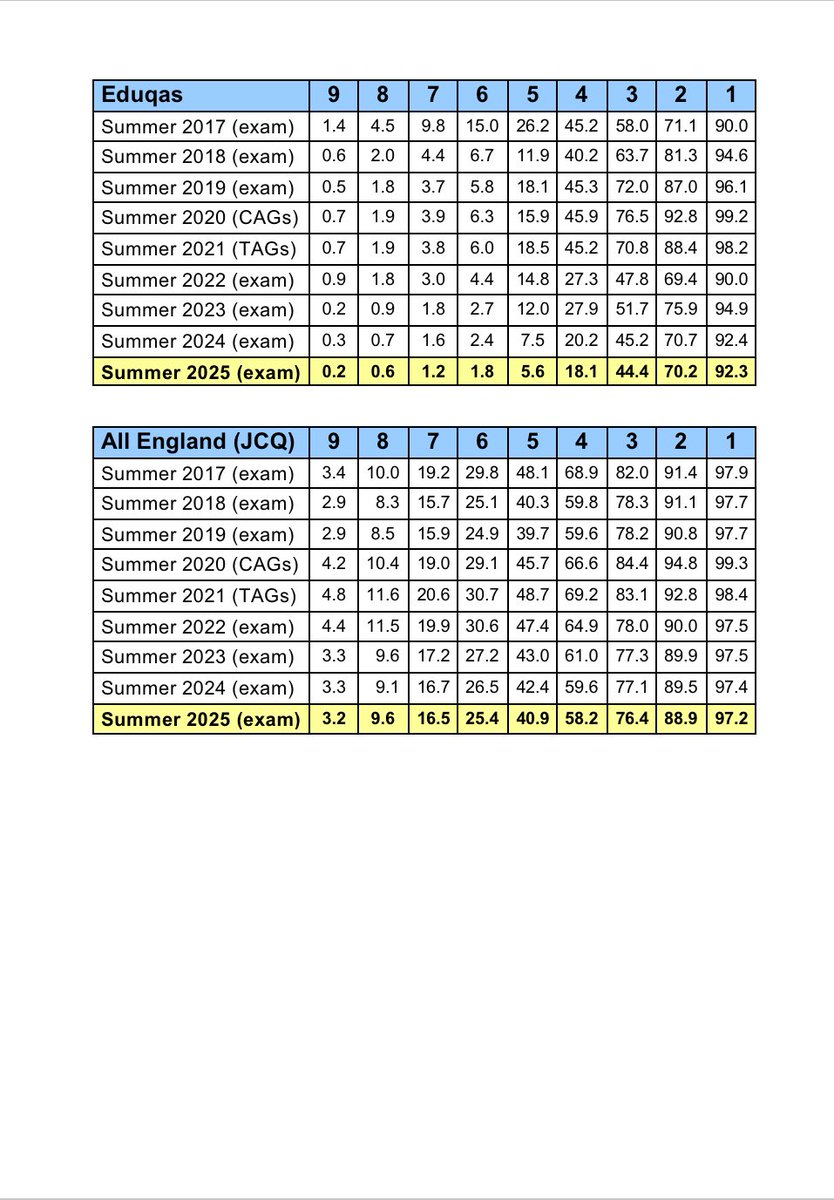
GCSE Mathematics grade distributions 2017-2025 for Pearson/Edexcel, AQA, OCR and Eduqas
Graham Cumming tweet mediaGraham Cumming tweet media
Català
4
4
18
3.9K
Alex Cutbill
Alex Cutbill@intersectarian·
@MathsNot Could you elaborate about the NRT efficacy opinions? I'm speaking at completemaths.com/community/math… on Sat, including concerns about the comparable outcomes system as implemented, including e.g. transparency about how NRT would be used. Any perspectives you could share would be great!
English
1
0
0
52
Graham Cumming
Graham Cumming@MathsNot·
@KerryDunton @mrenglishmaths The shape of the distribution might change though. Ofqual has introduced the National Regerence Test to help determine whether students get better or worse each year; opinions on its efficacy differ
English
1
0
1
108
Alex Cutbill
Alex Cutbill@intersectarian·
🤠* The rumours are true! I'll be at #MathsConf39 talking about exam standards. Do come along with your questions and thoughts. I promise it will be more interesting than it sounds! *hat not included
Complete Maths@LaSalleEd

📣 Another #MathsConf39 workshop announcement! ✨ The Maths Assessment System in England: How Standards Are Set and Maintained with Alex Cutbill (@intersectarian) Who decides how many pupils “meet the expected standard” at the end of KS2, or achieve grade 4 at GCSE? This session explores the mechanisms behind standard-setting, busts common myths, and critically examines whether the current system meets its aims. We’ll also consider what might be possible in the future for assessment in mathematics and how changes could impact teaching and learning. ✨ What you’ll take away: ✅ A clear understanding of how standards are set and maintained in KS2 and GCSE maths ✅ Insight into the myths and realities of assessment outcomes ✅ Discussion on the effectiveness of current systems ✅ Perspectives on possible future directions for assessment in maths Leave with a deeper understanding of maths assessment and its implications for schools, teachers, and learners. Learn more and book your tickets: completemaths.com/community/math…

English
0
0
2
97
Alex Cutbill
Alex Cutbill@intersectarian·
@MathsNot Strong evidence that if you want to get all A stars then you're best off doing 5 subjects 😉
English
0
0
3
186
Alex Cutbill
Alex Cutbill@intersectarian·
@PaulBushen @adamboxer1 It's a very complicated system, some of that is necessary but I worry that the system is more opaque than it needs to be.
English
1
0
2
54
Adam Boxer
Adam Boxer@adamboxer1·
Education people: a third of students have to fail every year Ofqual: no, thats not true. If standards improve year on year, grade allocations will change Eduction people: LIES
English
5
4
44
34.2K
Alex Cutbill
Alex Cutbill@intersectarian·
@noookophile @robeastaway I think maintaining standards is the fairest thing for students, given the way(s) that results are used. As for precision/'wrong' grades, to make things more precise there would need to be longer/more exams (and/or computer adaptive tests). So it's a trade-off.
English
1
0
0
36
Dennis Sherwood
Dennis Sherwood@noookophile·
@intersectarian @robeastaway To illuminate the opacity. I think much of what happens is arbitrary, and 'explained' by "maintaining standards". How can this be done with such precision? Why does this take priority over fairness? And given that one grade in every four is wrong anyway, what's the point?
English
1
0
0
26
Rob Eastaway
Rob Eastaway@robeastaway·
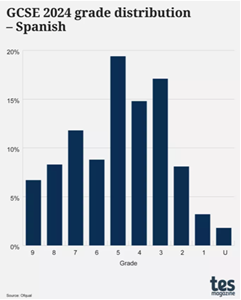
Here's a statistical mystery to solve. Exams marks typically follow a smooth bell curve, so you'd expect grades to do the same. But in Spanish GCSE they don't, they always dip at 4 (which some call the "pass" grade) and spike up at 3 (which some call "fail"). Explain.
Rob Eastaway tweet media
English
5
0
4
1.2K
Alex Cutbill
Alex Cutbill@intersectarian·
@noookophile @robeastaway I don't really understand your point here. Changing the grade boundary will change the grade distribution in any regime. Ofqual's goal isn't to enforce a normal distribution (for, I think, good reasons) but to maintain standards.
English
1
0
0
51
Dennis Sherwood
Dennis Sherwood@noookophile·
@intersectarian @robeastaway In general, yes; but in particular, not necessarily - the grade distribution is sensitive to very small changes in the grade boundary - for example this simulation of 2024 GCSE English, where the 3:4 boundary is changed by just one percentage point:
Dennis Sherwood tweet media
English
1
0
0
37
Alex Cutbill
Alex Cutbill@intersectarian·
@noookophile @robeastaway Examiners could have felt that only 69.9% of students met the old Grade C standard in 2017. I can't remember if KS2 data was being used as part of the statistical evidence for maintaining standards at that point, but it certainly is now.
English
0
0
0
24
Alex Cutbill
Alex Cutbill@intersectarian·
@noookophile @robeastaway I don't know the details in this case, but – as GCSEs aren't norm-referenced – maintaining standards from 2016 to 2017 wouldn't necessarily mean the same percentage of students getting an equivalent grade.
English
1
0
0
22
Alex Cutbill
Alex Cutbill@intersectarian·
@noookophile @robeastaway I think I've answered these points in more detail elsewhere. Let me know if not. But the main point is that Ofqual's goal is to maintain standards rather than enforce 'normality'.
English
0
0
0
24
Dennis Sherwood
Dennis Sherwood@noookophile·
@intersectarian @robeastaway But why is it that grade 3 is higher, and grade 4 lower, in so many cases? Especially when a very small change in the grade boundary would restore "normality". Fundamentally, what is the rationale that determines that a boundary is [here] rather than [there]?
English
1
0
0
21
Alex Cutbill
Alex Cutbill@intersectarian·
@noookophile @robeastaway As the 1/2 and 2/3 boundaries were set arithmetically, it could be that lots of students happened to get a Grade 3 in Spanish in the first year. (I haven't looked for the data - you could if you're interested.) Or it could be that the cohort taking Spanish has changed over time.
English
0
0
0
24
Alex Cutbill
Alex Cutbill@intersectarian·
@robeastaway But I'm only an expert on *maths* assessment, so I might be wrong about the state of play for e.g. Spanish
English
0
0
0
10
Alex Cutbill
Alex Cutbill@intersectarian·
@robeastaway AFAIK that's right for Spanish, though other languages had some tweaks: gov.uk/government/new… The speaking exam might affect things too. I believe it no longer contributes to a student's English grade because of reliability concerns.
English
1
0
0
25
Alex Cutbill
Alex Cutbill@intersectarian·
@robeastaway This leaves open the question about how the standard for each grade was set in the first place! I hope to find a bit of time to write about that too at some point.
English
1
0
0
32
Alex Cutbill
Alex Cutbill@intersectarian·
@robeastaway Grades are not done on a bell curve but are maintained statistically from one year to the next. The mechanisms behind this are complicated and somewhat opaque. I wrote about a special case (grade 4 at GCSE maths) recently here: linkedin.com/posts/alex-cut…
English
2
0
0
106