Sabitlenmiş Tweet
INTMAX main
1.8K posts

INTMAX main
@intmaxIO
A privacy L2 on Ethereum with a stateless architecture for transfers and payments. Achieving hyper-scaling and privacy at the same time. support:@intmax_support
Ethereum Katılım Eylül 2021
53 Takip Edilen31.2K Takipçiler

Agent payments change what payment infrastructure needs to optimize for.
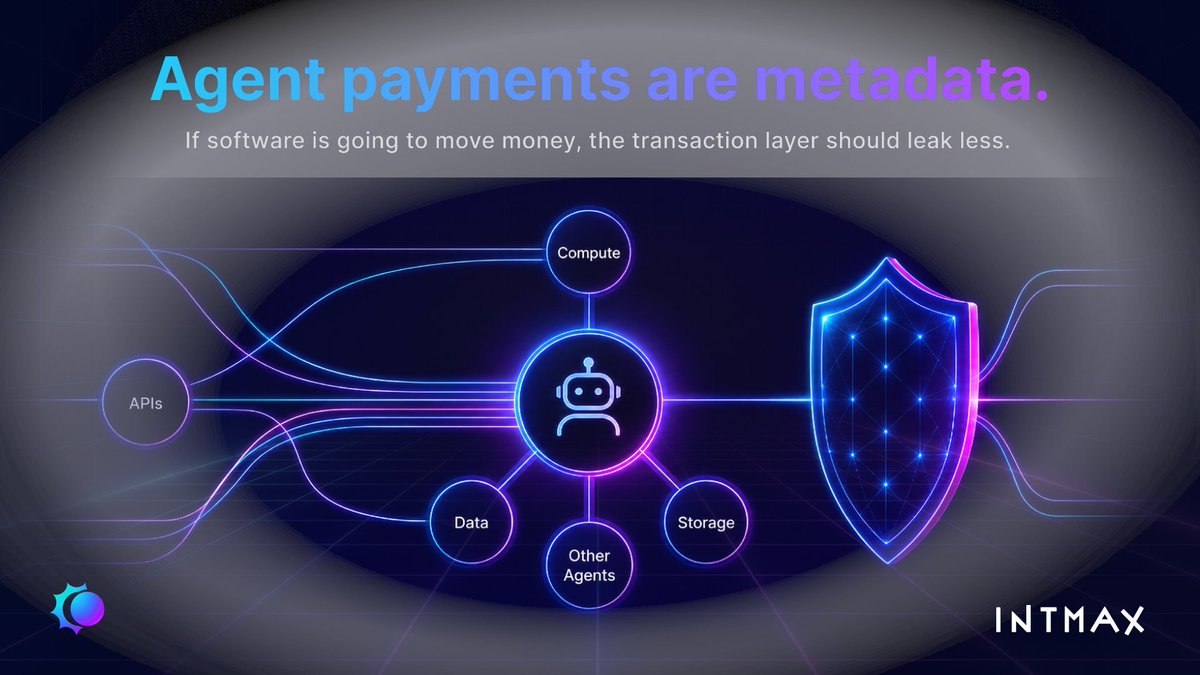
A person might make a few transactions a day. An agent can make hundreds of small payments in the background: API calls, data requests, model access, compute, content unlocks, and payments to other agents.
That is why x402 is an interesting signal. It treats payment less like a checkout flow and more like a native internet action: request a resource, pay, get access.
Once payments become that granular, small inefficiencies get expensive fast. A fee that looks fine on a $100 transfer can break a $0.02 API call. A channel that requires too much pre-positioned liquidity becomes clunky when agents need to pay for many services across many contexts.
There is also the privacy problem. A public payment trail can reveal more than the transfer itself. It can show which tools an agent used, which data it bought, how often it paid, and roughly what kind of task it was running.
For agent micropayments, cheap is not enough. The payment layer also needs privacy and better capital efficiency.
INTMAX3 is being built around multi-party payment channels with confidential balances. Instead of forcing every payment path to depend on isolated liquidity, a channel can support shared capacity across multiple participants.
For agents, that matters. You do not want capital sitting in the perfect place before an agent can pay a few cents for a resource. You want small payments to clear without turning liquidity management into the product.
Privacy matters for the same reason. If agents are paying APIs, services, and other agents all day, those payments become behavioral data. Over time, that data can leak workflows, strategies, and business logic.
INTMAX3 keeps balances confidential inside the channel using encrypted balance ciphertexts, so balance updates can be checked without exposing balances as plaintext. It also adds a post-quantum authentication path verified inside the proof pipeline.
If x402 points to a world where payments become native to HTTP, INTMAX3 is working on the private payment infrastructure that those flows will need underneath.

English

1. Channel update
A new off-chain state is constructed for the channel. In practice, this is where the parties agree on how balances and channel state should change before anything is pushed into the proof system. The key point is that the state transition is prepared off-chain first, instead of exposing the raw payment flow directly on the public chain.
2. Signature/authorization
Once the updated state is formed, it has to be authorized by the channel participants. This is the authentication layer of the flow: the system needs cryptographic proof that the proposed state transition was actually approved by the right parties, rather than injected by an external actor or forged after the fact. In the current framing, this is represented as a post-quantum authorization path.
3. Validity proof
After authorization, that approval is checked inside the validity proof pipeline. This is the important distinction: the system is not just collecting signatures at the application layer and asking users to trust them. The authorization data is pulled into the proof flow itself, so the verifier checks that the state transition satisfies the protocol rules and that the corresponding authorization conditions were met before settlement is accepted.
4. Private payment/settlement
Once the proof pipeline accepts the transition, settlement can move forward without revealing balances in plaintext on the public chain. The result is a payment flow where authorization is enforced, validity is proven, and privacy is preserved through settlement rather than being treated as an afterthought.
The point of the design is not just to add a signature. It is to bind authorization and privacy into the same proof-oriented flow. If private payments are meant to hold a longer security horizon, the authentication model matters just as much as the settlement model.
English

Most privacy models still depend on a shared pool that needs to stay sound forever.
INTMAX works the other way around. Users hold their own balance proofs and transaction history, while the protocol keeps almost nothing on-chain.
This shifts the main soundness risk away from a central pool and onto individual proofs.
English

Imagine the following:
An AI agent pays for compute every hour.
On public rails, that payment is more than a transfer. It tells outside observers which compute provider the agent uses, how often it runs, when activity spikes, and whether usage is growing or slowing down.
Now add storage.
Then APIs.
Then data access.
Then subscriptions.
Then payments to other agents.
After a while, the wallet stops looking like a wallet and starts looking like an operations log.
This is already uncomfortable for humans. A linked wallet can expose where you move funds, who you interact with, how often you transact, and which services you use.
For companies, the leak is larger. Vendor payments, recurring costs, treasury flows, partner relationships, and internal cadence can all show up as transaction metadata.
For agents, the problem gets stranger because the payment trail can reveal how the system behaves.
A transaction graph is not source code. But it can still show dependencies, routines, and changes in activity. That is enough to be useful to competitors, attackers, data brokers, or anyone watching the chain.
This is the part that gets missed in most “AI agents need crypto” takes.
Agents do need financial rails.
But if those rails are public by default, every useful agent becomes easier to study precisely because it is active. More usage means more metadata. More metadata means a clearer picture of what the agent depends on.
So agent payments are not only about UX, stablecoins, or wallet automation.
They are also about metadata leakage.
INTMAX was built for this category of problem.
The goal is not to make agents mysterious. It is to make their financial activity less revealing than an open operations log. If software is going to move money, the transaction layer needs to leak less.

English

Quantum isn’t breaking Ethereum today.
But IBM just put $10B behind quantum computing, and Ethereum is already mapping post-quantum upgrades.
Serious crypto infrastructure has to be built for the threat model that comes next, not only the one we have now.
Reuters@Reuters
IBM to invest $10 billion for large-scale quantum computer by 2029 reut.rs/3PRgmOl reut.rs/3PRgmOl
English

A transfer you make today could be decrypted by a quantum computer that doesn't exist yet.
That's why @NIST spent eight years standardizing post-quantum cryptography. INTMAX3 is designed around those standards with account auth built for that threat model.
English