iorulezz

173 posts

iorulezz banner
iorulezz

iorulezz

@iorulezz

building @deltadotnetwork.

base layer Katılım Mart 2021
850 Takip Edilen219 Takipçiler
iorulezz retweetledi

Ole Hylland Spjeldnæs
Ole Hylland Spjeldnæs@spjoleh·
Smoothing out the boundary between onchain and real-world is this enormous problem that no one is thinking about (except us… and… ripple)
English
0
2
12
1.8K
iorulezz
iorulezz@iorulezz·
@spjoleh Bru barber is someone you develop a personal relationship with. They hold razors on your neck jc
English
1
0
0
68
Ole Hylland Spjeldnæs
Ole Hylland Spjeldnæs@spjoleh·
Are most people able to determine what their hair will look like based on the hairdresser holding up one strand?
English
2
0
3
531
r-r o'leary ⛛ 🕊️
r-r o'leary ⛛ 🕊️@lunar_mining·
Why did DarkFi switch from PoS (proof-of-stake) to PoW (proof-of-work)? It was a major design shift and delayed our release. But it had to happen. Why? Proof-of-stake has some nice features but it is not a good way to start a blockchain. For proof-of-stake to work, the network token must to be distributed to stakers before the blockchain goes live. By the time we released the first version of DarkFi in 2023, we realized: First, nodes must have stake at the genesis (or beginning) of the chain, so there must be some token predistribution. Second, in the proof-of-stake we had implemented, the probability of winning a reward was quasi-proportional to the amount staked. This meant that unless the tokens were distributed over a wide network of people for a long period of time, block production would be centralized. Think about it: if 100 nodes have 100% of the coins in circulation when the blockchain is turned on, those 100 nodes will win the block rewards forever. Therefore, the token predistribution is absolutely critical. How can we do a protracted predistribution to a wide number of nodes, such that our block production is sufficiently decentralized? Can we do it in a permissionless way that doesn't compromise anonymity? Do you see where this is going? The solution to the bootstrap problem of proof-of-stake is proof-of-work itself. Proof-of-work is effectively a decentralized, anonymous, protracted distribution to the believers of the DarkFi project. Mining is anonymous, permissionless and deniable. Anyone can run a node using consumer hardware. We use a mining algorithm called RandomX to make this possible (Monero uses it as well). Since early proof-of-work coins are vulnerable to 51% attacks, we provide merge-mining with Monero to protect the network. We've been working on an implementation and it will be ready soon (TM). Will we switch to proof-of-stake in the future? That depends on you. The community will decide on DarkFi's destiny. But running proof-of-work now means that if a proof-of-stake switch does happen, at least it will be sufficiently decentralized.
r-r o'leary ⛛ 🕊️ tweet media
English
48
43
308
28K
iorulezz
iorulezz@iorulezz·
@knwang So this is like snark-based light client bridging, but possibly more general since you are framing it around events (whereas bridging is usually framed around tokens)
English
1
0
1
87
knwang
knwang@knwang·
in the context of interop: - message passing: push a command from chain A to be executed on chain B - proof pulling: incentivize a proof of something (event or state) happened on chain B to be passed to chain A although to be more precise message passing is actually proof (of a message sent to inbox) pushing
English
1
0
0
60
knwang
knwang@knwang·
(incentivized) proof pulling is the new message passing.
English
6
3
16
1.9K
iorulezz retweetledi
Benji
Benji@0xFunk·
Benji tweet media
ZXX
1
5
54
8.7K
iorulezz
iorulezz@iorulezz·
Using git's workflow as an analogy for [delta] 's @deltadotnetwork >>> >>> >>> git commit -m "delta workflow" >>> >>> Let’s assume there’s a project whose master branch [account state] lives in a monorepo [single state]. A developer [server as domain operator] writes code [operator orders and executes user transactions], resulting in code changes [state diffs]. Alternatively, some devs like to work in groups [decentralized network as a domain operator] and come up with code changes after they have reached consensus. Subsequently, they create a branch and push these code changes to it [submit SDL; SDL is included in the state as a result]. Once they are ready [have produced a proof for the submitted SDL], they open a PR [submit SDL proof]. The code reviewers [validators] review the changes [verify the submitted proof]. If approved, the code changes receive the required number of approvals per branch protection rules [at least quorum-many validators attest to the proof’s validity]. As a result, the code changes are merged into the codebase [diffs included in the SDL are applied to the account state]. Moreover, let’s assume that, for this repo, merge conflicts must be prevented [double-spending risk must be eliminated]. Thus, each file [vaults registered under the same domain] can only be modified by a single dev [can only spend through their associated domain]. This is [delta].
English
3
5
26
5.2K
iorulezz retweetledi
delta
delta@deltadotnetwork·
Here is the first article in a series on the technology underlying delta delta.network/articles/delta… This article is itself an overview, so we will only briefly summarize the key points below 👇
English
4
14
69
8.8K
Ole Hylland Spjeldnæs
Ole Hylland Spjeldnæs@spjoleh·
Our internal tech proposals increasingly look less like monotonic improvements and are becoming more about making the right trade-offs.
English
1
0
3
267
iorulezz retweetledi
delta
delta@deltadotnetwork·
The ultimate goal is a single global state machine in which vastly different types of applications live side by side across interoperable domains. Centralized and decentralized; general-purpose, vertical-specific, and app-specific; protocol and business. This is delta
Ole Hylland Spjeldnæs@spjoleh

x.com/i/article/1841…

English
2
6
43
7.2K
iorulezz retweetledi
Ole Hylland Spjeldnæs
Ole Hylland Spjeldnæs@spjoleh·
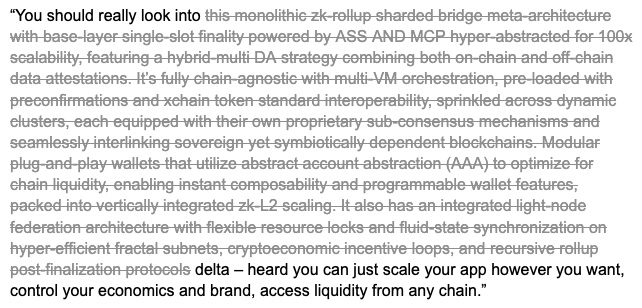
delta's design is exceedingly simple. To get there, you can start with a rollup stack and just delete stuff: - Remove the need for bridges and 3rd party interoperability services by having all the "rollups" (domains) share state - Integrate the execution layer with the base layer to further simplify interop by making all tokens "L1-native" by default, regardless of where they're deployed - Remove ordering consensus zk settlement enables completely heterogenous execution environments within the global state machine. Our view is that the ideal permissionless system consists of a minimal, neutral base layer which provides censorship resistance and extreme scale, combined with highly opinionated, customized execution environments. This system is delta.
English
8
5
62
11.1K
iorulezz retweetledi
rain & coffee
rain & coffee@rainandcoffee·
We're super excited to announce our investment into @deltadotnetwork! Having co-led the pre-seed and doubled down in the seed, it is only fair we give an overview of exactly why we're excited. The marriage of monolithic and modular; x.com/deltadotnetwor…
delta@deltadotnetwork

Introducing delta, a network of networks with shared state delta is an integrated system, built from the ground up to break the trade-off between sovereignty and interoperability for developers We’re thrilled to announce $11M in funding to realize this vision

English
2
4
56
5.8K
iorulezz retweetledi
Ole Hylland Spjeldnæs
Ole Hylland Spjeldnæs@spjoleh·
@_weidai Don't burden the global with that which can be taken care of locally
English
2
4
25
1.4K
iorulezz retweetledi
Wei Dai
Wei Dai@_weidai·
consensus and ordering are overrated. iykyk
Dansk
20
9
75
15.4K