Ishan

648 posts

Ishan

Ishan

@ishankbg

| Computer Programmer | CEO of @htmx_org | Loves Biology and Linguistics

Katılım Kasım 2021
185 Takip Edilen23 Takipçiler
Ishan retweetledi
Ishan
Ishan@ishankbg·
@Saatvata @shrutammegopaya Thanks for pointing out the nuance! Yeah, I agree that the comparison was a bit lazy and extreme. Also I didn't know about that for Classical Sanskrit! What book would you recommend for dwelling into this topic?
English
0
0
0
17
चेदिराड्रिपुपार्षदः 🟩⬜️⬛️
@ishankbg @shrutammegopaya A better comparison for Sanskrit to Prakrit would be Middle English to Modern English. The Middle English of Chaucer is much closer to modern English than to Old English as it postdates the Norman Conquest.
चेदिराड्रिपुपार्षदः 🟩⬜️⬛️@Saatvata

Vedic Sanskrit bhadró bhadráyā sácamāna ā́gāt svásāraṃ jāró abhí eti paścā́t। supraketaír dyúbhir Agnír vitíṣṭhan rúśadbhir várṇair abhí rāmám asthāt॥ (RV 10.3.3) Classical ("Standard Pāṇinian") Sanskrit: bhadró bhadráyā sácamāna ā́gāt svásāraṃ jāró 'bhyèti paścā́t। supraketaír dyúbhir Agnír vitíṣṭhamāno rócamānair várṇair rāmám abhyàsthāt॥ Mahārāṣṭrī ("Standard Dramatic/Literary") Prakrit (~5th c. AD): bhaddo bhaddāe saʸamāno āgaʸo (āʸaʸo) sasaṃ jāro abhiei pacchā suppakeehi jūhi (joāhi) Agaṇī (Aggī) viṭṭhaṃto roʸantehi vaṇṇehi rāmam abhiṭṭhiʸo English: "The auspicious male (i.e. Agní), accompanied by the auspicious female (i.e. Uṣás), has arrived. The paramour follows after his sister. Agní, spreading with his luminous glow (or alongside the clear skies), has overcome the night with his brilliant colors." Although rāmá- is not typically used in the sense "darkness/night" in Classical Sanskrit and sasā- ("sister", svasṛ+ḍā, cf. svasrāder ḍā Hem. 8.3.35) is marginal in Prakrit (having largely been displaced by bhagiṇī-/bhaïṇī-/bahiṇī-), I have retained the original wording as closely as possible, with alterations made only where necessitated by grammar. For example, the verb-root √ruś in the sense "to shine" is obsolete or non-productive in Classical Sanskrit, so I have replaced it with √ruc, which is listed as anudāttet "rúcÃ," dīptāv abhiprītau ca (to shine or to be agreeable/pleasing) and therefore takes ātmanepada endings by 1.3.12. The affix -ŚátṚ̃ takes parasmaipada-sañjñā by laḥ parasmaipadam while -ŚānáC (and KānáC) take ātmanepada-sañjñā by taṅ-ānāv ātmanepadam, so "rúcÃ" must take -ŚānáC. Although the vikaraṇa -ŚaP by kartari śap is pit and hence anudātta (anudattau suppitau 3.1.4) this vikaraṇa will make the root adupadeśa such that -ŚānáC will also become anudātta (by tāsy-anudātten-ṅid-ad-upadeśāt lasārvadhātukam anudāttam ah-nviṅoḥ, 6.1.186). This will override the cit-svara (6.1.163) of ŚānáC and the dhātu will retain its udātta (6.1.162), resulting in rócamāna-. I could theoretically replace rúśadbhiḥ by rúcadbhiḥ and justify it through the paribhāṣā "anudāttettva-lakṣaṇam ātmanepadam anityam," though I'd rather not employ grammatically contentious forms. Likewise, vi-√sthā must take ātmanepada endings as per sam-ava-pra-vibhyas sthaḥ, resluting in vitíṣṭhamānaḥ for Vedic vitíṣṭhan. Prakrit grammar is freer and -nta and -māṇa can be used interchangeably for -ŚátṚ̃ and -ŚānáC (nta-māṇau, śatrānaśaḥ), so I have applied the suffixes in accordance with the original Vedic mantra. I fully agree that the Sanskrit of RV is indeed more archaic than standard Sanskrit, but the point highlighted here is that Vedic Sanskrit is just barely a distinct language from Classical Sanskrit and both languages ultimately belong to the same grammatical and typological category (i.e. Old Indo-Aryan). In contrast, Prakrits are more distinct and belong to a separate class known as Middle Indo-Aryan in which the dual number has collapsed, the dative has largely merged with the genitive, there is a tendency to merge the optative mood w/ the imperative mood (particularly in later MIA), intervocalic stops undergo voicing→ fricativization→ elision, consonant clusters are typically replaced by geminates, the past tense system has largely been reworked (i.e. the perfect tense disappears relatively early in MIA and although aorist and imperfect survive a little longer, nearly all finite past forms are replaced by past participial constructions in later MIA), the declensional system has been simplified (albeit with far greater dialectical variation), etc. Cockney English to SSBE is not a very accurate comparison for OIA to early MIA (early inscriptional Prakrit, "Ārṣa" Ardhamāgadhī, Pāḷi, etc.) and clearly not an appropriate for OIA to later MIA (Dramatic Prakrits). Homeric Greek vs. Attic Greek would be a better comparison for Vedic vs. Classical Sanskrit while Chaucerian English vs. Modern Formal English would be a better comparison for OIA vs. MIA with Shakespearean English representing early MIA.

English
1
0
0
32
चेदिराड्रिपुपार्षदः 🟩⬜️⬛️
Strictly speaking, Indians don't speak languages descended from Sanskrit. They speak languages descended from OIA *sisters* of Sanskrit. Moreover, I never argued that Sanskrit was never a spoken language in India. A language very similar to Vedic Sanskrit was likely the vernacular at one point in time, at least in the Kuru kingdom. However, the proposition that Sanskrit was the vernacular language in the Gupta period is not valid. By the Mauryan period we already start to see inscriptional Prakrits with cluster simplifications, absence of the earlier OIA dual number, etc. This suggests that the vernaculars continued to evolve even though Sanskrit was fixed as a prestige/literary langage.
Anshul Tiwari@AnshulT25600630

@PrasunNagar I don't understand people claim Sanskrit was never language of common people then how majority Indians are still speaking languages originated and influenced from Sanskrit

English
12
9
114
12.2K
Ishan
Ishan@ishankbg·
@shrutammegopaya @Saatvata Except that it's not Classical Sanskrit but an ancestor of it and definitely not the ancestor of all IA languages. It's like saying Old English and Modern English are the same.
English
1
0
0
41
Ishan
Ishan@ishankbg·
@PatriotHeroLgnd "They say that Kaṇva is the son of Nr̥ṣad [/of the one who sits among men], and Śyāva [/the dusky], the prizewinner, took the stakes. The gleaming udder swelled for Kr̥ṣṇa [/the black one], but in there no one made the truth swell for him." — RV X.31.11
English
0
0
3
40
Ishan
Ishan@ishankbg·
@PatriotHeroLgnd If apparently Vedic Aryans were white then why are some Kanvas (one of the major families who composed Vedas) in Vedas defined as having syava (dark brown) skin in X.31.11?
English
2
1
3
39
Ishan
Ishan@ishankbg·
@PatriotHeroLgnd Read Through a Glass Darkly: Modern ‘Racial’ Interpretations vs. Textual and General Prehistoric Evidence on ārya and dāsa / dasyu in Vedic Society (Hock 1999) to understand how this verse was distorted. Where is the archaeological evidence for AIT? What makes one an Aryan?
English
0
0
0
5
Ishan
Ishan@ishankbg·
@PatriotHeroLgnd You literally quoted a poem about a sacred plant being strained which was mistranslated by colonial Indologists.
English
2
0
2
48
Ishan
Ishan@ishankbg·
@PatriotHeroLgnd conquerors? What's the evidence of conquest? They migrated and assimilated. You are really drunk on the 19th century Aryan Invasion model rejected by most academics. Are you in denial that Arya ethnonymn had not been used by most Euroeans historically? What makes one an Aryan?
English
1
0
5
87
Imperialist
Imperialist@PatriotHeroLgnd·
@ishankbg The Aryan conquerors of India were Aryan, not Dravidian subjects
English
1
0
1
78
Ishan
Ishan@ishankbg·
@PatriotHeroLgnd Wdym genetically not Aryans? You are shifting goalposts. How is one genetically Aryans anyway? There were pre Indo-Aryan groups like Kanvas who were later Aryanized and got their place in the Vedic canon. The concept of Aryan is cultural. Also Indians do have Steppe ancestry.
English
1
0
5
108
Imperialist
Imperialist@PatriotHeroLgnd·
@ishankbg And the Indians were never Aryan genetically so they are not Aryan
English
1
0
3
91
Ishan
Ishan@ishankbg·
@PatriotHeroLgnd The genetic identity doesn't mean ethnic identity. I happen to be closer to a Muslim living by the next door that doesn't mean I am a Muslim. Ethnic identities are social constructs not biological facts. The Europeans never referred to them as Aryans until the 19th century.
English
1
0
4
102
Imperialist
Imperialist@PatriotHeroLgnd·
@ishankbg Sintashta were genetically closer to Northern Europeans than anyone else
English
2
0
5
198
Ishan
Ishan@ishankbg·
Honestly I am tired of some white supremacists misusing linguistics to support their racist views. The term ārya is an ethno-cultural designation with roots in PIIr. *áryas. It has only been used by Indo-Iranians historically and cannot be traced back to proto-Indo-European.
English
1
0
2
53
Ishan
Ishan@ishankbg·
@yajnadevam @0007ferrero Can't take your word seriously anymore. You are nowdays resorting to outright lies. Mycaenean Greeks did have Steppe ancestry - biorxiv.org/content/10.110… Also you haven't answered regarding your misunderstanding of the comparative method when I pointed out the issues. You are dumb
English
0
0
0
11
yajnadevam
yajnadevam@yajnadevam·
Exactly what Sanskrit is, an alleged divergent of PIE. Another banger essay
Noemon Acragas@noemonas

Let's talk about identity. Several people that have been colonised, raped, appropriated and ridiculed by "white culture" tend to want to identify as "whites" just like the House slave of old, when masters picked a favorite, put them in the house and had them monitor the activities of the other non-privileged slaves. Greeks, Greek culture and Hellenism are by far one of the most vilified people by diachronic white western culture systematically. From the jealousy of the middle-Ages, when they first laid upon eyes on Constantinople, to the fact they were taught to use cutlery by a Greek Princess in the Holy Roman Empire of the German nation. Westerners have never stopped vilifying the Greek people. Western universities in the present day still use the English sounds of the Greek letters to teach and pronunce ancient Greek to their pupils and mock the native Greeks and their Greek language as 'divergent". A unique phenomenon in world history, where foreigner barbarians teach a fake version of Greek and claim it to be superior to the actual Greek language. The British Prime Ministers along with all their classical departments claim that the structural walls of the Parthenon are British national property. Armand D' Angour professor of Classics at Oxford and self-proclaimed expert on all things Greek, writes openly here on twitter that Oxford's theaters produce "more original theatrical performances than Epidavros in Greece". Yet a lot of uneducated Greeks along with other brown people that have only recently been upgraded to "white VIP" status, still try to identify with such people in stockholm syndrome fashion. Let it be known then, that Hellenism is not a White or a Black culture, it is a Hellenic culture that also happens to be universal. If anybody wants to be identified with it, then they should study our culture and immerse themselves in it and by that I do not mean the "classics" as taught in western universities. That only teaches them how to hate Hellenism and posture in arrogance pretending to own a "classic" like a ferrari, it is purely for narcissists and should be replaced by Hellenic studies or Greco-Roman studies. Hellenic studies are not a cat, to be called "precious". Greeks should learn at some point to be proud for who they are instead of chasing identities like "white" or "European" to hide under. If the so-called Europeans want to be identified with Greeks who invented the word Europe, they should request access from us with humility after they have immersed themselves into our culture, instead of inverting ownership, appropriating our names and then forcing Greek idiots to identify with their definitions of the words. There is a funny idea that ancient Greeks used to be very white, literally Germans basically and that modern Greeks mixed with Turks and Arabs and that is why they are darker [than Germans]. But the exact opposite is true. The default Greek colour is BROWN and the fact modern Greece has blondes is the divergence. The ancient Greeks had less R1b marker than the modern ones as they had not yet been subjected to the Varangian(Viking) and Slavic instrusions of the Middle-Ages. Aristotle in Physognomika defined the colour of the Greeks as the middle(meson) between Ethiopians and Northeners and women. Ancient Greek art celebrated the Brown Male Figure. We do not need to chase their "whiteness" they should be chasing our "brownness". In this inverted world we live in, it is up to us to set the record straight and the limits of our space and not leave it up to trolls to define who and what everybody is. If white people want to be Greek, learn our language and customs, be friendly, be brown in mind and spirit and we will welcome you in our tribe. We do not wish to be part of the "white tribe" cause there is no such thing besides its orange now. I would happily learn Swedish customs, not because they are "white" but because they are interesting. F*ck the "white" American label and let them stew in their own shite. Below, Andromeda the Ethiopian and Perseus the Greek:

English
1
16
109
5.5K
Ishan
Ishan@ishankbg·
@beaker_the12224 @yajnadevam Are you sure that Mycaenean Greeks had no Steppe ancestry AT ALL? Do read - biorxiv.org/content/10.110… Also your IVC having Sanskrit is not proven and has been criticised several times yet you treat it as if it's a fact. Publish it in a journal and then talk about it.
English
0
0
2
88
yajnadevam
yajnadevam@yajnadevam·
The fact that Mycenean Greeks had zero steppe as did the Iranians and the Indians have attested inscriptions before any steppe ancestry should falsify the steppe hypothesis for good. The three civilizations with bronze age IE literature had zero steppe ancestry!
Noemon Acragas@noemonas

@simianfromspace @Vuyo__ You are hallucinating about mounds and imaginary Indo-Europeans. 0% steppe ancestry among the ancient Greeks, increases slightly over time after the Romans and the Slavs.

English
10
26
124
13.3K
Ishan retweetledi
Florian Louis
Florian Louis@flr_louis·
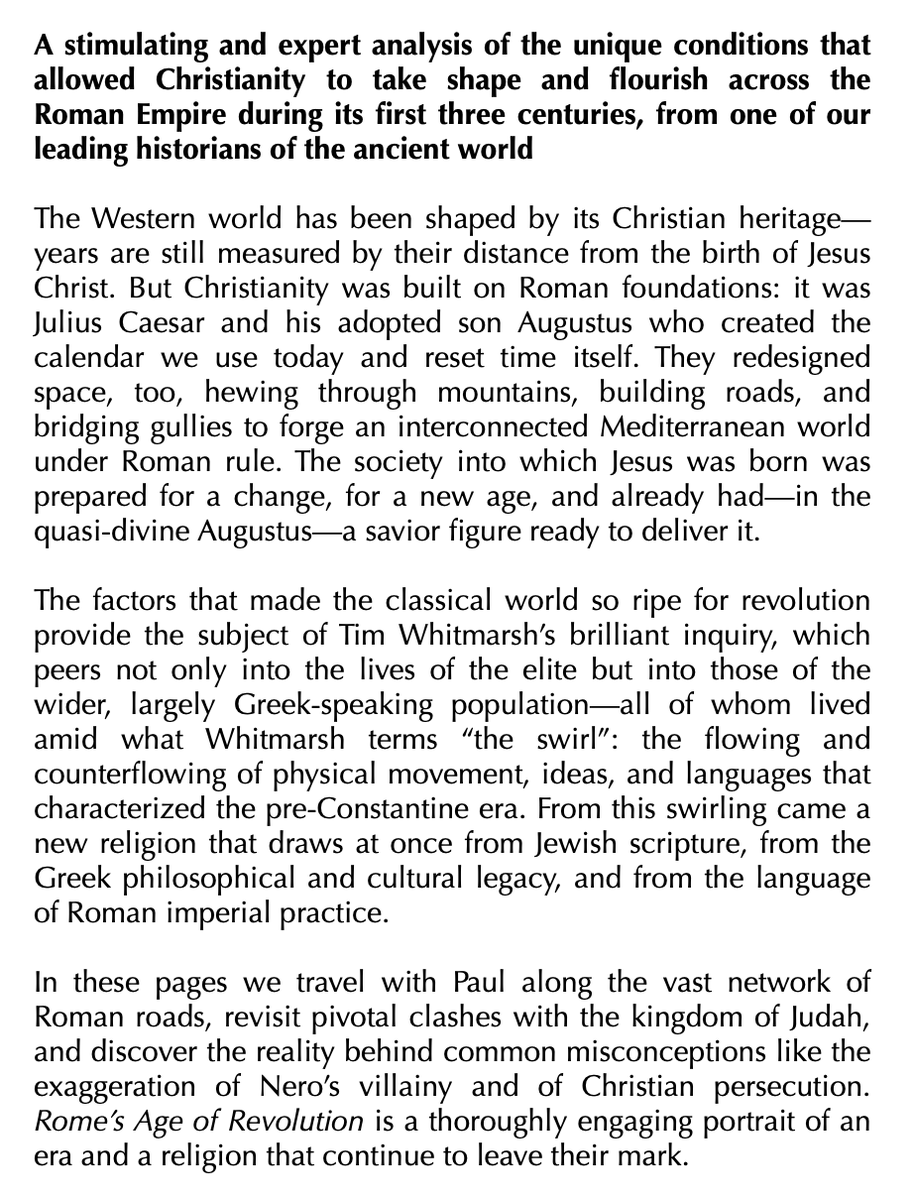
Tim Whitmarsh - Rome's Age of Revolution Augustus, Empire, and the Making of Christianity À paraître en novembre chez Knopf
Florian Louis tweet mediaFlorian Louis tweet media
Français
0
21
166
8.8K