ismail amara

358 posts

ismail amara

ismail amara

@ismailamara13

Account Abstraction | ZK | Marketing Lead @hedera_hacks | Building @MicrochainLabs

Barcelona Katılım Kasım 2021
259 Takip Edilen86 Takipçiler
ismail amara
ismail amara@ismailamara13·
late @consensus2026 tldr: crypto is slowly disappearing into the infrastructure layer itself. and honestly, i think that’s how you know parts of this industry are finally maturing. a few side events into miami 2026, it became very clear to me that the most important crypto companies over the next few years may not even, AND should not market themselves as crypto companies at all. they’ll look like neobanks (@raycashxyz lfg), payroll platforms, treasury systems, remittance apps, ai infrastructure providers, marketplaces, or fintech APIs. underneath, stablecoins, embedded wallets, onchain liquidity, and programmable settlement will just quietly power the movement of value. most users will never care what chain something settles on. they care that money moves instantly, global payments work properly, treasury operations become easier, and capital can move 24/7 without operational friction. i also think a lot of people still misunderstand where value will accrue in this world. everyone focuses on stablecoin issuance itself, but issuance is becoming increasingly commoditized. the harder problem is distribution. who owns the user relationship, who controls where balances sit, who powers payroll, remittances, marketplaces, ai commerce, treasury flows, and global settlement behind the scenes. privacy: privacy also came up far more than i expected. the second businesses begin moving meaningful stablecoin volume onchain, transparent wallets become a serious operational issue. treasury visibility, supplier mapping, balance exposure, salary tracking… these are not niche concerns once real companies start operating at scale onchain.
ismail amara tweet mediaismail amara tweet mediaismail amara tweet media
English
0
1
2
60
ismail amara
ismail amara@ismailamara13·
@consensus2026 tldr: crypto is slowly disappearing into the infrastructure layer itself. and honestly, i think that’s how you know parts of this industry are finally maturing. a few side events into miami 2026, it became very clear to me that the most important crypto companies over the next few years may not even, AND should not market themselves as crypto companies at all. they’ll look like neobanks (@raycashxyz lfg), payroll platforms, treasury systems, remittance apps, ai infrastructure providers, marketplaces, or fintech APIs. underneath, stablecoins, embedded wallets, onchain liquidity, and programmable settlement will just quietly power the movement of value. most users will never care what chain something settles on. they care that money moves instantly, global payments work properly, treasury operations become easier, and capital can move 24/7 without operational friction. i also think a lot of people still misunderstand where value will accrue in this world. everyone focuses on stablecoin issuance itself, but issuance is becoming increasingly commoditized. the harder problem is distribution. who owns the user relationship, who controls where balances sit, who powers payroll, remittances, marketplaces, ai commerce, treasury flows, and global settlement behind the scenes. privacy: privacy also came up far more than i expected. the second businesses begin moving meaningful stablecoin volume onchain, transparent wallets become a serious operational issue. treasury visibility, supplier mapping, balance exposure, salary tracking… these are not niche concerns once real companies start operating at scale onchain.
ismail amara tweet mediaismail amara tweet mediaismail amara tweet media
English
0
0
0
6
ismail amara
ismail amara@ismailamara13·
this is exactly the kind of problem people underestimate until they actually use stablecoins at scale. every transaction becomes a window into your financial life, and that compounds quickly across teams, vendors, and contractors. really excited to see @raycashxyz working on this. bringing trad finance levels of privacy and ease of use while keeping self-custody is the direction this needs to go.
English
0
0
0
22
Raycash
Raycash@raycashxyz·
You pay a contractor in stablecoins. Clean, fast, no intermediaries. They now have your wallet address. Which means they can see your balance, every payment you have ever made, and what you paid everyone else. Salary confidentiality has always been assumed. On-chain, it was never guaranteed.
English
5
2
16
915
Dr. Zuler
Dr. Zuler@zuler·
Today I present my MBA thesis on neobanks in Latin America. The region has 650 million people. Half of them are underbanked. Traditional banks never showed up. Then came @KASTxyz and others quietly building the rails that actually work for this market. The thesis is simple: Latin America doesn't need better banks. It needs to skip banks entirely. Solana is the obvious answer. Fast, cheap, mobile-first. Built for exactly the person who never had a bank account but has a phone. I've spent months on this. Today I defend it. Wish me luck!
Dr. Zuler tweet media
English
19
5
125
10.2K
ismail amara
ismail amara@ismailamara13·
preach
idará@idaratbn

the reason why africa leads in stablecoin adoption is because of intentional structural oppression i can’t send money directly from porthacourt to my friend in kigali because once my naira leaves nigeria and it gets converted to usd through *checks note* a correspondent bank which is likely in new york or london. then it will get routed through the SWIFT network touches at least 2-3 intermediary banks, arrives in rwanda, gets converted to rwandan franc before it hits my friend’s bank in kigali make no mistake, this will take 3 to 5 business days assuming the transaction doesn’t get flagged after a “compliance review” let’s not even talk about the fees LOL the same problem exists within our borders. if i wanted to fly to kigali (rwanda) and hand my friend the money, i still wouldn’t do it without sacrificing an arm and leg. an african passport is stronger outside africa than it is within it. a nigerian passport will get you into more countries in southeast asia or the caribbean with less hassle than crossing into some of your continental neighbors if i’m traveling to senegal, i need a visa. cote divoire? i need a visa but my country is in the same ECOWAS with these nations can you imagine that? whereas a person in lyon can wake up and decide they want to spend the weekend in barcelona. they book a train of about €40-80, pack their bags, get on a train and get off in barcelona after 5-6 hours. nobody will asked them for a visa. nobody will scrutinize their passport. in some cases, they won’t notice they crossed a border i can’t pay for shit online with my access bank card. in fact, we are more likely to discover life on mars before you see a nigerian bank card that works perfectly on your apple phone europe's internal borders were drawn by europeans and renegotiated over centuries of war, diplomacy, and eventually cooperation african borders were drawn in berlin by europeans who had probably never been here. they cut through ethnic groups, separated communities that had moved freely for generations, and created nation states that served as extraction units this architecture was never dismantled. it was inherited, and for generations to come it will remain this way this is not me being pessimistic, look around. the banking infrastructure was built with the same logic today there are policies implemented by central banks of african nations that restrict capital flows to protect foreign reserves and maintain monetary control. this is why we can’t move money freely even within the continent so when you see that africa leads global stablecoin adoption you are not seeing a tech trend. it’s not cyberpunk anything. you are seeing millions of individual workarounds to a system that was designed to make the most basic financial and physical movement hard. if you don’t know this as a founder, you’re building for the wrong crowd. sorry, not sorry end

English
0
0
0
66
ismail amara
ismail amara@ismailamara13·
i’d usually be excited by a statement like this, but it’s worth looking at who it’s coming from. jamie dimon has been consistent for years. critical of crypto as an asset class, very pragmatic about the underlying rails. when he speaks, it’s rarely about hype, it’s about where systems are heading. this reads more like recognition of efficiency than endorsement. crypto rails reduce friction in ways traditional systems struggle to match, and that’s hard to ignore at scale. when someone in his position says this publicly, it usually means those primitives are already being studied, integrated, or adapted within existing financial structures.
Documenting Saylor@saylordocs

🇺🇸 JAMIE DIMON, CEO OF JP MORGAN, GOES ON NATIONAL TV AND SAID: "CRYPTO IS BETTER THAN THE CURRENT FINANCIAL SYSTEM!" THE "EXPERIMENT" PHASE IS OVER. WILD 🔥

English
0
0
0
44
ismail amara
ismail amara@ismailamara13·
yeah it mostly comes down to incentives. teams can move fast or slow, doesn’t really matter. what matters is how growth, liquidity, and governance are wired together from day one. when usage actually strengthens the system, trust compounds over time. when it doesn’t, you just get early traction that fades.
English
0
0
1
37
nairolf
nairolf@0xNairolf·
the biggest lesson in crypto is that shortcuts dont work everyone trying to take them fails one way or another building trust takes years with audits, proofs, consistency, perseverance, everything just multiplied by ten we all have hundreds of examples of projects that tried to “growth hack” their way in, all of them are dead today if you look at the real success stories in crypto, they all share one thing: they went through the test of time and stayed true to their core values next time you think something is “the future” ask: (1) do they even have values? (2) will they actually stand by them? most projects wont pass (cool product or not)
English
39
8
123
4.7K
ismail amara
ismail amara@ismailamara13·
@ZeusRWA some control liquidity, others control access points, others control compliance or enterprise distribution. over time, value tends to concentrate where these layers converge into a single flow.
English
0
0
0
36
Zeus 🇬🇧
Zeus 🇬🇧@ZeusRWA·
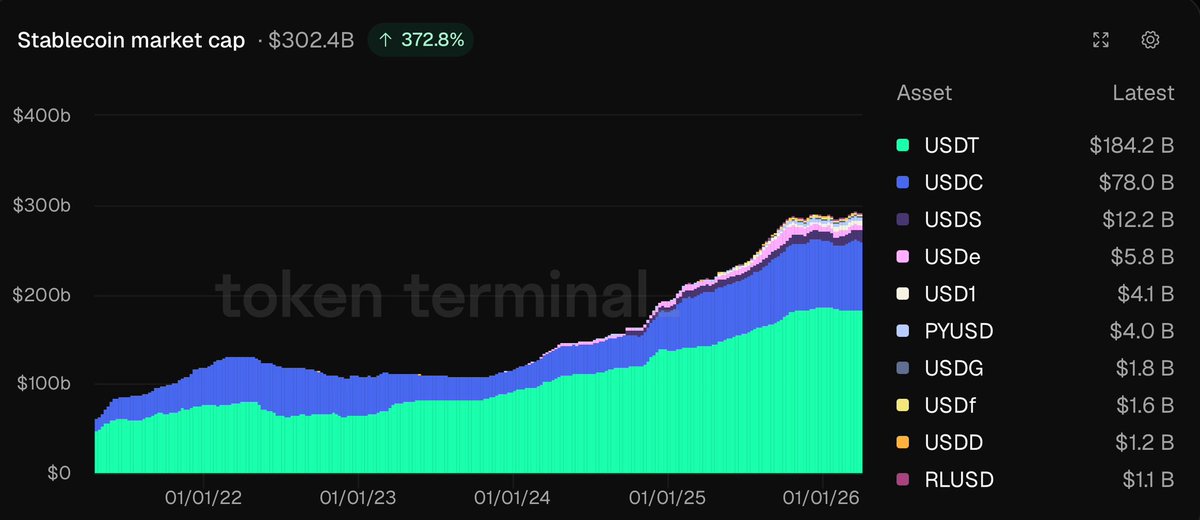
Stablecoins are one of the few real use cases crypto has actually seen mass adoption in. The market is still heavily dominated by Tether & USDC. A few other players have moved in and now we have > USDe pushing yield-native dollars > PayPal entering with PYUSD > Ripple stepping in with their own stablecoin push > New players like Falcon and others entering the mix They all have the same goal of wanting to own distribution of the digital dollar. Payments, trading, savings, RWAs… stablecoins are the base layer for everything. Via @tokenterminal
Zeus 🇬🇧 tweet media
English
24
12
88
5.4K
ismail amara
ismail amara@ismailamara13·
Fees dropped to near zero, and that changed what the market pays attention to. Once execution became cheap across multiple chains, it stopped being enough on its own. Lower fees, better throughput, and smoother UX still matter, but they no longer create the same differentiation they did before. The market started treating them as baseline conditions rather than a reason to care. What remained scarce was liquidity. Depth, tight spreads, reliable execution, and the ability to move size without distorting price became much more important than marginal improvements in infrastructure. That is where attention started to consolidate. Capital naturally moves toward environments where it can enter and exit efficiently, and over time that flow becomes self-reinforcing. This is why many discussions around chain competition miss the point. Once blockspace becomes abundant, the contest shifts away from who can offer the cheapest execution and toward who can support the strongest market structure.
English
0
0
1
23
ismail amara
ismail amara@ismailamara13·
I love stablecoins, but inflating outcomes without explanations is one of the reasons the crypto industry’s been lagging. a large share of this volume comes from trading loops, market makers, and internal rebalancing across venues. it boosts throughput, but doesn’t necessarily reflect new economic activity or real user adoption. there’s also a growing concentration risk. most of this activity relies on a small number of issuers and chains, which introduces dependencies at the very layer people assume is neutral. and as yield-bearing stablecoins expand, the line between cash and risk starts to blur. once returns are embedded, you’re no longer dealing with a pure settlement asset. duration, credit, and liquidity risks start creeping in. IGNORE THE HYPE, see what’s underneath.
haonan@haonan

Q1 2026 stablecoin stats: • stablecoins processed $28 trillion, more than visa and mastercard combined • total stablecoin supply hit a record $317 billion, growing even as the broader crypto market dropped ~20% • stablecoins now account for 75% of all crypto trading volume, the highest share ever recorded • in February, stablecoin monthly volume hit $7.2 trillion, surpassing the US ACH network ($6.8T) for the first time in history • yield-bearing stablecoins grew by 22%

English
0
0
1
41
ismail amara
ismail amara@ismailamara13·
@jonahlau_ agents will expose how much of execution used to rely on interpretation rather than precision.
English
0
0
0
16
Jonah Lau
Jonah Lau@jonahlau_·
Agents execute exactly what you specify. That's the failure mode. The best work from any capable team in crypto always comes after someone pushed back on the brief. Caught a wrong assumption. Noticed the gap between what the founder said and what they meant. That friction was the quality control. Agents don't do that. If the brief is wrong, the output is wrong, and nothing flags it. Many people always have to undo a full week of agent output because one assumption in the initial brief was wrong. Flawless execution on a bad specification. The management skill that survives the agent era is brief precision. Write it so tight and specific that you'd be comfortable if no human reviewed the output at all. Most managers haven't had to work at that level before. The team absorbed the ambiguity. Now the team doesn't absorb anything.
English
5
1
16
442
ismail amara
ismail amara@ismailamara13·
there’s some truth to this, but it simplifies the path a bit. a lot of the earlier cycles helped build the infrastructure and market conditions that rwAs rely on today. custody, liquidity, standards, and distribution all had to mature before real assets could realistically move onchain. it feels obvious in hindsight, but the sequencing mattered. what’s happening now is more of a continuation than a correction.
English
0
0
0
8
Zeus 🇬🇧
Zeus 🇬🇧@ZeusRWA·
Bitcoin was introduced over 15 years ago. Since then, we’ve seen thousands of blockchains launch, tens of thousands of tokens created, and billions of dollars poured into experiments across the space. Yet if we’re being real, most of it led to very little real world significance. We had cycles filled with memecoins, forks of forks and endless fake narrative loops. Innovation in some areas, yes, but not always in the direction that actually mattered long term. The thing is, the end goal was always right in front of us. It shouldn’t have taken this long to put financial assets onchain. We went from step 0 to 2838, instead of just doing 0 to 1. From day one, the mission was simple: take financial assets and give them better rails to run on. More transparent. More efficient. More accessible. More liquid. That was always the unlock, not creating infinite tokens with no underlying value, but upgrading the infrastructure that global finance runs on. The real opportunity was never just “crypto assets.” It was real estate, private credit, equities, commodities, stocks, the things that already power the global economy - being brought onchain in a way that makes them easier to access and interact with. And now, after all this time, we’re finally starting to see it. All different types of tokenzied assets are growing massively. Private credit is flowing into DeFi. Stocks are being wrapped and traded 24/7. New forms of capital markets are emerging in real time, right in front of us. It took over 15 years to get here. But this… this is what it was always meant for. Enjoy ur Sunday.
English
30
2
75
2.1K
ismail amara
ismail amara@ismailamara13·
@jonahlau_ content that builds an audience tends to follow engagement signals. growth work follows conversion and retention. both can coexist, but they require different feedback loops and different expectations.
English
0
0
0
14
Jonah Lau
Jonah Lau@jonahlau_·
Most companies mistake content for growth The result is budgets spent on people who can build an audience for themselves but not for a product. Those are different skills, and almost nobody talks about the gap. Real growth is picking two or three channels that can reach the right users, running them at a volume that feels unreasonable, and tracking what moves until something does. Most of that work happens in spreadsheets, not on timelines. Social presence and viral content are real channels, but they sit on top of a working funnel. Without the funnel, they generate noise that looks like traction. The companies that grow fastest this year will probably be the ones whose growth people nobody has heard of.
English
14
2
36
1.3K
ismail amara
ismail amara@ismailamara13·
RWAs operate inside legal systems that determine ownership, recourse, bankruptcy priority, and disclosure standards. without clarity there, every deal carries embedded uncertainty, and uncertainty raises the cost of capital. that cost flows through spreads, limits distribution, and keeps serious allocators on the sidelines.
English
0
0
1
10
Zeus 🇬🇧
Zeus 🇬🇧@ZeusRWA·
Unpopular opinion, but regulation is the biggest unlock for RWAs. Not better tech, not more chains, not faster throughput. Rules. RWAs live in two worlds at the same time, onchain and offchain. The token can move at internet speed, but the underlying asset still sits under real world jurisdiction. If the legal system doesn’t recognize what that token represents, you’re not really building infrastructure. What regulation actually unlocks is pretty simple when you strip it all back It unlocks institutional capital. Pension funds and sovereign wealth funds don’t get to “just try things out.” They are legally required to allocate into regulated products. No clarity means no mandates, and no mandates means no serious capital. It unlocks legal enforceability. If a tokenized bond defaults, or a structure breaks, the real question is whether anyone can enforce rights in court. Regulation is what gives a token real teeth instead of just promises on a website. It unlocks consumer protection. Proper disclosures, audits, accountability, and standards. Fewer rug pulls dressed up as “tokenized yield” and fewer people learning the hard way. It also unlocks interoperability with traditional finance. Banks won’t touch unregulated assets, no matter how elegant the smart contracts are. Frameworks are the bridge, not the blocker. The real enemy here isn’t regulation, it’s uncertainty. You can build around rules. You can’t build around “maybe.” RWAs were never meant to be purely decentralized. The asset is centralized, the legal rights are centralized, and the token is decentralized. That’s not a contradiction, that’s the design. Regulation isn’t coming to kill RWAs. It’s coming to legitimize them.
English
42
5
97
7.1K
ismail amara
ismail amara@ismailamara13·
@pet3rpan_ the next phase will belong to teams who can design formats where risk, anticipation, and status feel bounded, expressive, and socially legible.
English
0
0
0
23
Peter / 1k(x)
Peter / 1k(x)@pet3rpan_·
My personal view, notes and thoughts on building around financialization for crypto consumer: 1) Financialization is just a starting point, not the end goal 2) People's lives revolve around vices. Greed, Wrath, Lust, Envy, Gluttony, Pride, Sloth. "To deny our own impulses is to deny everything that makes us human." 3) We are inherently flawed by the impulses we seek. Yet it is precisely these sins that ultimately enable us to connect with one another as people. 4) A shared desire for fulfilling the exact same needs often creates the proper social context for some of the deepest bonds and a sense of belonging to form and exist. 5) However, for collective participation to emerge, we often require a socially acceptable method of consumption that allows us to satisfy these needs in a manner free from judgment and protected from potential social ostracization. 6) No one ever claims to be a fan of violence (wrath). But if you promote it as a sport, host it in an octagon, and broadcast it globally, you'll create an audience that might publicly identify as 'combat sports fans'. 7) The demand for experiencing wrath has also been met through other mediums such as video games, which allow people to temporarily wear a mask, pretend to be someone else, and express their inner desire for violence, conflict, and competition. 8) Violent video games don't make people violent. People are inherently violent and naturally seek to experience wrath itself. It is better for this to be expressed through low-stakes conflict resolution, such as video games or sports, rather than in a physically harmful way to others. 9) Framing, presentation, and story can entirely evolve the tone and social permeability of content, allowing us to consume and participate openly and socially in what otherwise might be taboo. 10) Crypto didn't make people greedier. It's only drawn out demand that was unfulfilled prior into the open public eye. We might not let greed dominate our lives, but we all universally love risk, anticipation, and expectation. 11) Variable outcomes – a thrill and rush we all seek. That said, crypto in its current natural form is unadulterated violence. It's far too raw in its current form to ever socially permeate beyond the current ring of adoption. 12) Hyper financialization or not. These are the wrong questions to ask. The real question is how. The clues of what will work, scale, and resonate are all onchain. 13) People aren't in it for the tech or for financialization or not. But to feel something they can't feel anywhere else.
English
11
0
65
3.2K
ismail amara
ismail amara@ismailamara13·
we've been working on this one for a while, here goes nothing: introducing erc-8039 github.com/ethereum/ERCs/… erc-8039 proposes a standard interface for smart accounts to verify succinct zero-knowledge proofs on chain. not a new proof system. not a new account abstraction model. just a simple, reusable way for accounts to say “this is a valid proof” in a way that other contracts and wallets can understand. The motivation is pretty straightforward. zk proofs inside smart accounts are deeply fragmented today. A proof generated with Circom typically relies on Groth16 or PLONK verifiers, requiring circuit-specific Solidity contracts with rigid calldata layouts. By contrast, a proof produced by Honk-barretenberg proving system introduces a fundamentally different verifier interface, proof encoding, and verification flow, making it incompatible with existing Circom-based on-chain tooling. Meanwhile, a proof generated by SP1 zkVM is verified as a VM execution trace, imposing yet another on-chain verification model that smart contracts must explicitly understand and integrate. That fragmentation makes zk-powered account logic hard to reuse, hard to compose, and hard to standardize across wallets and chains. this erc takes a different angle. standardize the verification interface, not the proof system. similar to how eip-1271 unified signature checks without dictating how signatures are produced. the goal is to make zk-based authentication, authorization, and state transitions feel native to smart accounts, regardless of whether the proof comes from groth16-circom, groth16-gnark, plonk-circom, honk-barretenberg, zkVMs, or something else tomorrow. it’s early and very much open for discussion, but we think this is an important step toward zk-first account abstraction on ethereum.
English
0
1
1
75
ismail amara
ismail amara@ismailamara13·
@malekanoms nothing else of consequence in the world happens on schedule without someone having the ability to intervene, delay, accelerate, or take credit.
English
0
0
0
17
Omid Malekan
Omid Malekan@malekanoms·
In one month, the Bitcoin protocol will mine the 20 millionth bitcoin. This will happen predictably & programmatically. Not because any one person wants it to, or because a central banker (or politician threatening a central banker) needs it to. And not because of the whims of a metal mining executive, or the random composition of the earth's crust. It will happen because Bitcoin lives inside thousands of independent nodes all over the world. Some managed by a corporation, others by a teenager. Some in the cloud, others on a Raspberry Pi. It will happen even if the world's most powerful governments and corporations don't want it to happen. It will happen even if Satoshi himself rises from the dead and declares "I was wrong, I don't want this to happen." It will happen even if it not happening—or happening sooner, or bigger—is better for the price of Bitcoin. It will happen despite the endless predictions by countless smart people who told us over and over, for 15 years, that Bitcoin is a scam, a bubble, a Ponzi; told us it won't live long enough to see this happen. And you know what always gets me about these people? The fact that regardless of the ultimate value, utility, or price of Bitcoin, they can't admit that it's pretty fucking cool that in one month, this is going to happen. And there won't even be someone who takes credit for it. But it will happen anyway.
English
5
6
54
3.4K
ismail amara
ismail amara@ismailamara13·
@0xJeff once rules can be enforced cryptographically, safety and openness stop being at odd
English
0
0
0
55
0xJeff
0xJeff@0xJeff·
Demand for privacy & security is slowly catching up to the demand for global finance and AI ​ - Hyperliquid = becoming the foundation of global finance layer ​ - Moving money around is getting cheaper, more fintech & startups are adopting blockchain rails ​ - In order to comply with rules & regulations, fintech needs privacy. zk-KYC, selective disclosure, real-time compliance monitoring & screening, risk-scoring, freeze/sanction list. ​ - OpenClaw is powerful but people are losing their credentials & their funds ​ - We're seeing a wave of privacy & security tools designed to prevent hacks, exploits, and breaches from happening
0xJeff@0xJeff

Consensus HK 2026: Side Event - 10 Feb: RWAiFi Connect (GAIB, Plume, Kite AI, etc.) - 10 Feb: The Fortified Stack: Building Compliant, Global Crypto-Native Payment Rails (AWS, Chainalysis, Sumsub, Triple-A) - 10 Feb: Quantum Qafe Coffee Meetup @ Consensus HK (Sushi, W3JOE, HXCO, HACKVC, Kite AI, 0G) - 10 Feb: Proof of AI - Builder and Influencer Night @ConsensusHK by Paypal Ventures & Kite AI & 499 - 11 Feb: Solana Accelerate APAC at Consensus - 11 Feb: Coded @ Consensus HK: Scaling Infra with Builders, VCs & Market Makers (Optimum, AWS, Caladan, Amber Group, etc.) - 11 Feb: Sentient Salon | HK Edition (Sentient, Kite AI, HASHKEY Capital) - 11 Feb: Avalanche Convergence: Stablecoin & Real-World Assets (Hashkey, HFintech, Techhub News) - 11 Feb: Institutional Capital X Solana RWAs (ft. Nest, Anchorage Digital, Synthesys, Superteam SG, Plume) - 11 Feb: RWAfi. RAW HK Skyline Mixer: Road to Mainnet (Pharos, Ant Group, Digital Technologies, etc.) - 11 Feb: Liquidity Harbour: DeFi & AI Punk Mixer (UST Web3 Labs, HKGHH, BitRush, Digital Visionaires Council) - 12 Feb: HypurrCo Gathers @ Consensus HK 2 (HypurrCollective, Kagea, Coinpilot, HyperDrive, Auros, No Limit Holdings, Native Markets, Redstone, Velar, Anchorage, Pear Protocol) - 13 Feb: Prediction Markets After Dark (Fireplace, Limitless, Polysights, Trendle, Prediction Index) [Luma links to the events in my bio] Have fun in Hong Kong! Let me know if there are other exciting events around.

English
29
4
72
19.8K
ismail amara
ismail amara@ismailamara13·
@ajwarner90 @stripe @Offchain focus needs to be more about becoming a credible default for teams that don’t want to assemble infrastructure like lego anymore. that pressure is only going to increase as crypto products start looking more like real businesses than experiments.
English
0
0
0
162
A.J. Warner
A.J. Warner@ajwarner90·
The collection of crypto talent that @stripe has put together is quite impressive. @Offchain has followed a similar strategy of building out industry leading expertise at various levels of the technical stack. Stripe: Tempo, Privy, Bridge Offchain: Prysm, Arbitrum, Zerodev I think verticalization is very logical as the marginal customer becomes more sophisticated and in need of one-stop technical partners to come to market. Who else is adopting this trend on the technical side?
English
13
5
110
14.4K