
Youtube recordings from the "Sex Differences in Addiction: An International Consensus Workshop" are now live! THANKS again to all the presenters & attendees for making this event a success. 🎥 Watch now: youtube.com/playlist?list=…
Isabella Goodwin
31 posts

@issy_goodwin
PhD candidate at Unimelb ☀ Investigating behavioural & neural correlates of psychosis 🧠 Research associate at Addiction Program ACU @HBMRC_ACU


Youtube recordings from the "Sex Differences in Addiction: An International Consensus Workshop" are now live! THANKS again to all the presenters & attendees for making this event a success. 🎥 Watch now: youtube.com/playlist?list=…

🗓️ Preliminary program 🗓️ MRI Together 2024 3️⃣ days filled with lots of open, reproducible and inclusive science MR research 🧲 Don’t forget to register ⬇️ eventbrite.co.uk/e/mri-together… #mritogether2024


Computational modelling shows evidence in support of both sensory and frontal theories of consciousness biorxiv.org/cgi/content/sh… #biorxiv_neursci


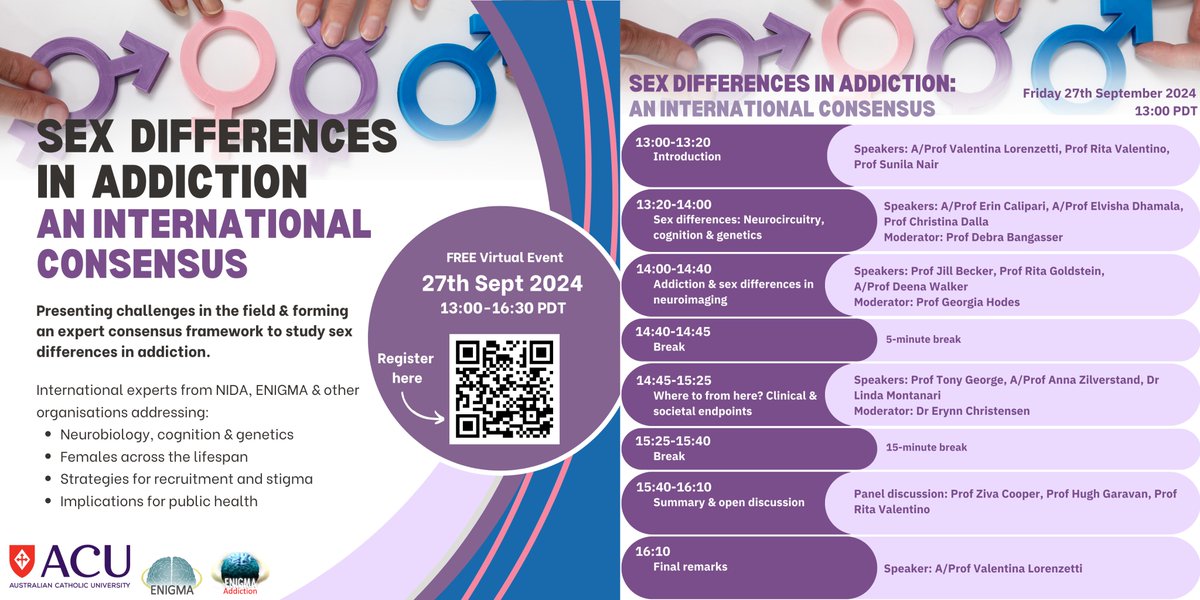
Check out our incredible lineup of speakers for the @HBMRC_ACU @enigmabrains & @AddictionEnigma online Sex Differences in Addiction: An International Consensus Workshop! WHEN: Fri 27th Sept 13:00-16:30 PDT Register for FREE by Mon 23rd Sept: forms.gle/8P8qAvWhdWedFk… More info⬇️


@HBMRC_ACU @AddictionEnigma & @enigmabrains are excited to announce Sex differences in Addiction: An International Consensus Workshop WHEN: Sept 27th 13:00-16:30 PDT Organised in conjunction with experts from @NIDAnews FREE registration: forms.gle/8P8qAvWhdWedFk… More info⬇️


Massive Congrats @issy_goodwin 🎊💪💥✨🎉 for leading a successful grant (I am sure the first of many) to unpack the neurobiology of #cannabis & #psychosis in youth #grant-in-aid for medical research 2024 from @BrainAustralia Looking forward to working together on this!


@SidChop et al. propose a guide for reproducible code-generated brain visualizations doi.org/10.52294/001c.…


This is unbelievable! Kurt Wüthrich, an 84-year-old, Swiss, male scientist, who won the Nobel Prize in 2002 claims that "as a male scientist" he has "a feeling of discrimination." He said this during the 72nd Lindau Nobel Laureate Meeting on a panel that had four old, male scientists including him and an old, male moderator. (It was literally a susage fest!) When Science Magazine asked him to elaborate on the kind of discrimnation he faced, "Wüthrich said he did not feel personally discriminated against as an individual at the event but thought that all men attendees faced discrimination while women were tokenized." Here's an example of the discrimination Kurt Wüthrich, a Nobel Prize winner, gave: In group photos of laureates, women laureates were asked to stand in front while male scientists like him were told to stand behind them 🤦😂😭 This makes him feel "horrible" because asking women laureates to stand in front is "ridiculous, fully ridiculuous." A young scholar countered Wüthrich's childish tantrum and the moderator tried to shut her up. For reference, here's a comparison: Nobel Prizes won: By men: 892 By women: 60 Speakers invited to this year's Lindau meeting: Men: 34 Women: 5 ------ A couple of observations: 1. The feeling among men that gender equality is somehow a form of discrimination against them is not limited to incels (involuntary celibates) on the internet. Male Nobel Prize winners can feel the same way too. 2. Many young scholars and scientists are still playing the "prestige" game: do a PhD in a "prestigious" university, do a postdoc in a "prestigious" lab, go to "prestigious" meetings like Lindau. Playing the prestige game takes a lot of toll on one's mental health and personal relationships. The worst part is make you feel extremely insecure. No amount of external validation, not even a Nobel Prize, will help you overcome your insecurities.