@LifeNetwork_AI I’m with Viewpoint A — this looks more like a real technological shift than a bubble. Growth is driven by actual demand and real-world use, not just hype.
English
itNickx.base.eth ⛓,🍊,💊
3.5K posts

@it_nickx
0xdfef3c4197c8e3982500ff34fc54b95082c600dfca2d1dbd358e8fb7ba093f01 #SUI


🌐 Community Question: With soaring investment and valuations in AI, is the AI bubble real or a myth? Viewpoint A: The AI Bubble Is a Myth Supporters argue that AI reflects a fundamental shift in computing. Demand for AI infrastructure continues to grow rapidly as industries adopt AI across areas such as healthcare, robotics, and digital biology. They also point to falling compute costs, improving reasoning capabilities, and expanding real-world applications as evidence that the growth is driven by genuine technological progress rather than speculation. Viewpoint B: The AI Bubble Is Real Critics warn that AI valuations and investment could be driven by hype and expectations of rapid breakthroughs. They argue that spending on infrastructure and startups could outpace real revenue and adoption, creating risks of market correction similar to the Dot-com Bubble. 👇 Drop A or B and share your perspective


$MOTO staking is LIVE on mainnet! Native yield on Bitcoin Layer 1 for the first time ever. Stake your $MOTO now and get positioned before the DEX launches. When Motoswap goes live, stakers collect 0.2% of every swap on the platform. motoswap.org/stake

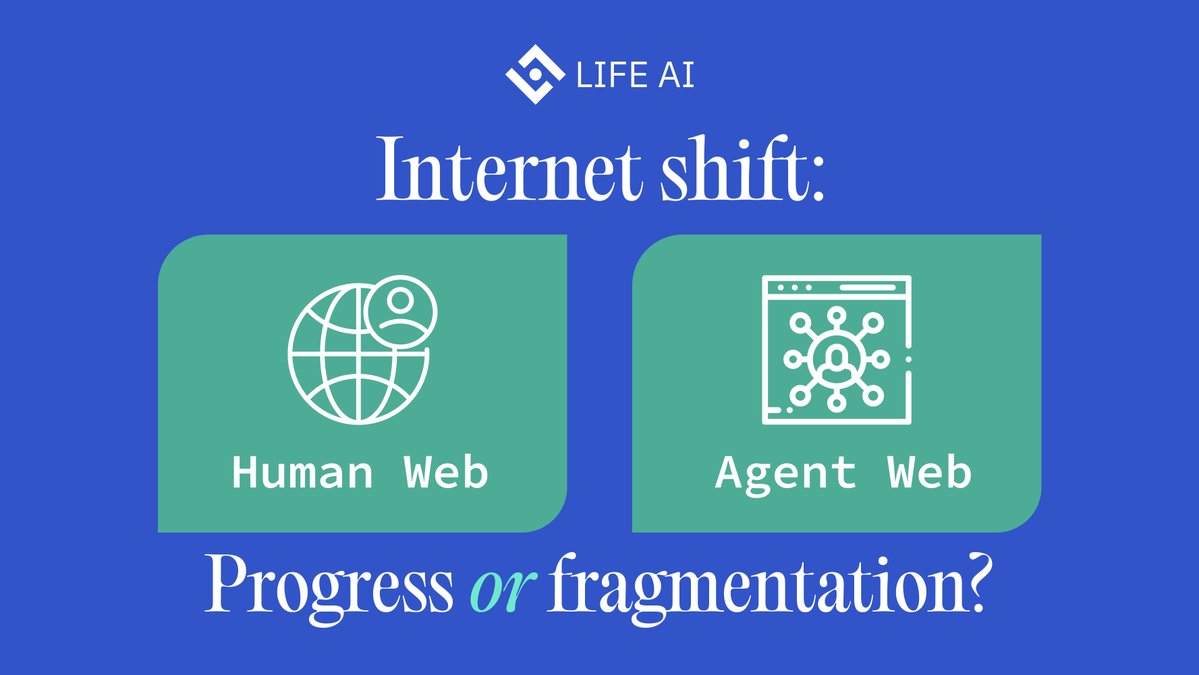
🌐 Community Question: As the internet evolves to support autonomous AI agents, splitting into the Human Web (interfaces for people) and the Agent Web (API-driven infrastructure for machines), will this shift drive innovation and automation, or fragment and dehumanize the online experience? Viewpoint A: A New Layer of Internet Intelligence The rise of AI agents interacting directly with digital systems could transform the internet into a more intelligent infrastructure. Agents can automate tasks such as trading, payments, data analysis, and content generation, enabling a new agent economy. This machine-to-machine coordination may significantly improve efficiency, scalability, and innovation across industries. Viewpoint B: Erosion of the Human-Centered Web Expanding the Agent Web may reduce the role of the Human Web, as machines increasingly interact through APIs rather than human interfaces. This could create privacy and security risks, weaken traditional web models, and concentrate power in automated systems, potentially leading to a fragmented internet with less authentic human participation. 👇 Drop A or B and share your perspective


🩺 Community Question: Is the “AI five layer cake” framework sufficient to power healthcare AI systems? (The “AI five layer cake” framework: Energy → Chips → Infrastructure → Models → Applications, introduced by Jensen Huang of NVIDIA) Viewpoint A: Yes Healthcare AI aligns with the stack. Energy, chips, and infrastructure enable intelligence generation at scale. Medical models, trained on clinical and biomedical data, interpret complex signals; applications then deliver value through radiology assistance, drug discovery, and clinical workflow automation. Viewpoint B: Not entirely The stack shows how capability is produced, but impact depends on translating that capability into clinical use. Strict validation, regulation, and the need to integrate with hospital workflows slow translation; consequently, healthcare applications often scale more slowly than the underlying AI stack. 👇Drop A or B and share your perspective