Ivan Baumann Fonay

8K posts

Ivan Baumann Fonay banner
Ivan Baumann Fonay

Ivan Baumann Fonay

@ivanfbf

Former National Director for Macroeconomic Policy (Argentina) Economist from Di Tella (2006, 2009) and Columbia (2021) Views are my own

Katılım Mayıs 2008
335 Takip Edilen2.9K Takipçiler
Ivan Baumann Fonay retweetledi
Natalia Gurushina
Natalia Gurushina@NGurushina·
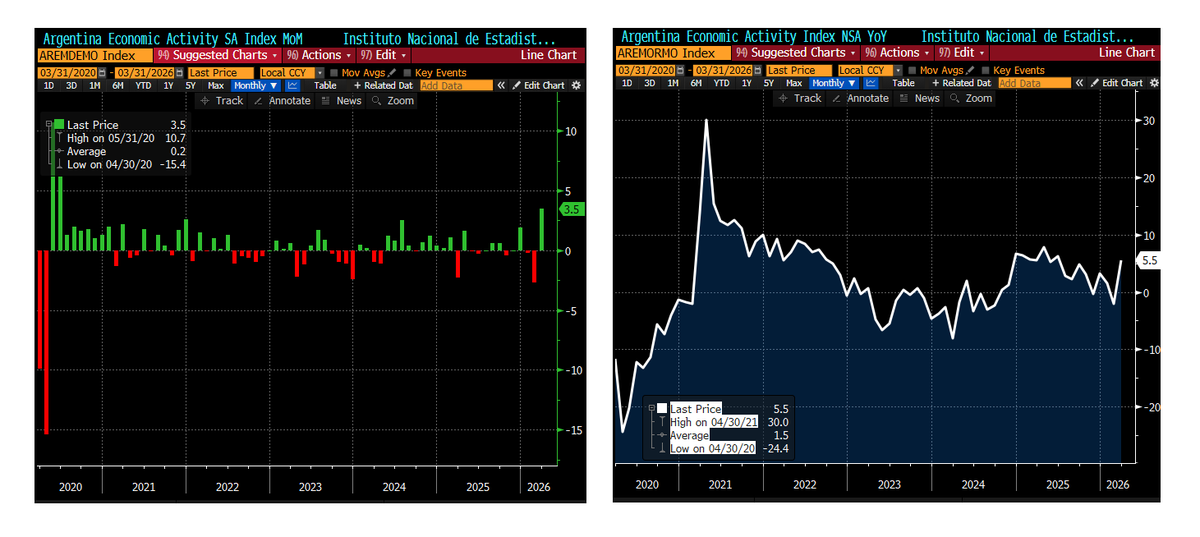
Argentina’s economic activity rebounded nicely in March (+3.5%mom) after scary February (-2.7%mom). A sustained growth recovery is essential for Pres Milei’s re-election prospects. Puente also aptly noted that Argentina’s fiscal consolidation is becoming more growth-dependent
Natalia Gurushina tweet media
English
3
10
78
2.3K
Ivan Baumann Fonay
Ivan Baumann Fonay@ivanfbf·
@anlopez1962 Si mal no recuerdo se levantó y se fue por las puteadas. Más tarde volvió con los otros dos
Español
2
0
1
140
Andres Lopez
Andres Lopez@anlopez1962·
Cuando hace varios años vino el G3 con Satriani, Vai y Fripp, abrió este último solito con su guitarrita y sus soundscapes. Algunos putearon, pero terminó tranquilo, no hubo quilombo. Y eso que era un público que iba a buscar hard rock ...
Español
2
0
1
502
Daiana Fernandez Molero
Estamos por hacer este detox legislativo.👇👇
Damián Di Pace@DiPace4

#LeyHojarazca 11 delirios que se tratan hoy en el Congreso con regulaciones existentes Las detallo: 1. Azotes y castigos medievalesLey 94 (1864): Inhabilita 10 años a cualquier autoridad que “haga azotar” a una persona. La pena de azotes ya estaba prohibida por la Constitución de 1853. Lleva 160+ años vigente sin sentido. 2. Premios por descubrir carbón (en plena descarbonización) Ley 448 (1870, época de Sarmiento): Otorga premio en metálico a quien descubra una mina de carbón. Hoy se busca eliminar el carbón por contaminación. 3. Televisión a colorLey 21.895 (1978): Autoriza las emisiones de TV en color (para el Mundial ’78, que se vio en blanco y negro). Como si hoy necesitáramos permiso estatal para ver Netflix o YouTube en HD. 4. Microfilmación de documentos: Varias leyes (18.569/1970, 20.114/1973, 23.756/1989): Obligan a usar microfilm para guardar documentos del Ejército, Armada y Poder Ejecutivo. Tecnología obsoleta desde hace décadas. 5. Carnet de mochileroLey 20.802 (1974): Obligaba a tener carnet especial para viajar “a dedo” (hacer dedo). Servía de pretexto para controles policiales. 6. Registro de palomas mensajeras: Ley 27.171 (2015): La Federación Colombófila debe registrar palomas “aptas para la defensa nacional” (año de nacimiento, matrícula, etc.). Las palomas dejaron de usarse militarmente hace más de un siglo. 7. Comisión Nacional de Cunicultura → Promover cría de conejos con fondos públicos (sin resultados visibles) 8. Mapas en etiquetas = Necesitabas aprobación del Instituto Geográfico Nacional para poner un mapa de Argentina en 1 botella de vino o producto regional 9- Reuniones en casas particulares = El Estado podía prohibirlas si “alteraban el orden”. 10- Padrinazgo presidencial = Para el séptimo hijo varón 11- Penalizar críticas al Estado = Ley 14.034 (1951): Prisión por propiciar sanciones internacionales contra Argentina.

Español
6
9
108
7.9K
Ivan Baumann Fonay
Ivan Baumann Fonay@ivanfbf·
En mi opinión, si el BCRA no estuviese comprando reservas, el dólar no estaría en $1100, sino por encima del nivel actual El programa de compra de reservas le brinda consistencia al programa cambiario estabilizándolo, aumentando la oferta de divisas y reduciendo su demanda
Español
0
0
19
1K
Nico Ajzenman
Nico Ajzenman@Nicolas_Ajz·
hablando de economía avanzada: que un mckinsey me haga la estimación de cuántas unidades de este libro se vendieron en la historia. es EL libro de micro avanzada usado en el 100% de los programas de phd del mundo y en muchísimos programas de maestría en economía. apuesten.
Nico Ajzenman tweet media
Español
24
12
334
65.8K
Ivan Baumann Fonay
Ivan Baumann Fonay@ivanfbf·
El Régimen de Zona Fría probablemente sea uno de los componentes más regresivos del gasto público nacional
Español
0
0
13
537
Ivan Baumann Fonay retweetledi
Jesús Fernández-Villaverde
Jesús Fernández-Villaverde@JesusFerna7026·
Smartphones are not the explanation for the recent decline in fertility. Instead, they are an accelerator of deeper forces already at work. Let’s start with the facts. Fertility is falling almost everywhere: in rich, middle-income, and poor countries; in secular and religious countries; and in countries with high and low levels of gender equality. The decline accelerated around 2014. So, no country-specific explanation will work unless you are willing to believe that 200 distinct country-specific explanations arrived at roughly the same time. Smartphones look like the obvious candidate: the first iPhone was released in 2007, and global adoption has been astonishingly fast. Economists understand the first major decline in fertility in advanced economies, from 6 or 7 children per woman throughout most of human history to about 1.8, that occurred between the early 1800s and roughly 1970, well before smartphones. The main drivers were a sharp fall in child mortality (effective fertility was rarely above 3 and often close to 2) and the shift from a low-skill, rural agrarian economy to a high-skill, urban industrial one. We have quantitative models that fit these facts well. Country-specific factors mattered too, of course. Proximity to low-fertility neighbors accelerated Hungary’s decline, while fragmented landowning structures accelerated France’s. But these were second-order mechanisms. This is also why most economists long considered Paul Ehrlich’s doom scenarios implausible. We forecast that fertility in middle- and low-income economies would follow the same path as in the rich, probably faster, because reductions in child mortality reached India or Africa at lower income levels (medical technology is nearly universal, and most gains come from handwashing and cheap antibiotics, not Mayo Clinic-level care). Much of what we see in Africa or parts of Latin America today is still that old story. But in the 1980s, a new pattern appeared. Japan and Italy fell below 1.8, the level we had thought was the new floor. By 1990, Japan was at 1.54 and Italy at 1.36. This second fertility decline began in Japan and Italy earlier than elsewhere, driven by country-specific factors, but the underlying dynamics were widespread: secularization, an education arms race, expensive housing, the dissolution of old social networks, and the shift to a service economy in which women’s bargaining power within the household is higher. The U.S. lagged because secularization came later, suburban housing remained relatively cheap, and African American fertility was still high. U.S. demographic patterns are exceptional and skew how academics (most of whom are in the U.S.) and the New York Times see the world. My best guess is that, without smartphones, Italy’s 2025 fertility rate would be about 1.24 rather than 1.14. I doubt anyone will document an effect larger than 0.1-0.2. Italy was at 1.19 in 1995, not far from today’s 1.14. The TFR is cyclical due to tempo effects, so I do not read too much into the rise between 1995 and 2007 or the decline from 1.27 in 2019 to 1.14 today. The direct effect of smartphones is not zero, but it is not, by itself, that large. Where social media, in general, and smartphones, in particular, matter is in the diffusion of social norms. What would have taken 25 years now happens in 10. Social media are not the cause of fertility decline; modernity is. But they are a very fast accelerator. That is why social media are a major part of the story behind Guatemala (yes, Guatemala) going from 3.8 children per woman in 2005 to 1.9 in 2025. Without them, Guatemala would also have reached 1.9, just 20 years later. Modernity, in its current form, is incompatible with replacement-level fertility. By modernity, I do not mean capitalism: fertility fell earlier and faster in socialist economies than in market economies. Socialist Hungary fell below replacement in 1960, and socialist Czechoslovakia in 1966 (both experienced small, short-lived baby booms in the mid-1970s). By modernity, I mean a society organized around rational, large-scale systems and formalized knowledge. Countries will not converge to the same fertility rate. East Asia is likely stuck near 1, possibly below, given its unbalanced gender norms and toxic education systems. Latin America faces the same gender problem plus weak growth prospects, so I expect something around 1.2. Northern Europe has more egalitarian family structures and might hold near 1.5. The very religious societies are probably the only ones that will sustain 1.8. All of this could change with AI or changes in population composition. We will see. But on the current evidence, deep sub-replacement fertility is the “new new normal.” Unless we reorganize our societies, better learn to handle it as best we can.
Jesús Fernández-Villaverde tweet media
English
219
906
3.7K
863.3K
Ivan Baumann Fonay
Ivan Baumann Fonay@ivanfbf·
@daianamol Pero a esta altura ya hicieron las etiquetas. Cambiar la norma sería forzarlas a incurrir en el costo nuevamente Y al exportar tienen que ajustarse al etiquetado del otro país independientemente de la norma local Mejor armonizar la norma y tomar la nuestra como base
Español
1
0
0
143
Ivan Baumann Fonay retweetledi
Daniel Schteingart
Daniel Schteingart@danyscht·
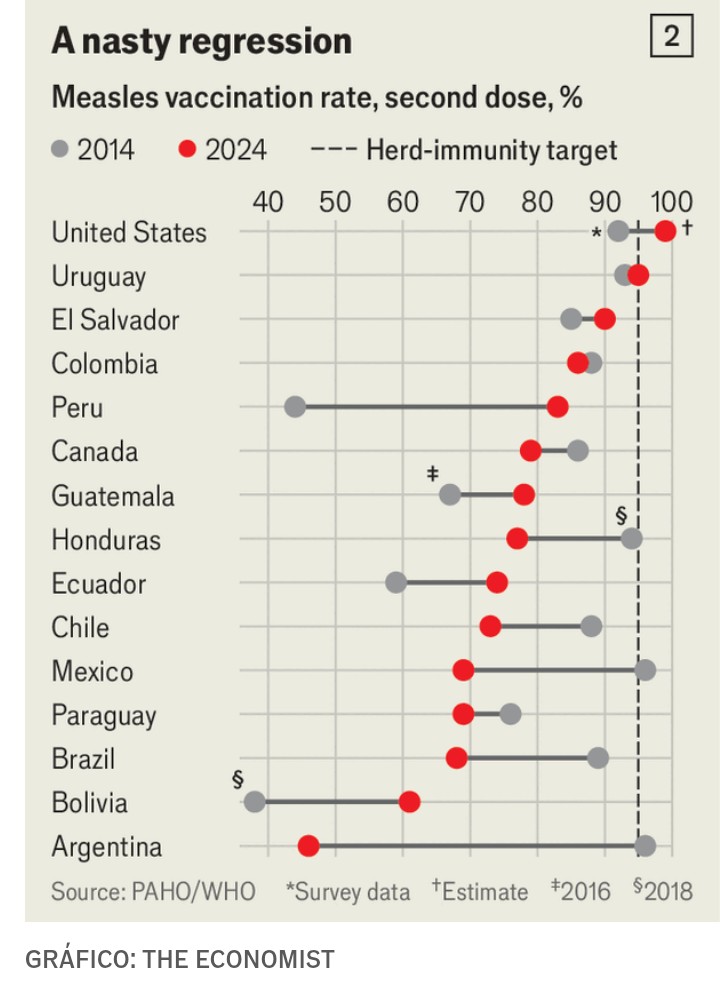
Dramática la caída de la vacunación infantil en muchos países de Latam. Lo de Argentina es terrible
Daniel Schteingart tweet media
Español
179
2.1K
4.5K
384K
Ivan Baumann Fonay retweetledi
ian bremmer
ian bremmer@ianbremmer·
trump’s approach to taiwan mirrors his approach to ukraine. he’d rather squeeze the weaker party in the conflict to achieve his preferred outcome than maintain ties with a trusted partner and us allies more broadly.
English
98
306
1.6K
70.7K
Ivan Baumann Fonay
Ivan Baumann Fonay@ivanfbf·
@JavierBlancoOK @FernandoMarull @belisarioAT Si faltaran pesos, creo yo que la gente los demandaría y los bancos colocarían sus excedentes en el BCRA a mejor retorno Mi impresión es que no faltan pesos porque no hay demanda genuina ya que la actividad está floja 3/n
Español
0
0
2
42
Ivan Baumann Fonay
Ivan Baumann Fonay@ivanfbf·
@JavierBlancoOK @FernandoMarull @belisarioAT ...a partir de (creo yo) la eliminación temprana de las LEFIs y la suba de encajes A partir de febrero se revirtieron estas medidas y aumentó la liquidez. Hoy el BCRA le pone piso a los pases y hay 3.5 Billones de pesos de bancos que hoy no tienen destino y están en el BCRA 2/n
Español
2
0
1
47
Ivan Baumann Fonay
Ivan Baumann Fonay@ivanfbf·
@NieveJuancito Es lo que creo que va a pasar. Mi punto, que traté de poner en el segundo tuit, es que en la práctica es darle dólares al Tesoro sin eliminar tu pasivo monetario en un contexto en donde tenés que tener un BCRA fuerte
Español
0
0
4
201
Juancito Nieve
Juancito Nieve@NieveJuancito·
@ivanfbf Quizas son los pesos que se van a usar para comprarle dolares al BCRA para el pagos de deuda
Español
1
0
10
859
Ivan Baumann Fonay
Ivan Baumann Fonay@ivanfbf·
La transferencia de utilidades del BCRA, con su efecto sobre la (des)capitalización de la entidad, resulta difícil de compatibilizar con el diagnóstico comunicado apenas un día antes: una demanda de dinero en caída y con expectativa de seguir contrayéndose 1/2
Ivan Baumann Fonay tweet mediaIvan Baumann Fonay tweet media
Español
2
2
28
3.6K
Ivan Baumann Fonay
Ivan Baumann Fonay@ivanfbf·
(No digo esto porque me preocupen estos nuevos pesos circulando, creo que no van a circular nunca. Lo digo porque debilita el balance del BCRA en un contexto donde la estabilización debería ser prioridad) 2/2
Español
0
1
4
439